By LCN Business Desk
The government has begun appointing a board, senior management and staff for the Guyana Development Bank ahead of its 5 October launch, Finance Minister Dr Ashni Singh said after signing the commencement order on Wednesday, News Source Guyana reported. "We are already putting, at the governmental level, all of the prerequisites in place," he said. La Caribeña News reported the order on 17 September.
A first tranche of US$100 million, about G$20 billion, goes in at start-up, half of the bank's authorised capital of G$40 billion, News Source reported. The bank's records will be examined annually by the Auditor General, and an annual report goes to the National Assembly.
What did the Finance Minister say the bank will do?
Two things beyond lending. The first is where an applicant goes. "We are going to be working with the commercial banks to establish in key strategic bank locations, a desk within the commercial banks to work with them so persons can go in and submit their applications," Singh said. The second is what happens after repayment: borrowers should "graduate from the development bank unto the full financial system" and take a commercial loan. The bank's structure will also allow borrowers to form consortia, for scale, specialisation and risk-sharing, according to News Source.
What is on offer, and who can apply?
- G$3 million at zero interest, with no collateral, the headline facility, and up to G$7 million more from a commercial bank at preferential rates under the co-financing arrangement (News Source; La Caribeña News on the co-financing arm).
- Five priority sectors: agriculture and agro-processing, tourism and hospitality, services and trade, creative industries, and digital industries (Guyana Development Bank Names Five Priority Sectors).
- Priority groups: women, youth and persons with disabilities (Women, Youth, and Differently Abled Entrepreneurs Named Priority Groups).
- Public servants may borrow, with conflict-of-interest guardrails, as Minister Zulfikar Ally confirmed in May (Public Servants to Access Development Bank Loans). A teacher or a ministry clerk with a registered side business is inside the design, not outside it.
- The second tranche is not guaranteed. The Act confers a bare power to co-finance, with no amount, no rate and no obligation on any commercial bank, as La Caribeña News reported in Seventy Per Cent of the Development Bank Package Sits at a Counter the Act Barely Reaches).
The application route, documents and mobile tracking were set out in May (Guyana Development Bank Application Roadmap), and the bank was announced as one "for every Guyanese", not only Georgetown (Development Bank "For Every Guyanese").
What does a borrower's money have to do next?
Consider a business that fits the design almost exactly. Sankofa Global, a Georgetown cosmetics venture led by Simone Barker, imports shea, mango and cocoa butter from Ghana, finishes them in Guyana with a proprietary blend, and sells both retail packs and bulk quantities to other small manufacturers. It showed its range at the International Building Expo in June, where La Caribeña News reported on it. It is services and trade with a manufacturing step, woman-led, and buying inputs that do not grow in this hemisphere.
A G$3 million loan is issued in Guyana dollars. Her supplier is in Accra. To pay it she needs foreign currency, and the payment leaves Guyana through correspondent banks in United States dollars, because there is no direct route between the Guyanese and Ghanaian banking systems. What Afreximbank finance has meant for Caribbean women in business was reported in The Mothers Built the Lane. Resource It.
That is the constraint the money runs into. The Georgetown Chamber of Commerce and Industry said in March 2023 that its members had complained of a shortage of US dollars since 2019, Kaieteur News reported. President Irfaan Ali said on 14 September that projected foreign-currency demand from 10 September to the end of the year is US$1.575 billion, and that credit card settlements alone have reached US$356 million this year, Guyana Times reported. A new borrower joins that queue on the day the loan is approved.
What would CAPSS change for that payment?
The CARICOM Payment and Settlement System is designed to move payments between member states in local currencies, and it is modelled on the Pan-African Payment and Settlement System, which does the same across African markets. PAPSS was already operating in the six countries of the West African Monetary Zone, whose members include Ghana, when the region's central banks adopted it, according to PAPSS. A rail that runs from CARICOM into PAPSS is the difference between Barker buying US dollars to pay Accra and paying Accra in currency the two central banks settle between themselves.
The governors of Trinidad and Tobago, Barbados, the Eastern Caribbean and The Bahamas met a PAPSS team in Port of Spain on 18 September to advance CAPSS, and the release does not name the Bank of Guyana, as La Caribeña News reported. The system has no launch date; the next step is a pilot, according to the Central Bank of Trinidad and Tobago.
Back at the bank: an LCN analysis
The Development Bank's own design says what is missing. It puts its application desks inside commercial banks, and it tells borrowers to graduate into those banks. Those are the same institutions that ration foreign currency, so the state has built a financing ladder that ends at the counter where the currency problem begins. Financing and settlement are being solved by two different arms of the same government, and only one of them opens on 5 October.
A development bank cannot join CAPSS; that is a central bank's decision. But it can say what its borrowers need, and it will hold the evidence from the first month: how many approved businesses import, from where, and in which currency they must pay. On the public record, Guyana is not at that table. Its newest bank is about to start lending to the people who would use the rail.
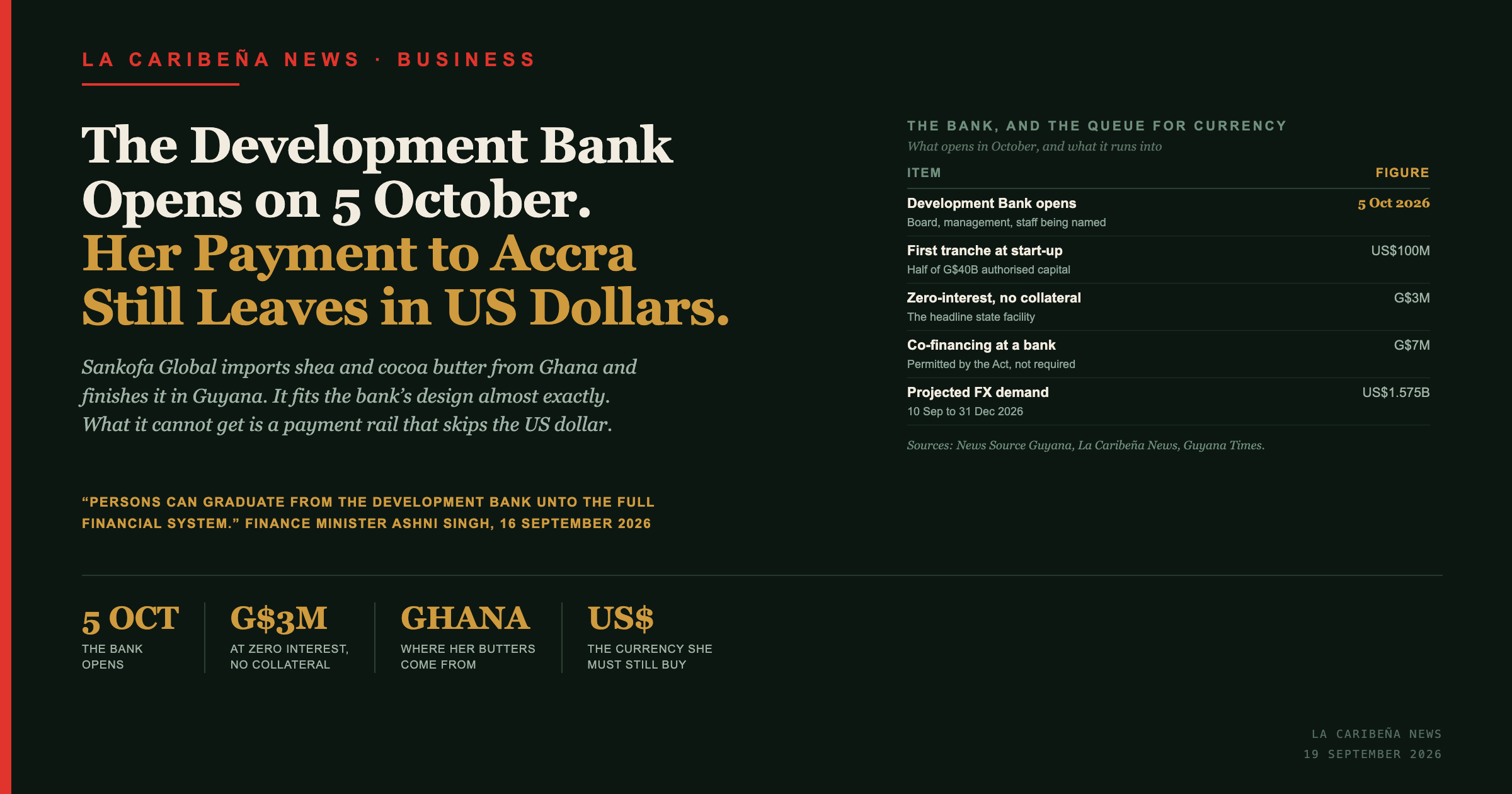
What the title card shows
- 5 October 2026: the Guyana Development Bank opens. Sources: News Source Guyana, La Caribeña News.
- US$100 million: first tranche at start-up, half of authorised capital of G$40 billion. Source: News Source Guyana.
- G$3 million + G$7 million: zero-interest state loan plus co-financing at a commercial bank, which the Act permits but does not require. Sources: La Caribeña News, News Source.
- US$1.575 billion: projected foreign-currency demand, 10 September to 31 December 2026. Source: Guyana Times.
- Sankofa Global: imports shea, mango and cocoa butter from Ghana, finishes them in Guyana with a proprietary blend. Source: La Caribeña News.
Frequently Asked Questions
When does the Guyana Development Bank open?
On 5 October 2026. The Finance Minister signed the commencement order on 16 September and said a board, senior management and staff are being appointed.
How much can a business borrow?
Up to G$3 million from the Development Bank at zero interest with no collateral, and up to G$7 million more from a partnered commercial bank at preferential rates. The Act permits the co-financing but obliges no bank to provide it.
Can a public servant apply?
Yes. Minister Zulfikar Ally confirmed in May that public servants with private business interests are eligible, subject to conflict-of-interest rules.
How does this connect to CAPSS?
A Development Bank loan is in Guyana dollars, but an importer must pay overseas suppliers in foreign currency, normally US dollars through correspondent banks. CAPSS is designed to settle payments between CARICOM states in local currencies and to connect to Africa's PAPSS. The Bank of Guyana is not named in the record of the September CAPSS meeting.
The bank opens on 5 October. The rail that would carry its borrowers' payments to Accra has no launch date, and no Guyanese seat on the public record.