By LCN Business Desk
The statement gives a reason and a legal ground, and they are not the same thing.
What did Washington actually do?
Secretary of State Marco Rubio designated a Cuban state-owned bank, alongside a Treasury action against Iranian financial actors.
The press statement of 15 October 2026 names the conduct and then names the legal ground, in consecutive sentences.
"Cuba's BANCO INTERNACIONAL DE COMERCIO S.A. (BICSA) has provided services to the designated Iran's Karafarin Bank since at least 2022. The Department of the Treasury sanctioned Karafarin Bank pursuant to Executive Order (E.O.) 13902 in 2020. Today, in concert with a Department of the Treasury action on Iranian financial actors, I am sanctioning the Cuban state-owned BICSA pursuant to Section 2(a)(i)(A) of E.O. 14404 for operating in or having operated in the financial services sector of the Cuban economy."
Source: US Department of State, Office of the Spokesman, 15 October 2026.
The Iran conduct is the stated reason. The legal test applied is operating in Cuba's financial services sector. Only the second has to be true for the designation to stand.
Which bank is this, exactly?
The Cuban one. There is another bank of the same initials and it has nothing to do with this.
The designated entity is Banco Internacional de Comercio S.A., listed by the Office of Foreign Assets Control at Oficina 506, Edificio Santa Clara, Centro de Negocios Miramar, Miramar, Playa, Havana, and recorded as a financial institution and a state-owned enterprise.
Banco Internacional de Costa Rica S.A. is a different institution, Panama-based and owned by Costa Rican state banks. It also goes by BICSA. It is not designated and it is not named in the action.
The distinction matters because a bank's counterparties act on acronyms.
What is Executive Order 14404?
A sectoral instrument, signed on 1 May 2026, that names five sectors of the Cuban economy.
The order is titled "Imposing Sanctions on Those Responsible for Repression in Cuba and for Threats to U.S. National Security and Foreign Policy". The statement lists the sectors it identifies: energy, defense and related materiel, metals and mining, financial services, and security.
| Executive Order 14404 | |
|---|---|
| Signed | 1 May 2026 |
| Sectors named | Energy; defense and related materiel; metals and mining; financial services; security |
| Clause used against BICSA | Section 2(a)(i)(A), operating in or having operated in a named sector |
| Related authorities cited | E.O. 14380; National Security Presidential Memorandum 5; the Cuban Assets Control Regulations |
| Ownership rule | Entities owned 50 per cent or more, individually or in aggregate, by blocked persons are themselves blocked |
Source: the same statement.
This newspaper reported the order's earlier use in September, when four Cuban nickel companies, four military research centres and three army officers were designated under it, the third round in four weeks to reach the industry at Moa and Nicaro, in Washington Blocked Cuba's Nickel Producer in August. Nickel is metals and mining. BICSA is the first bank.
Why does the sectoral ground matter more than the Iran allegation?
Because a Caribbean bank cannot be accused of serving Karafarin Bank, and can be standing in the sector.
The statement sets out the exposure in its own words.
"Foreign persons that engage in transactions with persons designated pursuant to E.O. 14404—or that operate or have operated in the energy, defense and related materiel, metals and mining, financial services, or security sector of the Cuban economy, as identified in E.O. 14404—are themselves at risk of sanctions. Non-U.S. persons, including foreign financial institutions, should proceed with caution in any dealings with a party sanctioned under this authority."
Two different things are at risk there. Transacting with a designated person is one. Operating in a named sector is the other, and it requires no transaction with anybody designated and no allegation about Iran.
The statement adds a further warning, aimed at what a counterparty might do after a designation lands.
"Actions to return assets to a sanctioned party or transfer them to another jurisdiction for potential use by the target expose non-U.S. persons to significant sanctions risk."
What does this change for a regional bank?
It attaches sanctions exposure to a sector a correspondent already examines.
A bank seeking a United States dollar correspondent account is assessed under one federal regulation, which asks its correspondent to document the nature of its business and the markets it serves, the purpose and expected activity of the account, and the supervisory regime of the jurisdiction that chartered it. That standard, and what a 13 October consent order found when a United States bank applied a reduced version of it inside its own group, was examined in There Is One Correspondent Banking Rule.
"The markets it serves" is the phrase that now carries sanctions weight as well as documentary weight. A correspondent assessing a regional institution with Cuban financial-sector exposure is reading the same fact under two regimes at once.
Correspondent withdrawal from Caribbean markets has its own documented history, examined in After the Jenec Ruling, the World Disagrees on What Comes Next and in A Designation Is Not a Conviction. The pattern in that record is that institutions facing an unclear exposure tend to exit the relationship rather than price it.
Does a designation stop the designated party functioning?
Not reliably, on the evidence this newspaper has gathered before.
A sitting head of state was added to the same list in September, and the measurable consequences were narrower than the designation implied, reported in The Sanctioned President. What a listing reliably does is change the behaviour of everyone who must decide whether to deal with the listed party. For a bank, those parties are its correspondents.
The statement is explicit that delisting exists and names the route. "The ultimate goal of sanctions is not to punish, but to bring about a positive change in behavior." Petitions run through OFAC's Reconsiderations Portal.
Where does this sit in the wider pattern?
In the same week that Washington loosened one Venezuelan restriction and tightened a Cuban one.
The Office of Foreign Assets Control exempted Venezuelan earthquake relief payments from the account its other licences must use, on 16 October, reported in Washington Exempted Venezuelan Earthquake Relief. The BICSA designation landed the day before, in an action whose other 26 targets were almost all Iranian.
Cuba's own exposure to this machinery has been building across sectors, with tourism examined in Cuba Lost Two Thirds of Its Visitors and Three Hotel Chains. Where regional compliance capacity actually stands was measured in Lima Hosts the Hemisphere's Compliance Congress.
The entities
* Banco Internacional de Comercio S.A. (BICSA) is the Cuban state-owned bank designated on 15 October 2026, listed by OFAC in Miramar, Playa, Havana. * Banco Internacional de Costa Rica S.A. is a separate Panama-based bank owned by Costa Rican state banks, which shares the BICSA initials and is not designated. * Executive Order 14404, signed 1 May 2026, authorises sanctions on persons operating in five named sectors of the Cuban economy. * Karafarin Bank is the Iranian bank that Treasury sanctioned under Executive Order 13902 in 2020, and which the State Department says BICSA has served since at least 2022. * Marco Rubio is the United States Secretary of State, who issued the press statement. * The Office of Foreign Assets Control (OFAC) administers the Specially Designated Nationals list and the Reconsiderations Portal through which delisting is sought. * The Cuban Assets Control Regulations (CACR) prohibit persons subject to United States jurisdiction from dealing in property in which Cuba or a Cuban national has an interest, unless authorised or exempt.
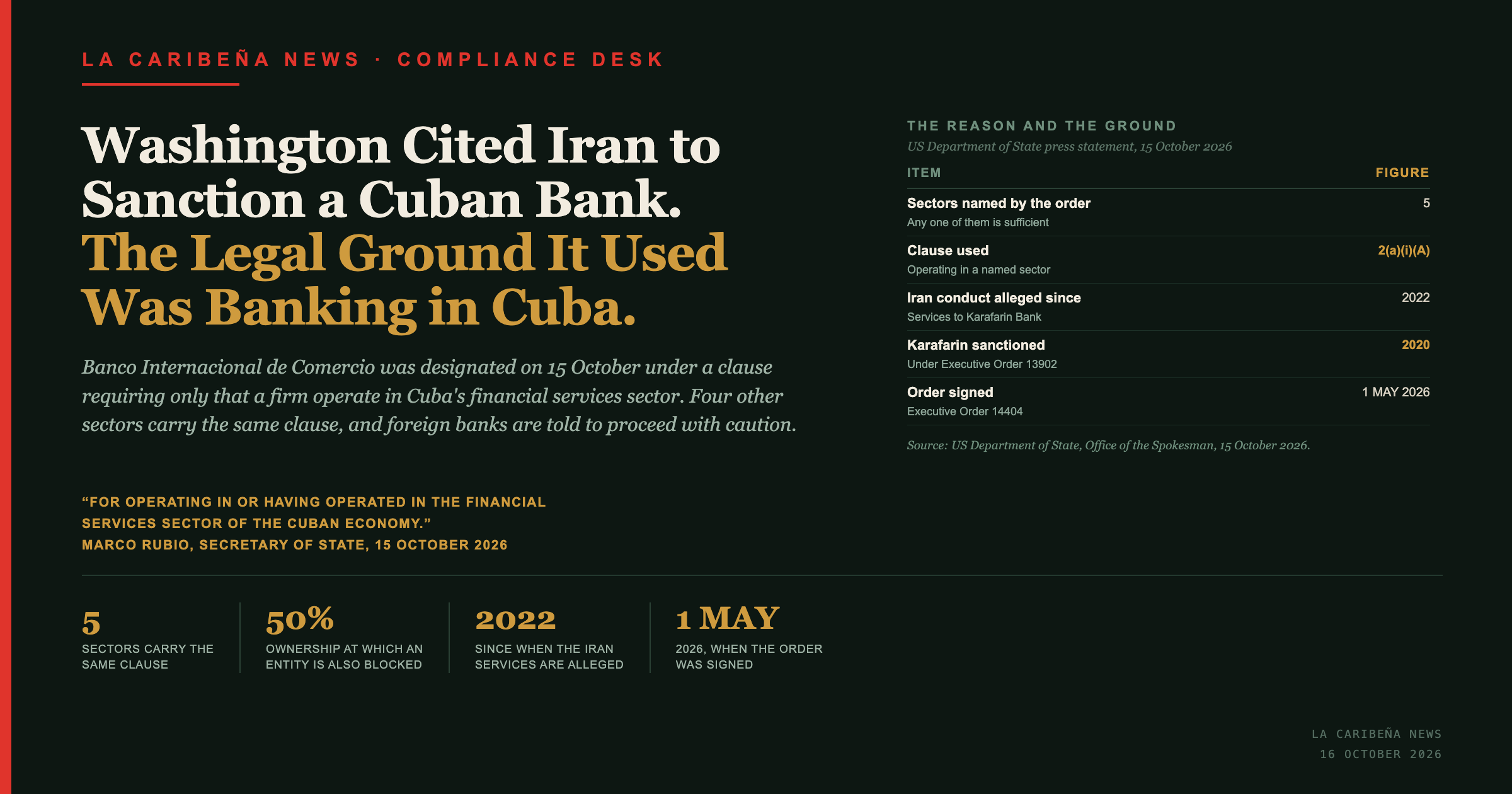
What the title card shows
Every data point on the article's title card, in text.
* 5 sectors. Energy, defense and related materiel, metals and mining, financial services and security, the sectors Executive Order 14404 identifies. Source: US Department of State, 15 October 2026. * Section 2(a)(i)(A). The clause BICSA was designated under, requiring only that it operate or have operated in a named sector. Source: US Department of State, 15 October 2026. * Since at least 2022. How long the State Department says BICSA has provided services to Iran's Karafarin Bank. Source: US Department of State, 15 October 2026. * 2020. When Treasury sanctioned Karafarin Bank under Executive Order 13902. Source: US Department of State, 15 October 2026. * 1 May 2026. When Executive Order 14404 was signed. Source: US Department of State, 15 October 2026. * 50 per cent. The ownership threshold at which an entity owned by blocked persons is itself blocked. Source: US Department of State, 15 October 2026. * Quotation: "for operating in or having operated in the financial services sector of the Cuban economy." Source: US Department of State, 15 October 2026.
Frequently Asked Questions
Which bank was sanctioned?
Banco Internacional de Comercio S.A., a Cuban state-owned bank listed by OFAC at an address in Miramar, Playa, Havana. It is not Banco Internacional de Costa Rica S.A., a separate Panama-based bank owned by Costa Rican state banks that shares the BICSA initials and is not designated.
Was it sanctioned because of Iran?
Iran is the reason the State Department gives. The statement says BICSA has provided services to Iran's Karafarin Bank since at least 2022, and that Treasury sanctioned Karafarin Bank under Executive Order 13902 in 2020. The designation itself was made under Section 2(a)(i)(A) of Executive Order 14404, for operating in or having operated in the financial services sector of the Cuban economy.
Why does that distinction matter?
Because the legal test does not require the Iran conduct. It requires operating in a named sector. The same clause is available against any firm operating in Cuba's energy, defense and related materiel, metals and mining, financial services or security sectors.
What is the risk to banks outside the United States?
The statement says foreign persons that transact with persons designated under the order, or that operate or have operated in any of the five named sectors, are themselves at risk of sanctions, and that non-US persons including foreign financial institutions should proceed with caution in dealings with a party sanctioned under this authority.
Has Executive Order 14404 been used before?
Yes. In September 2026 four Cuban nickel companies, four military research centres and three army officers were designated under it, the third round in four weeks to reach the nickel industry at Moa and Nicaro. That is the metals and mining sector. BICSA is the first bank designated under the order.
Can a designated party be removed from the list?
The statement says the goal of sanctions is to change behaviour rather than to punish, and that petitions for removal may be routed through OFAC's Reconsiderations Portal, with further guidance on the State Department's delisting page.