By LCN Business Desk
On 24 August 2026 a lawyer at Avianca signed a letter to a former president of Colombia telling him he could not fly. Renato Covelo, legal representative of Aerovías del Continente Americano, wrote that Gustavo Petro's name appeared on the Specially Designated Nationals list, and that "solely to comply with this applicable regulation, we must proceed to cancel your tickets." The measure, the letter said, was "of a purely legal character, unrelated to any Avianca consideration or criterion." The airline refunded the fare in full. Petro flew to Mexico on Aeroméxico instead.
Six days of notice, one cancelled reservation, one refund. Set against what a head of state's designation is usually imagined to mean, that is close to the whole of it.
Every Colombian outlet covering the cancellation called the list by another name: la Lista Clinton, the Clinton List. That name is thirty-one years old and belongs to a different instrument. Executive Order 12978, signed by President Bill Clinton on 21 October 1995, declared a national emergency over narcotics traffickers centred in Colombia and named the four heads of the Cali Cartel, Gilberto and Miguel Rodríguez Orejuela, José Santacruz Londoño and Helmer Herrera Buitrago. Colombians called the resulting blacklist after the president who signed the order, and the nickname attached itself to OFAC designations generally and never came off. Petro is not on the list under that order.
What did OFAC actually do?
The United States Treasury's Office of Foreign Assets Control designated Petro on 24 October 2025, under Executive Order 14059, the global illicit drug trade authority signed in December 2021.
He was not a former official, a private citizen or a fugitive. He was the sitting, elected president of the Republic of Colombia, a sovereign state and a founding member of the United Nations, which signed the UN Charter on 26 June 1945 and deposited its ratification that November. Colombia was, in the same year it was designated, the top recipient of American assistance in the region and, as the Associated Press put it, one of the closest United States allies in South America.
A finance ministry of one United Nations member state placed the serving head of state of another on a blocking list. Three others were designated with him: his wife Verónica Alcocer, his son Nicolás Petro, and Interior Minister Armando Benedetti.
The Federal Register entry records Petro at Bogotá, born 19 April 1960 in Zipaquirá, citizen of Colombia and, on the face of the record, also a citizen of Italy. He was designated under section 1(a)(i) for conduct materially contributing to the international proliferation of illicit drugs. The other three were designated under section 1(b)(i)(B), a derivative ground, for providing support to him. Only one of the four is on the list for drugs.
Treasury Secretary Scott Bessent said that since Petro came to power "cocaine production in Colombia has exploded to the highest rate in decades, flooding the United States and poisoning Americans." Treasury's statement cited his "total peace" policy, a September 2025 presidential determination that Colombia was "failing demonstrably" on drug control, and an incident in 2024 in which, it said, Petro shared confidential information obtained through secure anti-money laundering channels, leading to the suspension of Colombia's Financial Intelligence Unit from the Egmont Group.
The production half of that claim is supported by a source independent of the United States government. The United Nations Office on Drugs and Crime found Colombian coca cultivation rose 10 per cent in 2023 to 253,000 hectares, the highest level it has recorded there, with potential cocaine production up 53 per cent to 2,664 tonnes. Colombia's own government published the 2024 figures in June 2026: 261,000 hectares, a further rise of 3.5 per cent, at a much slower rate. UNODC's World Drug Report put global coca cultivation and cocaine manufacture at record highs in 2024. Petro has questioned the UN figures.
Two distinctions sit inside those figures. The first is botanical. Coca is a plant, cocaine is an alkaloid drawn out of it, and the leaf is not the drug. The World Health Organization's Expert Committee on Drug Dependence completed a two-year critical review of coca leaf and found that its use "does not appear to pose a particularly serious public health risk", while noting that the safety of long-term use is not well documented. The committee nonetheless kept coca leaf in Schedule I of the 1961 Single Convention on Narcotic Drugs, where it stays a controlled substance confined to medical and scientific purposes, and it acknowledged the leaf's "important cultural and therapeutic significance for Indigenous peoples". Bolivia holds a reservation to the convention covering traditional use, and national frameworks in the Andes carry their own exemptions for chewing and tea.
The second distinction is in the arithmetic. UNODC surveys hectares under coca, which it can measure. It does not measure cocaine. "Potential cocaine production" is an estimate of what a crop could yield if it were all converted, derived from the cultivated area and assumed yields. A rise in hectares becomes a rise in narcotics only on the assumption that the leaf is bound for a laboratory, and that assumption is doing the work in the sentence a Treasury secretary reads out.
The American series moves the other way across the same period. The National Center for Health Statistics estimated 80,391 drug overdose deaths in the United States in 2024, down 26.9 per cent from 110,037 the year before, the largest decline it has recorded. That figure covers all drugs together. It is not a cocaine-specific count, and it measures deaths rather than supply.
Petro answered on X: "Combating drug trafficking effectively for decades brings me this measure from the government of the society we helped so much to stop its use of cocaine. Quite a paradox, but not one step back and never on our knees." He named American lawyers to defend him in US courts.
Does sanctioning a president sanction the country?
No, and this is the part most often got wrong.
Freshfields put it plainly: OFAC sanctions on these individuals "do not automatically extend to ministries of the Colombian government, the entirety of the Colombian government, or Colombia itself." OFAC's 50 per cent rule turns on ownership, not control, so a ministry is not blocked because a blocked person leads it. Paul Weiss reached for the Venezuela precedent: designating an official of that government does not block the government. United States persons could continue dealing with every non-designated Colombian official and entity throughout.
What was blocked was four people's property and interests in property within US reach, and dealings with those four. Nothing else.
This newspaper has set out the same distinction before, in A Designation Is Not a Conviction, and in the reporting on what the Jenec ruling did to the debanking debate.
So why did an airline stop him?
Because of Avianca's exposure, not Colombia's status.
The airline told El Colombiano it maintains permanent operations on United States territory, routes transactions including ticket sales through the US financial system, and holds assets and affiliated companies there. "Estamos obligados a cumplir las regulaciones de EE. UU." Its own compliance screening returned the SDN entry, and OFAC applies civil penalties on a strict liability basis.
The prohibition reached a Colombian carrier through that carrier's own American footprint. A company with no US nexus faced no such duty, which is why a Mexican airline could sell him the seat Avianca could not. The same logic governs any Caribbean bank, freight forwarder or distributor with a correspondent relationship or a US affiliate, and it is the logic behind the region's de-risking problem.
What happened to Colombia?
The country-level measures were separate instruments, and they were real.
In September 2025 the United States added Colombia to the list of countries failing to cooperate in the drug war, the first time in almost thirty years. The State Department then cut assistance. Colombia had received roughly US$230 million in the budget year to 30 September, itself down from more than US$700 million in recent years, and officials indicated a further cut of about 20 per cent, some US$18 million. Trump called Petro "an illegal drug leader" and threatened tariffs on Colombian exports. Colombia recalled its ambassador, Daniel García-Peña, in October.
The United States embassy in Bogotá did not close. It operates from Carrera 45 No. 24B-27 with a 24-hour emergency line. Americans were never forbidden to travel to Colombia. The State Department advisory sits at Level 3, Reconsider Travel, for crime, terrorism, civil unrest, kidnapping and natural disasters, with Do Not Travel notices for Arauca, Cauca, Valle del Cauca and Norte de Santander. Not one line of it concerns sanctions. Colombian goods kept moving, and Colombia and CARICOM continued negotiating a trade agreement through the same period.
What came before the designation?
The record shows an escalation, and the Associated Press has drawn the causal links at its earlier steps.
In January 2025 Petro refused to accept United States military aircraft carrying deported Colombians, saying he would receive citizens "on civilian planes, without treating them like criminals." AP reported that this rejection led Trump to threaten tariffs. Trump announced 25 per cent tariffs rising to 50, a travel ban, visa sanctions on members and supporters of the Colombian government, and emergency financial measures. Petro ordered retaliatory tariffs. Within a day the White House said Colombia had agreed to its terms.
Through 2025 the United States struck vessels it said were carrying drugs off South America, killing at least 43 people by late October. Petro objected. When he attended the United Nations General Assembly in New York, the State Department said it would revoke his visa because he had told American soldiers to disobey orders. The designation followed in October.
Those are the dates. Treasury's stated grounds are drugs, and the record of the year is also a record of a quarrel.
What does this mean for a Caribbean business?
Three things, none of them about Colombia.
A designation attaches to a person, not to a passport or a flag. The instrument names individuals, and the burden falls on counterparties who have to screen. Screening obligations travel through your own American exposure, so the question a Caribbean firm must answer is not where its customer is from but where its own money, assets and affiliates sit.
Proximity is the risk that gets missed. LCN has reported before on how a famous surname and political closeness carry exposure of their own. Three of the four Colombians designated were named for supporting the fourth, not for the underlying conduct.
And mobility is a separate control from money. The visa was revoked before the assets were blocked, which is a pattern the region already knows from the cost of an American business visa.
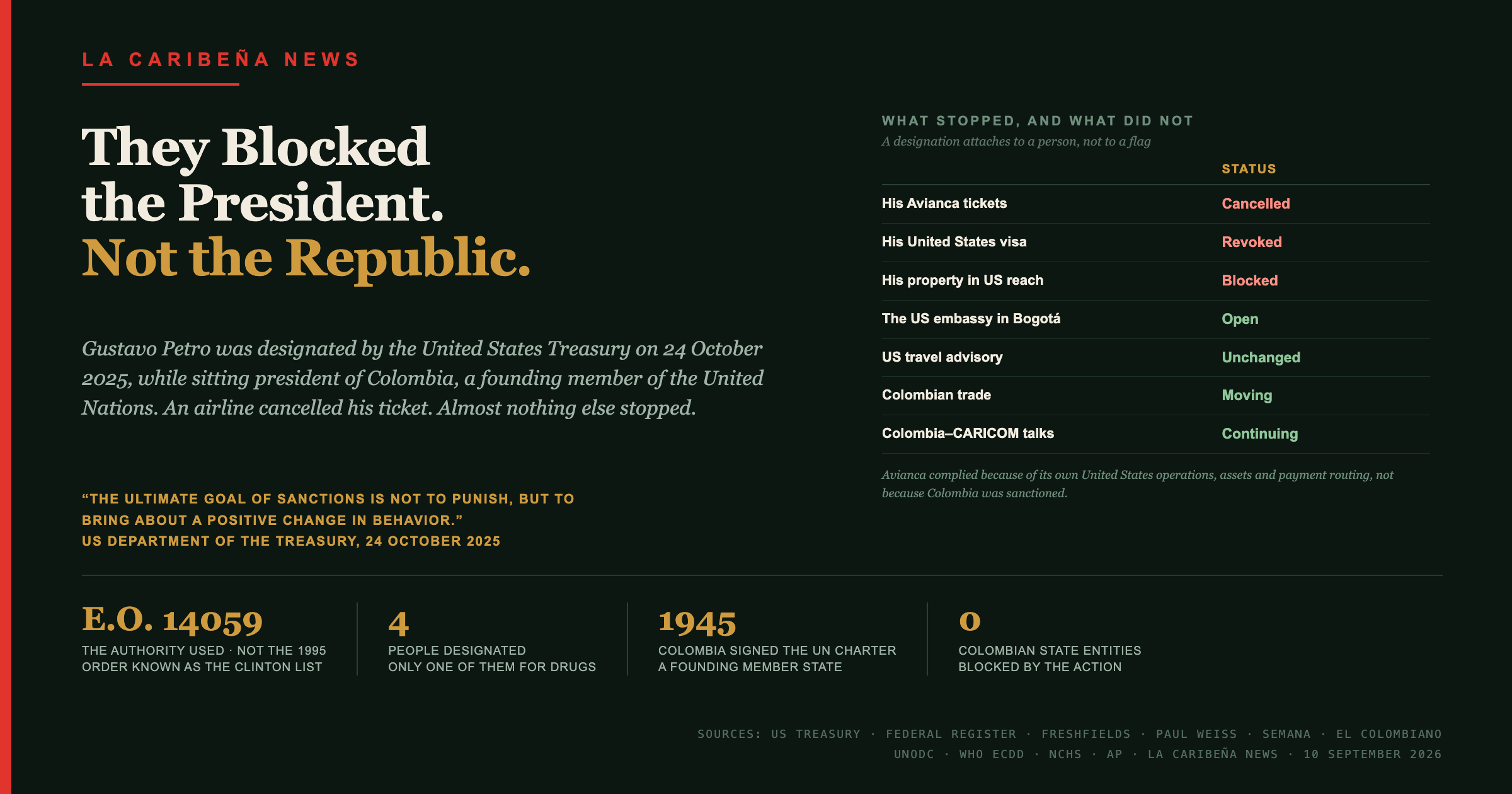
What does the title card show?
The title card carries a two-column table headed "What stopped, and what did not", under the line "A designation attaches to a person, not to a flag".
- His Avianca tickets: cancelled. Source: the Avianca letter of 24 August 2026, published by Semana.
- His United States visa: revoked. Source: Associated Press, reporting the State Department.
- His property within United States reach: blocked. Source: Federal Register, FR Doc. 2025-20152.
- The United States embassy in Bogotá: open. Source: US Embassy Colombia.
- United States travel advisory: unchanged, Level 3, Reconsider Travel, on grounds unrelated to sanctions. Source: US Department of State.
- Colombian trade: moving. Colombia and CARICOM trade talks: continuing.
- Executive Order 14059, the authority used, and not the 1995 order known as the Clinton List. Source: Federal Register.
- Four people designated, only one of them under the drug-trade criterion, the other three on a derivative support ground. Source: Federal Register.
- 1945, the year Colombia signed the United Nations Charter as a founding member state. Source: United Nations.
- Zero Colombian state entities blocked by the action.
- Quoted on the card: "The ultimate goal of sanctions is not to punish, but to bring about a positive change in behavior." Source: US Department of the Treasury, 24 October 2025.
Frequently Asked Questions
Was Colombia sanctioned when its president was designated?
No. Freshfields advised that the sanctions "do not automatically extend to ministries of the Colombian government, the entirety of the Colombian government, or Colombia itself." OFAC's 50 per cent rule applies to ownership, not control, so institutions Petro led were not blocked.
Did the United States embassy in Bogotá close?
No. It remained operational at Carrera 45 No. 24B-27 with 24-hour emergency contact.
Were Americans banned from travelling to Colombia?
No. The State Department advisory is Level 3, Reconsider Travel, on grounds of crime, terrorism, civil unrest, kidnapping and natural disasters. No part of it rests on sanctions.
Is growing coca the same as producing cocaine?
No. Coca is a plant with traditional, culinary and medicinal uses across the Andes, and cocaine is an alkaloid extracted from its leaves. UNODC measures the area under cultivation and separately publishes a "potential cocaine production" estimate, which is modelled from that area rather than measured. The WHO's Expert Committee on Drug Dependence found in its critical review that coca leaf use "does not appear to pose a particularly serious public health risk", and kept the leaf in Schedule I of the 1961 Single Convention.
Why is the SDN List called the Clinton List?
Because of Executive Order 12978, signed by President Bill Clinton on 21 October 1995, which declared a national emergency over narcotics traffickers centred in Colombia and first named the four heads of the Cali Cartel. The nickname stuck to OFAC listings generally. Petro was not designated under that order. His designation is tagged ILLICIT-DRUGS-EO14059.
Can a designated person be removed from the list?
Treasury says so in the same announcement: "The ultimate goal of sanctions is not to punish, but to bring about a positive change in behavior," and it points to its published procedure for filing a petition for removal from an OFAC list.
A head of state was blocked, and the machinery of a country carried on around him. The embassy stayed open, the advisory did not move, the cargo cleared and the trade talks continued. What changed was narrower and sharper than the word sanctions suggests: four names on a list, and every company with an American footprint obliged to read it before selling one of them a seat.