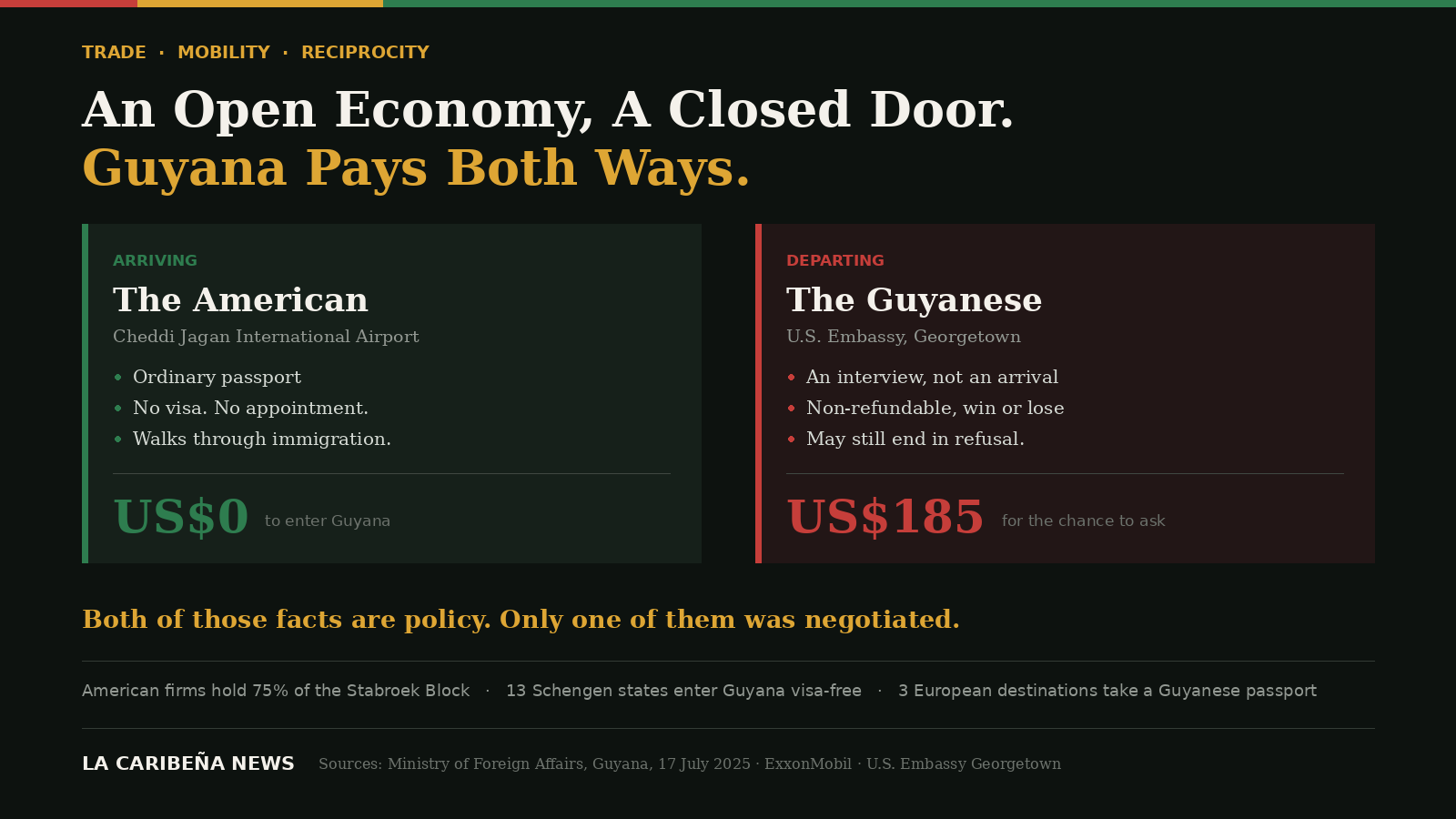
Guyana admits nationals of 13 Schengen states and the United States without a visa. American companies hold 75 per cent of the Stabroek Block. Not one of those countries admits ordinary Guyanese passport holders without a visa.
An American oil executive lands at Cheddi Jagan International Airport, shows an ordinary passport, and walks through immigration. No visa, no fee, no appointment. A Guyanese welder who wants to visit a cousin in Queens pays the United States Embassy in Georgetown US$185, non-refundable, for the interview that may end in a refusal.
Both of those facts are policy. Only one of them was negotiated.
Which countries enter Guyana without a visa?
Thirteen Schengen members, plus the United States, Canada, Japan, Australia, New Zealand and the United Kingdom. The Ministry of Foreign Affairs list of countries whose nationals require no visa, updated 17 July 2025, names Austria, Belgium, Denmark, Finland, France, Greece, Italy, Luxembourg, Norway, Portugal, Sweden, Switzerland and the Netherlands.
Spain appears exactly once on that list, and only for holders of diplomatic passports.
Now turn the page over. The companion list, countries for which Guyanese require no visa, was updated on 16 October 2025. Its European section runs to three entries for ordinary passport holders: Albania, the Russian Federation for 90 days, and the United Kingdom. Thirteen out, three back, published by the same ministry on the same web page.
What does Guyana give the countries that exclude its citizens?
Close to everything else. The visa desk is the smallest concession Georgetown makes, and it is the only one anybody frames as generosity.
ExxonMobil operates the Stabroek Block with a 45 per cent interest. Chevron holds 30 per cent, acquired when it absorbed Hess Corporation in July 2025 after an arbitration fight. Two American companies, 75 per cent of a block holding over 11 billion barrels of recoverable oil equivalent, currently producing around 650,000 barrels per day. China’s CNOOC holds the remaining quarter. The United States requires a visa of every Guyanese national. Guyana requires nothing of any American.
The pattern repeats away from the oil. On 16 May 2026 Guyana licensed three new wholesale financial institutions: Citibank N.A., Crown Agents Bank and One Americas. Citi went on to open a representative office in Georgetown after nearly three decades of doing business with the country from a distance. Germany’s development agency signed six implementation agreements worth €31.9 million in Georgetown in April 2026. A German oil trader has proposed up to US$60 million into the local energy market.
Germany requires a Schengen visa of Guyanese. So does every Schengen state on the inbound list. Britain is the honourable exception in that paragraph, and it is worth naming precisely because it is rare: Crown Agents Bank is British, and Britain admits Guyanese without a visa. It is the only large economy on both sides of the ledger.
Read the whole arrangement plainly. Guyana grants market access, banking licences, production sharing terms and border entry to countries that require its own citizens to pay a fee and sit an interview. Openness is not a principle Guyana is being asked to adopt. It is already the entire economic strategy. What Georgetown has never done is charge for any of it in the one currency that would reach an ordinary Guyanese, which is the right to travel.
Who actually grants Schengen visa exemptions?
Not Spain. Short-stay visa policy is a European Union competence. Under Regulation (EU) 2018/1806, nationals of third countries listed in Annex II are exempt from the visa requirement for stays of no longer than 90 days in any 180-day period.
Nine CARICOM states sit on that Annex: Antigua and Barbuda, The Bahamas, Barbados, Dominica, Grenada, St Kitts and Nevis, St Lucia, St Vincent and the Grenadines, and Trinidad and Tobago. Five got there by negotiation. Trinidad and Tobago, Dominica, Grenada, Saint Lucia and Saint Vincent and the Grenadines each concluded a short-stay visa waiver agreement with the European Union, signed under Council Decisions in 2015 and concluded in 2016.
Madrid applies that exemption. Madrid did not write it. Any account crediting Spain with granting Caribbean visa-free access has misread which capital holds the pen, and Georgetown will not charm its way off Annex I through the Spanish. Guyana, Jamaica, Suriname, Belize and Haiti remain on the list of countries whose nationals must hold a visa.
What did Mark Brantley do for St Kitts and Nevis?
He treated visa waivers as a product line and worked them like one. As Foreign Minister, Brantley set out to negotiate as many agreements as possible so the federation’s passport would become, in his words, “the most powerful in all of CARICOM.”
The output was close to 26 new full waivers in five years. By December 2021 the St Kitts and Nevis passport reached over 161 destinations, level with Barbados regionally and 24th in the world. He signed with Burkina Faso on 10 October 2021 and with Gabon the next day, both in the corridors of the Non-Aligned Movement summit in Belgrade, then with Palestine on 12 October. São Tomé and Príncipe followed in December, signed in New York. He was doing this for roughly 47,000 people on two islands with no oil, no gold and no bauxite. What he had was a calendar, a mandate and a willingness to sign in a hallway. Guyana has 11 billion barrels and not one of those agreements.
Why does Guyana lack the same commercial motive?
Because it has no passport to sell. Brantley tied the waiver drive directly to the Citizenship by Investment programme, calling passport strength what sets the federation apart from its regional competitors. St Kitts and Nevis pioneered the model in 1984.
This is the part that disappears when the story is told as simple negligence. A citizenship is worth what its passport opens. Every waiver Brantley signed raised the value of the inventory, which made his foreign ministry, functionally, a product development department with a revenue target behind it. Antigua and Barbuda, Grenada, Dominica and Saint Lucia run the same model and chase the same buyers. It is why those five names recur every time the European Parliament debates suspending Annex II access over investor citizenship schemes.
Guyana sells nothing of the kind. No CBI programme, no passport revenue line, and therefore no department inside government whose numbers improve when a waiver is signed. Oil money arrives whether or not a Guyanese can board a plane to Lisbon. Mobility is a public good with no profit and loss statement attached, and public goods without a revenue owner do not get worked. That explanation is less satisfying than negligence and considerably harder to fix, because negligence can be corrected with a memo.
What changes when ETIAS starts in late 2026?
The gap stops being a queue and becomes a category. The European Travel Information and Authorisation System is expected to become operational in the final quarter of 2026, covering nationals of 59 visa-exempt countries and territories at €20 for a three-year authorisation.
For a Trinidadian or a Kittitian, Europe becomes a ten-minute online form. For a Guyanese exporter, nothing changes at all. The consular file stays exactly where it is. Two Caribbean passports, one region, and by roughly October one clears Europe from a phone while the other books an appointment abroad. Guyana already leads South America in skilled worker departures. Mobility is not a soft issue in a country whose talent is already walking.
What would it take to change Guyana’s position?
A negotiation, not a complaint. The route onto Annex II is a bilateral short-stay visa waiver agreement with the European Union, the same instrument Trinidad and Tobago concluded in 2015. The European side weighs irregular migration, public policy and security, document integrity, readmission cooperation and reciprocity.
Reciprocity is the one line where Guyana already leads and collects nothing. Thirteen Schengen states have entered freely for years. Georgetown has been giving away, unpriced and unremarked, the single concession it would otherwise carry to the table. That is not leverage lost in a bad round of talks. It is leverage never entered in the ledger. The same instinct shows up in trade, where the region is still arguing to restore duty-free access to the United States it once had.
Guyana marked 60 years of independence in May 2026 with global capital deciding the country was worth the flight. The passport has not caught up with the balance sheet. A federation of 47,000 people fixed that with a signature pad and a travel budget. A country holding 11 billion barrels has been paying, at the border and in the block, for the privilege of being excluded.
Frequently asked questions
Is Guyana’s economy open to countries that require visas from Guyanese?
Yes, comprehensively. American companies hold 75 per cent of the Stabroek Block, with ExxonMobil operating at 45 per cent and Chevron holding 30 per cent. Guyana licensed Citibank N.A. among three wholesale banks in May 2026 and admits American, Schengen and Japanese nationals without a visa. Most of those countries require Guyanese to obtain a visa before travelling.
Does Spain grant Caribbean nationals visa-free access to Europe?
No. Spain applies a European Union policy it did not create. Short-stay visa exemption is set at EU level through Annex II of Regulation (EU) 2018/1806, which exempts listed nationals from the visa requirement for stays of no longer than 90 days in any 180-day period. Spain, like every Schengen member, implements that list at its border rather than deciding it.
Which CARICOM countries still need a Schengen visa?
Guyana, Jamaica, Suriname, Belize and Haiti. Their nationals must apply for a Schengen short-stay visa before travelling. The nine CARICOM states holding exemptions are Antigua and Barbuda, The Bahamas, Barbados, Dominica, Grenada, St Kitts and Nevis, St Lucia, St Vincent and the Grenadines, and Trinidad and Tobago.
How did St Kitts and Nevis build a stronger passport than Guyana?
Through sustained bilateral negotiation tied to a commercial objective. Foreign Minister Mark Brantley signed close to 26 new full visa waiver agreements in five years, reaching over 161 destinations by December 2021 and ranking 24th globally. Passport strength differentiated the federation’s Citizenship by Investment programme, giving its foreign ministry a revenue reason to work the file that Guyana has never had.
Will ETIAS affect Guyanese travellers to Europe?
Not directly, and that is the problem. ETIAS is expected to launch in the final quarter of 2026 for nationals of 59 visa-exempt countries at €20 for three years. It replaces nothing for Guyanese, who remain on the full consular visa process. The practical distance between a Guyanese passport and a Trinidadian one widens on the day it starts.