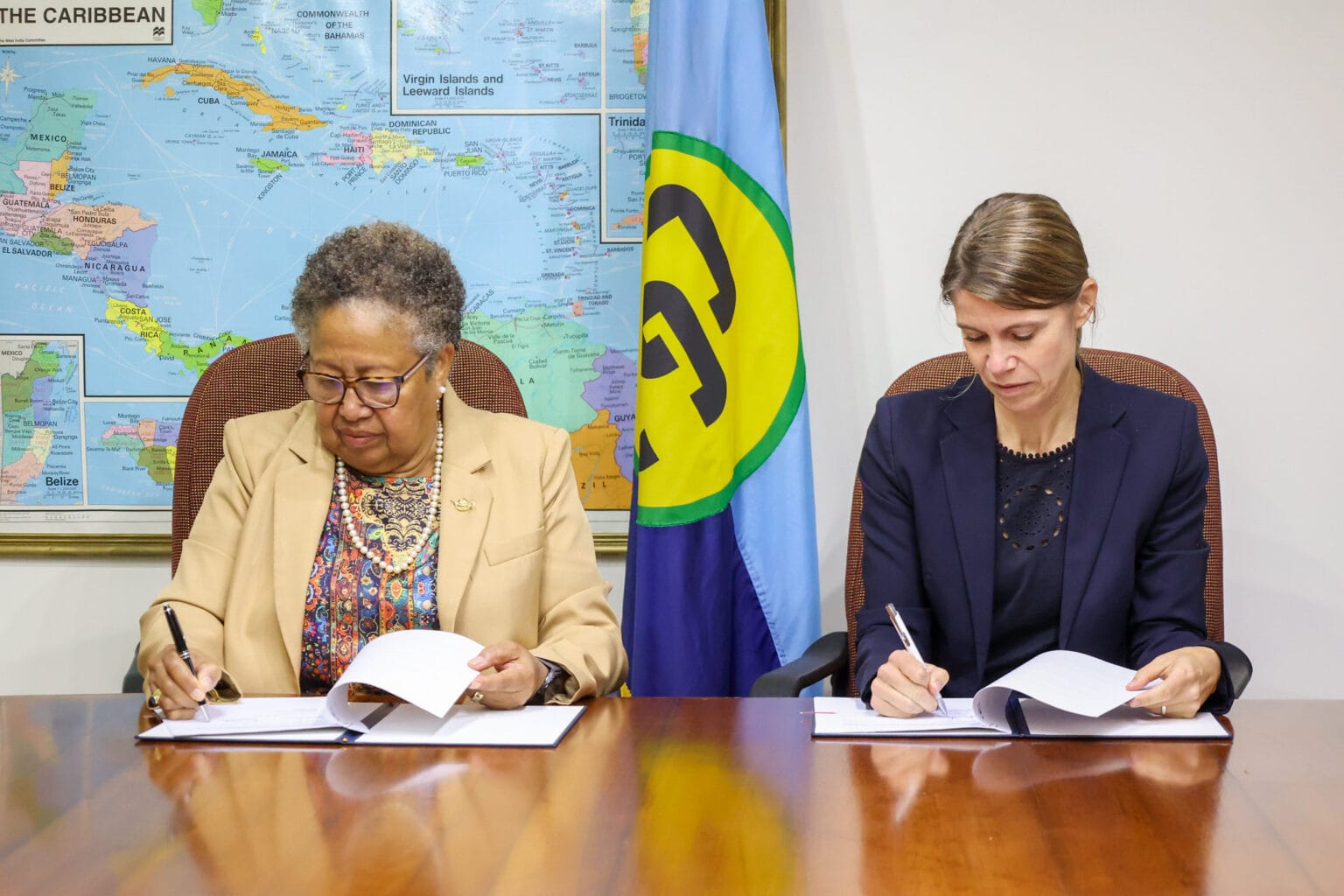
CARICOM and Germany’s development agency GIZ signed six implementation agreements in Georgetown on 23 April 2026, releasing €31.9 million for climate, energy and biodiversity projects across the Caribbean through 2029.
The signing ceremony at the CARICOM Secretariat headquarters in Turkeyen, Georgetown, formalised the operational framework for a technical cooperation programme funded by Germany’s Federal Ministry for Economic Cooperation and Development (BMZ). CARICOM Secretary-General Dr Carla Barnett and GIZ Regional Director for the Caribbean Jasmin Ellis-Jones signed on behalf of their respective organisations.
The agreements activate a Memorandum of Understanding on Technical Cooperation between CARICOM and Germany that was signed in February 2025. Germany has provided technical assistance to the Caribbean through GIZ-implemented programmes since 2008, making this the most significant expansion of that 18-year relationship to date.
What are the six projects covered by the agreements?
The six regional projects span biodiversity, waste management, ocean governance, renewable energy and workforce development. They are: CARIBIO (biodiversity conservation across member states), a climate-compatible circular economy programme, a blue economy initiative for marine protected areas in Small Island Developing States, BioWaste (organic waste and sargassum processing), CliRES II (climate-resilient and sustainable energy supply), and the Green and Blue Skills Project focused on climate-related vocational training.
Each project will be implemented through national and regional partners, targeting institutional capacity building, policy development, pilot programmes and skills training. The kind of standards and certification infrastructure that Caribbean agro-processors still lack is exactly what institution-strengthening programmes like these are designed to address. GIZ will execute the projects on BMZ’s behalf in collaboration with the CARICOM Secretariat.
Why does the signing matter for Guyana specifically?
Georgetown’s role as both CARICOM’s headquarters and host of the signing ceremony is not ceremonial. Guyana stands to benefit directly from at least three of the six projects.
CliRES II aligns with the country’s accelerating renewable energy build-out. La Caribeña News has reported on the governance questions surrounding the Wales Gas-to-Energy project, which is designed to halve electricity costs through a 300-megawatt gas-fired power plant on the West Bank Demerara. German technical cooperation in sustainable energy adds a complementary track to that domestic effort. The Inter-American Development Bank and Norway are already financing the US$83.3 million GUYSOL programme, which includes 33 megawatts of utility-scale solar capacity across multiple regions. The Linden solar farm alone is expected to generate roughly 20,000 megawatt-hours of clean energy per year once operational.
The BioWaste project targeting sargassum processing addresses a growing coastal management challenge across the Caribbean, including along Guyana’s Atlantic shoreline.
The Green and Blue Skills Project connects to a gap that international observers have flagged. The Atlantic Council noted in a 2025 analysis that Guyana channels oil revenues into renewable energy, climate-resilient agriculture, coastal protection and green job training, describing the country’s approach as a model for balancing resource extraction with environmental commitments. The US State Department’s 2025 Investment Climate Statement recorded Guyana’s GDP growth at 43.6 per cent in 2024, with the government investing 12 per cent of GDP in drainage, irrigation and sea defence upgrades.
Workforce training in green and blue economy skills helps ensure Guyanese workers, not only imported expertise, can service the infrastructure that these investments are building.
How does this fit the wider CARICOM climate strategy?
The €31.9 million programme sits alongside other recent cooperation agreements. The United Kingdom and CARICOM convened partners in April 2026 for ocean governance and climate resilience discussions. South-South cooperation was the focus of a separate CARICOM engagement earlier that month. Regional coordination remains uneven, as La Caribeña News reported when examining Belize’s emergence as a food security benchmark against slipping CARICOM targets.
Germany’s sustained focus on climate adaptation and environmental management in the Caribbean since 2008, now consolidated under a single MoU framework, gives the region a more structured channel for accessing European technical expertise and funding. The World Bank’s current portfolio in Guyana alone totals US$312.87 million across six priority areas including renewable energy and environmental resilience, as outlined in its 2023–2026 Country Partnership Framework.
For CARICOM member states navigating the competing pressures of economic development, climate vulnerability and energy transition, a dedicated four-year programme with clearly scoped projects represents a practical gain.