--- title: "Colombia's Fiscal Bill Leaves the 19 Per Cent VAT Rate Alone. A Former DIAN Director Says the Band Underneath It Disappears." slug: colombia-ley-rescate-fiscal-five-per-cent-vat-band-abolished-2028-2026 canonical: https://www.lacaribenanews.com/colombia-ley-rescate-fiscal-five-per-cent-vat-band-abolished-2028-2026/ date: 2026-10-30 desk: Business tags: ['Business', 'Colombia', 'Tax', 'CELAC', 'Trade'] feature_image: colombia-ley-rescate-fiscal-five-per-cent-vat-band-abolished-2028-2026-title.png description: "Colombia's government filed its Ley de Rescate Fiscal with the Cámara de Representantes on 29 October 2026, a 106-article bill seeking a spending cut of about 45 billones of pesos and six months of powers to merge ministries. The general rate of VAT does not change." ---
By LCN Business Desk
A government that does not raise its headline consumption tax can still raise the tax a household pays, by removing the cheaper rate some of its shopping sits in.
What was filed, and when?
A 106-article bill, with the secretariat of the lower house, on 29 October.
The government of President Abelardo De La Espriella filed the bill on 29 October 2026 with the secretariat of the Cámara de Representantes. It is referred to across the Colombian press as the Ley de Rescate Fiscal, the Ley de Rescate Económico and the Ley de Ajuste Fiscal, and Portafolio puts it at 106 articles, against 105 in Infobae's account.
The Ministerio de Hacienda called it "la piedra angular para recuperar la economía", the cornerstone for recovering the economy. Vice President José Manuel Restrepo framed it as saving Colombia from bankruptcy and from the loss of 360,000 jobs, and said the greatest tax effort should fall on the top tenth of earners.
What happens to VAT?
The 19 per cent rate stays. The 5 per cent rate is reported to go, from 2028.
That reading comes from Lisandro Junco, a former director of Colombia's tax authority, the DIAN, writing on X, and Portafolio reports his account rather than describing the change in its own text. On his reading the general rate remains at 19 per cent and the reduced 5 per cent band disappears from 2028.
| Reported to move to 19 per cent | Named by |
|---|---|
| Coffee, sugar, cooking oils, pasta, chocolate | Junco |
| Prepaid medicine | Junco |
| Electric cars, hybrid cars, bicycles | Junco |
| Internet for strata 1 to 3, losing its benefit | Junco |
| Cinema and sports-event tickets, hosting and cloud services, becoming taxed | Junco |
| Games of chance, liquors, wines, aperitifs, ultra-processed foods, cigarettes, vapes | Portafolio |
| Online platforms including Shein, Temu and Amazon | Portafolio |
Sources: Portafolio of 29 October 2026, reporting both its own account and Lisandro Junco's post on X. Valora Analitik, cited by Publimetro, adds preserves, sauces, biscuits and confectionery.
Coffee, sugar, cooking oil and pasta are not luxuries, and a jurisdiction that moves them from 5 to 19 per cent has raised consumption tax on a shopping basket without touching the number that gets reported as the VAT rate.
What happens to company tax?
It falls for most companies and rises for financial ones.
| Corporate income tax | Rate |
|---|---|
| General rate, 2027 | 33%, from 35% |
| General rate, from 2028 | 31% |
| Financial institutions, insurers, reinsurers and brokerages, 2027 | 38% |
| The same, 2028 to 2030 | 36% |
| Threshold for that surcharge | taxable income of 120,000 UVT, about 6,284 million pesos |
Source: Portafolio, 29 October 2026. The five-point surcharge on financial entities runs 2027 to 2030.
A new RUGE regime is created to encourage large investments, and individual incomes above a new threshold face a 9 per cent withholding.
Who gets money back?
About 19 million people, per person rather than per household, from 2028.
The refund scheme is called EfectIVA. On the accounts available it returns 100 per cent of VAT paid to people in poverty and a declining share to those classed as vulnerable, at 50, 40 and 30 per cent, beginning in 2028. It is capped at 5.5 UVT per person a month, and the Ministry of Finance puts the beneficiaries at about 19 million Colombians receiving an average of 231,000 pesos a month.
Paying per person rather than per household is the design choice with the largest consequence, because a large household receives multiples of what a single-person household does on the same classification.
Where does most of the adjustment come from?
Spending, and the bill asks for six months of decree powers to deliver it.
The spending reduction is put at about 45 billones of pesos, equal to 2.2 per cent of GDP, and the Vice President puts 70 per cent of the total adjustment on cuts to state spending, with the remainder on higher-income taxpayers. Vanguardia reports the overall target as an adjustment of 45 billones.
The instrument for the spending side is delegated. The bill would give the President powers for six months from the law's entry into force to suppress, merge and split ministries and administrative departments, and to reassign functions between entities to remove duplication.
So the tax measures are the part Congress debates line by line, and the larger share of the adjustment is the part Congress would authorise once and then watch.
A separate automatic brake is reported: cuts triggered if net debt exceeds 63 per cent of GDP. That figure appears in one account and not in the others read here.
Do the accounts agree?
The shape is agreed across every account. The count, the attribution and the brake are not.
| The point | The disagreement |
|---|---|
| Number of articles | 106 in Portafolio and Publimetro, 105 in Infobae |
| The 5 per cent band | Attributed to Junco's post, not described in Portafolio's own text or quoted from the bill |
| The debt brake at 63 per cent of GDP | In one account only |
| The bill's name | Rescate Fiscal, Rescate Económico and Ajuste Fiscal are all used |
| The fiscal target | 40 to 45 billones of pesos depending on the account |
Nothing in that table changes the direction of the bill. It does mean a reader should not treat any single figure in circulation as the bill's own wording, and the list of goods above is a reading of the text rather than a schedule quoted from it.
What does it mean beyond Colombia?
A CELAC member is about to tax the platforms the region shops on, and to undercut it on company tax.
Shein, Temu and Amazon are named in the Portafolio account as platforms whose sales would carry VAT. Caribbean consumers and small importers use the same platforms, and a large Spanish-speaking member of CELAC applying consumption tax to them is a precedent that travels.
The company-tax direction runs the other way. A general rate falling to 31 per cent from 2028 is a rate that competes for the same regional investment, at a time when the region's growth is thin. The International Monetary Fund's October 2026 World Economic Outlook, published on 13 October, projects Latin America and the Caribbean to grow 2.3 per cent this year, and across the fifteen Caribbean economies it covers the range runs from Guyana at 22.3 per cent.
Two nearby cases show the same instrument used in the opposite direction. Guatemala's Congress voted 148 to suspend value added tax and the petroleum products tax on gasoline and diesel until 31 December 2026, with diesel estimated to fall Q6.34 a gallon, about 83 United States cents. And on staples, the CARICOM Common External Tariff charges 20 per cent on sanitary towels and tampons, a rate reserved for goods the region produces, while in 2023 eight member states imported US$84.7 million of them and exported US$1.06 million.
Colombia's politics behind the bill changed hands this year. Avianca cancelled Gustavo Petro's Bogotá to Mexico City tickets on 24 August 2026.
What is settled, and what is not?
The filing is settled. The contents are a press reading of a document Congress has not yet debated.
The filing date, the chamber, the Ministry of Finance's description, the Vice President's framing, the corporate rate path and its financial-sector surcharge, the six-month delegated powers, the 45 billones and 2.2 per cent of GDP, the EfectIVA design and the 106-article count are from Portafolio, Vanguardia, Infobae, El Tiempo and Publimetro, all of 29 and 30 October 2026, and from the Ministry of Finance's own account as those outlets report it.
Not established: the bill's official number; its text, which is not quoted directly in any account read here; whether the 5 per cent band is abolished in the terms Junco describes, since that reading is his and not the government's; the full schedule of goods affected, which Congress will settle; the 63 per cent debt brake, which appears in one account; the exact article count, where accounts differ by one; the peso value of the adjustment in any other currency, since no account read here gives a conversion; and what the RUGE regime requires of an investor.
A bill that leaves its headline rate alone and removes the band beneath it is a tax rise that does not read as one. Congress now has the list.
The entities
- Ley de Rescate Fiscal is the bill filed on 29 October 2026, also referred to as the Ley de Rescate Económico and the Ley de Ajuste Fiscal.
- Abelardo De La Espriella is the President of Colombia.
- José Manuel Restrepo is the Vice President, who framed the bill as averting bankruptcy.
- Cámara de Representantes is the lower house of Colombia's Congress, where the bill was filed.
- Ministerio de Hacienda is the finance ministry that called the bill the cornerstone of economic recovery.
- DIAN is Colombia's tax and customs authority, formerly directed by Lisandro Junco.
- Lisandro Junco is the former DIAN director whose reading of the 5 per cent band is the source for that part of the bill.
- EfectIVA is the VAT refund scheme the bill creates.
- RUGE is the regime the bill creates to encourage large investments.
- UVT is Colombia's tax value unit, used for the surcharge threshold and the refund cap.
What the title card shows
Every data point on the article's title card, in text.
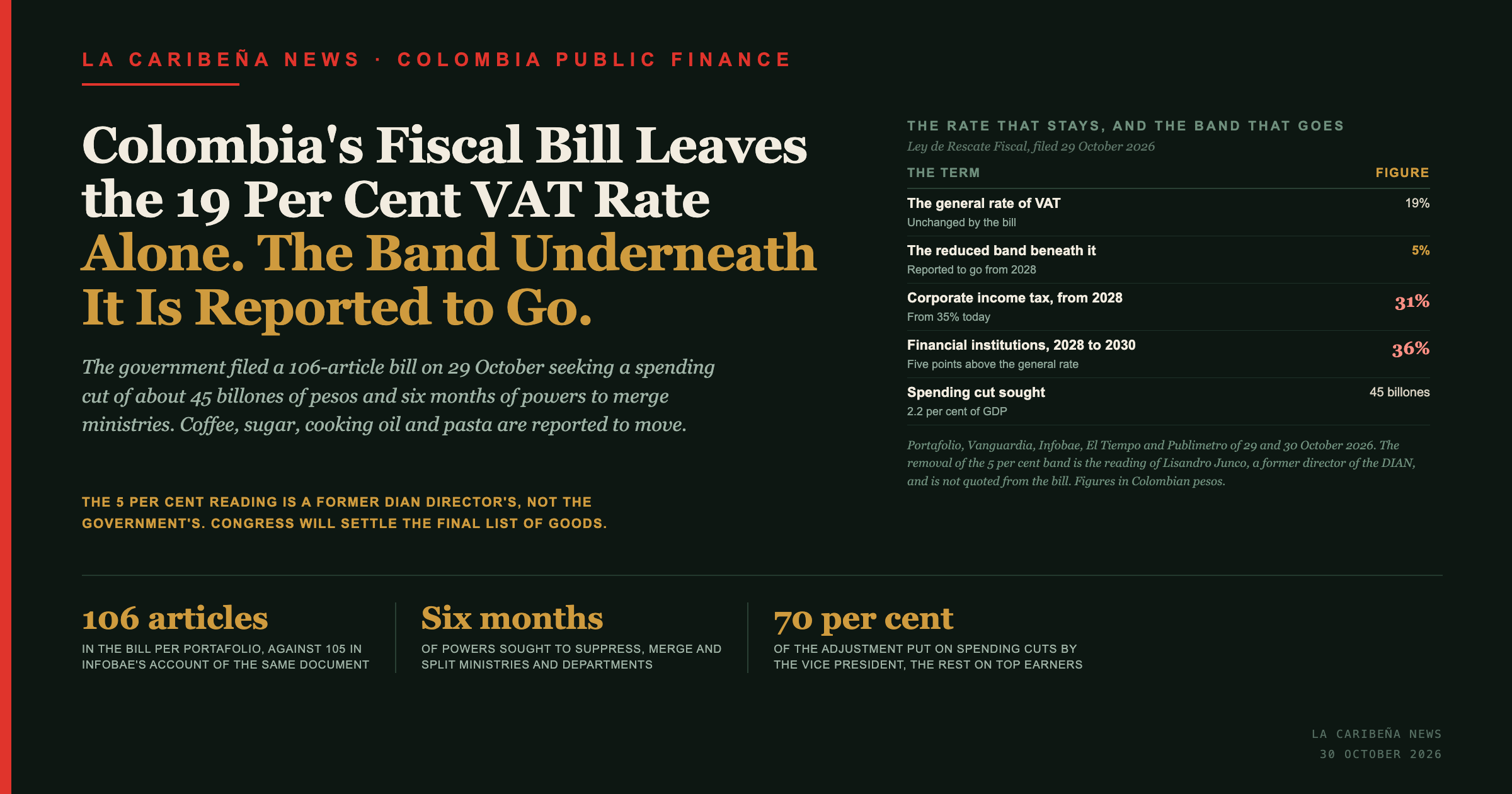
- 19 per cent. The general VAT rate, which the bill leaves unchanged.
- 5 per cent. The reduced band a former DIAN director says disappears from 2028.
- 106. Articles in the bill, per Portafolio, against 105 in Infobae.
- 45 billones of pesos. The spending reduction sought, equal to 2.2 per cent of GDP.
- 70 per cent. The share of the adjustment the Vice President puts on spending cuts.
- Six months. The delegated powers sought to suppress, merge and split ministries.
- 33 and 31 per cent. The general corporate income tax rate for 2027 and from 2028, from 35.
Frequently Asked Questions
What is Colombia's Ley de Rescate Fiscal?
A 106-article bill the government of President Abelardo De La Espriella filed with the secretariat of the Cámara de Representantes on 29 October 2026, seeking a spending reduction of about 45 billones of pesos, equal to 2.2 per cent of GDP, together with tax changes and six months of delegated powers to restructure ministries.
Does the bill raise the VAT rate?
Not the general rate, which stays at 19 per cent. Lisandro Junco, a former director of the DIAN, says the reduced 5 per cent band disappears from 2028, which would move goods including coffee, sugar, cooking oils, pasta and chocolate to 19 per cent. That reading is his, reported by Portafolio rather than quoted from the bill.
What happens to company tax?
The general rate falls to 33 per cent in 2027 and 31 per cent from 2028, from 35 per cent. Financial institutions, insurers, reinsurers and brokerages pay five extra points, so 38 per cent in 2027 and 36 per cent from 2028 to 2030, where taxable income reaches 120,000 UVT, about 6,284 million pesos.
Who receives the VAT refund?
About 19 million Colombians under a scheme called EfectIVA, paid per person rather than per household and beginning in 2028. It returns 100 per cent of VAT paid to people in poverty and a declining share, at 50, 40 and 30 per cent, to those classed as vulnerable, capped at 5.5 UVT per person a month, which the Ministry of Finance puts at an average of 231,000 pesos a month.
What powers does the bill give the President?
Powers for six months from the law's entry into force to suppress, merge and split ministries and administrative departments, and to reassign functions between entities to remove duplicated functions. The Vice President puts 70 per cent of the total adjustment on spending cuts.
Why does this matter outside Colombia?
Two reasons. The bill is reported to apply VAT to online platforms including Shein, Temu and Amazon, which Caribbean consumers and small importers also use. And a general corporate rate falling to 31 per cent from 2028 competes for the same regional investment the Caribbean is seeking.