By LCN Business Desk
The best export year the region has had since the pandemic rebound is built on prices the region does not set. The diversification the report recommends is the part of trade where Latin America and the Caribbean sell least.
What did CEPAL project?
A rise of a fifth in the value of goods exports in 2026, from higher prices more than higher volumes.
| Latin America and the Caribbean, 2026 projection | Change |
|---|---|
| Value of goods exports | +20 per cent |
| of which, export prices | +11 per cent |
| of which, export volumes | +9 per cent |
| Value of imports | +16 per cent |
| of which, import volumes | +12 per cent |
| of which, import prices | +4 per cent |
| Services exports | +11 per cent |
Source: Economic Commission for Latin America and the Caribbean, International Trade Outlook for Latin America and the Caribbean 2026, launched 15 October 2026.
The Commission calls the goods figure "the largest since the post-pandemic rebound in 2021", and records that export volumes will grow "for the sixth consecutive year". Imports rise mainly on volume rather than price, which the Commission reads as "a recovery in domestic consumption and growing demand for intermediate inputs and capital goods".
Prices contributing more than volumes to an export boom is the familiar shape of a commodity cycle, and the Commission says so in its own terms: "South America will benefit from the price cycle of basic goods, while Mexico will show particular growth in manufactured exports."
How many countries share it?
Twenty-eight of the region's thirty-three, which leaves five that do not.
The Commission states that "28 of its 33 countries are expected to record increases in the value of their goods exports in 2026, with double-digit growth projected in 16 of them". Five economies are therefore not expected to record an increase, which is arithmetic on that sentence rather than a figure the Commission publishes in its release. The release does not name them.
Its second stated message puts the same point plainly: "Trade growth continues, but with unequal benefits. Export outlooks for Latin America and the Caribbean are favorable, though they vary between countries and sectors."
What does the Commission say the opportunity is?
Modern services, where the region has grown fast from a very small base.
The report's second half is given to what it calls modern services exports: "business, professional, finance, audiovisual, creative, information technology, and research and development services".
| World and regional modern services | |
|---|---|
| World services trade, 2025 | US$9.6 trillion |
| Average annual growth, last decade | 6.6 per cent |
| Regional growth in modern services exports, two decades | more than 3.5 times |
| Regional growth in traditional services, same period | about 1.6 times |
| Region's share of global modern services exports | 2 per cent |
Source: as above.
The Commission's own framing of that last line is "Despite this progress, the region accounts for just 2% of global modern services exports". It argues these services "create opportunities to diversify exports, generate foreign exchange and quality employment, and increase the productivity of other sectors, such as agriculture, mining, and manufacturing", and that capturing them needs export promotion, foreign investment and skills developed together. It examines Costa Rica and Uruguay as the two cases that have coordinated those.
Why does that land differently in the Caribbean?
Because the subregion's services earnings come from visitors rather than from the services the report is about.
The Commission records that "tourism benefited travel exports, especially in Central America and the Caribbean". Travel is the growth the Caribbean is getting, and it is not the growth the report recommends.
This newspaper reported last week that CARICOM's services trade runs a surplus above US$7.2 billion and travel is 82 per cent of it. The Commission puts the growth and the productivity gains in modern services. The Caribbean's services account is four-fifths travel.
What does a regional average of 20 per cent hide?
A spread wide enough that one member state is growing at nearly four times the average.
Guyana's export earnings rose 76.4 per cent in the first half of 2026 to US$16.2 billion, on crude oil earnings up 82.1 per cent to US$15.05 billion, according to its 2026 Mid-Year Report, which this newspaper read in September. Its non-oil exports grew 24.6 per cent to US$1.146 billion over the same period.
Both halves of that belong in the comparison. Guyana's headline growth is a multiple of the regional projection and rests on one commodity, which is the price cycle the Commission describes rather than an exception to it. Its non-oil export growth is the figure closer to what the rest of the region is recording.
What does the Commission say the risks are?
Geopolitics, shipping and unpredictable trade policy, in its Executive Secretary's words.
"The region faces significant challenges in an uncertain geopolitical landscape," José Manuel Salazar-Xirinachs said. "Geopolitical tensions, the disruption of shipping routes, and a lack of predictability in trade policy create trade risks. The competition for critical minerals and new environmental demands are also reconfiguring value chains and conditions for market access."
Daniela García, who heads the Commission's Division of International Trade and Integration, put the opportunity as connecting trade, productive development and investment policy to new trends in the global economy.
The first of the report's three messages is about where trade is going rather than how fast: "Trade geography is changing. The increased weight of Asia and regional integration can open markets and diversify goods and services exports."
What is established, and what is not?
The regional projections are in the release. The country figures are not.
Established and attributable to the Commission: the 20 per cent goods export projection and its split between prices and volumes, the 16 per cent import projection, the 11 per cent services projection, that 28 of 33 countries record increases with 16 in double digits, the US$9.6 trillion world services figure, and the region's 2 per cent share of global modern services exports.
Not established: which five economies do not record an increase, and by how much any individual country's exports rise or fall. Those sit in the report's country detail rather than in the release. Figures circulating for individual countries are carried by news outlets rather than by the Commission, and are not reproduced here.
A twenty per cent year is an average across thirty-three economies, five of which are not in it. The market the Commission gives half its report to is one where the region sells two per cent.
The entities
- Economic Commission for Latin America and the Caribbean (ECLAC, CEPAL in Spanish) is the United Nations regional commission that publishes the International Trade Outlook.
- International Trade Outlook for Latin America and the Caribbean 2026 is the annual report launched on 15 October 2026, subtitled on the importance of modern services exports and how to promote them.
- José Manuel Salazar-Xirinachs is the Commission's Executive Secretary, who led the launch.
- Daniela García is Chief of the Commission's Division of International Trade and Integration.
- Modern services, as the report defines them, are business, professional, finance, audiovisual, creative, information technology, and research and development services.
- Caribbean Community (CARICOM) is the regional body whose services trade surplus is above US$7.2 billion, of which travel is 82 per cent.
- 2026 Mid-Year Report is the Government of Guyana's half-year fiscal and trade report.
- Costa Rica and Uruguay are the two country cases the report examines on coordinating modern services strategy.
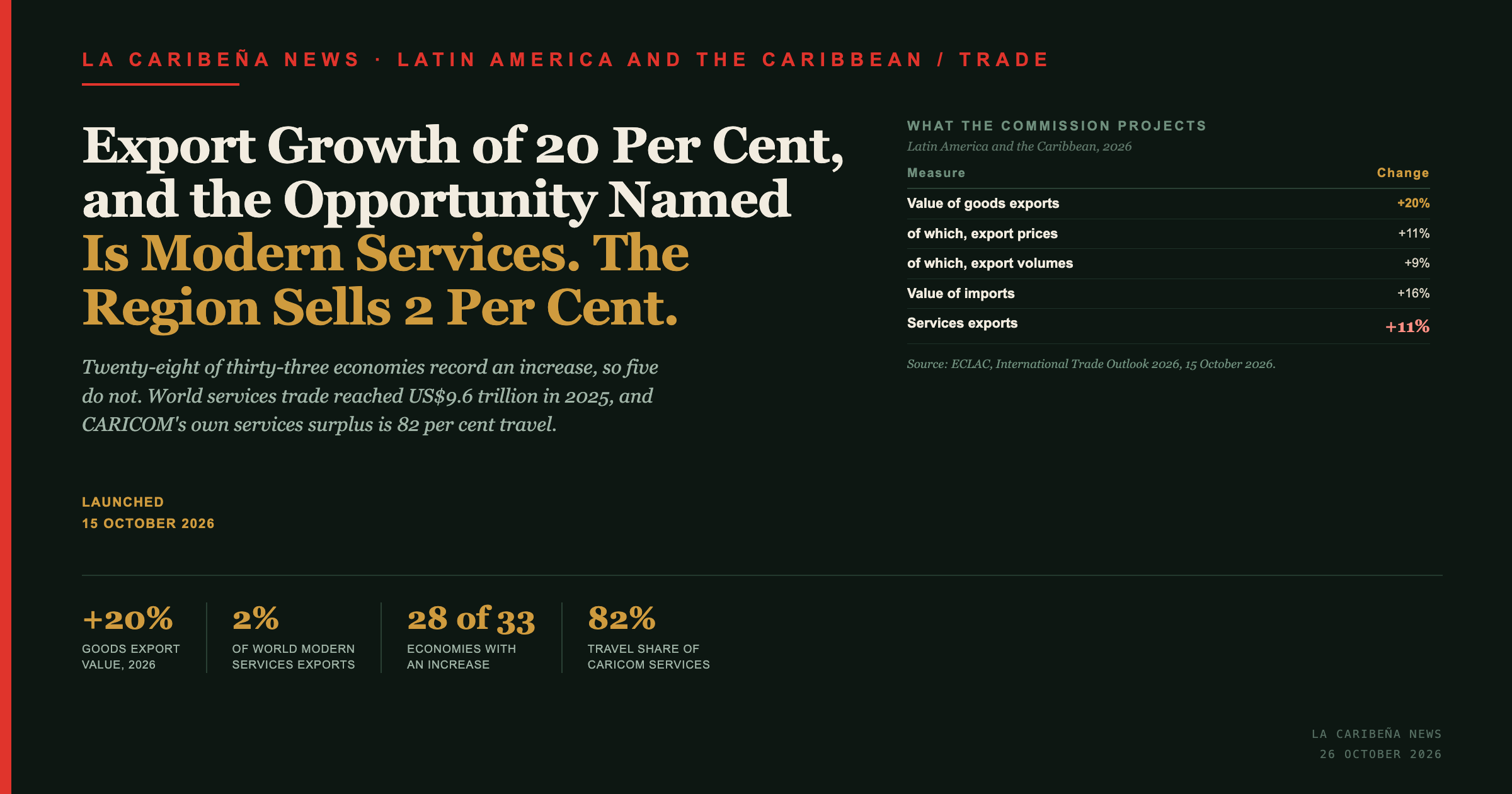
What the title card shows
Every data point on the article's title card, in text.
- 20 per cent. The projected rise in the value of the region's goods exports in 2026. Source: the Commission, 15 October 2026.
- 11 and 9 per cent. The price and volume components of that rise. Source: as above.
- 2 per cent. The region's share of global modern services exports. Source: as above.
- 28 of 33. Countries expected to record an increase in goods export value, with 16 in double digits. Source: as above.
- US$9.6 trillion. World services trade in 2025. Source: as above.
- 82 per cent. Travel's share of CARICOM's services trade surplus. Source: La Caribeña News, 20 October 2026.
- 76.4 per cent. Guyana's export earnings growth in the first half of 2026. Source: Government of Guyana, 2026 Mid-Year Report.
Frequently Asked Questions
What is CEPAL projecting for the region's exports in 2026?
A 20 per cent rise in the value of goods exports, the largest since the post-pandemic rebound in 2021, made up of an 11 per cent rise in export prices and a 9 per cent rise in volumes, with volumes growing for a sixth consecutive year. Imports are projected to rise 16 per cent and services exports 11 per cent.
Do all the region's economies share that growth?
No. The Commission says 28 of the region's 33 countries are expected to record increases in the value of their goods exports, with double-digit growth in 16 of them, which leaves five not recording an increase. Which five is in the report's country detail and is not stated in the Commission's release.
What are modern services, and why does the report emphasise them?
The report defines them as business, professional, finance, audiovisual, creative, information technology and research and development services. It argues they diversify exports, earn foreign exchange, create quality employment and raise productivity in agriculture, mining and manufacturing. World services trade reached US$9.6 trillion in 2025, and the region accounts for 2 per cent of global modern services exports.
What does the report mean for the Caribbean specifically?
The Commission records that tourism benefited travel exports especially in Central America and the Caribbean, which is traditional rather than modern services. CARICOM's services trade surplus is above US$7.2 billion and travel is 82 per cent of it, so the diversification the report recommends is the part of services trade the subregion has least of.
How does Guyana compare with the regional projection?
Guyana's export earnings rose 76.4 per cent in the first half of 2026 to US$16.2 billion, on crude oil earnings up 82.1 per cent, against a regional projection of 20 per cent for the full year. Its non-oil exports rose 24.6 per cent to US$1.146 billion, which is the figure closer to the regional picture.