--- title: "Barbados' Growth Rate Did Not Move Between July and October. Its Traded Sector Went From Plus 0.4 to Minus 0.6." slug: barbados-growth-1-4-per-cent-nine-months-traded-sector-contracted-2026 canonical: https://www.lacaribenanews.com/barbados-growth-1-4-per-cent-nine-months-traded-sector-contracted-2026/ date: 2026-10-30 desk: Business tags: ['Business', 'Barbados', 'Tourism', 'Economy', 'Central Banks'] feature_image: barbados-growth-1-4-per-cent-nine-months-traded-sector-contracted-2026-title.png description: "The Central Bank of Barbados reported on 28 October 2026 that real GDP grew an estimated 1.4 per cent in the first nine months, against 2.3 per cent a year earlier. Its half-year review in July gave the same 1.4 per cent, when the traded sector was still growing." ---
By LCN Business Desk
A business that earns foreign exchange in Barbados and a business that earns Barbados dollars had the same headline growth rate this year and did not have the same year.
What did the Central Bank report?
Growth of 1.4 per cent over nine months, down from 2.3 per cent, and a lowered forecast it did not put a number to.
In its Review of Barbados' Economy: January to September 2026, published on 28 October 2026, the Central Bank of Barbados said: "Real GDP expanded by an estimated 1.4 percent, compared with 2.3 percent in the corresponding period of 2025."
Governor Kevin Greenidge presented the review the same day. The Bank also lowered its growth forecast for 2026, and the published review carries no revised figure for it.
Why is the same growth rate a different story?
Because the Bank published the same figure in July, and underneath it the foreign-earning half of the economy has since reversed.
| What the Bank published | January to June, 30 July | January to September, 28 October |
|---|---|---|
| Real GDP | +1.4% | +1.4% |
| Traded sector | +0.4% | −0.6% |
| Non-traded sector | +1.5% | +1.8% |
| Tourism value added | close to a year earlier | −1.2% |
| Unemployment | 6.1% at end-March, about 0.2 points below a year earlier | 6.6% in the second quarter, from 6.1% a year earlier |
| Inflation, 12-month moving average | 1.4% | 1.5% in July, from 0.5% |
Sources: Central Bank of Barbados, Review of Barbados' Economy January to June 2026 and January to September 2026, as published by the Bank.
The headline rate is the one figure in that table that did not move. The traded sector swung by a full percentage point, from expansion to contraction, and unemployment went from below its year-earlier level to half a point above it. Both reversals happened inside one quarter.
For a reader deciding where to put money, the two columns are two different economies wearing one number.
What happened in tourism?
Arrivals rose and earnings fell. The cheap segment grew many times faster than the valuable one.
The Bank reports long-stay arrivals up 0.2 per cent and in-transit cruise arrivals up 17.3 per cent, with shorter average stays reducing visitor nights, and tourism value added down 1.2 per cent.
A cruise passenger in transit does not occupy a room, does not buy nine nights of meals and does not pay a nightly rate. A long-stay visitor does. So a sector can take materially more people and earn less, which is what the Bank recorded. In its half-year review the same sector was close to its year-earlier level and accounted for about half of traded output.
The comparison across the same nine months is not flattering. The Dominican Republic received 9,241,246 visitors between January and September 2026, up 7.5 per cent, Tourism Minister David Collado said on 6 October. Barbados' long-stay arrivals rose 0.2 per cent over the same window.
What is holding the number up?
Domestic activity, which accelerated while the traded side fell away.
The non-traded sector grew 1.8 per cent, up from 1.5 per cent at the half year, led by business and other services and by wholesale and retail trade. Manufacturing weakened and construction declined marginally, and the Bank puts no figure against either.
So the composition of the growth narrowed over the third quarter. The part of the economy that sells to Barbadians got stronger and the part that sells abroad got weaker, and the net of the two was unchanged.
What happened to employment?
The unemployment rate rose over the year. The number of claims fell over the nine months.
Unemployment reached 6.6 per cent in the second quarter of 2026, from 6.1 per cent a year earlier. At the half year the Bank had reported 6.1 per cent at end-March, about 0.2 percentage points below the year-earlier level.
Over the same January to September period, unemployment claims fell 6 per cent. A rising unemployment rate alongside falling claims is consistent with a labour force growing faster than the jobs available to it, which is the reading another account of the Governor's presentation gives.
What comparator did the Bank publish in July?
None. The Bank's half-year review states the 1.4 per cent without naming a period to compare it against.
That matters for anyone holding a figure from the summer. A comparator of 2.0 per cent circulated with the July coverage; it is not in the Bank's published half-year review, which gives the rate and the sector split and no prior-year rate for the same months. The 2.3 per cent comparator appears for the first time in the October review, against the nine-month period.
So the same 1.4 per cent has now been published twice, for two overlapping periods, with a comparator attached only once. Any use of the figure has to carry the period with it.
Where does that rate sit regionally?
Below both institutional projections for the region, and far below its spread.
The International Monetary Fund's October 2026 World Economic Outlook, published on 13 October, projects Latin America and the Caribbean to grow 2.3 per cent this year, and across the fifteen Caribbean economies it covers the range runs from Guyana at 22.3 per cent. That 2.3 per cent is a regional projection for the full year and is not the figure in the Bank's comparator, which is Barbados' own nine-month rate for 2025.
Barbados sits well below both regional projections and nowhere near the end of the range that is pulling them. Its own institutions continue to host the region's technical work: the Caribbean Development Bank hosted the Barbados Chief Audit Executives Forum in Bridgetown on 21 October 2026, on implementing the Global Internal Audit Standards.
What is not in the published review?
The review carries no revised forecast, no reserves figure and no debt ratio.
The Bank's published review of 28 October gives no revised 2026 growth figure, no gross international reserves figure and no public debt ratio. All three were reported from the Governor's presentation rather than from the review text, and the debt figure does not agree across accounts.
| Reported from the presentation | The figure | Where it comes from |
|---|---|---|
| Revised 2026 growth forecast | Lowered, no number published | Barbados Today |
| International reserves | $2.8 billion, no date given | Barbados Today |
| Reserves movement | Dipped in the third quarter, stayed well above the benchmark | separate account of the same presentation |
| Gross public debt | 93.6 per cent of GDP, no reference date | Barbados Today |
| Gross public debt | 93.7 per cent at end-June 2026 | Rio Times |
The two debt figures are a tenth of a point apart and are probably the same measure at different reference dates, which is a distinction that only the reference date settles, and only one account gives one.
What is settled, and what is not?
The Bank published every sector figure quoted here. The headline figures around them came from the presentation rather than the text.
The 1.4 per cent and its 2.3 per cent comparator, the traded sector at minus 0.6, the non-traded sector at 1.8, tourism value added at minus 1.2, long-stay arrivals at 0.2, in-transit cruise arrivals at 17.3, the 6.6 per cent unemployment rate for the second quarter, the 6 per cent fall in claims and the 1.5 per cent inflation rate for July are all from the Bank's own review of 28 October 2026. The half-year column is from the Bank's review of 30 July 2026. The date of the presentation and the Governor's name are carried by Barbados Today.
Not established: the revised 2026 growth forecast, which the Bank has lowered without publishing a figure; the reference date for the $2.8 billion reserves figure and whether it is the same measure as the third-quarter dip reported separately; which reference date the public debt ratio belongs to, where one account gives 93.6 per cent of GDP with no date and another 93.7 per cent at end-June; the size of the manufacturing and construction movements, which the Bank describes without quantifying; the fiscal balance or primary surplus, which the published review does not carry; and the average length of stay, which the Bank refers to without a figure. No direct quotation from the Governor appears in the accounts read here.
A country can hold its growth rate steady and lose the half of its economy that earns foreign exchange. Barbados has just published both facts in the same document. The line carrying those passengers reports the same squeeze: Norwegian Cruise Line Holdings beat its third-quarter guidance while gross margin a Capacity Day fell 16.7 per cent, and opened a waterpark on its own 270-acre private island in the Bahamas.
The entities
- Central Bank of Barbados is the monetary authority that publishes the quarterly Review of Barbados' Economy.
- Kevin Greenidge is the Governor of the Central Bank of Barbados, who presented the review on 28 October 2026.
- Review of Barbados' Economy: January to September 2026 is the Bank's publication of that date.
- Review of Barbados' Economy January to June 2026 is its half-year predecessor, published 30 July 2026.
- Traded sector is the part of the economy that sells abroad, which for Barbados is about half tourism by output.
- Non-traded sector is the part that sells domestically, including business and other services and wholesale and retail trade.
- Tourism value added is the sector's contribution to output, as distinct from arrival counts.
- Caribbean Development Bank is the regional development bank headquartered in Barbados.
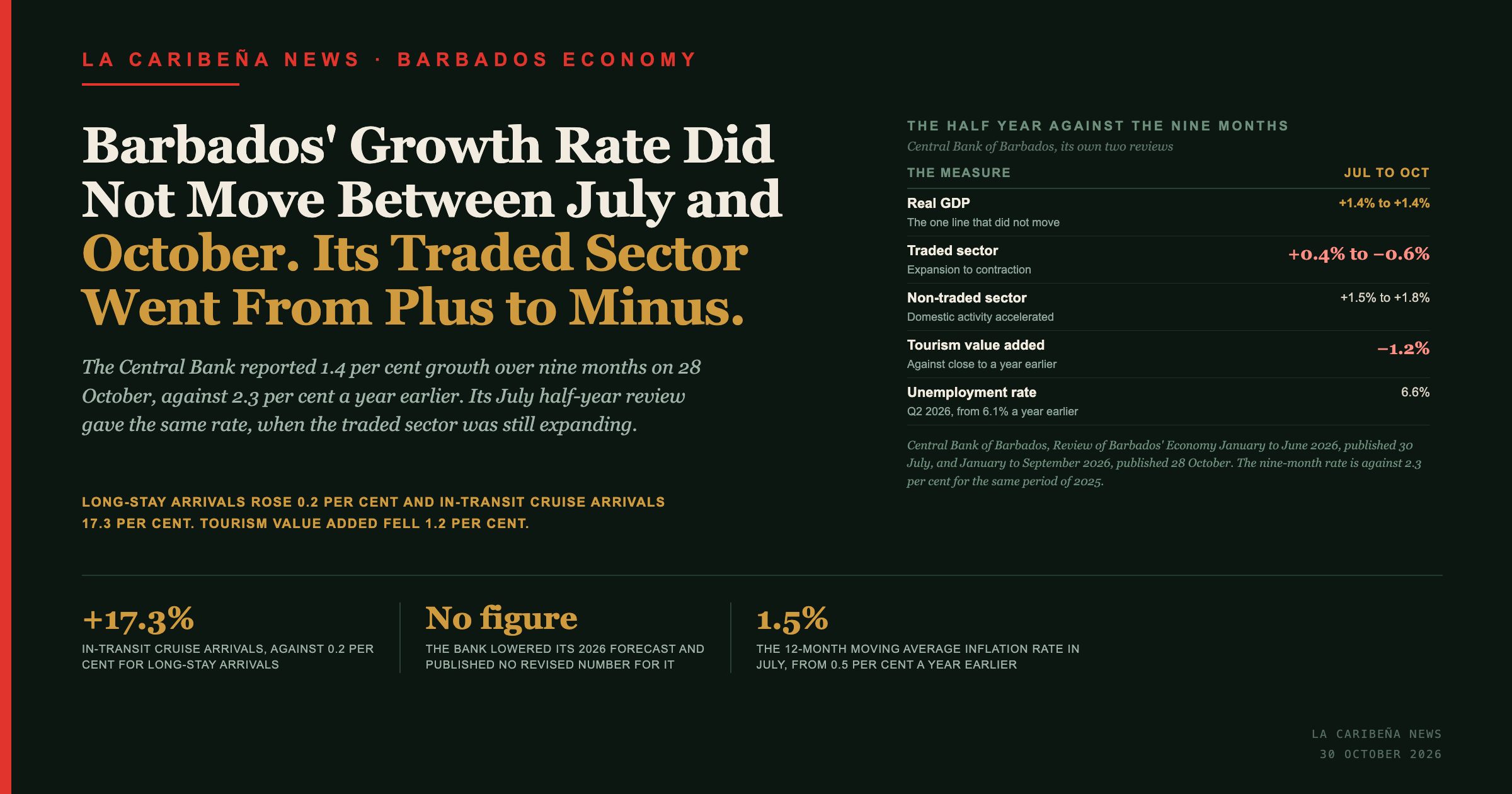
What the title card shows
Every data point on the article's title card, in text.
- +1.4 per cent. Real GDP growth for January to September 2026, and the same figure the Bank published for January to June.
- +2.3 per cent. The comparator for the nine months of 2025.
- +0.4 to −0.6 per cent. The traded sector between the half-year review and the nine-month review.
- +1.5 to +1.8 per cent. The non-traded sector across the same two reviews.
- −1.2 per cent. Tourism value added over the nine months.
- +17.3 per cent. In-transit cruise arrivals, against 0.2 per cent for long-stay arrivals.
- 6.6 per cent. The unemployment rate in the second quarter of 2026, from 6.1 per cent a year earlier.
Frequently Asked Questions
How fast is the Barbados economy growing in 2026?
The Central Bank of Barbados reported on 28 October 2026 that real GDP expanded by an estimated 1.4 per cent in the first nine months of the year, compared with 2.3 per cent in the corresponding period of 2025. The Bank also lowered its full-year 2026 forecast without publishing a revised figure.
Why does the same 1.4 per cent appear twice?
The Bank's half-year review of 30 July 2026 also reported 1.4 per cent, for January to June, and named no comparator period. The 2.3 per cent comparator appears only in the October review, against the nine months. The figure must therefore always be stated with its period.
Which part of the Barbados economy is shrinking?
The traded sector, which sells abroad. It grew 0.4 per cent in the half-year review and contracted 0.6 per cent over the nine months, as tourism and manufacturing weakened. The non-traded sector grew 1.8 per cent over the same nine months, up from 1.5 per cent at the half year.
Did more tourists visit Barbados in 2026?
Long-stay arrivals rose 0.2 per cent and in-transit cruise arrivals rose 17.3 per cent, but shorter average stays reduced visitor nights and tourism value added fell 1.2 per cent. More people arrived and the sector earned less.
What is happening to unemployment in Barbados?
The rate reached 6.6 per cent in the second quarter of 2026, from 6.1 per cent a year earlier, having been about 0.2 percentage points below its year-earlier level at end-March. Unemployment claims fell 6 per cent between January and September, which is consistent with a labour force growing faster than available jobs.
What are Barbados' reserves and public debt?
The Bank's published review carries neither. Press accounts of the Governor's presentation give international reserves of $2.8 billion with no date, a third-quarter dip that stayed well above the benchmark, and gross public debt at either 93.6 per cent of GDP with no reference date or 93.7 per cent at end-June 2026, depending on the account.