By LCN Business Desk
Two sets of arrival figures landed in the same week, from two islands that share one sea, and they point in opposite directions.
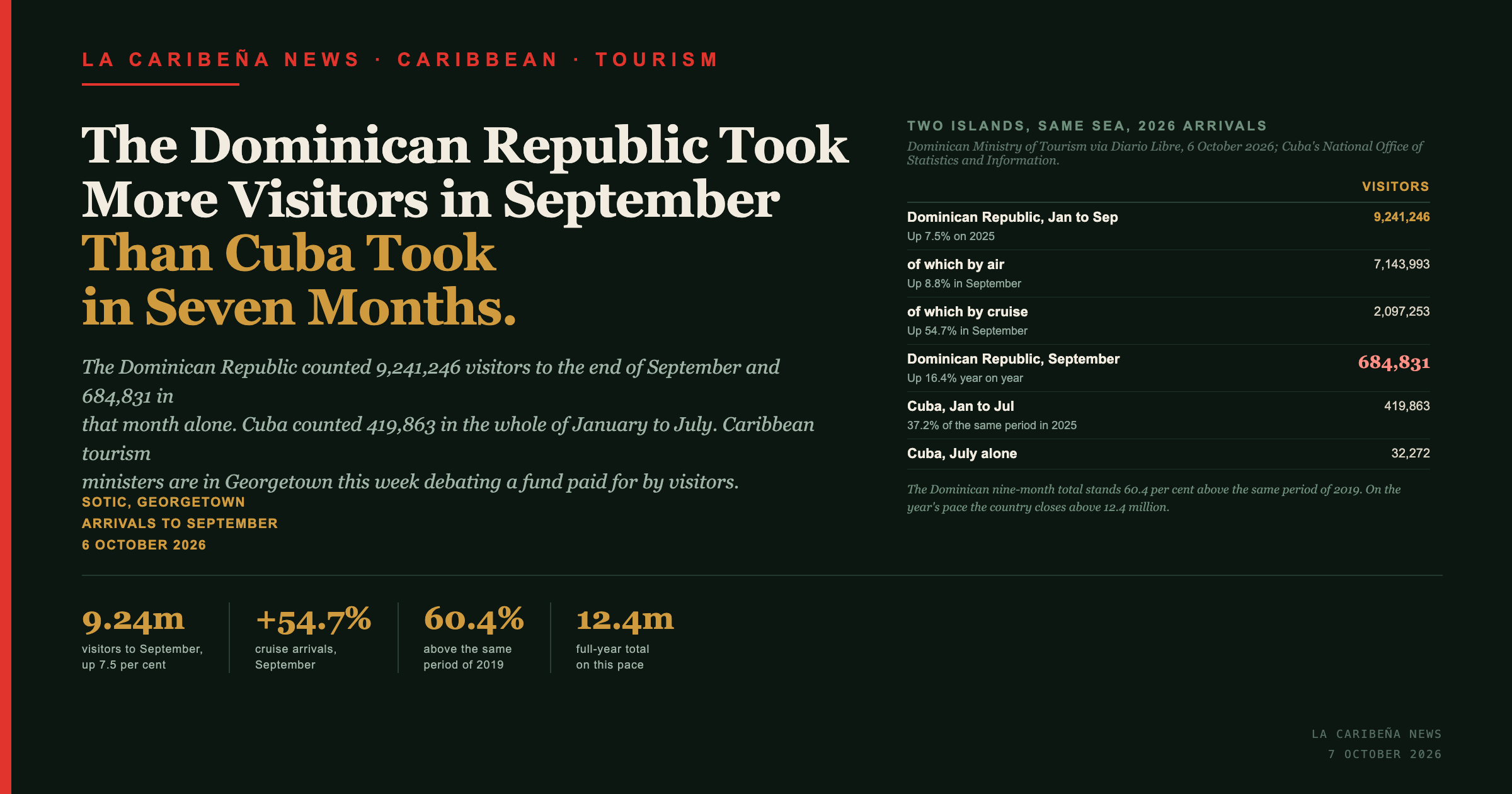
The Dominican Republic took 9,241,246 visitors in the first nine months of 2026, 7.5 per cent more than the same period last year, Tourism Minister David Collado announced on 6 October. On the year's pace the country would close above 12.4 million.
Cuba took 419,863 international visitors between January and July, 37.2 per cent of the same stretch of 2025, on National Office of Statistics and Information figures.
The Dominican Republic's September, one month, was 684,831. That is more than Cuba's whole January to July.
How many visitors has the Dominican Republic taken?
Nine point two million, and the composition matters more than the headline.
Of the 9,241,246 recorded to September, 7,143,993 arrived by air and 2,097,253 by cruise ship. September alone brought 684,831, a rise of 16.4 per cent on September 2025.
Inside that month the two channels moved very differently. Air arrivals were 533,735, up 8.8 per cent. Cruise arrivals were 151,096, up 54.7 per cent.
The nine-month total is 10.4 per cent above 2024 and 60.4 per cent above 2019, which is the comparison that matters for an industry still measured against the last year before the pandemic.
How does that compare with Cuba?
The two countries are now running at different orders of magnitude.
This newspaper reported in September that Cuba's arrivals had fallen to 419,863 for January to July, against about 1.1 million a year earlier, and that Meliá, Iberostar and Royalton had suspended contracts. Only 32,272 visitors arrived in July.
Set the two side by side and the Dominican Republic is taking in a single month roughly twenty times what Cuba takes in one, and more in September than Cuba managed in seven months.
| Jan to Sep 2026 unless stated | Visitors |
|---|---|
| Dominican Republic, nine months | 9,241,246 |
| Dominican Republic, September alone | 684,831 |
| Cuba, January to July | 419,863 |
| Cuba, July alone | 32,272 |
The figures do not establish that one country's visitors became the other's. Arrivals data records where people went, not where else they considered going, and the Dominican Republic was growing before Cuba's collapse. What the two sets establish together is that the regional total is being redistributed as well as grown.
Where is the growth coming from?
Cruise, faster than anything else.
A 54.7 per cent rise in cruise arrivals in a single month is the standout figure in the Dominican release, and it arrives as the deployment maps are being redrawn. This newspaper reported on 30 September that Europe will tie the Caribbean in Carnival Corporation's 2027 deployment, with the ships that stay increasingly calling at ports the lines own.
Cruise growth and air growth are not interchangeable for a destination. A cruise passenger spends a day; a stopover visitor spends a week. The Dominican Republic is adding both, with cruise adding fastest.
What does this mean for the levy proposed in Georgetown?
It sets the arithmetic, and it exposes a gap in the model.
At the Caribbean Tourism Organisation Ministerial Council in Georgetown on 6 October, Jamaica's Tourism Minister Edmund Bartlett proposed a Caribbean Tourism Resilience Fund financed by visitor fees, naming Jamaica's Tourism Enhancement Fund as the model. Jamaica's fee is US$20 on an arriving air passenger and US$2 on a cruise passenger.
Apply that structure to the Dominican figures and the shape of the problem appears. The 7,143,993 air arrivals would carry ten times the charge of the 2,097,253 cruise arrivals, while cruise is the segment growing at 54.7 per cent and air at 8.8.
A levy weighted ten to one towards air passengers is a levy weighted away from the fastest-growing arrivals in the region's largest tourism economy.
A charge designed around who stays longest will collect least from where the growth is.
There is a second gap, and it is structural rather than technical. The Dominican Republic is not a member of the Caribbean Community. A fund agreed among CARICOM states would not reach the arrivals counted above, which are the largest single block of visitors in the Caribbean. Any regional instrument that means to capture the region's tourism volume has to reach beyond CARICOM to do it.
What happens next?
The conference runs to 9 October, and the Dominican year has three months left.
Georgetown is hosting the State of the Tourism Industry Conference through 9 October. The Dominican Republic's own projection of more than 12.4 million for the full year implies roughly 3.2 million more arrivals before December.
Hurricane Melissa cost Jamaica 56.7 per cent of its 2024 gross domestic product, which is why the resilience fund is on the table at all. The Dominican numbers are the measure of what a visitor levy could raise, and the measure of who would have to agree to it.
What the title card shows
Every data point on the article's title card, in text.
* 9,241,246. Dominican Republic visitors, January to September 2026, up 7.5 per cent on the same period of 2025. Source: Ministry of Tourism, announced by Minister David Collado, 6 October 2026, as reported by Diario Libre. * 7,143,993 and 2,097,253. The air and cruise split of that nine-month total. Source: as above. * 684,831. Dominican Republic visitors in September 2026 alone, up 16.4 per cent year on year. Source: as above. * 533,735 and 151,096. September air arrivals, up 8.8 per cent, and September cruise arrivals, up 54.7 per cent. Source: as above. * 419,863. Cuba's international visitors, January to July 2026, 37.2 per cent of the same period in 2025. Source: National Office of Statistics and Information, as previously reported by this newspaper. * 60.4 per cent. How far the Dominican nine-month total stands above the same period in 2019. Source: as above. * 12.4 million. The full-year 2026 total the Dominican Republic would reach on the year's pace. Source: as above.
Frequently Asked Questions
How many tourists has the Dominican Republic received in 2026?
9,241,246 between January and September, of whom 7,143,993 arrived by air and 2,097,253 by cruise ship. That is 7.5 per cent above the same period in 2025 and 60.4 per cent above 2019.
Is Dominican tourism still growing?
Yes. September 2026 brought 684,831 visitors, 16.4 per cent more than September 2025. Cruise arrivals grew fastest, at 54.7 per cent, against 8.8 per cent for air.
How does that compare with Cuba?
Cuba received 419,863 international visitors in the first seven months of 2026, 37.2 per cent of the same period in 2025. The Dominican Republic received more than that in September alone.
Did Cuba's visitors go to the Dominican Republic?
Arrival statistics cannot show that. They record where people went, not where else they considered. The Dominican Republic was growing before Cuba's decline, and both things are true at once.
Why do these numbers matter to the Georgetown conference?
Because a visitor levy was proposed there on 6 October, modelled on a fee of US$20 per air passenger and US$2 per cruise passenger. The Dominican Republic has the region's largest arrivals base, its fastest growth is in the segment charged least, and it is not a member of the Caribbean Community.