By LCN Business Desk
The proposal came at the State of the Tourism Industry Conference, which this newspaper previewed in September when Cuba's visitor collapse was the question hanging over it. Georgetown is hosting, and the question the conference has produced is a financing one.
Edmund Bartlett, Jamaica's Minister of Tourism, told the Caribbean Tourism Organisation Ministerial Council that the region should build a Caribbean Tourism Resilience Fund out of a "modest resilience contribution" linked to visitor activity.
"A few dollars multiplied across millions of visitors can become hundreds of millions of dollars in resilience investment," he said, according to the Jamaica Gleaner. "I am not speaking about a measure that undermines competitiveness. I am speaking about using the enormous volume of tourism activity in the region to create a permanent pool of capital capable of protecting the very destinations on which the industry depends."
The model he named is Jamaica's own. It is also the part of the proposal that carries a warning the speech did not mention.
What did Bartlett actually propose?
A regional pool of capital, levered, spread across six uses.
The fund would finance resilient infrastructure and renewable energy, rapid liquidity after disasters, tourism worker protection, small business and community tourism, natural capital and the blue economy, and technology, data and early-warning systems. He proposed a Caribbean tourism resilience observatory alongside it, using satellite data and predictive analytics.
The money is not meant to sit still. "Every dollar placed in the proposed fund should be used to leverage additional resources through blended finance, guarantees, co-investment, insurance products and partnerships with development banks," he said. Governments, hotels, airlines, cruise lines, banks, insurers, pension funds and private investors were all named as participants.
For too long, we have become experts at rebuilding. The next stage of Caribbean development requires us to become experts at reducing the need to rebuild.
Two things the proposal does not yet contain are a fee level and an administering body.
How much does a visitor levy raise?
Jamaica's answer is on the record, because Jamaica has charged one since 2005.
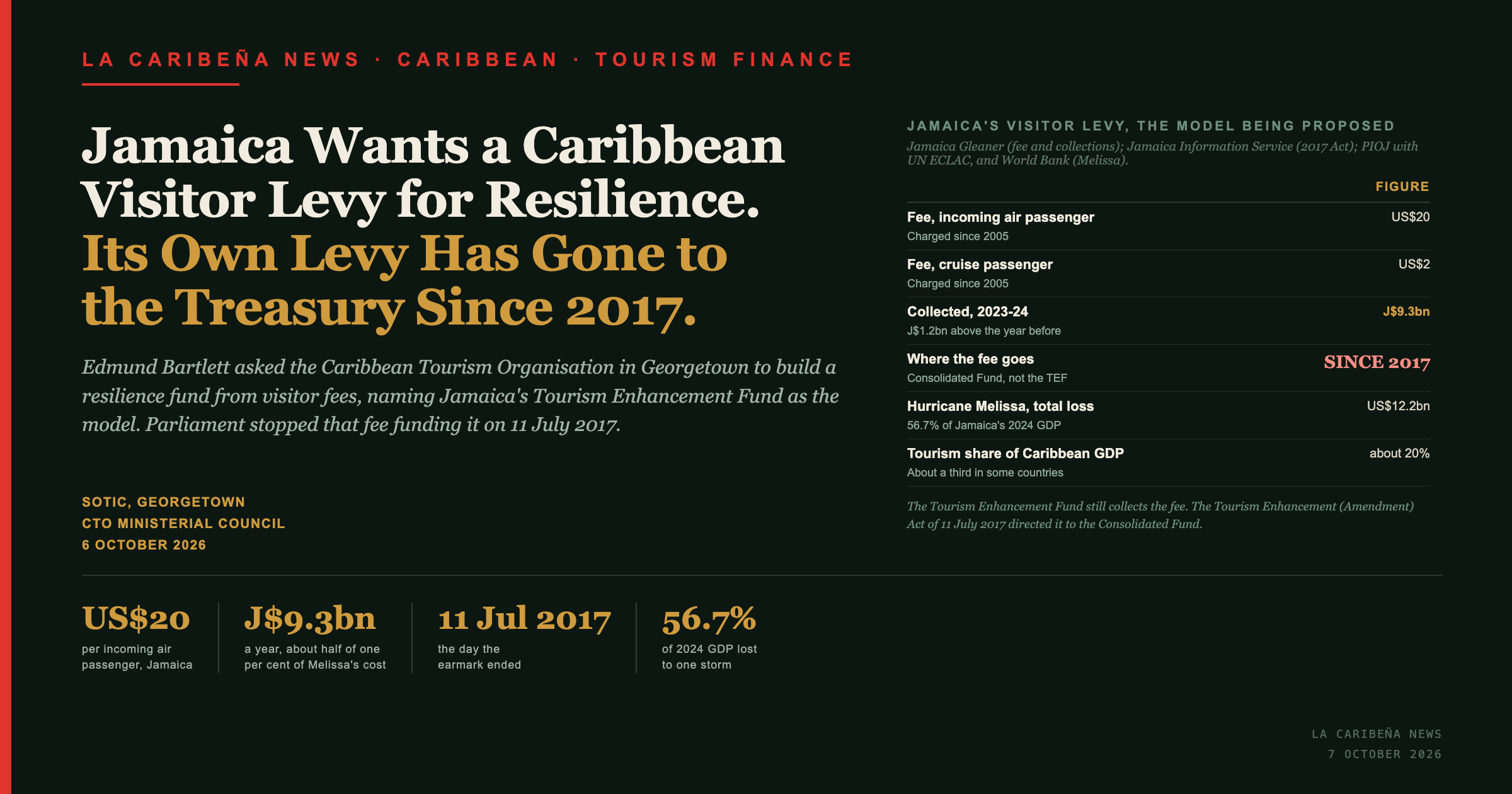
The Tourism Enhancement Fee is US$20 on an incoming airline passenger and US$2 on a cruise passenger. In the 2023 to 2024 financial year it was projected to collect J$9.3 billion, about US$58 million at roughly J$160 to the United States dollar, and J$1.2 billion more than the year before.
That is the test of "a few dollars multiplied across millions of visitors". One country, and the region's largest stopover market, produces tens of millions rather than hundreds. Bartlett's figure needs the whole region, which is precisely what he is asking for.
The quotation worth setting beside this week's speech is his own, from 2023: the fund "is now projected to bring $9.3 billion to our revenue".
What happened to Jamaica's own tourism fund?
Parliament stopped the fee funding it, nine years ago.
The Tourism Enhancement Fund began operations in 2005, financed directly by the fee. On 11 July 2017 the House of Representatives passed the Tourism Enhancement (Amendment) Act, together with amendments covering the Jamaica Civil Aviation Authority and the CHASE Fund, directing their money into the Consolidated Fund. The TEF became a budget-funded entity. It still collects the fee. It no longer keeps it.
The reason given was not a tourism argument. Minister of Finance Audley Shaw told the House it was "important to ensure a degree of predictability of funding of the Government's programmes and activities and improve its ability to prioritise and allocate the resources to meet the country's needs."
He put the objection to earmarking more plainly still.
You have one Government and you can't have a dispersal of funds and some of them build surpluses while Government has to come to Parliament imposing new taxes.
The Gleaner reported in May 2017 that the move was a structural benchmark under Jamaica's standby agreement with the International Monetary Fund, which required legislation directing all earmarked TEF revenue to the Consolidated Fund.
So the instrument being offered to the region as a model was dismantled at home, by a finance ministry, for reasons that apply to any earmarked fund anywhere.
Why is the money being asked for now?
Because of what one storm cost one member state.
Total loss and damage from Hurricane Melissa in Jamaica is assessed at J$1.952 trillion, about US$12.2 billion, equal to 56.7 per cent of Jamaica's 2024 gross domestic product, in a damage and loss assessment prepared by the United Nations Economic Commission for Latin America and the Caribbean with the Government and published by the Planning Institute of Jamaica.
That figure supersedes an earlier joint estimate from the Inter-American Development Bank and the World Bank, which put physical damage alone at US$8.8 billion, 41 per cent of 2024 GDP. The two measure different things: one counts what was destroyed, the other adds the income not earned afterwards.
Against that, the IDB's sector lead specialist Roberto Duran-Fernandez told the conference tourism is about 20 per cent of Caribbean gross domestic product, and about a third in some countries. A region that depends on tourism for a fifth of its output lost more than half of one member's annual output in a single storm.
A year of Jamaica's entire tourism fee, at J$9.3 billion, is about half of one per cent of what Melissa cost it.
What has not been answered?
The fee level, the administrator, and whether the money would stay where it is put.
The first two are ordinary gaps in a speech and will be filled if the proposal advances. The third is the one Jamaica's own record puts on the table, and no finance ministry in the region will sign up without an answer to it. An earmarked regional fund faces exactly the pressure that ended Jamaica's earmark: a treasury under strain, a pool of money accumulating outside the budget, and a minister explaining why taxes must rise elsewhere while a fund builds a surplus.
Bartlett is proposing to do regionally what his own government stopped doing nationally. That is not a reason the proposal is wrong. It is the first question it has to answer.
What the title card shows
Every data point on the article's title card, in text.
* US$20 and US$2. Jamaica's Tourism Enhancement Fee on an incoming airline passenger and on a cruise passenger. Source: Jamaica Gleaner, 25 November 2023. * J$9.3 billion. Projected Tourism Enhancement Fee collections for the 2023 to 2024 financial year, J$1.2 billion above the year before. Source: as above, quoting Minister Bartlett. * 11 July 2017. The day the House of Representatives passed the Tourism Enhancement (Amendment) Act, directing the fee into the Consolidated Fund. Source: Jamaica Information Service. * US$12.2 billion. Total loss and damage from Hurricane Melissa in Jamaica, J$1.952 trillion, assessed by the United Nations Economic Commission for Latin America and the Caribbean with the Government and published by the Planning Institute of Jamaica. * 56.7 per cent. That total as a share of Jamaica's 2024 gross domestic product. Source: as above. * US$8.8 billion. The earlier Inter-American Development Bank and World Bank estimate of physical damage alone, 41 per cent of 2024 gross domestic product. Source: World Bank press release, 19 November 2025. * 20 per cent. Tourism's share of Caribbean gross domestic product, about a third in some countries, per the Inter-American Development Bank's Roberto Duran-Fernandez at the conference. * Six. The financing areas named for the proposed fund.
Frequently Asked Questions
What is the Caribbean Tourism Resilience Fund?
A fund proposed by Jamaica's Tourism Minister Edmund Bartlett at the Caribbean Tourism Organisation Ministerial Council in Georgetown on 6 October 2026, to be financed by a contribution linked to visitor activity and spent across six areas including resilient infrastructure, post-disaster liquidity and tourism worker protection. No fee level or administering body has been named.
How much does Jamaica's tourism fee collect?
US$20 from each incoming airline passenger and US$2 from each cruise passenger, projected at J$9.3 billion in the 2023 to 2024 financial year.
Does Jamaica's Tourism Enhancement Fund still receive that fee?
No. Since the Tourism Enhancement (Amendment) Act passed on 11 July 2017, the fee is paid into the Consolidated Fund and the Tourism Enhancement Fund is financed through the national budget. It still collects the fee but does not keep it.
How much did Hurricane Melissa cost Jamaica?
Total loss and damage is assessed at J$1.952 trillion, about US$12.2 billion, or 56.7 per cent of 2024 gross domestic product. An earlier Inter-American Development Bank and World Bank estimate put physical damage alone at US$8.8 billion, 41 per cent of gross domestic product.
Why does the 2017 change matter to the regional proposal?
Because the fund Bartlett named as his model no longer works the way the proposal describes. Jamaica's finance ministry ended the earmark on the stated ground that funds accumulating outside the budget are hard to justify while taxes rise elsewhere, an argument that would apply to a regional fund too.