By LCN Business Desk
Cuba received 419,863 international tourists between January and July 2026, just 37.2 per cent of arrivals over the same stretch of 2025, according to figures from the National Office of Statistics and Information cited by OnCubaNews, which drew on EFE and Prensa Latina. CNN en Español reported the same collapse in round terms: about 419,000 visitors so far in 2026, against 1.1 million a year earlier.
Only 32,272 visitors arrived in July, up slightly from 28,100 in June. Canada sent 127,645 travellers, the United States 37,351, Russia 21,374 and Mexico 19,828. The Cuban community abroad, long the sector's most dependable source, cut its visits from 140,546 to 88,525.
Three weeks after those figures were reported, the Caribbean Tourism Organization's State of the Tourism Industry Conference opens in Georgetown on 5 October and runs to the 9th at Pegasus Corporate Suites, bringing hundreds of the region's tourism leaders to Guyana.
What is actually squeezing Cuban tourism?
CNN en Español reported that President Donald Trump imposed a sweeping energy embargo on the island in January, compounding a crisis already fed by earlier United States sanctions and a failed domestic financial reform that triggered inflation. Between May and July, the outlet reported, the State Department announced measures striking the heart of the tourism industry, from frozen accounts to bans on operating in the United States financial system.
Meliá, Iberostar and Royalton suspended their contracts.
DW Español reported that supply shortages, power cuts and general economic decline are compounding the pressure, with newer measures penalising foreign nationals and firms doing business with sanctioned Cuban entities. 14ymedio reported that a Cuban sandwich shop in Ireland became a casualty of the same regime.
What did OFAC add in September?
The United States Treasury sanctioned a grandson of former Cuban president Raúl Castro along with state-owned entities, Reuters and Infobae reported. Infobae reported that the Office of Foreign Assets Control blacklisted him together with the Havana-based Banco Exterior de Cuba, Comercial Cupet, and the state firms Nicarotec, Abapet and Cexni, which it described as specialising in technical services, energy infrastructure equipment, and the import of raw materials or machinery for nickel and cobalt processing.
OnCubaNews and EFE reported that the sanctioned grandson is a son of Alejandro Castro Espín, himself a son of Raúl Castro and Cuba's intelligence director, whom Washington had previously sanctioned, and that OFAC designated the grandson on the basis of that family tie. Secretary of State Marco Rubio said the designations reflect President Trump's "unwavering vision of a free Cuba."
EFE and OnCubaNews reported that the Banco Exterior de Cuba is a state financial entity focused on foreign trade and international transactions. A bank that exists to settle a country's foreign trade is not a peripheral target.
Why does this matter to a room in Georgetown?
Because the mechanism is the one this newspaper set out this week in the Petro case, and Cuba is that mechanism applied to an entire industry.
Meliá is Spanish. Iberostar is Spanish. None of the three chains that walked away is American, and Cuba's designation list does not name them. They suspended contracts because they carry United States exposure of their own, in operations, assets or payment routing, exactly as Avianca did when it cancelled a former Colombian president's ticket. A designation attaches to named persons and entities. The obligation to screen travels through each company's own American footprint.
For a hotel group, a destination management company, a tour operator or an airline sitting in Georgetown next month, that is not a Cuban question. It is a question about their own banking relationships, their own affiliates and where their card settlement runs, and this newspaper has reported the same de-risking pressure across Caribbean banking and the distinction that a designation is not a conviction.
The compliance question is not abstract for the host either. Guyana is building a tourism industry from a low base, and the Lima compliance congress put the region's financial-integrity obligations on the same table.
What happens to the visitors who did not go?
On the figures reported, roughly 680,000 fewer people travelled to Cuba in seven months than in the same seven months a year before. Where that demand went, or whether it travelled at all, is not established in the reporting consulted. Canada alone still sent Cuba 127,645 travellers, more than three times the United States figure.
Guyana is not a beach destination and does not compete for the same visitor. The relevance runs the other way. The region's tourism leaders are meeting in a country whose own arrivals story is written in oil, business travel and diaspora return, at the moment the Caribbean's largest sun-and-sand destination has lost two thirds of its market to an instrument no ministry of tourism controls.
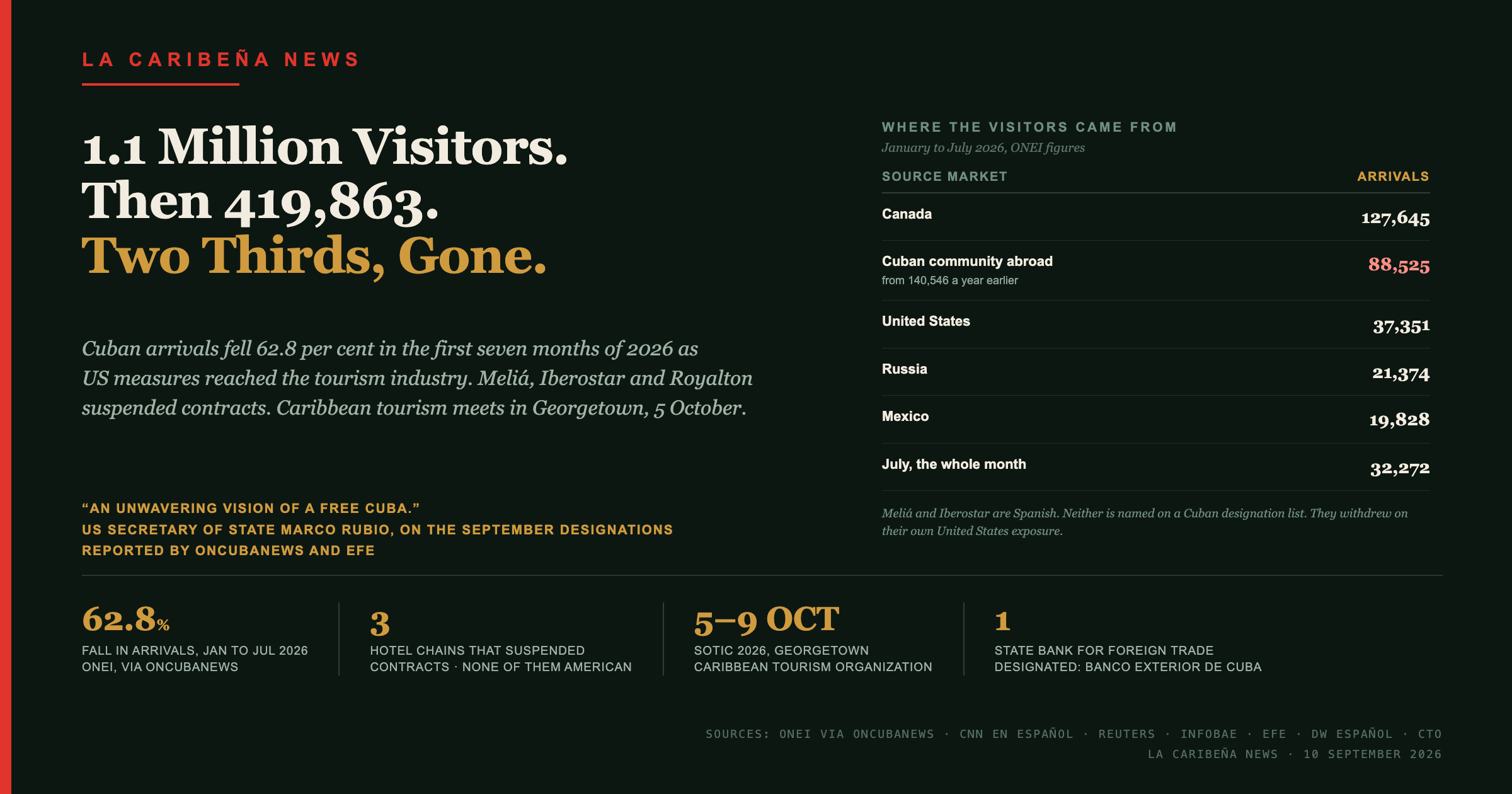
What does the title card show?
The title card carries a source-market table headed "Where the visitors came from", for January to July 2026, on ONEI figures reported by OnCubaNews.
- Canada 127,645 arrivals.
- Cuban community abroad 88,525, down from 140,546 a year earlier.
- United States 37,351. Russia 21,374. Mexico 19,828.
- July, the whole month, 32,272 arrivals.
- 62.8 per cent, the fall in arrivals January to July 2026. Source: ONEI via OnCubaNews.
- Three hotel chains suspended contracts, none of them American: Meliá, Iberostar and Royalton. Source: CNN en Español.
- 5 to 9 October, SOTIC 2026 in Georgetown, the Caribbean Tourism Organization's State of the Tourism Industry Conference.
- One state bank for foreign trade designated, the Banco Exterior de Cuba. Source: Infobae.
- Quoted on the card: "an unwavering vision of a free Cuba", US Secretary of State Marco Rubio on the September designations, reported by OnCubaNews and EFE.
- Noted on the card: Meliá and Iberostar are Spanish, neither is named on a Cuban designation list, and they withdrew on their own United States exposure.
Frequently Asked Questions
How far have Cuban arrivals fallen?
OnCubaNews reported ONEI figures of 419,863 international tourists between January and July 2026, 37.2 per cent of the same period in 2025, a fall of 62.8 per cent. CNN en Español reported about 419,000 against 1.1 million a year earlier.
Which hotel chains withdrew?
CNN en Español reported that Meliá, Iberostar and Royalton suspended their contracts, following State Department measures between May and July targeting the tourism industry.
Who and what did OFAC designate in September?
Reuters and Infobae reported the designation of a grandson of Raúl Castro. Infobae reported that OFAC also blacklisted the Banco Exterior de Cuba, Comercial Cupet, Nicarotec, Abapet and Cexni.
Does this mean companies cannot deal with Cuba at all?
The designations name specific persons and entities and block dealings with them. The practical constraint on any given company runs through that company's own United States exposure, which is why non-American hotel chains withdrew.
When and where is SOTIC 2026?
The Caribbean Tourism Organization's State of the Tourism Industry Conference runs in Georgetown, Guyana, from 5 to 9 October 2026, at Pegasus Corporate Suites.
Cuba's tourism ministry can change its marketing, its prices and its airlift. It cannot change the list. Three chains that are not American read their own exposure and left, and 419,863 arrivals is what the island has to show for the first seven months of the year.