By LCN Business Desk
President Irfaan Ali announced on Monday that Guyana's economy grew by an estimated 33.3 per cent in the first half of 2026. "The non oil economy grew by an estimated 10.1 percent," he said at the Office of the President, the Department of Public Information reported.
The Mid-Year Report 2026 published by the Ministry of Finance carries the detail behind both numbers. Its own tables show the full-year forecast for the whole economy raised, and the forecast for the economy outside oil lowered.
What drove the 33.3 per cent?
A full half-year of four oil vessels, measured against a weak first half in 2025.
The report attributes the outturn largely to "the first full six-month period in which four Floating Production, Storage, and Offloading vessels (FPSOs) operated simultaneously in the Stabroek Block," after the One Guyana vessel began producing in August 2025. Oil production averaged about 902,000 barrels a day, against about 639,000 a year earlier, and the oil and gas subsector grew 41.3 per cent.
The comparison flatters the figure. In the first half of 2025, before One Guyana started, the economy grew 7.5 per cent, according to the report's growth table. Growth of 33.3 per cent this year is measured against that base.
For the whole of 2026, overall growth is now projected at 20.8 per cent, up from the 16.2 per cent in Budget 2026. Oil and gas is projected to grow 24.2 per cent for the year.
How much of the economy is oil?
Nearly four-fifths of it, and the share is still rising.
The report's table of sector shares, sourced to the Bureau of Statistics, shows petroleum and gas accounting for 78.9 per cent of real GDP in the first half of 2026.
| Share of real GDP, first half | 2023 | 2024 | 2025 | 2026 |
|---|---|---|---|---|
| Petroleum and gas | 68.1% | 75.9% | 74.4% | 78.9% |
| Services | 13.2% | 9.5% | 9.6% | 7.7% |
| Agriculture, forestry and fishing | 7.7% | 5.6% | 5.7% | 4.3% |
| Construction | 3.8% | 3.6% | 4.4% | 4.1% |
| Manufacturing | 1.7% | 1.4% | 1.7% | 1.3% |
| Gold | 2.1% | 1.3% | 1.3% | 1.1% |
*Source: Ministry of Finance, Mid-Year Report 2026, Appendix A2, citing the Bureau of Statistics.*
A shrinking share does not mean a shrinking sector. Services grew 7.2 per cent in the first half. Its share fell because oil grew faster.
How did the rest of the economy do?
It grew at 10.1 per cent, slower than a year earlier and slower than the Budget assumed.
Non-oil growth in the first half of 2025 was 14.0 per cent. For the full year, Budget 2026 projected non-oil growth of 10.8 per cent. The Mid-Year Report revises that to 10.2 per cent.
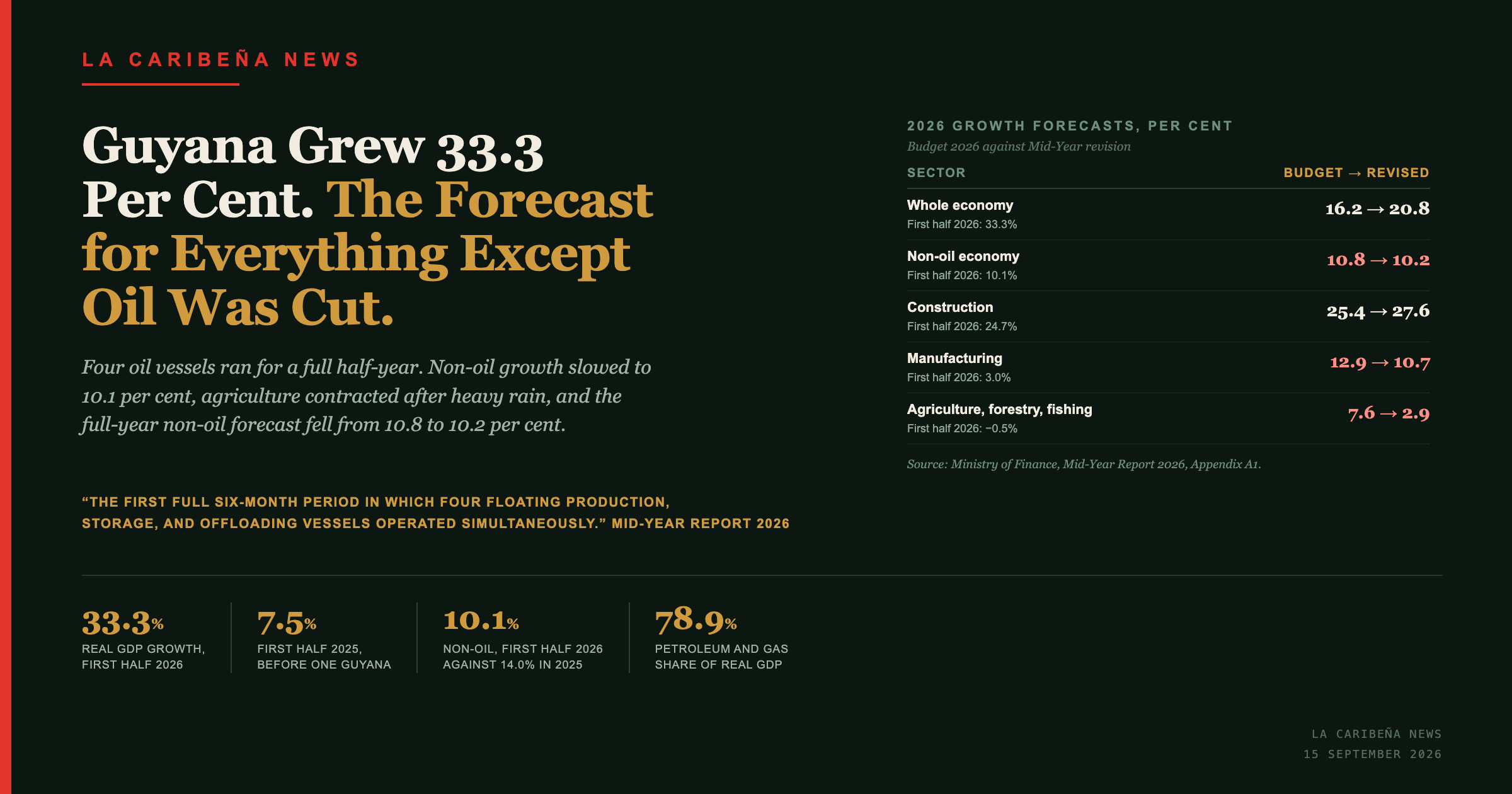
| Sector | Budget 2026 forecast | First half 2026 | Revised 2026 forecast |
|---|---|---|---|
| Whole economy | 16.2% | 33.3% | 20.8% |
| Non-oil economy | 10.8% | 10.1% | 10.2% |
| Construction | 25.4% | 24.7% | 27.6% |
| Other mining and quarrying | 10.3% | 40.0% | 14.9% |
| Services | 6.8% | 7.2% | 7.7% |
| Gold | 5.4% | 11.3% | 5.4% |
| Manufacturing | 12.9% | 3.0% | 10.7% |
| Agriculture, forestry and fishing | 7.6% | -0.5% | 2.9% |
*Source: Ministry of Finance, Mid-Year Report 2026, Appendix A1.*
Construction led, at 24.7 per cent, which the report ties to the Public Sector Investment Programme and private investment. Sand declarations rose 61.7 per cent on the back of that building. Within services, transport and storage grew 14.2 per cent, financial and insurance activities 12.7 per cent, and wholesale and retail trade 10.9 per cent.
Agriculture contracted 0.5 per cent against a Budget forecast of 7.6 per cent. The report attributes this to "sustained above-normal rainfall" that "disrupted planting cycles, damaged crops, and constrained field access." Other crops fell 6.4 per cent, with vegetables down 4.2 per cent and spices down 17.7 per cent, while sugar, rice, livestock, forestry and fishing grew.
Manufacturing grew 3.0 per cent in the first half against a Budget forecast of 12.9 per cent. The revised full-year forecast of 10.7 per cent assumes a far stronger second half. Rice manufacturing fell 2.7 per cent.
The International Monetary Fund projects non-oil growth averaging about 7 per cent a year over the next five years, this newspaper reported from its July Article IV statement.
Where did the oil money go?
Into the Natural Resource Fund, and out of the country as the partners' share and cost recovery.
The Government received US$1,778.6 million as its share of profit oil between January and June, and US$218.4 million in royalties, according to the report. After withdrawals of US$1,020 million, the Natural Resource Fund held US$4,294.2 million at the end of June.
The balance of payments shows the other side. Crude oil export earnings rose 82.1 per cent to US$15,053.7 million in the first half. Net payments for factor services rose to US$4,737.1 million, which the report attributes to "higher repatriated earnings from the Stabroek Block coventurers' share of profit oil." Net foreign direct investment recorded a deficit of US$2,994.4 million, reflecting "an increase in cost recovery from the Stabroek Block." How the cost bank is recovered was the subject of this newspaper's report in August.
What did it mean for prices?
Food drove prices up faster than in the rest of the basket.
Consumer prices rose 4.4 per cent between the end of 2025 and the end of June 2026, the report says. Food prices rose 6.7 per cent and contributed 3.4 percentage points of that increase, with vegetables alone accounting for 2.5 points. The 12-month inflation rate in June was 4 per cent, against 4.2 per cent in June 2025.
The report connects part of the food increase to "unfavourable weather conditions," the same rainfall behind the contraction in agriculture.
What happens in the second half?
More oil, and a weather risk to farming.
The report expects further output from One Guyana and first oil from the fifth vessel, Errea Wittu, in the final quarter. It warns that anticipated El Niño conditions "pose downside risks to agricultural output, particularly non-traditional crops," which would hit crops just as they recover from flooding. Mining is expected to recover as pits dry out.
What the title card shows
- 33.3%: real GDP growth, first half of 2026. 7.5%: first half of 2025. Source: Mid-Year Report 2026, Appendix A1.
- 10.1%: non-oil growth, first half of 2026, against 14.0% in the first half of 2025.
- Full-year forecasts: whole economy 16.2% at Budget, revised to 20.8%; non-oil 10.8% at Budget, revised to 10.2%.
- 78.9%: petroleum and gas share of real GDP, first half of 2026 (68.1% in 2023). Source: Appendix A2, Bureau of Statistics.
- Agriculture -0.5% and manufacturing 3.0% in the first half, against Budget forecasts of 7.6% and 12.9%.
- US$4,294.2 million: Natural Resource Fund balance at end-June 2026.
Frequently Asked Questions
How fast did Guyana's economy grow in the first half of 2026?
Real GDP grew by an estimated 33.3 per cent, according to the Ministry of Finance's Mid-Year Report 2026. The non-oil economy grew by an estimated 10.1 per cent. In the first half of 2025, overall growth was 7.5 per cent and non-oil growth 14.0 per cent.
Why was growth so high?
The report attributes it largely to the first full six months with four oil production vessels operating in the Stabroek Block, after One Guyana began producing in August 2025. Oil production averaged about 902,000 barrels a day, against about 639,000 a year earlier.
What is Guyana's growth forecast for 2026?
The Mid-Year Report projects real GDP growth of 20.8 per cent, up from 16.2 per cent in Budget 2026, and non-oil growth of 10.2 per cent, down from the Budget's 10.8 per cent.
How much of Guyana's economy is oil?
Petroleum and gas accounted for 78.9 per cent of real GDP in the first half of 2026, up from 68.1 per cent in the first half of 2023, according to the report's sector shares table.
Which sectors underperformed?
Agriculture, forestry and fishing contracted 0.5 per cent against a Budget forecast of 7.6 per cent, after heavy rainfall, and manufacturing grew 3.0 per cent against a forecast of 12.9 per cent.