By LCN Business Desk
A Mexican haulier with more than 250 million pesos of annual income has fourteen months to re-cost its toll bill.
What changes for a Mexican haulage firm in 2027?
The income ceiling for deducting tolls twice.
The scheme lets a haulage firm treat toll payments as an operating expense and additionally credit them against income tax. Access is governed by an annual income ceiling, and the ceiling is being lowered.
| The toll deduction | |
|---|---|
| Created | 2002, with no limit |
| First capped | 2019, at 300 million pesos |
| Proposed for 2027 | Ceiling cut to 250 million pesos |
| Firms using the scheme | 2,580 |
| Firms losing the full benefit | 170 |
| Users unaffected | 94 per cent, including hombre camión operators |
Source: the Secretaría de Hacienda y Crédito Público, 26 October 2026.
Hombre camión operators, Mexico's owner-drivers running a single truck, are inside the 94 per cent the ministry says keeps access. The diesel fuel-duty deduction is untouched, and fiscal benefits to the sector reached 115,000 million pesos in 2025. Finance Minister Édgar Amador Zamora, who set out the change, is the same minister who delivered the 2027 Economic Package to Congress on 8 September creating no new taxes. A narrowed relief is not a new tax, which is how both statements stand together, and it is the second time the ceiling has moved in seven years.
What does the change cost the firms it reaches?
About 26.5 million pesos a year each, on the ministry's own figures.
The benefit costs the treasury 13,900 million pesos in 2026, and Hacienda projects 4,500 million pesos of additional revenue in 2027 from the lower ceiling. Divided across the 170 firms, that is roughly 26.5 million pesos apiece. Set against the scheme's total cost, the relief being withdrawn from 6 per cent of users is worth close to 32 per cent of what the whole scheme costs. Both figures are La Caribeña News calculations from the two the ministry published on the same morning.
The ceiling is not a charge on hauliers generally. It reaches a group small enough to count individually and heavy enough that the scheme's cost falls by roughly a third when they come out of it.
What did the stoppage do to freight movement?
It reached 19 states and shut one motorway for most of a day.
| What Segob counted, 26 October | |
|---|---|
| States with mobilisations | 19 |
| Protest points | 38 |
| Vehicles | 691 |
| People | 858 |
Source: the Secretaría de Gobernación, reported by La Jornada and El Economista.
Veracruz carried the most points at eight, XEVT reported, ahead of the Estado de México at six and Nuevo León and Tlaxcala at three each, with a total blockade at Tlaxco in Tlaxcala and partial closures elsewhere in that state and in Veracruz. El Universal reported that the México-Pachuca motorway was liberated after 14 hours, and that at the Ecatepec toll plaza on that route truckers parked their units and hung banners without closing the road.
Organisers had called for as many as one million units. Segob counted 691, so the disruption was concentrated rather than general, and a shipper's exposure depended on which of the 38 points sat on its route.
Sector organisations put possible losses at up to 21,500 million pesos for each day the stoppage continued. The entire toll benefit costs the treasury less across a year than that estimate puts at risk in a single day.
What is already in the sector's cost base?
Cargo theft, driver deaths and road condition, by the organisers' own count.
El Universal reported that the organisations convoking the stoppage cited 1,125 robberies against cargo transport, the killing of 15 operators so far in 2026, and the deterioration of up to 80 per cent of the roads.
Those three sit on the same profit-and-loss account as the toll relief. Cargo theft prices insurance and writes off loads, driver deaths price recruitment in a trade already short of operators, and road condition prices tyres, suspension and fuel burn. A firm above the new ceiling meets all three and loses the deduction as well.
Who is at the table with Hacienda?
Three transport bodies, and not the one that struck.
CANACAR, the Cámara Nacional del Autotransporte de Carga, headed by Augusto Ramos Melo, called the stoppage and asked for the reduction to be reconsidered, warning of higher operating costs.
Sistema Mexiquense reported that CANAPAT, CONATRAM and ANTP, all within the industrial chambers confederation CONCAMIN, agreed to privilege dialogue with the federal government after meeting on the Monday, and asked for fiscal incentives and operating conditions to be reviewed. A working agenda was set for that week at federal and state level with Hacienda present. President Claudia Sheinbaum confirmed the sector had been offered a meeting with the finance ministry at 11:00 that morning.
For a counterparty with freight on Mexican roads, that is the operational read: the negotiation runs through CONCAMIN's transport members and the finance ministry, and the chamber that called the stoppage is outside it.
Why does this matter to a Caribbean shipper?
Because the corridor is Mexican and the instrument is regional.
A stoppage at 38 points on Mexican highways is a routing problem before it is anything else, and the same instrument has already moved a price in the isthmus this quarter. Guatemala's Congress capped fuel at Q39 a gallon eight days after truckers blockaded highways nationwide and sealed the routes toward Mexico and El Salvador.
Mexico's stoppage ran one day, produced a working agenda with three of the four bodies involved, and left the ceiling proposal where it was. The two outcomes, eight weeks apart on the same corridor, are the range to plan against.
What is settled, and what is not?
The measure, the count and the negotiating line-up are settled. The outcome is not.
The threshold change, the 2,580 users and the 170 affected are the finance ministry's own account of its own policy, given publicly. Segob's figures for the day are the interior ministry's own. CANACAR's call and the three other bodies' position are each reported by named outlets.
Not established: whether the 250 million peso ceiling survives the legislative process; what the working agenda with Hacienda produced after the first meeting; and whether the 21,500 million peso daily figure rests on any published method, since it is an estimate of a stoppage that did not continue. On the public record there is no stenographic transcript of the 26 October morning conference, so the President's confirmation of the meeting is as reported.
The relief was created in 2002 with no ceiling at all. It has been narrowed twice since, and a firm planning past 2027 is planning against a third.
The entities
- Secretaría de Hacienda y Crédito Público is Mexico's finance ministry, which proposed the lower ceiling, and whose minister is Édgar Amador Zamora.
- Secretaría de Gobernación (Segob) is Mexico's interior ministry, which counted the protest.
- Claudia Sheinbaum is President of Mexico, who confirmed the meeting offered to the sector on 26 October 2026.
- Cámara Nacional del Autotransporte de Carga (CANACAR) is the cargo haulage chamber that called the stoppage, headed by Augusto Ramos Melo.
- CANAPAT is the national chamber of passenger and tourism road transport, CONATRAM the national confederation of Mexican transporters, and ANTP the national private transport association, the three bodies that set a working agenda with the government.
- Confederación de Cámaras Industriales (CONCAMIN) is the industrial chambers confederation within which those three sit.
- Hombre camión is Mexico's term for an owner-operator running a single truck, a category the ministry says keeps access to the deduction unchanged.
What the title card shows
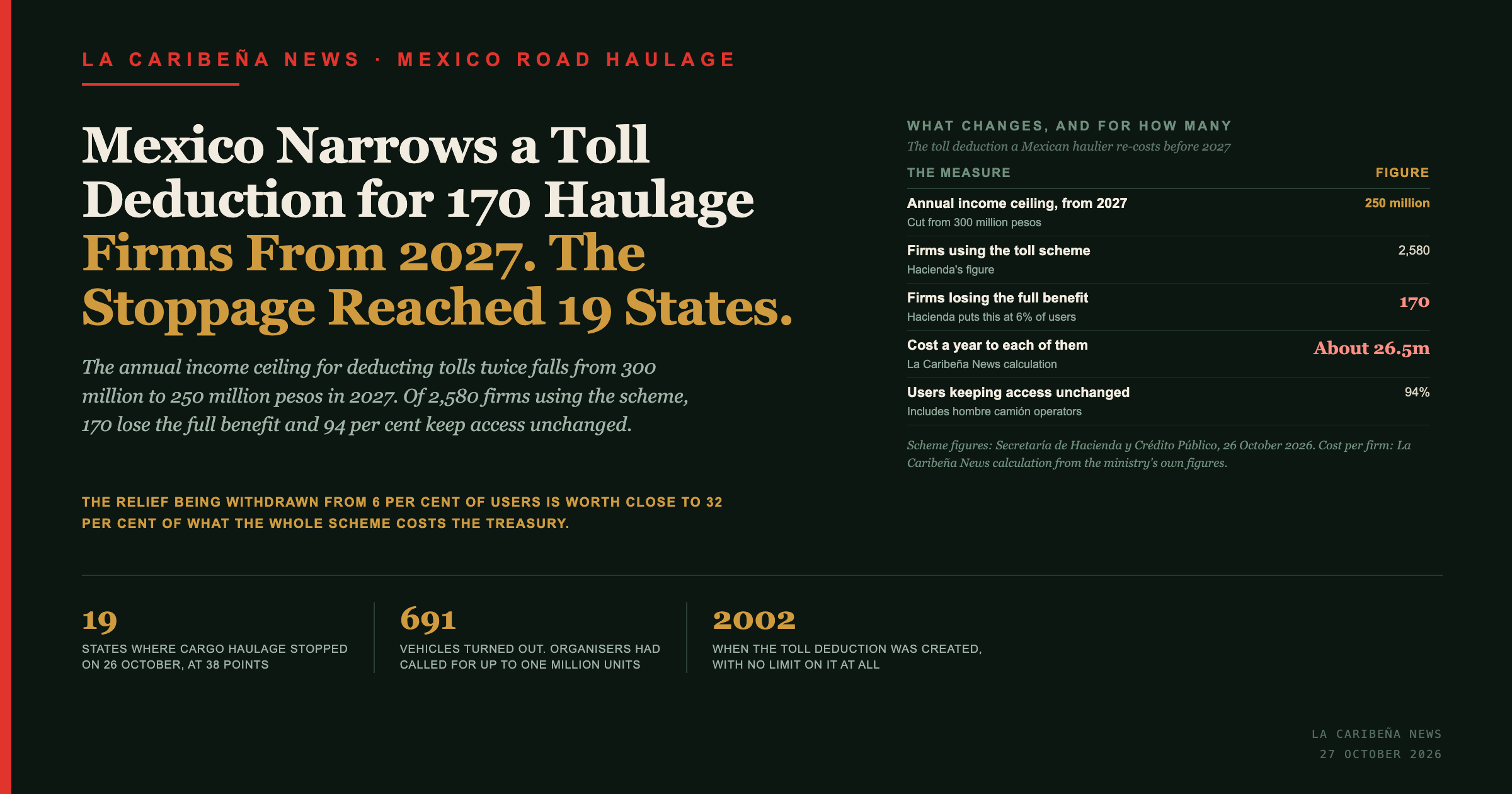
Every data point on the article's title card, in text.
- 300 to 250 million pesos. The annual income ceiling, before and after. Source: the Secretaría de Hacienda y Crédito Público.
- 170 of 2,580. Firms losing the full toll benefit, out of those using the scheme. Source: as above.
- 94 per cent. Share of users keeping access unchanged, including hombre camión operators. Source: as above.
- About 26.5 million pesos. Annual cost to each affected firm. Source: La Caribeña News calculation from the ministry's figures.
- 19. States with mobilisations on 26 October 2026. Source: Segob.
- 691. Vehicles taking part, where organisers had called for up to one million units. Source: Segob, and El Universal for the call.
Frequently Asked Questions
What is changing in Mexico's toll deduction for hauliers?
The annual income ceiling for access falls from 300 million to 250 million pesos for 2027. The scheme lets a haulage firm deduct toll payments as an operating expense and additionally credit them against income tax. The diesel fuel-duty deduction is not affected.
How many haulage companies does the change affect?
Of 2,580 companies using the scheme, 170 stop receiving the full benefit in 2027, which the finance ministry puts at 6 per cent of users. It says 94 per cent of contributors keep access unchanged, including those taxing as hombre camión.
What does it cost an affected firm?
Hacienda projects 4,500 million pesos of additional revenue in 2027 from the lower ceiling. Spread across the 170 firms, that is roughly 26.5 million pesos each a year, on a La Caribeña News calculation. The benefit costs the treasury 13,900 million pesos in 2026, so the relief being withdrawn is worth close to 32 per cent of the scheme's total cost.
How much freight disruption did the stoppage cause?
The Secretaría de Gobernación counted mobilisations in 19 states at 38 protest points, involving 691 vehicles and 858 people. Veracruz had the most points at eight. A total blockade was reported at Tlaxco, Tlaxcala, and the México-Pachuca motorway was liberated after 14 hours. Organisers had called for up to one million units.
Who is negotiating with the government?
CANAPAT, CONATRAM and ANTP, three transport bodies within CONCAMIN, set a working agenda with the federal government at federal and state level with Hacienda present. CANACAR, which called the stoppage, asked for the ceiling reduction to be reconsidered.