By LCN Business Desk
A bank in Georgetown or Kingston that wants a United States dollar correspondent account is assessed under a single federal regulation. It must document its business and the markets it serves, record the purpose and expected activity of the account, produce an assessment of its home supervisor rather than that supervisor's name, and hand over what is known of its own anti-money laundering record. The account is then reviewed periodically to check that what moves through it matches what was declared.
The regulation is 31 C.F.R. 1010.610, and it is not a Caribbean standard. It applies to every foreign financial institution for which a United States bank maintains a correspondent account.
Including the bank's own foreign branches.
What exactly does the rule require?
Three obligations, and five factors inside the second one.
The consent order published on 13 October 2026 recites the regulation before applying it. A covered institution must (i) determine whether the correspondent account is subject to enhanced due diligence; (ii) assess the money laundering risk the account presents, considering all relevant factors; and (iii) apply risk-based procedures to detect and report suspected money laundering, "including a periodic review of the correspondent account activity sufficient to determine consistency with information obtained about the type, purpose, and anticipated activity of the account."
The five factors named under the second obligation:
| The regulation's factor | What it asks to be documented |
|---|---|
| (a) | the nature of the foreign financial institution's business and the markets it serves |
| (b) | the type, purpose and anticipated activity of the correspondent account |
| (c) | the nature and duration of the relationship with that institution and its affiliates |
| (d) | the anti-money laundering and supervisory regime of the jurisdiction that chartered it, and of the jurisdiction of any corporate owner |
| (e) | information known or reasonably available about that institution's anti-money laundering record |
Source: 31 C.F.R. 1010.610(a), as recited in the FinCEN consent order of 13 October 2026. The statutory authority is 31 U.S.C. 5318(i).
So what did the bank apply to its own branches?
A policy it called "simplified", imposing what the order quotes as "reduced requirements".
The Financial Crimes Enforcement Network (FinCEN) found that until late 2024 Bank of America operated a policy permitting "simplified" due diligence on the correspondent accounts it maintained for its own foreign branches and affiliates. The policy changed in December 2024. FinCEN's investigation of the issue examined twelve of those branches and affiliates.
The policy was a carve-out. A requirement is reduced from something, and the something was the bank's general correspondent due diligence standard, the one under which every unaffiliated foreign financial institution is assessed. The bank applied that general standard outside its own group and a reduced version inside it.
The order makes no finding about the due diligence the bank performed on institutions it does not own, and nothing here should be read as one. What it finds is that the reduced tier existed, that it attached to the accounts of the bank's own branches and affiliates, and that it did not satisfy the regulation.
Factor by factor, what was in the file?
General statements, a missing purpose, and on the supervisor nothing but a name.
| The regulation asks for | What the order found in the own-branch files |
|---|---|
| (a) the nature of the business and the markets served | "general statements about the nature of the foreign branch or affiliate's business and markets served, such as 'treasury services' or 'cash management'" |
| (b) the type, purpose and anticipated activity of the account | files "lack sufficient information about the anticipated activity in the correspondent account and the account's purpose" |
| (d) the supervisory regime of the chartering jurisdiction | "insufficient information about the supervisory regime applicable to the foreign branch or affiliate, such as merely providing the name of the local regulatory body" |
| (iii) periodic review of activity against what was declared | monitoring models applied to the correspondent accounts "were too narrow, failed to capture key risks, and allowed high-risk relationships to continue unchecked" |
Source: FinCEN consent order, 13 October 2026, section on due diligence programmes for correspondent accounts. The monitoring finding comes from a third-party review of the bank's anti-money laundering programme conducted in 2025.
Beyond those, the order says the files "often consisted of information irrelevant to the Bank's ability to detect and report, on an ongoing basis, suspicious activity conducted through or involving the correspondent accounts."
The example the order gives is graphs depicting the price of the bank's own parent holding company's publicly traded stock.
What about the questionnaire?
A respondent institution completes one for itself. Some of the bank's were completed in bulk.
Two other categories of material existed and the order finds neither closed the gap. The foreign branch risk assessments were "generally several years old", were framed as documents for the local management of those branches to manage their own risks, and did not explicitly discuss the correspondent accounts, their expected activity or the purpose of maintaining them.
Then the questionnaires. The order says the bank obtained them "in a manner that did not fulfill its regulatory obligations", and gives two reasons. Some were completed by the bank on behalf of all its foreign branches and affiliates at once. Others were completed for specific branches shortly before the policy changed in December 2024.
A questionnaire is the instrument through which a correspondent interrogates a respondent, entity by entity, and the respondent answers for itself. One filled in centrally, covering every branch together, is a different document performing a different function.
Why did the bank think the reduced tier was appropriate?
Because of the client profile it attributed to its own branches.
FinCEN identifies as an apparent cause the bank's focus on the general attributes of those branches: that they were focused on serving, in the order's quotation, "large multinational corporations…large financial institutions, and institutional investors." Alongside that, the bank emphasised whether its foreign branches held accounts for non-U.S. banks, as distinct from non-bank financial institutions, and that the transactions they processed locally related primarily to "interbank settlement" and "bank-to-bank bulk flows."
A wholesale profile. Big corporates, other banks, settlement traffic.
FinCEN found the relevant branches and affiliates maintained accounts for more than 250 non-bank financial institutions, including money services businesses or their foreign equivalents. The payments associated with those customers "were inconsistent with 'bank-to-bank bulk flows' or 'interbank settlements'."
That is factor (a) of the regulation, the nature of the business and the markets served, and it was wrong.
Why does the asymmetry matter to the Caribbean?
Because the regulation is the reason given when a regional institution is turned down.
Nothing in the orders names a Caribbean country, a Caribbean bank or a Caribbean money transfer operator, and nothing in them should be read as a finding about the region. Correspondent withdrawal from Caribbean markets has its own documented history, examined in After the Jenec Ruling, the World Disagrees on What Comes Next and in A Designation Is Not a Conviction.
The cost of documenting a correspondent relationship to that standard is the stated reason a small institution is told its account is uneconomic. The category the bank got wrong inside its own group is the one remittances move through. Those flows and the institutions carrying them were examined in Caribbean Remittances.
Tighter correspondent supervision has historically been followed by correspondents carrying fewer foreign relationships rather than monitoring them better. The remediation this order imposes runs toward monitoring. Whether the institutions on the other side of those accounts experience it that way is not something the order decides.
The combined FinCEN, Office of the Comptroller of the Currency (OCC) and Office of Foreign Assets Control (OFAC) penalties exceed US$1.21 billion, as reported in the first article in this series.
Who checks the fix?
An outside consultant, with FinCEN holding a veto over the appointment.
Within 60 days of the order Bank of America must propose a qualified independent consultant, to be hired within 30 days at the bank's own expense, to test the effectiveness of its customer due diligence and of its due diligence programme for correspondent accounts maintained for foreign financial institutions, expressly including its own foreign branches and affiliates.
The test the consultant applies is the statutory one, and it is the same test a respondent institution is held to: whether the programme enables the bank to detect and report, on an ongoing basis, any known or suspected money laundering conducted through or involving any such correspondent account.
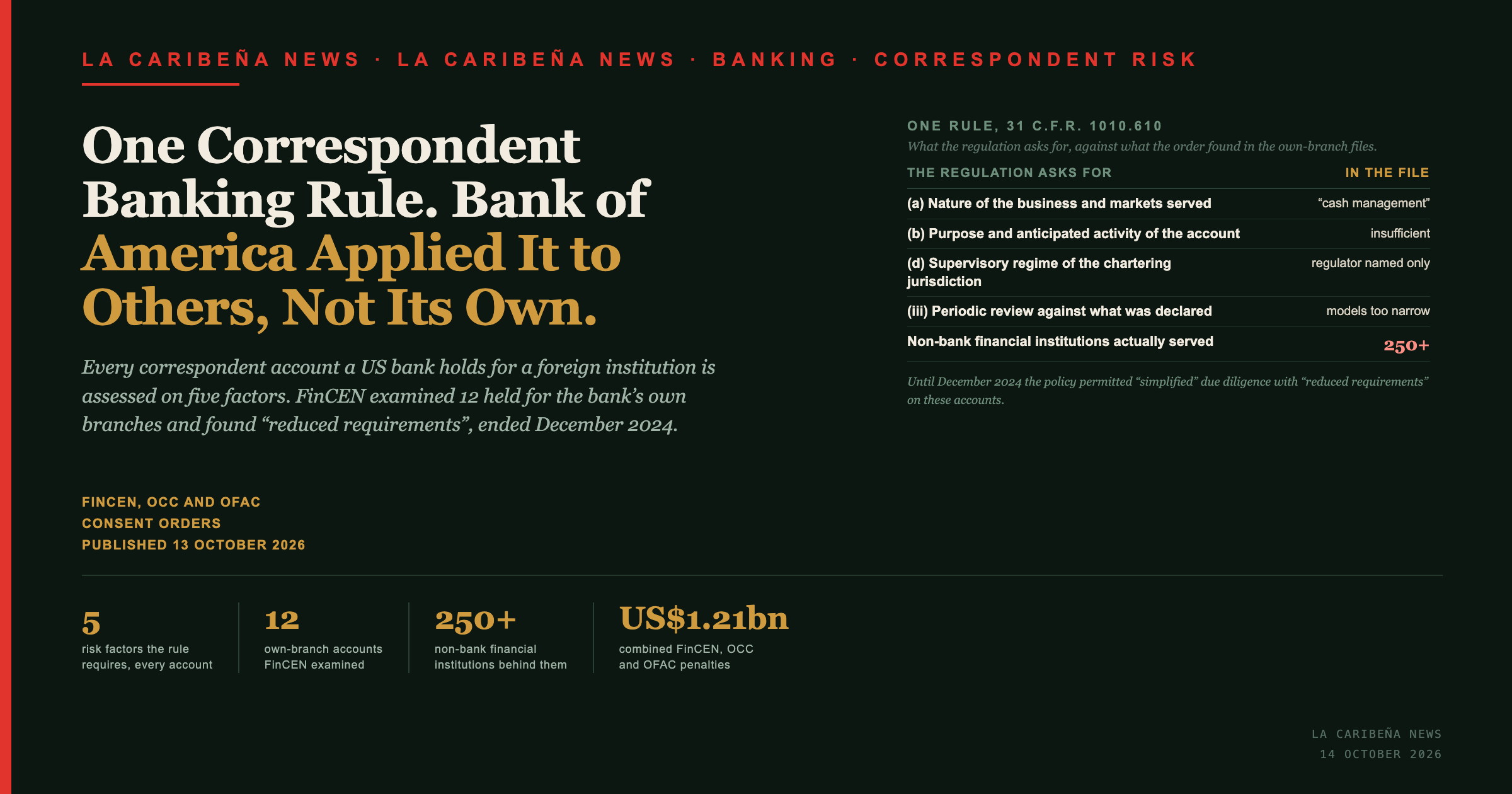
What the title card shows
Every data point on the article's title card, in text.
- 5 factors. The money laundering risk factors at 31 C.F.R. 1010.610(a) that must be considered for every correspondent account held for a foreign financial institution, inside three overall obligations.
- 12 foreign branches and affiliates. The number FinCEN's investigation of the correspondent account issue examined.
- More than 250 non-bank financial institutions. The accounts those branches and affiliates maintained, including money services businesses or their foreign equivalents, whose payments the order says were inconsistent with interbank settlement or bank-to-bank bulk flows.
- December 2024. When the bank changed the policy that had permitted "simplified" due diligence with "reduced requirements" on the correspondent accounts of its own foreign branches and affiliates.
- US$1.21 billion. The combined FinCEN, OCC and OFAC penalties announced on 13 October 2026.
Frequently Asked Questions
Is the due diligence standard different for a bank's own foreign branch?
The regulation at 31 C.F.R. 1010.610 applies to correspondent accounts maintained for a foreign financial institution, and the order applies it to Bank of America's own foreign branches and affiliates. FinCEN found the bank had a policy permitting "simplified" due diligence with "reduced requirements" on those accounts until December 2024, and found that policy did not satisfy the regulation.
What does the regulation actually require?
Three obligations: determining whether the account is subject to enhanced due diligence; assessing the money laundering risk of the account against five named factors, including the nature of the institution's business and the markets it serves, the purpose and anticipated activity of the account, the supervisory regime of the chartering jurisdiction, and the institution's anti-money laundering record; and applying risk-based procedures including periodic review of the account's activity against what was declared.
How did the own-branch files compare with those factors?
The order found the files described the branch business in general terms such as "treasury services" or "cash management", lacked sufficient information on the anticipated activity and purpose of the account, and sometimes went no further on the supervisory regime than naming the local regulator. A 2025 third-party review found the monitoring models applied to those accounts were too narrow and allowed high-risk relationships to continue unchecked.
What was wrong with the questionnaires?
The order says they were obtained in a manner that did not fulfil the regulatory obligations: some were completed by the bank on behalf of all its foreign branches and affiliates at once, and others were completed for specific branches shortly before the policy changed in December 2024.
Does the order make any finding about Caribbean banks?
No. The orders name no Caribbean country, bank or money transfer operator, and nothing in them should be read as a finding about the region. The relevance is that the regulation cited when a regional institution is refused an account is the same regulation the order finds was not satisfied at the United States end.