By LCN Wire
Migrants sent US$728.6 billion home to families in low- and middle-income countries in 2025, nearly double the figure of a decade earlier, according to a report released on 14 September by the United Nations' International Fund for Agricultural Development (IFAD), UN News and the Jamaica Gleaner reported. Latin America and the Caribbean grew fastest of any region, with inflows up 132 per cent over the decade to US$168.6 billion.
Remittances to the Caribbean rose 10.8 per cent in 2025, faster than the region as a whole, with Haiti up 22.2 per cent, according to estimates from the Inter-American Development Bank (IDB) built from central bank data. Growth slowed to 5.9 per cent in the first quarter of 2026.
What did the IFAD report find?
Remittances grew 94 per cent between 2016 and 2025, while the number of migrants from low- and middle-income countries rose 28 per cent, the report, Sending Money Home 2026, found, according to UN News. Some 220 million migrants and diaspora members now support about 1.1 billion relatives, and the flows exceed foreign direct investment to those countries and are more than four times global official development assistance, the IFAD release said.
A typical transfer is US$300 to US$400, sent nine or 10 times a year, and about three-quarters is spent on immediate needs such as food, shelter and utilities, UN News reported. More than half of transfers now begin digitally, but only 35 per cent of services are digital at both ends, and digital transfers cost an average 4.6 per cent against 7.3 per cent for non-digital ones.
"Their potential benefits are greatest when families have access to affordable and trusted financial services," IFAD President Alvaro Lario said in the release.
How did remittances to the Caribbean change in 2025 and 2026?
The IDB puts total remittances to Latin America and the Caribbean at a record US$173.7 billion in 2025, up 7.3 per cent, a separate estimate from IFAD's that is built from central bank and statistics office data for 23 countries, according to the bank. The Caribbean grew 10.8 per cent. Haiti rose 22.2 per cent, partly because its central bank revised its data series. The Dominican Republic, the subregion's largest recipient, received US$11.9 billion, up 9.3 per cent. Jamaica rose 3.8 per cent and Trinidad and Tobago 3.1 per cent.
In the first quarter of 2026 Caribbean inflows grew 5.9 per cent year on year to US$5.23 billion, the IDB reported. Haiti again led at 12.0 per cent, followed by the Dominican Republic at 4.2 per cent, Jamaica at 4.1 per cent and Trinidad and Tobago at 2.1 per cent. The bank's estimate for Guyana, which it groups with South America and for which official first-quarter data were not yet published, was 9.2 per cent.
How much do Caribbean economies depend on remittances?
Personal remittances equalled 17.0 per cent of Haiti's gross domestic product and 16.2 per cent of Jamaica's in 2024, and 9.7 per cent of the Dominican Republic's and 7.0 per cent of St Vincent and the Grenadines' in 2025, according to World Bank data. The Central American economies IFAD highlighted rely on them more heavily: 30 per cent of GDP in Honduras, 28 per cent in El Salvador and 27 per cent in Nicaragua, UN News reported.
Is tighter US immigration showing up in Guyana's remittances?
Not in the official figures so far. Guyana escaped the measures Washington used against other Caribbean states in the past year: it was placed neither under the visa bond nor under the pause on immigrant visa processing that took effect on 21 January 2026, as La Caribeña News reported, even though its nationals overstayed business and tourist visas at a rate of 4.00 per cent in fiscal 2024, higher than bonded Antigua and Barbuda and Grenada, and were refused US business and tourist visas at a rate of 26.61 per cent in fiscal 2025, below every bonded state, where refusals ran from 38.89 to 70.86 per cent. The money kept arriving. Workers' remittances rose to US$444.4 million in 2025 from US$421.3 million in 2024 and US$392.9 million in 2023, and receipts from bank accounts abroad rose to US$588.9 million from US$455.1 million, lifting net private transfers to US$1,035.9 million, according to the Bank of Guyana's 2025 annual report. The one decline was through money transfer agencies, which handled US$350.4 million in transactions, 3.8 per cent less than in 2024; most of their inbound flows were workers' remittances and the United States remained the largest source, the central bank reported, noting "softer volumes". In the first half of 2026 net private transfers reached US$478.7 million, US$5.4 million more than a year earlier, the Ministry of Finance's Mid-Year Report shows, and the IDB estimated first-quarter growth at 9.2 per cent. Their weight in the economy fell all the same: personal remittances dropped from 7.2 per cent of GDP in 2016 to 3.2 per cent in 2023 as oil output expanded the economy, World Bank data show, and Guyana's economy grew 33.3 per cent in the first half of 2026.
What could slow the flows?
IFAD warned that deportations, employment restrictions and weaker demand for labour in destination countries could cut household income in migrant-sending nations, and the United States is the dominant source of remittances to Latin America and the Caribbean, the Gleaner reported. "Figures right now do not show actually a reduction in remittances," said Pedro de Vasconcellos, who manages IFAD's Financing Facility for Remittances, UN News reported.
The IDB found no sign of a significant impact from the 1 per cent US tax on certain remittances that took effect on 1 January 2026. It attributed the slowdown to migrants having drawn down savings and extended working hours during 2025, and noted that the Mexican migrant labour force in the United States fell by 730,000 in the first four months of 2026, while the labour force from other countries in the region grew by about 360,000. The bank expects another record in 2026, with "less scope to repeat the 2025 surge", it said.
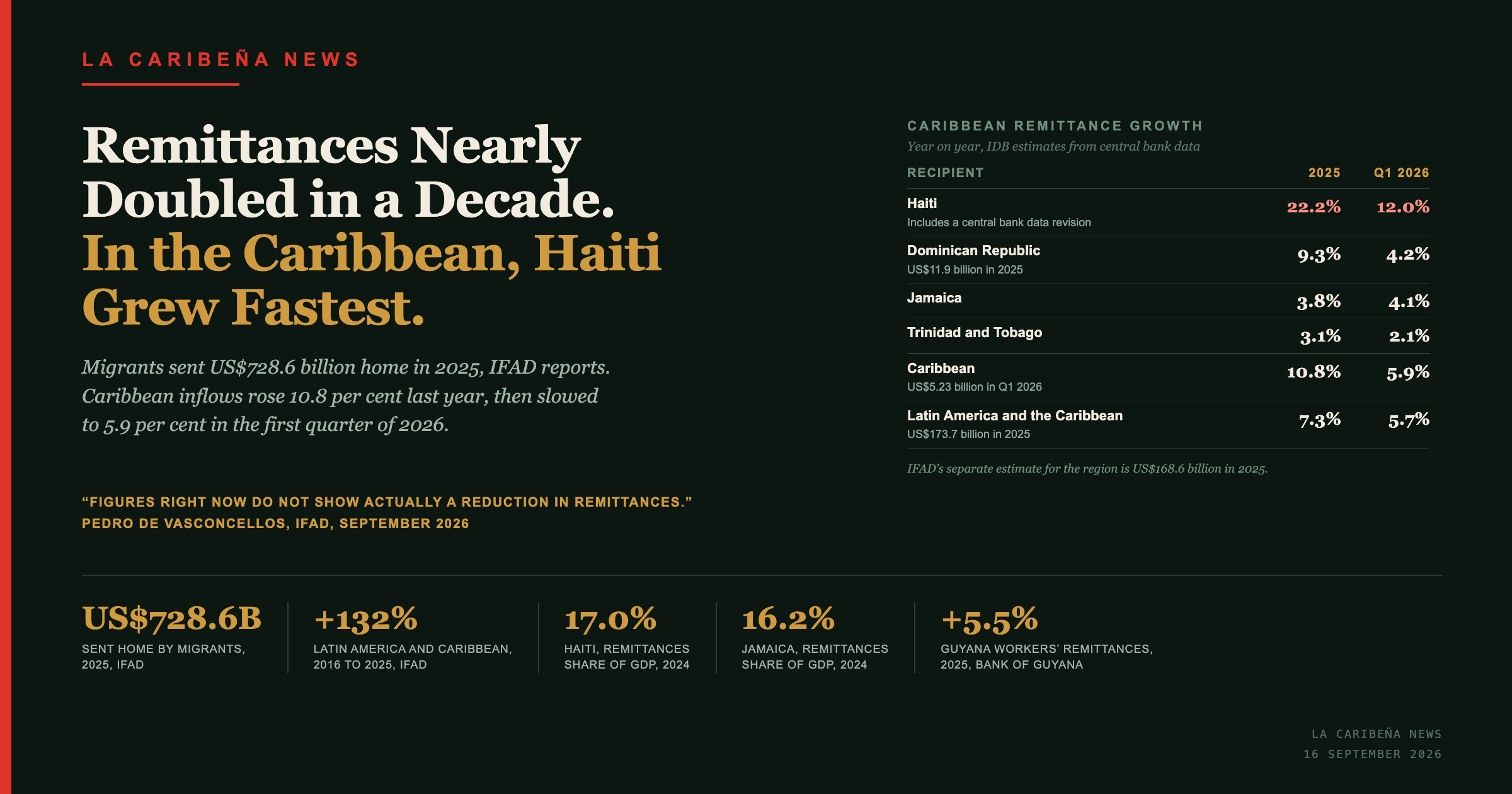
What the title card shows
- US$728.6 billion in remittances to low- and middle-income countries in 2025; 132 per cent decade growth to US$168.6 billion for Latin America and the Caribbean. Source: IFAD, via UN News.
- Caribbean remittance growth, 2025 and Q1 2026: Haiti 22.2 / 12.0 per cent; Dominican Republic 9.3 / 4.2; Jamaica 3.8 / 4.1; Trinidad and Tobago 3.1 / 2.1; Caribbean 10.8 / 5.9; Latin America and the Caribbean 7.3 / 5.7. Source: IDB.
- Totals: Dominican Republic US$11.9 billion in 2025; Caribbean US$5.23 billion in the first quarter of 2026; Latin America and the Caribbean US$173.7 billion in 2025 (IDB), against IFAD's separate estimate of US$168.6 billion. Sources: IDB, UN News.
- Remittances as a share of GDP, 2024: Haiti 17.0 per cent; Jamaica 16.2 per cent. Source: World Bank.
- Guyana: workers' remittances US$444.4 million in 2025, up from US$421.3 million in 2024 (5.5 per cent); money transfer agency transactions down 3.8 per cent; net private transfers US$478.7 million in the first half of 2026. Sources: Bank of Guyana, Ministry of Finance.
- Quotation: "Figures right now do not show actually a reduction in remittances", Pedro de Vasconcellos, IFAD, September 2026. Source: UN News.
Frequently Asked Questions
How much money did migrants send home in 2025?
US$728.6 billion to low- and middle-income countries, nearly double the figure a decade earlier, according to IFAD's Sending Money Home 2026 report, UN News reported.
Which Caribbean country's remittances grew fastest?
Haiti's, by 22.2 per cent in 2025 and 12.0 per cent in the first quarter of 2026, according to the IDB. Part of the 2025 rise reflects a revision to the Haitian central bank's data series.
How important are remittances to Caribbean economies?
They equalled 17.0 per cent of Haiti's GDP and 16.2 per cent of Jamaica's in 2024, according to the World Bank. In Guyana the share fell to 3.2 per cent by 2023 as oil output grew.
Has tighter US immigration reduced remittances to Guyana?
Not on the official record so far. Workers' remittances rose 5.5 per cent to US$444.4 million in 2025 and net private transfers edged up to US$478.7 million in the first half of 2026, although transactions through money transfer agencies fell 3.8 per cent in 2025, according to the Bank of Guyana and the Ministry of Finance.
Has the US remittance tax reduced transfers?
Not significantly so far. The IDB found no sign of a significant impact from the 1 per cent tax on certain US remittances in data through the first quarter of 2026, according to the bank.
The Caribbean received US$5.23 billion in the first three months of 2026, more than a year earlier, and its growth rate was about half of 2025's.