By LCN Business Desk
Panels and the hour of maximum demand do not overlap.
How large is the programme?
144 parks, with a year-end target above 1,500 megawatts.
President Miguel Díaz-Canel set out the figures on his weekly broadcast, Criterio Compartido.
| Cuba's solar programme | |
|---|---|
| Installed solar | 1,418 MW across 144 parks |
| Target | More than 1,500 MW by the end of 2026 |
| At consumer sites | A further 563 MW, state and non-state |
| Storage installed | 50 MW |
| Storage due October | A further 100 MW |
| Planned for water pumping | 200 MW, to make pumping independent of the grid in early 2027 |
Source: President Miguel Díaz-Canel, as reported by pv magazine, 30 September 2026.
The President said solar now covers more than 20 per cent of electricity consumption. Outlets differ on whether that figure describes national consumption or generation at consumer sites, so it is given here as his statement rather than as a measured share.
Where does the shortfall actually fall?
At the peak hour, which the grid operator forecasts daily and names in every bulletin.
Unión Eléctrica publishes a forecast each day. The phrase in them is horario pico, the peak hour. One October bulletin puts it more plainly still: durante la noche, during the night.
| 2026 | Availability | Maximum demand | Forecast impact at peak |
|---|---|---|---|
| 7 October | 1,210 MW | 3,000 MW | 1,820 MW |
| 10 October | Not stated | Not stated | 1,680 MW |
| 14 October | 1,026 MW | 2,910 MW | 1,914 MW |
| 15 October | 935 MW | 2,920 MW | 2,015 MW |
| 17 October | 758 MW | 2,800 MW | 2,072 MW |
Source: Unión Eléctrica de Cuba daily forecasts, via Cubadebate and Juventud Rebelde.
A photovoltaic panel produces nothing in that hour. Whatever 1,418 megawatts contributes to a Cuban afternoon, its contribution to the forecast at the peak hour is zero.
So what is the binding constraint?
Storage. Cuba has 28 megawatts of solar for every 1 megawatt of storage.
The 100 megawatts due in October would narrow that to about 9 to 1. It would also leave total storage at 150 megawatts, against a forecast shortfall that has not been below 1,600 megawatts this month.
The 200 megawatts earmarked for water pumping is not intended to feed the grid at all. It is intended to take pumping off the grid, which is a way of reducing demand rather than meeting it.
Who supplies which buyer?
China supplies the state's parks. American exporters supply private households and businesses.
| 2026, to end-July | The state's programme | The private channel |
|---|---|---|
| Principal supplier | China | United States |
| Value | US$19.5 million, down 83 per cent on the full-year 2025 total | US$6.3 million, up 1,070 per cent on the full-year 2025 total |
| Buyer | The state's 144 solar parks | Households and privately owned businesses |
| US authorisation | Not available under SCP, which excludes the state | License Exception SCP, 15 CFR 740.21 |
| Route | State procurement | Shipping agencies such as CubaMax, paid for outside Cuba |
Source: US Census data and BloombergNEF, via Energy Connects; BIS guidance of 4 March 2026; 15 CFR 740.21.
The two movements are not a contest for one customer. License Exception SCP, at 15 CFR 740.21, permits exports to Cuba of items classified EAR99, or controlled only for anti-terrorism reasons, where they are “for use by the Cuban private sector for private sector economic activities”. The same paragraph excludes any item that would “primarily generate revenue for the state” or “contribute to the operation of the state”. A panel bought by a Cuban household qualifies. A panel bought for a state park does not, so nothing arriving through the American channel can enter the 1,418 megawatts.
Private systems sit instead in the 563 megawatts the President described as installed at consumer sites.
On 4 March 2026 the Bureau of Industry and Security suspended that authorisation “for any export, reexport, or transfer (in-country) involving the deposit of foreign funds into a Cuban owned bank”, while leaving third-country banks and other payment systems untouched. Payment has to happen outside Cuba, and in the cases reported it does. Havana Times describes a business owner whose relative abroad bought 5 kilowatt-hour lithium batteries on Amazon and shipped them through CubaMax.
Storage is the component the state's own programme has least of.
So the two halves of Washington's Cuba policy are one instrument. The State Department designated a Cuban state bank on 15 October under an order whose financial-services clause reaches any firm operating in that sector, reported in Washington Gave Iran as the Reason for Sanctioning a Cuban Bank. The same executive order was used three times in four weeks against the nickel industry, reported in Washington Blocked Cuba's Nickel Producer in August. The licence exception supplies the private sector; the designations close the state's accounts.
What does this mean for the rest of the Caribbean?
That a solar figure without a storage figure describes an afternoon, not a grid.
Capacity rose through the year. The forecast deficit at the peak hour did not fall.
Guyana's own costings for household solar were examined in A Rooftop System for Every Guyanese Household Costs Between US$486 Million and US$1.27 Billion, and what it publishes about each solar farm, against what it does not publish about the power plant, in Guyana Publishes What Each Solar Farm Costs. Costa Rica's position, where solar is 0.4 per cent of the grid, was examined in Costa Rica's Solar Is 0.4 Per Cent of the Grid.
Uruguay has signed 500 megawatts of data centre load, which runs through the night, into the same contract as a 350 megawatt solar plant, reported in Uruguay Has Signed 500 Megawatts of Data Centres.
Guyana has met the same gap between a capacity statement and an evening. Georgetown lost power on 12 September, five days after Guyana Power and Light told a news conference that generation was adequate and distribution was not, reported in Georgetown Went Dark Again.
The entities
- Unión Eléctrica de Cuba is the state electricity utility, which publishes the daily peak-hour forecast.
- President Miguel Díaz-Canel is the President of Cuba, who set out the solar and storage figures on his weekly broadcast, Criterio Compartido.
- Horario pico is the peak demand hour named in every Unión Eléctrica forecast.
- License Exception SCP is the US authorisation, at 15 CFR 740.21, for exports to Cuba's private sector.
- The Bureau of Industry and Security is the US Commerce Department body that administers that authorisation and suspended part of it on 4 March 2026.
- CubaMax is a shipping agency named as a route by which equipment reaches Cuban buyers.
- BloombergNEF and US Census data are the source of the solar export figures.
- pv magazine is the trade publication that reported the President's figures.
What the title card shows
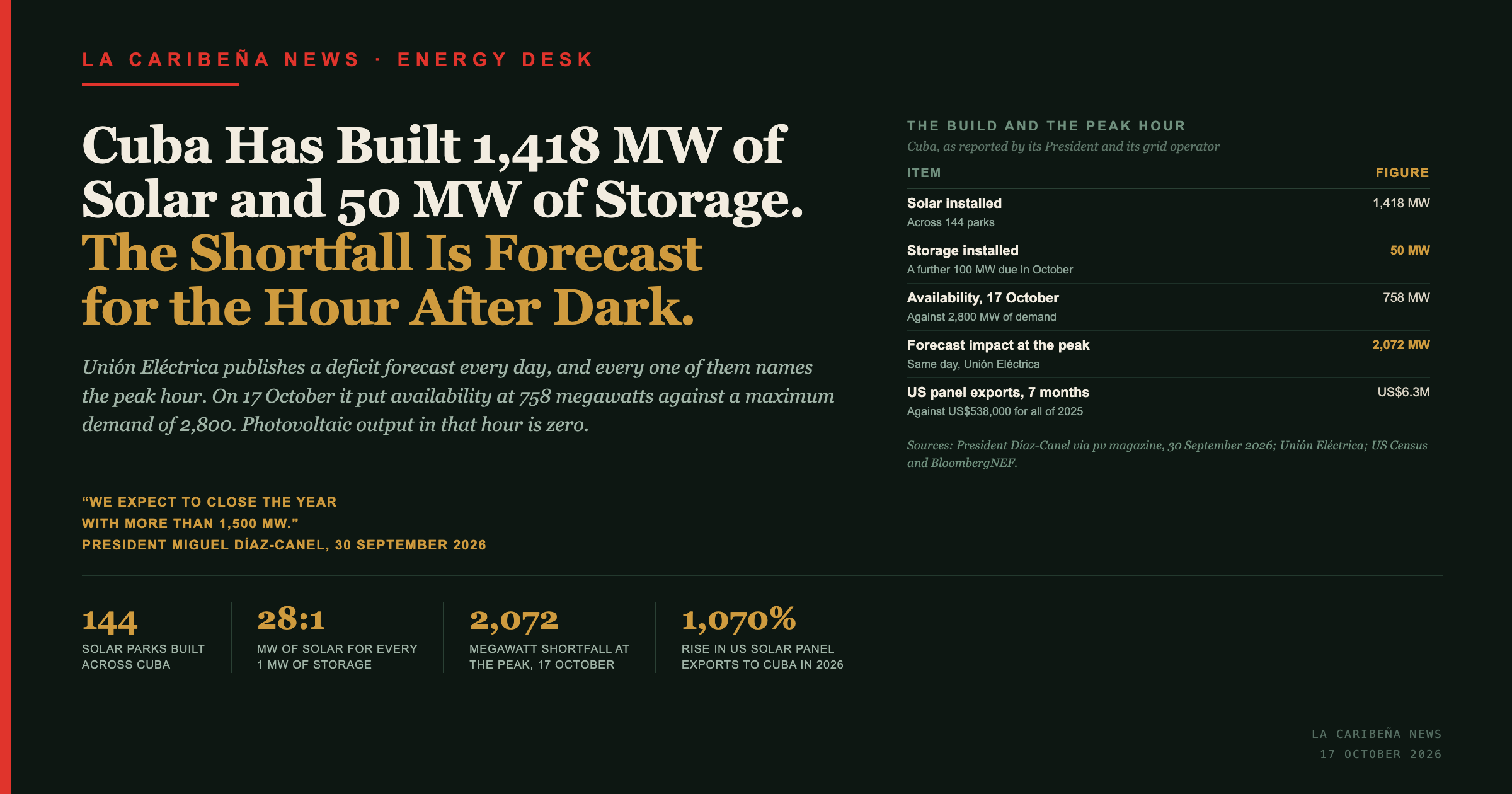
Every data point on the article's title card, in text.
- 1,418 MW. Cuba's installed solar across 144 parks. Source: President Díaz-Canel, via pv magazine.
- 50 MW. Storage installed, with 100 MW more due in October. Source: President Díaz-Canel.
- 2,072 MW. The forecast impact at the peak hour for 17 October 2026. Source: Unión Eléctrica.
- 758 MW. Availability against a maximum demand of 2,800 MW on the same day. Source: Unión Eléctrica.
- 1,070 per cent. The rise in US solar exports to Cuba in the first seven months of 2026. Source: US Census data and BloombergNEF.
- Quotation: "We expect to close the year with more than 1,500 MW." President Miguel Díaz-Canel, 30 September 2026. Source: pv magazine.
Frequently Asked Questions
How much solar has Cuba installed?
1,418 megawatts across 144 parks as at 30 September 2026, with a target of more than 1,500 megawatts by year end, and a further 563 megawatts at consumer sites.
How much storage does it have?
50 megawatts installed, with a further 100 megawatts due in October 2026.
How large is the shortfall?
Unión Eléctrica forecast an impact at the peak hour of between 1,680 and 2,072 megawatts through October 2026. On 17 October it forecast 758 megawatts of availability against a maximum demand of 2,800 megawatts.
Why does the timing matter?
Because the forecasts are for the peak hour, which Unión Eléctrica names in every bulletin and which one October bulletin describes as during the night. Photovoltaic output in that hour is zero, so solar capacity does not reach the shortfall being forecast.
Who supplies Cuba's panels?
Two different buyers are supplied by two different countries. China supplies the state's 144 parks, at US$19.5 million to the end of July. The United States supplies private households and businesses, at US$6.3 million over the same period against US$538,000 for all of 2025. The American channel is authorised by License Exception SCP, 15 CFR 740.21, which permits exports for use by the Cuban private sector and excludes items that would benefit the state, so it cannot supply the parks.
What is the lesson for other Caribbean states?
That a solar capacity figure describes daytime generation, and a grid is judged at its peak. Cuba's installed capacity rose through 2026 and its forecast deficit at the peak hour did not fall.