By LCN Business Desk
A data centre does not have a quiet hour.
What did Uruguay actually sign?
Orsi signed a complex spread across three departments, operating under the free zone regime.
The counterparty is Spain's Solaria Energía y Medio Ambiente, and the complex sits under the zona franca regime, which carries tax benefits.
| The complex | |
|---|---|
| Total investment | US$5,700 million |
| Data centres | US$5,500 million, 500 MW |
| Solar plant | US$200 million, 350 MW |
| Phase 1 | 200 MW data centres plus the 350 MW solar plant |
| Phase 2 | 300 MW data centres |
| Departments | Canelones and San José (data centres), Florida (solar) |
| Jobs | 3,100 in construction toward 2029; 1,500 permanent |
| Regime | Zona franca |
Source: Presidencia de la República Oriental del Uruguay, 16 October 2026.
The Presidency calls it the largest investment in the country's history. President Orsi: "Gana Uruguay porque en este proyecto converge buena parte del país que queremos construir." Uruguay wins because much of the country we want to build converges in this project.
How big is that against the national grid?
Just under a fifth of the maximum the whole country reached last year.
The Administración del Mercado Eléctrico (ADME), which runs Uruguay's electricity market, records it in the annual report: "El pico máximo de potencia en 2025 fue de 2.507 MW y se registró el 7 de marzo." The signed load is 19.9 per cent of that 2,507 MW maximum.
The same report puts the growth in that maximum at 12 per cent between 2024 and 2025, and gives the reason: "el uso masivo de aire acondicionado durante un verano excepcionalmente caluroso." Mass air conditioning use during an exceptionally hot summer. That happened before a single server was installed.
The complex is phased toward 2029 and demand is rising on its own, so the load does not arrive on the 2025 maximum.
What does the announcement not say?
Three terms, and the Presidency states none of them.
The announcement gives no construction start date, no term for any power purchase agreement with the state utility UTE, and no figure for water use.
MercoPress reported on 16 October that construction begins in 2027, that the UTE agreement runs up to 40 years, and that the complex uses "low-water cooling systems". All three are that outlet's reporting, and none appears in the government's announcement.
A solar plant produces when the sun is up. A data centre draws when it is not. Something fills the gap between the two, and the announcement does not say what, on what terms, or for how long.
Can Solaria carry it?
A senator says ten analysts told him no.
MercoPress reports that Senator Sebastián Da Silva, of the opposition Partido Nacional, said: "There is not a single private analyst, of the 10 I consulted, who tells me Solaria is in a position to take on a US$5.7 billion investment."
| Solaria, FY2025, from its own results presentation | |
|---|---|
| Total revenues | EUR 303.4 million, up 27 per cent |
| EBITDA | EUR 266.1 million, up 32 per cent |
| Net profit | EUR 137.4 million, up 55 per cent |
| Capacity, operating-data table | 2,352.0 MW, up 42 per cent |
Source: Solaria Energía y Medio Ambiente, FY 2025 Results Presentation, 26 February 2026.
Is Solaria new to Uruguay?
No. It has been generating in Uruguay at a scale the new complex dwarfs.
The same operating table breaks capacity down by country.
| Solaria in Uruguay | FY2025 | FY2024 |
|---|---|---|
| Capacity (MW) | 22.7 | 22.7 |
| Energy sales (EUR million) | 3.7 | 3.4 |
| Production (GWh) | 32.0 | 29.3 |
| Average price (EUR/MWh) | 115.6 | 116.0 |
Source: the same presentation.
The solar plant alone in the new complex is more than fifteen times that fleet.
What is the case for it?
Solaria already holds data centre contracts, all of them in Spain.
The same presentation titles its outlook "From Renewable Equity to Strategic Energy Infrastructure. Positioned for the AI Power Supercycle." It reports a "Second Data Centers agreement signed: 213 MW" and states that "DC Services and DC PPAs will generate more than EUR 3bn revenues".
That business is Spanish. The slide headed "2028 targets by country" names Portugal, Italy and Germany, and describes European expansion as "a key growth driver and a major derisking lever".
Solaria can build data centres. Its published roadmap puts them in Europe, and its Uruguayan fleet has not gained a megawatt in two years.
Why does this matter in the Caribbean?
Because the same offer is circulating here, and one government has already taken it.
Trinidad and Tobago signed three memoranda with United States companies on 11 July 2026 covering up to 800 megawatts of data centre capacity, against a national generation capacity of about 2.4 gigawatts that runs on gas, reported in Trinidad Has Signed Up 800 Megawatts of Data Centres. Those data centres would draw on gas whose utilisation has been falling since 2015. Uruguay's generation is written into the same contract as the load.
In Guyana the resource ministry has named 600 megawatts for Wales against a project under construction at 300, examined in The Resource Ministry Says Wales Will Carry 600 MW.
The wider contest over who supplies the compute was set out in The Plan to Slow AI Names Washington, Its Allies and Beijing, which found the Caribbean named nowhere in it. Montevideo has now settled that question for itself. Uruguay's position in the queue for the trans-Pacific trade pact was examined in Two Clubs That Admit Members Only by Consensus.
A long-dated commitment by a state utility to a private counterparty belongs to the same class of obligation as a stability clause in a mining agreement, where Guyana has promised five companies that if the law changes, the state pays, reported in Guyana Has Promised Five Mining Companies That If the Law Changes, the State Pays. The term of Uruguay's is not in the announcement.
The entities
* Solaria Energía y Medio Ambiente is a Spanish listed renewable energy company reporting FY2025 revenues of EUR 303.4 million, 2,352.0 MW of operating capacity, and 22.7 MW in Uruguay. * Yamandú Orsi is the President of Uruguay, who signed the agreement on 16 October 2026. * Sebastián Da Silva is a senator of the Partido Nacional, in opposition to the Frente Amplio government, who questioned Solaria's capacity to fund the investment. * Administración del Mercado Eléctrico (ADME) is the administrator of Uruguay's wholesale electricity market, and publishes the national peak demand figure used here. * UTE is Uruguay's state electricity utility, reported as the counterparty to the project's power purchase agreement. * Zona franca is Uruguay's free zone regime, under which the complex operates, carrying tax benefits.
What the title card shows
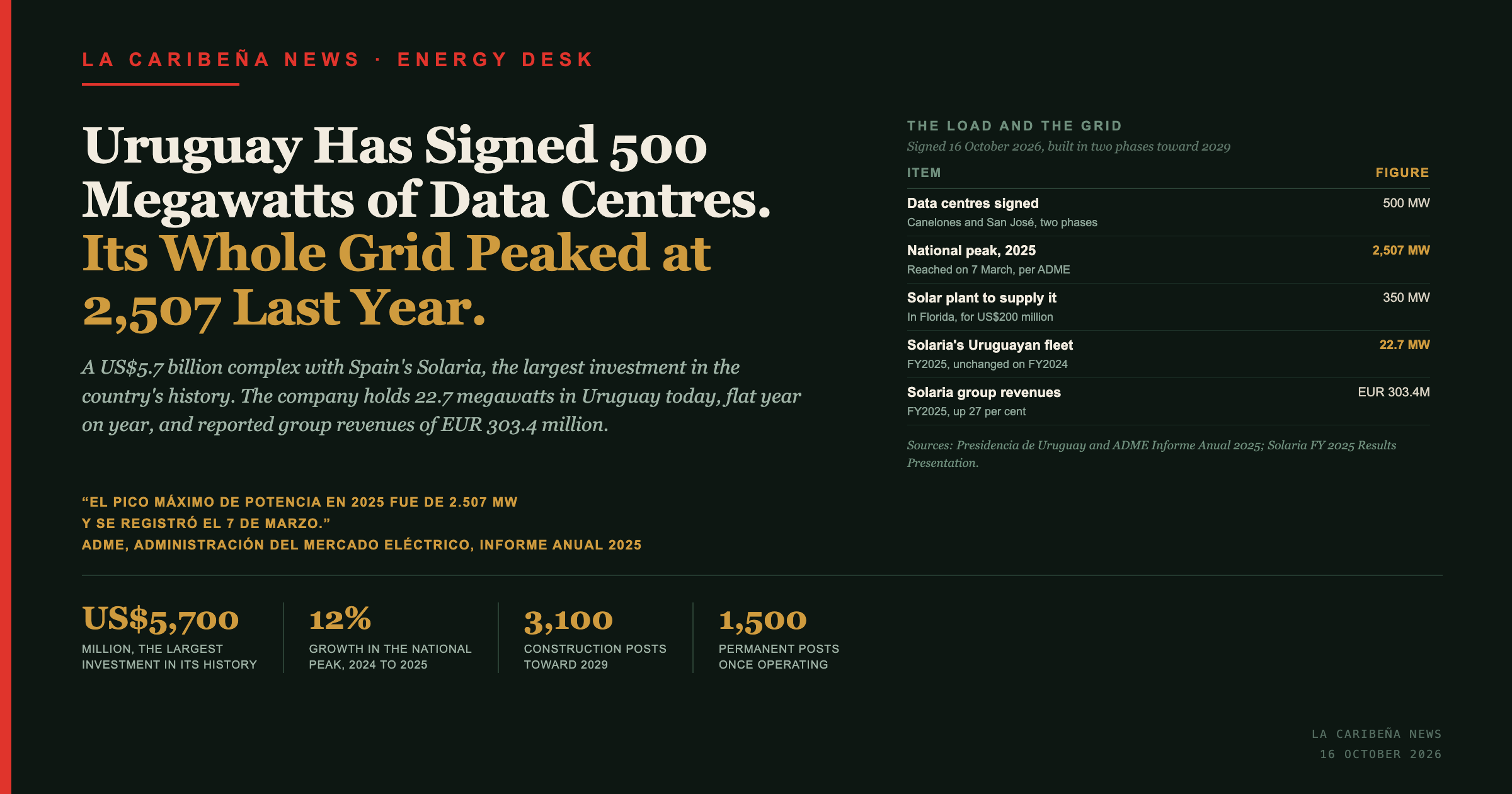
Every data point on the article's title card, in text.
* 500 MW. The data centre capacity signed, in two phases. Source: Presidencia de Uruguay, 16 October 2026. * 2,507 MW. Uruguay's maximum power peak in 2025, recorded on 7 March. Source: ADME, Informe Anual 2025. * US$5,700 million. The total investment, described as the largest in the country's history. Source: Presidencia de Uruguay, 16 October 2026. * EUR 303.4 million. Solaria's total revenues in FY2025. Source: Solaria FY 2025 Results Presentation, 26 February 2026. * 22.7 MW. Solaria's installed capacity in Uruguay in FY2025, unchanged from FY2024. Source: Solaria FY 2025 Results Presentation, 26 February 2026. * 350 MW. The solar plant that is to supply the complex, for US$200 million. Source: Presidencia de Uruguay, 16 October 2026. * Quotation: "There is not a single private analyst, of the 10 I consulted, who tells me Solaria is in a position to take on a US$5.7 billion investment." Senator Sebastián Da Silva. Source: MercoPress, 16 October 2026.
Frequently Asked Questions
What did Uruguay sign with Solaria?
A US$5.7 billion complex: US$5,500 million for 500 megawatts of data centres in Canelones and San José, and US$200 million for a 350 megawatt solar plant in Florida to supply them. It operates under the zona franca regime and is expected to create 3,100 construction jobs toward 2029 and 1,500 permanent ones.
How does 500 megawatts compare with Uruguay's grid?
ADME, the electricity market administrator, records a maximum power peak of 2,507 MW in 2025, reached on 7 March. The complex's 500 megawatts is just under a fifth of that. The build is phased toward 2029 and demand is growing, by ADME's own 12 per cent between 2024 and 2025, so the comparison sizes the commitment against the system as measured today rather than forecasting 2030.
What does the government's announcement leave out?
It gives no construction start date, no term for any power purchase agreement with UTE, and no water use figure. MercoPress reports construction from 2027, a UTE agreement of up to 40 years and low-water cooling, but none of the three appears in the Presidency's own announcement.
Has anyone questioned whether Solaria can fund it?
MercoPress reports that Senator Sebastián Da Silva of the opposition Partido Nacional said no private analyst among ten he consulted thought Solaria was in a position to take on a US$5.7 billion investment. Solaria's own FY2025 presentation reports group revenues of EUR 303.4 million, EBITDA of EUR 266.1 million and 22.7 MW of capacity in Uruguay, unchanged year on year.
Does Solaria already operate in Uruguay?
Yes. Its FY2025 operating data shows 22.7 MW of Uruguayan capacity, flat on FY2024, producing 32.0 GWh and selling EUR 3.7 million of energy at an average EUR 115.6 per MWh.
Does Solaria have a data centre business?
In Spain. Its FY2025 presentation reports a second data centre agreement signed for 213 MW and states that data centre services and power purchase agreements will generate more than EUR 3 billion in revenues. Its published "2028 targets by country" slide names Portugal, Italy and Germany.
What is the Caribbean comparison?
Trinidad and Tobago signed memoranda on 11 July 2026 covering up to 800 megawatts of data centre capacity against a national generation capacity of about 2.4 gigawatts running on gas whose utilisation has fallen since 2015. Uruguay's 500 megawatts arrive with a 350 megawatt solar plant written into the same contract.