By LCN Business Desk
An accession that needs everyone's agreement gives everyone a lever.
What did the Commons actually say about CPTPP?
A shadow minister asked whether Britain would use its membership against Argentina, and the minister declined to rule it out.
Wendy Morton, the Conservative member for Aldridge-Brownhills, put it directly on 13 October: "Argentina has applied to join the comprehensive and progressive agreement for trans-Pacific partnership... Are the Government prepared to use Britain's position in the CPTPP to make it clear that such behaviour carries consequences?"
Uma Kumaran, Parliamentary Under-Secretary of State for Foreign, Commonwealth and Development Affairs, answered: "The UK does not comment publicly on CPTPP accession discussions. Our focus now is on the merit of an application, to maintain the strongest agreement, though Argentina's behaviour does raise very serious questions about its reliability as a partner for the United Kingdom."
Source: Official Report, 13 October 2026, Commons Chamber, statement on the Falkland Islands.
What is the second club?
The Organisation for Economic Co-operation and Development, raised minutes later and priced.
Kit Malthouse, the Conservative member for North West Hampshire, told the House that "as well as applying to join the CPTPP, the Argentinians are in the final stage of accession to the Organisation for Economic Co-operation and Development."
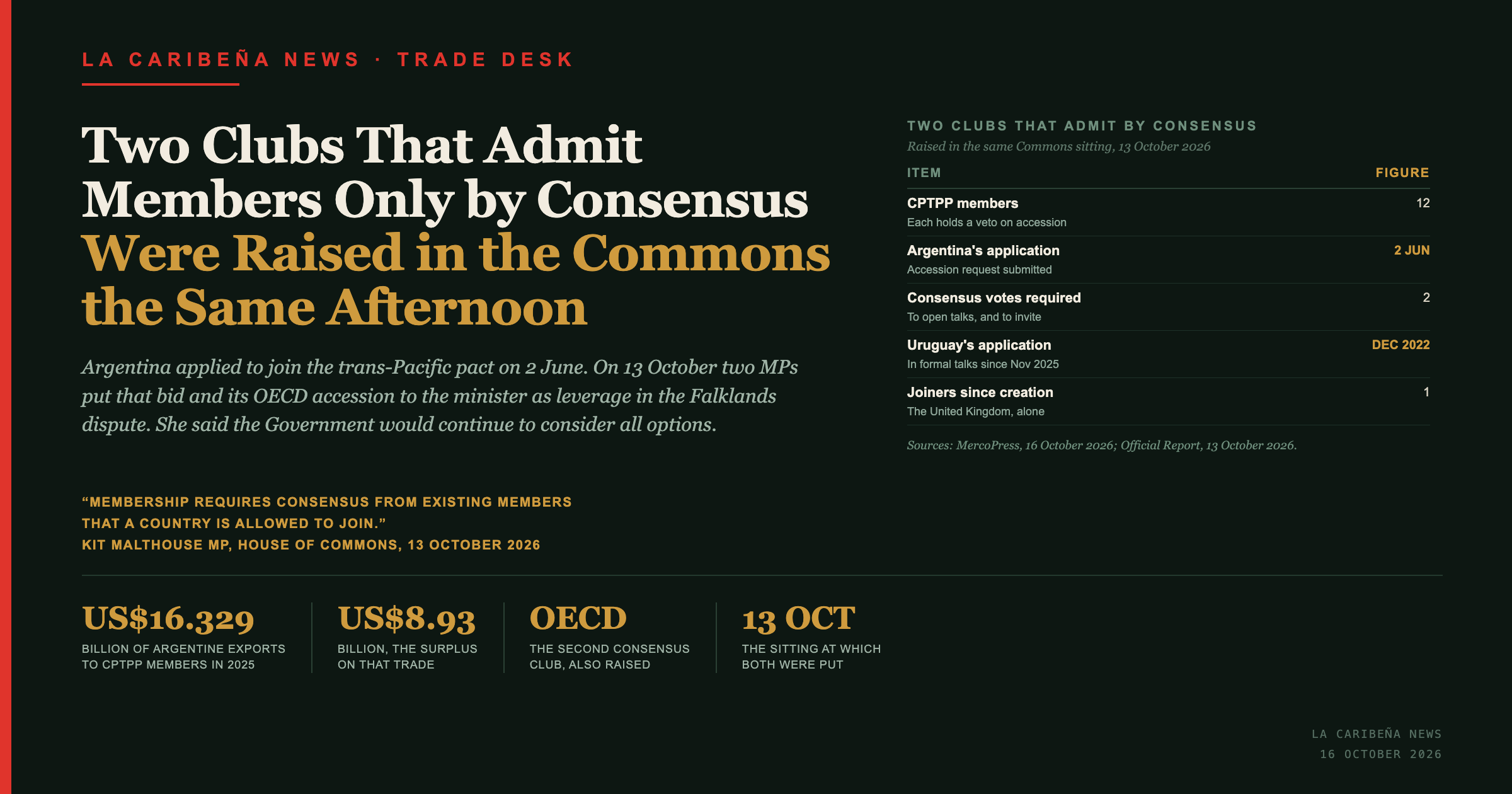
He then put a number on what that is worth: "Membership of that organisation brings with it significant benefits in terms of the risk premium attached to national debt, which could be worth hundreds of millions of dollars, if not billions, to Argentina. However, membership requires consensus from existing members that a country is allowed to join."
Kumaran's reply: "We will continue to consider all options. Indeed, I have been clear in my statement that the behaviour of the Argentine Government is not what we would expect. I hope that they will reflect on that."
Both accessions turn on the same procedural fact, and both were raised in the same sitting.
How does CPTPP accession work?
By consensus, twice, so any single member can stop it.
MercoPress reported on 16 October that Argentina submitted its accession request on 2 June, and that opening accession talks and issuing the final invitation each require the consensus of all members.
| CPTPP | |
|---|---|
| Members | Australia, Brunei, Canada, Chile, Japan, Malaysia, Mexico, New Zealand, Peru, Singapore, Vietnam, United Kingdom |
| The only country to have joined since creation | United Kingdom |
| Argentina's application | 2 June 2026 |
| Consensus required | To open accession talks, and again to issue the final invitation |
| Uruguay's application | December 2022, in formal negotiations since November 2025 |
| Chair of the Uruguay working group | Chile |
Source: MercoPress, 16 October 2026.
The United Kingdom is therefore one of twelve, and the newest of them.
What would exclusion cost Argentina?
Exclusion would not stop the trade. It would leave Argentine exporters outside the pact's tariff preferences and common rules while competitors inside the pact enjoy them.
Argentina's foreign ministry puts the country's exports to CPTPP members at US$16.329 billion in 2025, with a surplus of US$8.93 billion, which implies imports from those members of about US$7.4 billion.
Argentina's foreign minister, Pablo Quirno, rejects the reliability argument. "Reliability is shown by honouring the international commitments one has undertaken," he said earlier this month, arguing that the United Kingdom is exploiting disputed resources in breach of United Nations resolutions calling on both countries to negotiate.
Why does a South Atlantic dispute reach a Pacific trade pact?
Because the week's other moves had already crossed from sovereignty into commerce.
Argentina asked the International Tribunal for the Law of the Sea on 13 October to halt the Sea Lion project, reported in A British Minister Told the Commons That Provisional Measures Are Binding. The same day London said it would use its protection of trading interests legislation to shield British companies from Argentine measures.
The measures the minister had in mind were set out in September, when Buenos Aires moved against the project's contractors and the three largest oil-services companies said they would not take part, reported in Argentina Charges the Sea Lion Operator. That sequence is what both MPs were pointing at when they used the word reliability.
Washington has been moving in the other direction on Argentina. The Export-Import Bank signed Buenos Aires a framework of up to US$7 billion through 2027, reported in Guyana's President Met the American Lender on Monday, and the corridor branding that came with it was examined in America Built Its First Trade Corridor in This Hemisphere.
What does this mean for the Caribbean and Latin America?
That a consensus rule is a lever any member can pull, including a small one.
Uruguay is in the same queue and further along it, having applied in December 2022 and opened formal negotiations in November 2025 under a working group chaired by Chile. MercoPress reports that the separate Argentine and Uruguayan bids have caused friction in Mercosur, where Brazil has questioned their departure from joint negotiations with third countries. What Mercosur negotiating jointly does produce reaches the Caribbean directly: its interim agreement with the European Union is removing a EUR 98 a tonne sugar advantage in tranches, reported in EUR 98 a Tonne Was the Caribbean's Sugar Advantage.
No CARICOM state is a CPTPP member, though members of the pact already trade in the region: New Zealand sells mining technology across Latin America and milk in Guyana, reported in New Zealand Is Selling Mining Technology in Latin America.
The mechanism is the closer parallel, and CARICOM runs on it. A regional 35 per cent tariff on paints and varnishes due to take effect on 1 July was reversed after a formal objection from Guyana, reported in How One Objection From Guyana Reopened a CARICOM Tariff Decision. In a bloc that decides by consensus, the smallest member holds the same veto as the largest, and a dispute anywhere can reach a trade decision everywhere. Argentina's reserve arrangements and their limits were examined in Argentina's China Swap Reads US$19 Billion.
The entities
* Comprehensive and Progressive Agreement for Trans-Pacific Partnership (CPTPP), a twelve-member trade pact whose accessions require the consensus of all members, both to open talks and to issue a final invitation. * Organisation for Economic Co-operation and Development (OECD), an intergovernmental organisation whose membership also requires consensus from existing members, and which Argentina is in the final stage of joining. * Uma Kumaran, Parliamentary Under-Secretary of State for Foreign, Commonwealth and Development Affairs, who answered for the British government on 13 October 2026. * Wendy Morton, Conservative member for Aldridge-Brownhills, who asked whether Britain would use its CPTPP position against Argentina's bid. * Kit Malthouse, Conservative member for North West Hampshire, who raised Argentina's OECD accession and the risk premium attached to it. * Pablo Quirno, Argentina's foreign minister, who rejects the argument that his country is an unreliable partner. * Mercosur, the South American customs union in which Brazil has questioned Argentina's and Uruguay's separate approaches to third countries. * Sea Lion, the oil project north of the Falkland Islands at the centre of the dispute between Argentina and the United Kingdom.
What the title card shows
Every data point on the article's title card, in text.
* 12 CPTPP members. Australia, Brunei, Canada, Chile, Japan, Malaysia, Mexico, New Zealand, Peru, Singapore, Vietnam and the United Kingdom, each holding a veto on accession. Source: MercoPress, 16 October 2026. * 2 June. The date Argentina submitted its CPTPP accession request. Source: MercoPress, 16 October 2026. * 2 consensus votes required. One to open accession talks, one to issue the final invitation. Source: MercoPress, 16 October 2026. * December 2022. When Uruguay applied, with formal negotiations opening in November 2025. Source: MercoPress, 16 October 2026. * 1 joiner since creation. The United Kingdom is the only country to have joined the pact since it was created. Source: MercoPress, 16 October 2026. * US$16.329 billion. Argentina's exports to CPTPP members in 2025. Source: Argentina's foreign ministry, via MercoPress, 16 October 2026. * US$8.93 billion. The surplus on that trade. Source: Argentina's foreign ministry, via MercoPress, 16 October 2026. * OECD. The second consensus club, raised in the same Commons sitting. Source: Official Report, 13 October 2026. * 13 October. The sitting at which both accessions were put to the minister. Source: Official Report, 13 October 2026. * Quotation: "Membership requires consensus from existing members that a country is allowed to join." Kit Malthouse MP, House of Commons, 13 October 2026. Source: Official Report, 13 October 2026.
Frequently Asked Questions
Has Argentina applied to join the CPTPP?
Yes. MercoPress reports that Argentina submitted its accession request on 2 June 2026.
Could the United Kingdom block it?
Opening accession talks and issuing the final invitation each require the consensus of all members, and the United Kingdom is one of the twelve. Asked on 13 October whether the Government would use that position, the minister said the United Kingdom does not comment publicly on accession discussions, while adding that Argentina's behaviour raises very serious questions about its reliability as a partner.
What was said about the OECD?
Kit Malthouse told the Commons that Argentina is in the final stage of OECD accession, that membership is worth hundreds of millions of dollars, if not billions, through the risk premium on national debt, and that it requires consensus from existing members. The minister replied that the Government would continue to consider all options.
What is the trade at stake?
Argentina's foreign ministry puts exports to CPTPP members at US$16.329 billion in 2025 with a surplus of US$8.93 billion. Exclusion would not stop that trade but would leave Argentine exporters outside the pact's tariff preferences and common rules.
Is any CARICOM state in the CPTPP?
No. The relevance is the mechanism: in a bloc admitting members by consensus, every member holds a veto regardless of size.