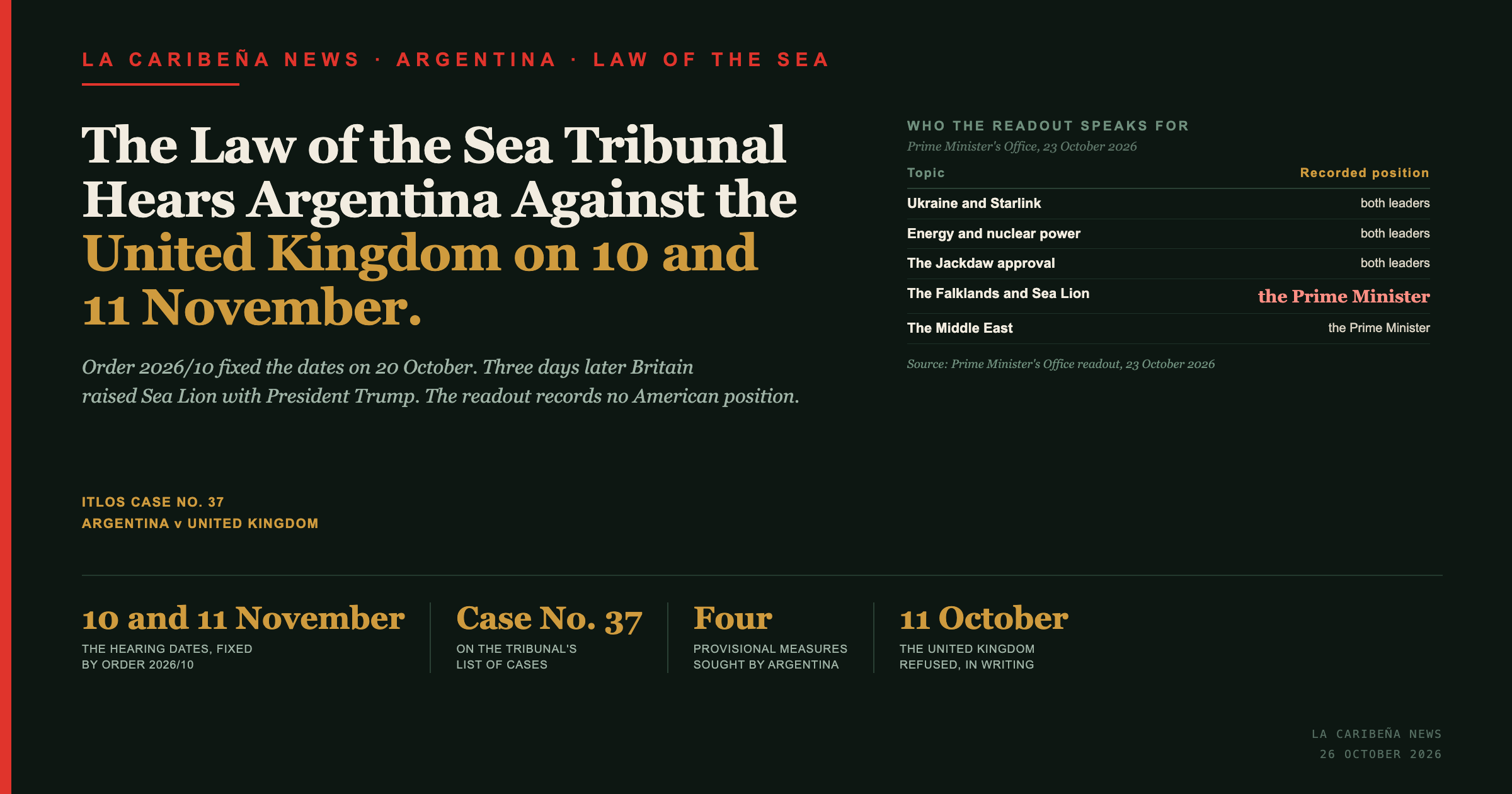
--- title: "The Law of the Sea Tribunal Hears Argentina Against the United Kingdom on 10 November. Downing Street Took Sea Lion to Trump Three Days After the Date Was Fixed." slug: itlos-case-37-hearing-10-november-sea-lion-no10-readout-2026 canonical: https://www.lacaribenanews.com/itlos-case-37-hearing-10-november-sea-lion-no10-readout-2026/ date: 2026-10-26 author: LCN Business Desk tags: [Argentina, Energy, Law of the Sea, Analysis] meta_title: "ITLOS fixes 10 November hearing on Sea Lion; No10 readout records no US position" meta_description: "ITLOS Order 2026/10 fixed 10 and 11 November 2026 for the hearing on Argentina's request to stop exploitation by Sea Lion. Three days later Britain raised it with President Trump, and the readout records no American position." ---
By LCN Business Desk
A date now exists. Everything a contractor, a lender or an insurer has been pricing against this dispute runs to it.
What has the Tribunal fixed, and under what provision?
Two hearing days, by an order of the Tribunal's President, with everything after them left open.
The case is No. 37 on the Tribunal's List of Cases, entered as the Case concerning hydrocarbon exploitation in the South-West Atlantic Ocean (Argentina v. United Kingdom), Provisional Measures. The Tribunal's own title uses neither of the names the parties use for the islands.
Order 2026/10 was made on 20 October 2026 by Judge Maurice K. Kamga, President of the Tribunal, and attested by the Registrar, Ximena Hinrichs Oyarce, at Hamburg. Its operative part is two lines:
"Fixes 10 and 11 November 2026 as the dates for the hearing; and
Reserves the subsequent procedure for further decision."
The Order records that it was made "having ascertained the views of the Parties", so the dates were set with both governments heard. It proceeds under Article 290, paragraph 5 of the United Nations Convention on the Law of the Sea, the provision that lets the Tribunal act before the arbitral tribunal that will decide the dispute has been constituted. That arbitral tribunal does not yet exist, which is the reason the case is in Hamburg at all.
The second line is the one a business reader should hold. Nothing beyond the hearing has been decided, including when a decision follows it.
How did the case reach Hamburg?
Through London first. The Tribunal was the second venue, not the first.
Argentina's own Request sets out the sequence at its second paragraph, and the step in the middle has not previously been reported here.
| Date | Step |
|---|---|
| 28 September 2026 | Argentina institutes arbitration under Annex VII by note received the same day, with a Statement of Claim and a request that the United Kingdom itself adopt provisional measures |
| 11 October 2026 | The United Kingdom refuses, in writing |
| 13 October 2026 | Argentina asks the Tribunal to prescribe the measures instead |
| 20 October 2026 | Order 2026/10 fixes the hearing |
| 10 and 11 November 2026 | Hearing, Hamburg |
Source: Argentina's Request for the Prescription of Provisional Measures, paragraph 2, and Order 2026/10.
The Request puts the refusal in one sentence: "By a note dated 11 October 2026, the United Kingdom rejected Argentina's claims and refused to implement the provisional measures requested." Twelve working days separate the first approach from a fixed hearing date, which is quick for an international tribunal and is what Article 290(5) is built for.
This newspaper reported the filing itself, and the British minister who told the Commons the same afternoon that such orders bind the parties, on 16 October.
What is Argentina asking the Tribunal to order?
Four things, and the fourth reaches beyond the single project.
At paragraph 50 the Request asks for measures requiring the United Kingdom to prevent the commencement or continuation of exploitation by the Sea Lion project; to refrain from using exploration information to Argentina's detriment; to stop preventing Argentina from meeting its own marine-environment obligations under Articles 192 and 194; and "to refrain from any other measure that might aggravate the dispute, in particular the granting of new permits for the exploitation of the resources of the disputed continental shelf".
Argentina's stated ground is that exploitation "will produce an irreversible fait accompli and irreparable damage to the Argentine rights at stake". Its pleading also argues that because the Commission on the Limits of the Continental Shelf declined to consider the contested parts of both States' submissions, neither State may exploit the disputed shelf beyond 200 nautical miles pending the Commission's recommendations. That is Argentina's characterisation in its own pleading, and the Tribunal has made no finding on it.
What does the Downing Street readout actually record?
What the Prime Minister raised. Not what the United States answered.
The Prime Minister's Office published a readout of Prime Minister Andy Burnham's call with President Donald Trump on 23 October 2026. It runs to six short paragraphs covering Ukraine, energy, the Jackdaw gas field, the Falklands and the Middle East. Its Falklands paragraph reads in full:
"Turning to the Falklands Islands, the leaders discussed the Sea Lion project. The Prime Minister raised the economic consequences of Argentina's coercive measures for the UK and US and reiterated the importance of respecting the Islanders' right to develop their natural resources."
The verbs across the document are not uniform, and the pattern is checkable by anyone who opens it.
| Topic in the readout | Verb used |
|---|---|
| Ukraine and Starlink | "the leaders agreed to work together" |
| Energy and nuclear power | "the leaders welcomed the continued collaboration" |
| The Jackdaw approval | "the leaders agreed on the significant benefits" |
| The Falklands and Sea Lion | "the Prime Minister raised… and reiterated" |
| The Middle East | "the Prime Minister reaffirming" |
Source: Prime Minister's Office readout, 23 October 2026.
On three topics the readout speaks for both leaders. On the Falklands it speaks for one. The phrase "for the UK and US" sits inside the clause describing what the Prime Minister raised, so it is his account of where the consequences fall rather than a statement that Washington shares it. A reader pricing American involvement in this dispute has, from this document, nothing to price.
What will be on the public record, and when?
The hearing itself, live, and a verbatim transcript afterwards.
The access terms are set in the Tribunal's press release of 20 October. The hearing is in the main courtroom and open to the public, with advance registration through the Press Office. Media may attend with accreditation, and "unobtrusive audio and video recording of the hearing is permitted". The proceedings will be broadcast live on the Tribunal's website, a recorded webcast follows each sitting, and the verbatim records are published on the case page shortly afterwards.
The release carries its own warning that press releases of the Tribunal "do not constitute official documents and are issued for information purposes only", so the Order is the text to cite for anything operative.
For a company, a lender or a ministry with exposure, the practical consequence is that both governments will argue this in public on a known date, and the transcript will be free to read. Few commercial disputes of this size offer that.
What is commercially exposed?
Licences that were extended a month ago, an operator already facing Argentine criminal process, and a contractor base that has already stepped back.
The Falkland Islands Government extended every offshore production licence by five years with two more at its discretion, five days after an Argentine judge ordered the field halted, as this newspaper reported on 23 September. Argentina's Request lists that extension among its annexes, alongside the islands' final investment decisions of December 2025 and the operator's own interim report and market announcements.
On the contractor side, the world's three largest oil-services companies said they would not take Sea Lion work, two days before Argentina announced a criminal complaint against the field's operator, which this newspaper reported on 9 September. None of those allegations has been proven.
The read-across for this region was set out in the same September coverage. Guyana licenses and produces oil while a neighbour claims two thirds of its territory and the claim sits at the International Court of Justice. The mechanism in Hamburg is different from the one in The Hague, and the commercial question a contractor asks is the same one: what a tribunal can order about work already under way.
What has not been established?
Four, and the Order reserves the first of them by its own terms.
The outcome. Order 2026/10 fixes dates and reserves everything after them. Nothing in it indicates how the Tribunal will rule, or when after the hearing it will do so.
The American position. The readout records none, and no United States statement on Sea Lion appears on the public record this newspaper can find.
The arbitral tribunal. It has not been constituted. Article 290(5) exists precisely for that gap, and the measures sought are expressly "pending the constitution of the Arbitral Tribunal".
The operator's current commercial position. Argentina's annex list cites the operator's interim report of 30 September and a market announcement of 5 October, neither of which is summarised in the Request.
Two governments have a fixed date, a public courtroom and a live feed. What follows it is reserved. Since that order, the Falkland Islands Executive Council adopted the Islands Plan 2026-2030 on 27 October 2026, with progressing a sovereign wealth fund for energy revenues as the first of six first-year priorities.
The entities
- International Tribunal for the Law of the Sea (ITLOS) is the court established under the United Nations Convention on the Law of the Sea, sitting at Hamburg, which registered this case as No. 37.
- Article 290, paragraph 5 of the Convention is the provision allowing the Tribunal to prescribe provisional measures before the arbitral tribunal that will hear the dispute has been constituted.
- Annex VII of the Convention is the arbitration procedure Argentina invoked by note on 28 September 2026.
- Order 2026/10 is the order of 20 October 2026 fixing the hearing dates.
- Judge Maurice K. Kamga is the President of the Tribunal, who made that order.
- Sea Lion is the offshore oil project in the basin north of the islands that is the subject of the measures sought.
- Andy Burnham is the Prime Minister of the United Kingdom, who raised the project with President Donald Trump on 23 October 2026.
- Commission on the Limits of the Continental Shelf (CLCS) is the body to which both States made submissions, and which declined to consider the contested parts of them.
What the title card shows
Every data point on the article's title card, in text.
- 10 and 11 November 2026. The hearing dates. Source: ITLOS Order 2026/10 of 20 October 2026.
- Case No. 37. The case's number on the Tribunal's List of Cases. Source: as above.
- 28 September 2026. The date Argentina instituted arbitration under Annex VII. Source: Order 2026/10 and the Request, paragraph 2.
- 11 October 2026. The date the United Kingdom refused the measures in writing. Source: the Request, paragraph 2.
- 13 October 2026. The date Argentina asked the Tribunal to prescribe them instead. Source: as above.
- Four. Provisional measures sought. Source: the Request, paragraph 50.
- 23 October 2026. The date of the call with President Trump. Source: Prime Minister's Office readout.
Frequently Asked Questions
When is the ITLOS hearing on Argentina's Sea Lion request?
On 10 and 11 November 2026, in the main courtroom at Hamburg. The dates were fixed by Order 2026/10 of 20 October 2026, made by the Tribunal's President, Judge Maurice K. Kamga, after ascertaining the views of both parties.
Can the public watch the ITLOS Sea Lion hearing?
Yes. The Tribunal says the hearing is open to the public with advance registration, media may attend with accreditation, unobtrusive audio and video recording is permitted, the hearing will be broadcast live on its website, and verbatim records will be published on the case page shortly after each sitting.
What is Argentina asking the Tribunal to order?
Four measures: to prevent the commencement or continuation of exploitation by the Sea Lion project; to refrain from using exploration information to Argentina's detriment; to stop preventing Argentina from meeting its marine-environment obligations under Articles 192 and 194; and to refrain from any measure aggravating the dispute, in particular granting new permits on the disputed continental shelf.
Did the United States take a position on Sea Lion?
Not in the Downing Street readout of the 23 October call. That document records that the Prime Minister raised the economic consequences of Argentina's measures and reiterated the islanders' right to develop their resources. On other topics in the same readout the leaders are recorded as agreeing; on this one only the Prime Minister's position is given.
Why is the case at ITLOS rather than an arbitral tribunal?
Because the Annex VII arbitral tribunal has not been constituted. Article 290, paragraph 5, of the Convention allows ITLOS to prescribe provisional measures in the interim, and Argentina went to Hamburg on 13 October after the United Kingdom refused, by a note of 11 October, to adopt the measures itself.