By LCN Business Desk
CELAC has thirty-three members and no tariff. The largest of them has just settled a presidential election, and the instruments that decide what a shipment costs sit in two customs unions neither of which was on the ballot.
What is settled, and on whose authority?
The count, to the signature.
| Share of valid votes | Votes | |
|---|---|---|
| Luiz Inácio Lula da Silva (PT) | 51.79% | 64,256,232 |
| Flávio Bolsonaro (PL) | 48.21% | 59,826,041 |
| Valid votes | 124,082,273 | |
| Total votes cast | 80.78% of the roll | 128,236,074 |
| Abstention | 19.22% | 30,509,005 |
| Registered electorate | 158,745,502 | |
| Sections totalled | 100.00% | 499,248 of 499,248 |
Source: the Superior Electoral Court's own cryptographically signed results file for the second round, read on 25 October 2026.
The candidate totals add to exactly the valid-vote figure inside the signed payload, so the split reconciles to the signature rather than to anyone's transcription of it. And the first round on 4 October ran the other way, Flávio Bolsonaro on 47.03 per cent against 45.16 per cent, so a first-round lead in Brazil priced nothing.
Abstention ran to 30,509,005, close to seven times the winning margin of 4,430,191.
When does it take effect, and why is the date disputed in print?
5 January 2027, and the older date is a repealed text.
Article 82 of the Constitution was amended by Emenda Constitucional 111 of 2021, and the published text now reads that the mandate "terá início em 5 de janeiro do ano seguinte ao de sua eleição". The pre-2021 wording said 1 January and is still in circulation.
Four days are not a rounding error to a counterparty. The date fixes when the outgoing administration stops signing, and a CELAC firm with a Brazilian licence application, tariff ruling or supply contract in train is working to it either way.
Does CELAC itself change anything here?
No. It sets no tariff.
The Community of Latin American and Caribbean States is a forum of heads of state and government. Its summits produce declarations, and La Caribeña News has reported their substance, including the Bogotá summit of 21 March 2026. What CELAC does not have is a common external tariff, a secretariat that issues binding rulings, or a schedule a customs officer reads.
So a CELAC declaration about Brazilian relations changes no landed cost anywhere. Two instruments do: the Common External Tariff a Caribbean importer pays at the port, and the external schedule Mercosur negotiates.
Which customs union actually prices a Caribbean shipment?
CARICOM's, and it does not cover the whole membership.
This newspaper reported that regional trade totals cover 13 of CARICOM's 15 member states, excluding The Bahamas and Haiti because they sit outside the Common External Tariff, and that Haiti is about 11.5 million of the region's roughly 18 million people. The Common External Tariff is also what stands behind the region's manufacturing, with CARICOM teams meeting this month on paint, cement, glass and bitumen.
Freight into the Caribbean is assessed on landed value, so carriage sits inside the figure the Common External Tariff applies to rather than beside it.
Two CARICOM members, Guyana and Suriname, share a land border with Brazil. What applies at those crossings is a schedule rather than a membership, and it does not move because a president changes.
What would actually change the cost of Guyana-Brazil trade?
A road, and roughly 150 kilometres of it is built or under contract.
Guyana's corridor from the coast to the Brazilian border is being upgraded in sections, and La Caribeña News set out its state on 15 October alongside the Minister of Housing and Water's remark that she is baffled more private investment is not going to Lethem.
| Section | Length | Status |
|---|---|---|
| Linden to Mabura Hill | 121 km | US$190 million contract. More than 120 km reported complete by late September 2026, past a revised August deadline |
| Mabura Hill towards Kurupukari | 30 km | Contract signed September 2026, G$7.6 billion budgeted |
| Kurupukari onward to Lethem | the remainder, several times the above | Mostly unpaved laterite, reported as often impassable in the rainy season where the road runs low |
Source: La Caribeña News, 15 October 2026, drawing on Guyana's Department of Public Information and the Caribbean Development Bank on contracting and financing.
The built and contracted sections stop well short of the border, and the longest stretch is the one that decides whether freight moves in the wet season. Forty-eight bridges have been completed along the wider corridor. An election in Brasília does not pave laterite, and what governs a lorry at Lethem in June is a works programme administered in Georgetown.
The Brazilian side carries its own date. Roraima, the state across the Takutu from Lethem, falls under the working-week amendment, and employers have until roughly the end of 2027 to comply. That lands inside the term beginning in January, not before it.
What is on the clock in Brazil that a CELAC exporter should follow?
Two instruments, and neither is a poll.
The first is Mercosur's external posture. The Caribbean's sugar preference into Europe is being removed in tranches under the EU-Mercosur interim agreement that entered provisional application on 1 May 2026, with the European Commission allocating 10,000 tonnes to Brazil by 24 July. That erosion runs on its own timetable. Separately, Brazil has questioned Argentina's and Uruguay's departure from joint Mercosur negotiations with third countries. Whether the bloc negotiates as one determines whether an exporter faces a single external schedule or several, and that question sits with the government taking office in January.
The second is a cost base rather than a schedule. Brazil's Senate approved a constitutional amendment reducing the maximum working week from 44 hours to 40 with no salary cut on 14 October. A constitutional amendment does not finish in one chamber, so its remaining passage falls across the handover. Where a CELAC producer competes with Brazilian output, or sites production near it, that is the number that moves.
What has not been established?
Four things.
The certification has not happened. The court records the count as complete and the election as mathematically defined, which is a separate step from the formal diplomação, and no date for it appears in the signed result.
The composition of the incoming Congress is not established here. Legislative seats were decided in the first round, are totalled by state rather than nationally, and are allocated by quotient rather than by raw votes, so any national figure would be a construction rather than a reading.
The voting-hours decision has not been read. Flávio Bolsonaro has said he does not accept the result and that it should be annulled, objecting to a late extension of voting by two hours, which he called unacceptable. The objection is reported as made and not as founded, and it is bounded by the congressional leaders who have congratulated the President and by the Senate's presiding officer indicating the chamber would recognise the result.
Market prices. The second round completed late on Sunday 25 October and the first Brazilian trading session after it had not opened.
What is decided before January, and by whom?
Four things, none of them in Brasília's gift alone.
Whether a Brazilian instrument already in train is handled by the outgoing administration or the incoming one is settled by 5 January, and the file determines which. The landed cost of a Caribbean shipment is settled by the Common External Tariff heading the goods move under, and by whether the freight sits inside the assessed value, both of which are fixed before any cabinet is named. The competing labour cost is settled by the remaining passage of the working-week amendment rather than by its announcement. And the number of external schedules a CELAC exporter prices against is settled by whether Mercosur negotiates jointly.
A result with a signature behind it settles who governs. It settles nothing a customs officer reads.
The entities
- Community of Latin American and Caribbean States (CELAC) is the thirty-three member regional forum of heads of state and government, which issues declarations and sets no tariff.
- Superior Electoral Court (Tribunal Superior Eleitoral, TSE) is the Brazilian court that administers elections and publishes the cryptographically signed results file this article is counted from.
- Luiz Inácio Lula da Silva is the President of Brazil, elected in the second round with 51.79 per cent of valid votes.
- Flávio Bolsonaro is the candidate who led the first round and lost the second, and who has said he does not accept the result.
- Emenda Constitucional 111 de 2021 is the constitutional amendment that moved the start of the Brazilian presidential term from 1 January to 5 January.
- Common External Tariff (CET) is the CARICOM schedule applied to goods entering the region from outside it, and the instrument that determines a Caribbean importer's landed cost.
- Mercosur is the South American customs union whose external negotiating posture determines the tariff schedule third countries meet.
- Diplomação is the formal certification of an elected candidate in Brazil, separate from the completion of the count.
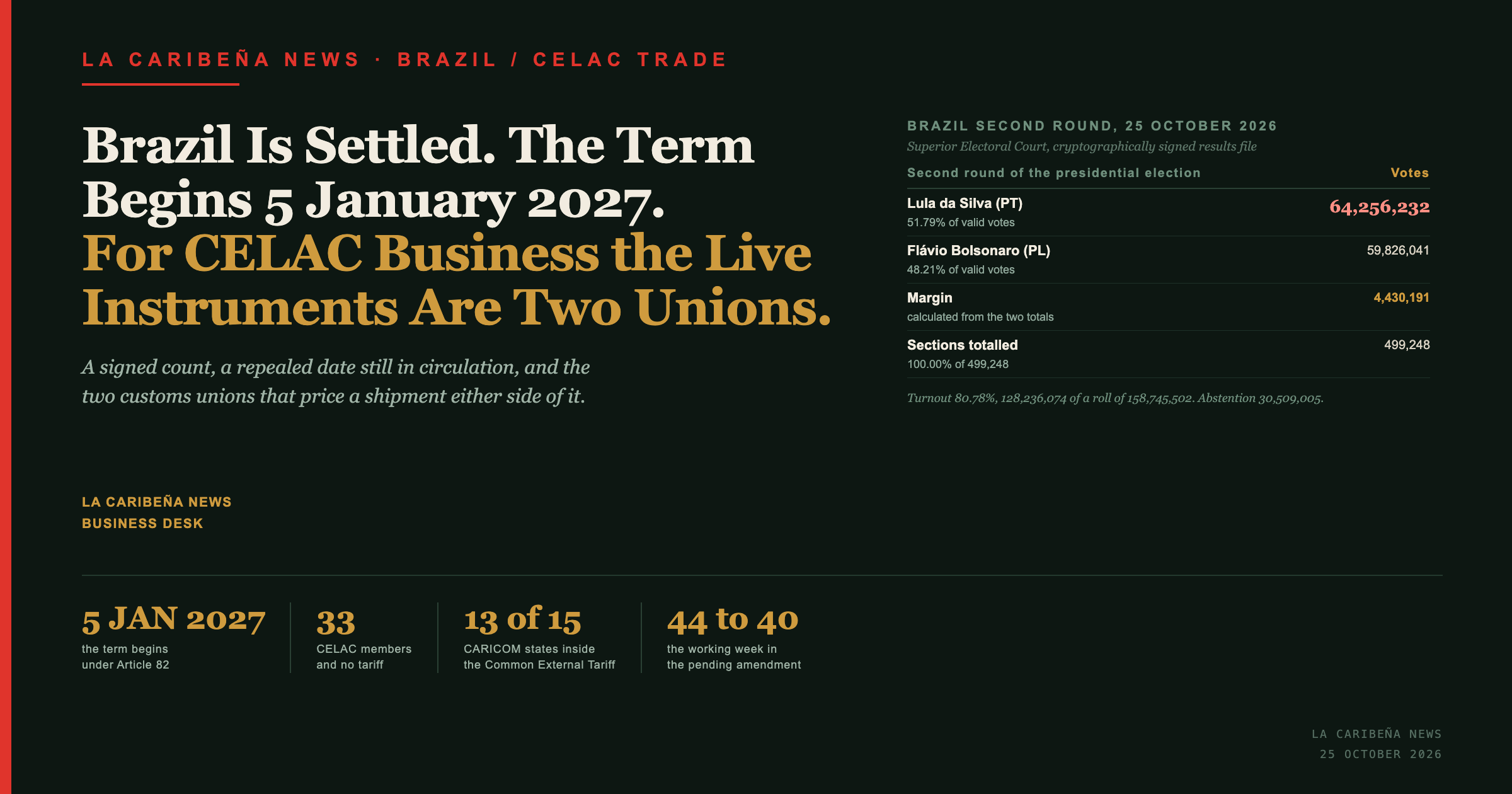
What the title card shows
Every data point on the article's title card, in text.
- 51.79%. The President's share of valid votes in the second round. Source: the Superior Electoral Court's signed results file, 25 October 2026.
- 48.21%. Flávio Bolsonaro's share of valid votes. Source: as above.
- 4,430,191. The margin in votes, calculated from the two totals in the same file.
- 100.00%. Sections totalled, 499,248 of 499,248. Source: as above.
- 5 January 2027. The date the term begins, under Article 82 as amended by Emenda Constitucional 111 de 2021.
- 13 of 15. CARICOM member states inside the Common External Tariff. Source: La Caribeña News, 21 October 2026.
- 44 to 40. The change in Brazil's maximum working week in the amendment approved by the Senate on 14 October 2026. Source: La Caribeña News, 15 October 2026.
Frequently Asked Questions
Who won Brazil's 2026 presidential runoff, and by how much?
President Luiz Inácio Lula da Silva took 51.79 per cent of valid votes, or 64,256,232, against 48.21 per cent and 59,826,041 for Flávio Bolsonaro, a margin of 4,430,191 votes, with all 499,248 sections totalled on 25 October 2026 according to the Superior Electoral Court's cryptographically signed results file.
When does the new Brazilian presidential term begin?
On 5 January 2027. Article 82 of the Constitution was amended by Emenda Constitucional 111 of 2021 to move the start of the term from 1 January to 5 January of the year following the election.
Does CELAC set a tariff that businesses pay?
No. CELAC is a forum of heads of state and government across thirty-three countries and issues declarations. The schedules that determine landed cost in the Caribbean are CARICOM's Common External Tariff, which covers 13 of 15 member states, and in South America the Mercosur customs union.
What should a Caribbean exporter watch in Brazil before January?
Mercosur's external negotiating posture, because whether the bloc negotiates jointly decides how many external schedules an exporter prices against, and the constitutional amendment cutting Brazil's maximum working week from 44 hours to 40, which has not completed its passage and moves a competing cost base.
Has the Brazilian result been certified?
Not yet. The court records the count as complete and the election as mathematically defined, which is separate from the formal certification, and no certification date appears in the signed result.