By LCN Compliance Desk
Cuba's Soviet-influenced system of central planning and state control "is exhausted", Carlos Fernández de Cossío, the deputy foreign minister and one of Havana's main interlocutors with Washington, told The Atlantic in an interview in Washington, D.C., published on Wednesday, 16 September. Cuba needs an economy "more dependent on financial instruments, on the market economy, with a much greater role for the private sector", he told the magazine's Vivian Salama, with the state remaining a participant.
He made the case while the United States tightens the sanctions it has widened since 1 May, and while Cuba's Caribbean neighbours move food, medicine and solar panels to the island through a banking system that has repeatedly turned their payments back.
What did Fernández de Cossío tell The Atlantic?
He described the reforms under way as the "most significant social and economic transformations" in Cuba in 60 years, The Atlantic reported. "The country has changed. We've changed demographically. Our human resources have changed. The world has changed," he said. "We've come to the conclusion this year that, in spite of that, we cannot delay any more the transformation that we need to put in place in Cuba."
He asked for no aid package. "We're not asking for a grant. We're not asking for gifts or favors. We want the U.S. to stop punishing the Cuban economy," he said, naming the restrictions on Americans travelling to, trading with and investing in Cuba. Travel runs the other way under restriction too: Proclamation 10998 limited entry from Cuba in December 2025, as La Caribeña News reported, and Cuban visitors have posted a US visa bond since 6 January, alongside Antigua and Barbuda, Dominica and Grenada (Antigua Pays a US$20,000 Visa Bond). American companies "could invest" and "could have a better relation with the emerging private sector in Cuba", he said, adding: "They could even claim a victory."
He called relations with Washington "bilateral contacts", not negotiations, The Atlantic reported. Foreign Minister Bruno Rodríguez told reporters in Havana on 7 September that "there are no negotiations or agendas, although a willingness to stay in contact remains", Reuters reported, and put the damage from the embargo in 2025 at US$8.1 billion. The Atlantic noted that Havana treats its political system as nonnegotiable and that Cuba remains a one-party state. Cuban outlet Periódico Cubano reported the interview as an admission made on American soil.
What does Washington say?
A White House official told The Atlantic in a written response that Cuba "has been horribly run for years" and that the United States is "ready to open a new chapter in the relationship", adding: "The only thing standing in the way of a better future are those who control Cuba for their own gain at the expense of the Cuban people." Secretary of State Marco Rubio said in March that economic and political freedom "come hand in hand", the magazine reported.
CIA Director John Ratcliffe travelled to Havana on 14 May to deliver President Donald Trump's message that the United States was prepared to engage on economic and security issues "only if Cuba makes fundamental changes", a CIA official told The Associated Press, as reported by NPR. Ratcliffe met Raúl Castro's grandson, Raúl Guillermo Rodríguez Castro, and Interior Minister Lázaro Álvarez Casas.
What has Cuba changed so far?
In June the government approved 176 measures expanding private business, foreign investment and private participation in banking, and giving investors a larger role in state-owned companies, The Atlantic reported. The package opens direct foreign investment in private and cooperative Cuban enterprises for the first time, according to Horizonte Cubano at Columbia Law School. Cubans living abroad may now own or invest in businesses on the island.
How have US sanctions tightened this year?
Executive Order 14404, signed on 1 May, allows sanctions on any foreign person operating in Cuba's energy, defence, mining, financial or security sectors. La Caribeña News has followed each round:
- 17 September: four nickel companies, four military research centres and three officers, the third round in four weeks to reach the nickel industry (Washington Blocked Cuba's Nickel Producer in August).
- July and August: the Ministry of Tourism, the maritime group GEMAR and the foreign trade group GECOMEX, set beside actions on Ecuador and Venezuela (In Six Weeks, One US Office Froze a Tourism Ministry).
- July: Spain's Meliá ended its Cuban operations, citing sanctions (Meliá Exits Cuba).
- January to July: international visitors fell to 37.2 per cent of the same period in 2025 (Cuba Lost Two Thirds of Its Visitors).
- Beyond Cuba: the same office designated Colombia's sitting president (The Sanctioned President) and licensed six companies to work Venezuela's oil while excluding any Cuban counterparty (Washington Licensed Six Companies).
Mexico's state oil company Pemex paused exports to Cuba this year after the United States seized Nicolás Maduro in January, The Atlantic reported. Cuba had received Venezuelan crude for two decades, and the US licences now governing Venezuelan oil bar any transaction with a person in Cuba, as La Caribeña News reported on General Licence 50C and on BP and Shell's Venezuelan authorisations. Nationwide blackouts now span days, Reuters reported, and Rodríguez described "long months spent living with only 2 or 3 hours of electricity a day or less".
What is CARICOM doing for Cuba?
Caribbean Community (CARICOM) heads of government agreed at their 50th meeting in St Kitts and Nevis in February, the same meeting that restated support for Guyana on Essequibo (Venezuela Has Taken Its Energy Talks to Three CARICOM Capitals), to support humanitarian efforts in Cuba, the chairman, Prime Minister Terrance Drew, announced on 27 February, according to the CARICOM Secretariat. The Secretariat in Georgetown coordinates the purchase of powdered milk and baby formula, beans, flour, rice, canned goods, basic medical supplies, solar panels, batteries and water tanks on behalf of member states, and Mexico identifies suppliers and ships the goods from Mexico to Cuba free of charge, the Secretariat stated on 24 March.
The money was harder to move than the milk. Funds sent to buy baby formula were rejected three times before clearing, Barbados Prime Minister Mia Mottley said at the close of the 51st heads meeting in Saint Lucia in July, Kaieteur News reported. "Nobody is going to release the milk without payment, and because we are shipping it to Cuba, therefore the process goes through enhanced due diligence," she said. "Humanitarian relief comes above everything else, because none of us can give back life to anybody." Banks that process transactions for sanctioned parties risk losing US correspondent accounts, the pressure behind the region's decade of de-risking that La Caribeña News has covered in A Designation Is Not a Conviction, After the Jenec Ruling and Lima Hosts the Hemisphere's Compliance Congress, where Cuba sits in GAFILAT and no CARICOM state does. Mottley said CARICOM had told Washington and Havana it stands ready to help facilitate talks. The heads' communiqué records their agreement to "continue its coordinated efforts to provide humanitarian support to the people of Cuba".
The shipment that landed in Havana in early September was the 13th of its kind to reach Cuba's Ministry of Foreign Trade and Investment, and Barbados contributed food, mainly powdered milk, Barbados Today reported, quoting Barbados's ambassador to CARICOM, David Comissiong: "It took CARICOM some time to implement that decision because the American blockade has made it very, very difficult to send anything into Cuba." OFAC has said it does not intend to target non-US persons under the order for supplying food, medicine and medical devices to Cuba, in FAQ 1264.
CARICOM's foreign ministers, meeting as the Council for Foreign and Community Relations, "unequivocally" affirmed Cuba's "sovereign right to import and receive fuel" and condemned the obstruction of its energy supplies in a statement of 27 May, according to the Secretariat. Guyana and Trinidad and Tobago reserved their positions on that statement.
What has CELAC said?
At their summit in Bogotá on 21 March 2026, the heads of state and government of the Community of Latin American and Caribbean States (CELAC) adopted a declaration whose paragraph 7 reiterates the need to end the economic, commercial and financial embargo on Cuba, opposes laws with extraterritorial effects, and states that Cuba's designation as a state sponsor of terrorism has created obstacles to international financial transactions with the island, according to the Declaration of Bogotá.
Eleven member states dissociated from that paragraph, according to a footnote to the declaration: Argentina, Bolivia, Chile, Costa Rica, Ecuador, El Salvador, Honduras, Panama, Paraguay, Peru, and Trinidad and Tobago. Guyana dissociated from the sentences on extraterritorial laws and the terrorism designation while remaining with the call to end the embargo.
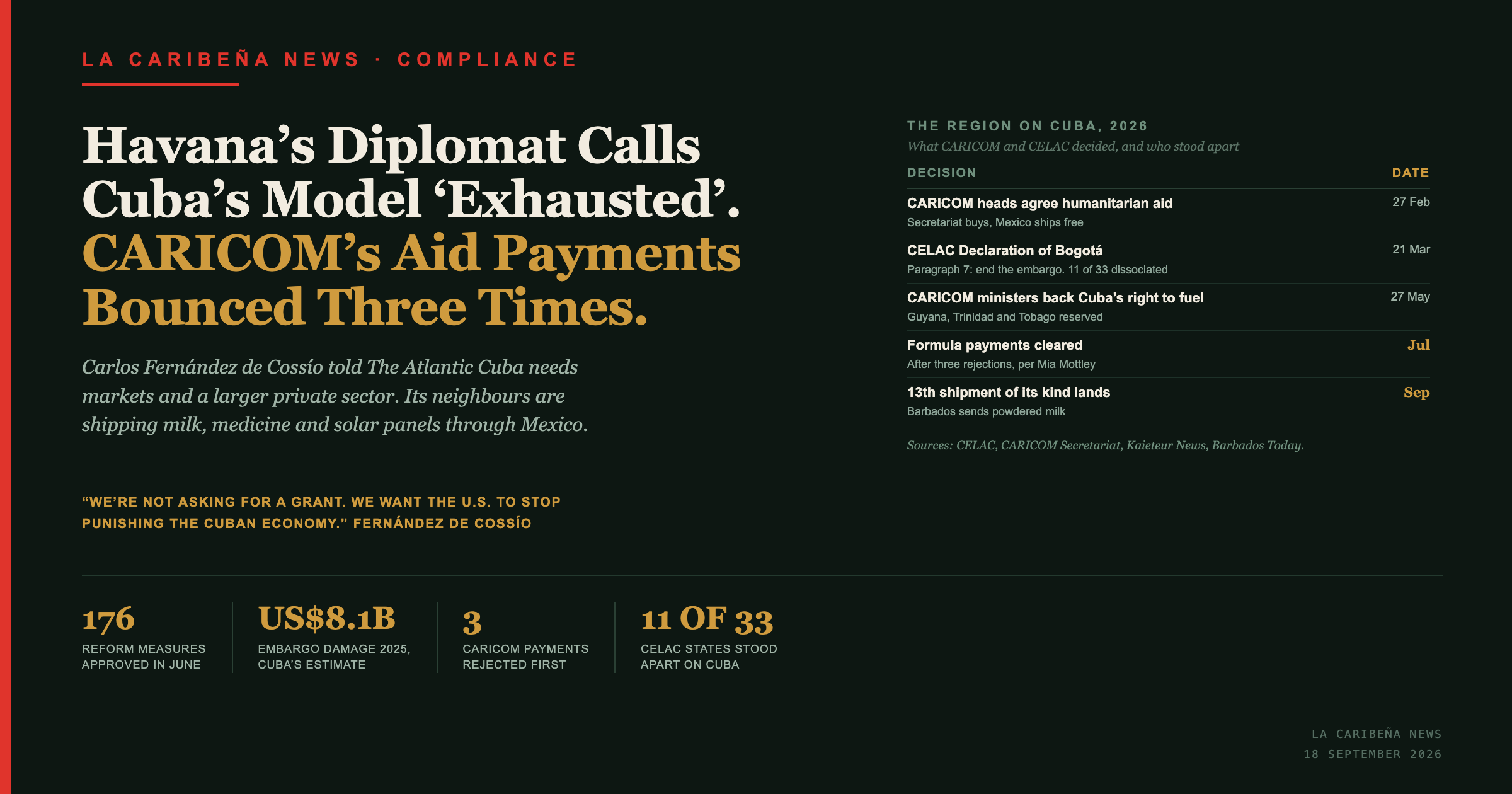
What the title card shows
- Quotation: Cuba's system of central planning and state control "is exhausted", Carlos Fernández de Cossío, The Atlantic, 16 September 2026. Source: The Atlantic.
- Reforms: 176 measures approved in June 2026. Sources: The Atlantic, Horizonte Cubano.
- Embargo damage, 2025: US$8.1 billion, Cuba's estimate. Source: Reuters.
- CARICOM aid: decided February 2026; 13th shipment of its kind landed September 2026, per Barbados Today; baby-formula payments rejected three times before clearing. Sources: CARICOM Secretariat, Barbados Today, Kaieteur News.
- CELAC: 11 of 33 members dissociated from the Cuba paragraph of the Declaration of Bogotá; Guyana in part. Source: Declaration of Bogotá.
Frequently Asked Questions
What did Cuba's deputy foreign minister say about the economic model?
Carlos Fernández de Cossío told The Atlantic, in an interview published on 16 September 2026, that Cuba's system of central planning and state control "is exhausted" and that the economy needs financial instruments, markets and a much greater role for the private sector, with the state remaining a participant.
Are Cuba and the United States negotiating?
Cuban officials say no. Fernández de Cossío called relations "bilateral contacts", and Foreign Minister Bruno Rodríguez said on 7 September that there are no negotiations or agendas. The White House says the United States is ready to open a new chapter if Cuba changes.
What aid has CARICOM sent to Cuba?
Food, including powdered milk and baby formula, basic medical supplies, solar panels, batteries and water tanks, bought by the CARICOM Secretariat for member states and shipped by Mexico free of charge. A shipment including Barbadian powdered milk landed in Havana in early September 2026, the 13th of its kind to reach Cuba's trade ministry, Barbados Today reported.
Do all CARICOM and CELAC members back Cuba's position on sanctions?
No. Guyana and Trinidad and Tobago reserved their positions on CARICOM's May 2026 statement, and eleven CELAC members, Trinidad and Tobago among them, dissociated from the Cuba paragraph of the Declaration of Bogotá, with Guyana dissociating in part.
CARICOM's aid now reaches a government whose deputy foreign minister calls its own economic model exhausted, under sanctions that Washington ties to change in the political system Havana says it will not negotiate.
Disclosure: EICCIO Advisors, which shares ownership with this newspaper, advises businesses on sanctions compliance.