By LCN Business Desk
Two notices, eight days apart, on one corridor.
The carrier filed them under different headings, Surcharges and Rates, so on its own news feed they appear as two unrelated items. Both reach the Caribbean.
What do the two notices say?
One is a surcharge with an expiry date. The other is an increase with none.
Hapag-Lloyd AG published both on its own CustomerNEWS service, under its own tariff headings.
| Peak Season Surcharge | General Rate Increase | |
|---|---|---|
| Notice dated | 6 October 2026 | 14 October 2026 |
| Effective | 5 November 2026 | 15 November 2026 |
| Duration | 30 days | Until further notice |
| Amount | US$500 per 20ft, US$1,000 per 40ft dry container | US$1,000 per standard container |
| Applies to | Long-term shipments only | Ocean Tariff rates |
| Filed under | Surcharges, Latin America | Rates, Latin America |
Source: Hapag-Lloyd CustomerNEWS, notices of 6 and 14 October 2026.
The surcharge notice sets out its own scope:
"A Peak Season Surcharge (PSS) from East Coast South America to the United States, Canada, Mexico, Caribbean, Central America, South America West Coast, Colombia, Venezuela and Suriname is coming up."
The increase notice sets out its own:
"A General Rate Increase (GRI) from South America East Coast to South America West Coast, North America, Central America and the Caribbean for cargo transported in standard containers is coming up. This GRI will apply from November 15, 2026."
Which services carry the increase?
Three, each at the same figure, and one of them is the Caribbean service.
| Corridor | Service | Increase |
|---|---|---|
| South America East Coast to South America West Coast | CON | US$1,000 per standard container |
| South America East Coast to North America, Central America and the Caribbean | GS1 | US$1,000 per standard container |
| South America East Coast to North America East Coast | SEC | US$1,000 per standard container |
Source: Hapag-Lloyd CustomerNEWS, 14 October 2026.
The increase is the same US$1,000 whether the box is 20ft or 40ft, because it is written per standard container with no size split. The surcharge published eight days earlier is written the conventional way, with the 40ft at double the 20ft.
Where do the two overlap?
Between 15 November and early December, on cargo that meets both notices' conditions.
The surcharge runs 30 days from 5 November. For the three weeks from 15 November in which both are live, a 40ft dry container carries US$1,000 of surcharge and US$1,000 of increase.
That stack is not automatic. The surcharge is "applicable to long-term shipments only". The increase is written against Ocean Tariff rates. A box takes both only where both conditions are met, and the notices do not state that the two populations are the same.
What survives December is the increase. Nothing in its notice commits the carrier to a date for removing it.
What is not in either notice?
Guyana, a reason, and the surcharges that sit on top.
Neither notice names Guyana. Both name the Caribbean as a region, and the surcharge notice names Suriname individually, separately from the Caribbean, which leaves the question of where Guyana sits unanswered on the face of the documents.
Hapag-Lloyd does serve the country. It lists an office entry at Georgetown, held by its agent MAPOR Guyana Inc on New Market Street, North Cummingsburg. But the carrier's office directory files Guyana, Suriname, Trinidad and Tobago, Barbados, Aruba and Belize all under Latin America, so the directory is a different arrangement from the tariff schedule and cannot settle a tariff question.
Neither notice gives a reason. There is no capacity figure, no utilisation figure and no explanation beyond the headings Rates and Surcharges.
And neither is the whole bill. The increase notice places the commodity scope and the bunker, security, terminal handling and peak season charges behind separate links, then adds a line of its own: "Please keep in mind that local and contingency charges may also apply."
Why does a South America corridor matter when the canal was the story?
Because the exposure the region was warned about was never only about the canal.
The Caribbean Private Sector Organisation put the number on it in September. It estimated US$8 billion to US$10 billion of CARICOM's annual imports exposed to Panama Canal restrictions, about a quarter to a third of the non-fuel import bill, with US$4.5 billion to US$7 billion transiting the canal directly and the rest consolidated through United States ports. That assessment, and Patrick Antoine's account of where the cost lands, was set out in The Panama Canal Cut Its Daily Booking Slots to 32. The auction prices behind it were examined in A Ship Paid US$5.3 Million to Cross the Panama Canal, and the loading limits that started it in Panama Has Cut the Canal's Loading Limit Four Times in Nine Weeks.
These two notices are a different mechanism reaching the same place. No canal slot is involved. The corridor is the Atlantic coast of South America, and the instrument is the carrier's own tariff.
The CPSO's warning included the quieter half of the problem, that when capacity tightens and carriers rationalise port calls, small markets lose sailing frequency first. A carrier redeploying for commercial reasons rather than physical ones does the same thing, as the Caribbean found when MSC Cancelled Five Months of Brooklyn Sailings and Moved the Meraviglia to Miami.
What does an ocean rate do to the price on the shelf?
It moves the base that duty is then calculated on.
Duty in the Caribbean is assessed on landed value, so freight is inside the figure the Common External Tariff applies to rather than beside it. A US$85 million import line taxed at 20 per cent was traced through that machinery in Sanitary Pads Enter the Caribbean at 20 Per Cent Duty. The scale of what the region buys from outside, on CARICOM's own published series, was set out in CARICOM's Published Trade Totals Cover 13 of Its 15 Member States.
The ocean leg is also only the first leg. Where cargo has to move again after the wharf, the second leg has its own constraint, which is the subject of A 1959 Ferry Is Still Alongside at Bartica.
What happens on 5 December?
The date the surcharge lapses, and whether the increase is still on the tariff after it.
On 5 December the 30 days on the surcharge expire. Whether the corridor returns to its October level or settles US$1,000 above it is answered by the tariff in December, not by either notice published in October.
The entities
- Hapag-Lloyd AG is the German container line that published both notices.
- CustomerNEWS is the carrier's own channel for tariff and service notices, filtered by topic and region.
- General Rate Increase (GRI) is an increase to Ocean Tariff rates on a stated corridor.
- Peak Season Surcharge (PSS) is a time-limited charge added to a stated corridor.
- GS1 is the service named for North America, Central America and the Caribbean.
- CON is the service to the South America West Coast, and SEC the service to the North America East Coast.
- MAPOR Guyana Inc is the carrier's agent in Georgetown.
- Caribbean Private Sector Organisation (CPSO) is the CARICOM associate institution that estimated the region's canal exposure.
- Common External Tariff is the CARICOM arrangement under which duty is assessed on landed value.
What the title card shows
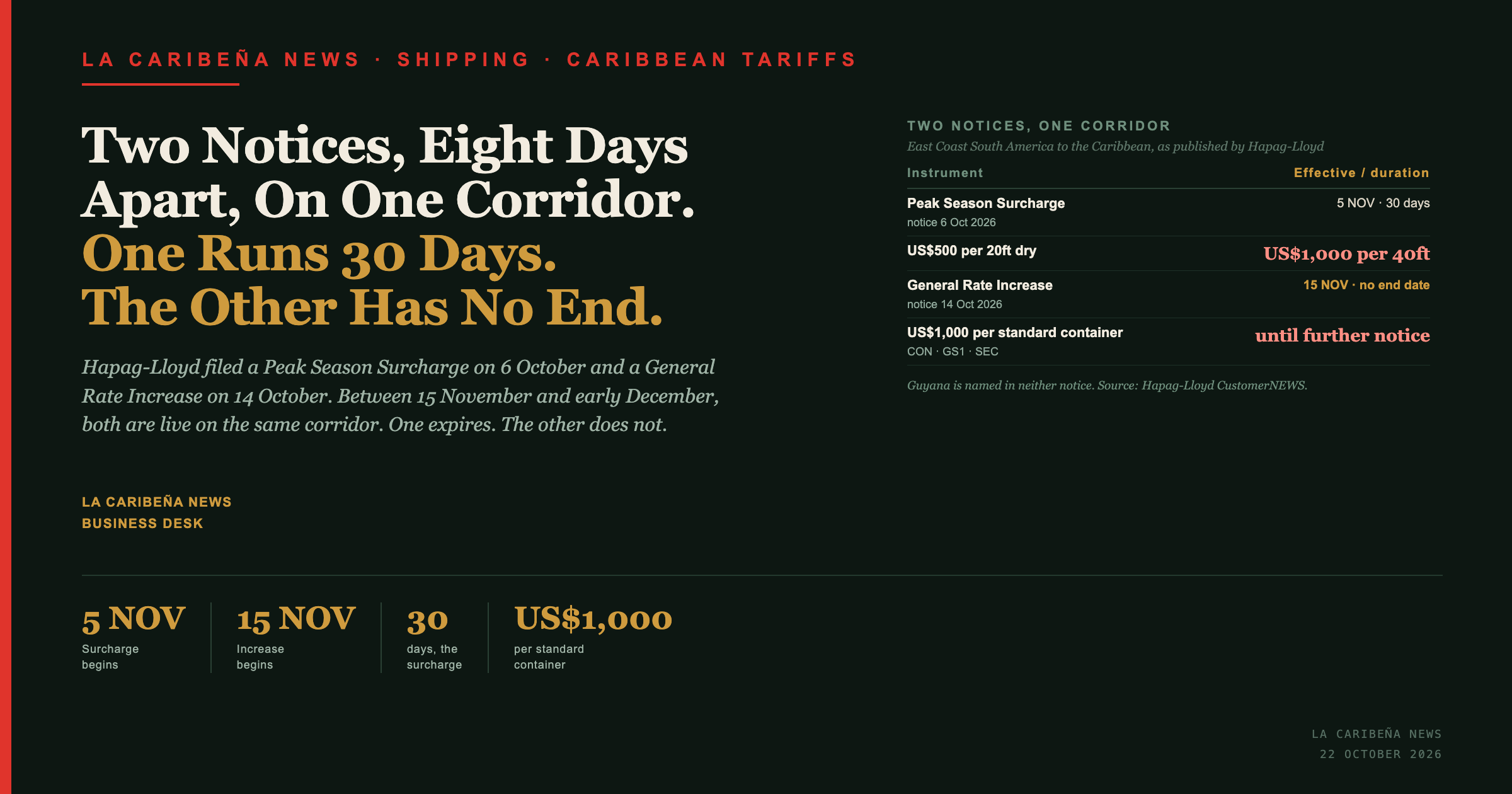
Every data point on the article's title card, in text.
- 5 NOV. Date the Peak Season Surcharge begins. Source: Hapag-Lloyd CustomerNEWS, 6 October 2026.
- 15 NOV. Date the General Rate Increase begins. Source: Hapag-Lloyd CustomerNEWS, 14 October 2026.
- 30. Days the surcharge runs, against no end date on the increase.
- US$1,000. The increase, per standard container.
- Panel, Peak Season Surcharge, notice of 6 October 2026: effective 5 November, 30 days. US$500 per 20ft dry container, US$1,000 per 40ft.
- Panel, General Rate Increase, notice of 14 October 2026: effective 15 November, no end date. US$1,000 per standard container on the CON, GS1 and SEC services, until further notice.
- Panel note: Guyana is named in neither notice. Source: Hapag-Lloyd CustomerNEWS.
Frequently Asked Questions
What did Hapag-Lloyd announce for the Caribbean in November 2026?
Two things. A Peak Season Surcharge effective 5 November 2026 for 30 days, at US$500 per 20ft and US$1,000 per 40ft dry container, and a General Rate Increase effective 15 November 2026 at US$1,000 per standard container, valid until further notice.
Which corridor do they apply to?
Cargo from the East Coast of South America. The surcharge covers the United States, Canada, Mexico, the Caribbean, Central America, the South America West Coast, Colombia, Venezuela and Suriname. The increase covers the South America West Coast, North America, Central America and the Caribbean.
Does the increase apply to Guyana?
The notice does not name Guyana. It names the Caribbean as a region, and the surcharge notice names Suriname separately from the Caribbean. Hapag-Lloyd serves Guyana through an agent in Georgetown, but the carrier's office directory is not its tariff schedule and does not answer the question.
How much is the increase on a 40ft container?
US$1,000, the same as on a 20ft. The increase is written per standard container with no size split, unlike the surcharge published eight days earlier.
When does the surcharge end?
Thirty days from 5 November 2026, so in early December. The increase has no end date and is stated as valid until further notice.
Do both charges apply to the same cargo?
Not necessarily. The surcharge is applicable to long-term shipments only and the increase is written against Ocean Tariff rates. Both apply only where both conditions are met, and the notices do not state that the two populations are the same.
Is this connected to the Panama Canal restrictions?
No. These notices concern the Atlantic coast of South America and involve no canal transit. The Caribbean Private Sector Organisation separately estimated US$8 billion to US$10 billion of CARICOM imports exposed to canal restrictions, of which US$4.5 billion to US$7 billion transits the canal directly.
Does freight affect the duty paid on an import?
Yes. Duty in the Caribbean is assessed on landed value, which includes freight, so an ocean rate change moves the base the Common External Tariff is applied to.