By LCN Business Desk
On 4 November a Caribbean head of government is either in St John's or in Madrid. Which one depends on whether the country's former coloniser spoke English or Spanish.
What is happening on 4 November?
Two summits of heads of government, both convening the Americas.
CHOGM 2026 runs 1 to 4 November 2026 in St John's, Antigua and Barbuda, under the theme "Accelerating Partnerships and Investment for a Prosperous Commonwealth", bringing together leaders from 56 Commonwealth nations, according to the Commonwealth Secretariat. The operation moving its delegates is being bought from private operators, with more than 400 drivers registered against a state school bus fleet of about 40.
The XXX Cumbre Iberoamericana de Jefas y Jefes de Estado y de Gobierno runs 4 and 5 November in Madrid, dates announced in September 2025 by Spain's Minister of Foreign Affairs, European Union and Cooperation, José Manuel Albares. King Felipe VI presides as head of state. Spain was chosen by consensus in 2024, and this is its fourth time hosting after 1992, 2005 and 2012. It is the thirtieth summit, falling 35 years after the first, held in Mexico in 1991. The motto is "Iberoamérica. Juntos construimos nuestra Comunidad. Juntos la proyectamos hacia el futuro y hacia el mundo."
How many states sit at both tables?
None.
| Member states | In the Americas | |
|---|---|---|
| Commonwealth | 56 | 13 |
| Ibero-American Conference | 22 | 19 |
| Shared between them | 0 | 0 |
Sources: the Commonwealth Secretariat's member list and the Spanish government's own summit page.
The Ibero-American Conference admits Spanish-speaking and Portuguese-speaking states. The Commonwealth Caribbean speaks English. Each grouping is assembled on a shared language and no state in this hemisphere qualifies for both, so neither room has an attendee who will be in the other.
Which Caribbean countries go where?
Twelve to St John's, two to Madrid, and two to neither.
| CARICOM member | 4 November |
|---|---|
| Antigua and Barbuda, The Bahamas, Barbados, Belize, Dominica, Grenada, Guyana, Jamaica, Saint Lucia, St Kitts and Nevis, St Vincent and the Grenadines, Trinidad and Tobago | St John's |
| Haiti | neither |
| Suriname | neither |
| Cuba, Dominican Republic (outside CARICOM membership, see below) | Madrid |
Haiti and Suriname are full members of CARICOM. Haiti is francophone and Creole-speaking, Suriname is Dutch-speaking, and neither language admits a state to either grouping.
Montserrat is a fifteenth full CARICOM member and a British Overseas Territory rather than a sovereign state, so it sits outside both summits' membership for a different reason again.
Eight associate members sit alongside the fifteen: Anguilla, Bermuda, the British Virgin Islands, the Cayman Islands, Curaçao, French Guiana, Martinique and the Turks and Caicos Islands. Three are French or Dutch territories, none is a sovereign state, and none has a seat at either summit.
Cuba and the Dominican Republic are neither full nor associate members, which is not the same as having no standing with CARICOM. The Community has a free trade agreement with the Dominican Republic, cited in Caribbean Export's own programme documents alongside the CSME and the Economic Partnership Agreement. It has a Trade and Economic Cooperation Agreement with Cuba, whose Second Protocol was signed on 9 November 2017 and under which Cuba granted 326 duty-free items against CARICOM's 74; CARICOM's treaty page records one ratification, by Saint Vincent and the Grenadines on 4 August 2020, and no entry-into-force date. So the two states crossing to Madrid are not strangers to the body meeting in St John's. They hold agreements with it and no seat in it.
Does the arithmetic close?
It does.
Twelve Commonwealth Caribbean states and nineteen American Ibero-American states account for 31 of the 33 members of the Community of Latin American and Caribbean States. The residual is two. CELAC has thirty-three members and, as this newspaper has reported, no common external tariff and no schedule a customs officer reads, so its summits settle declarations rather than duties. It is the only one of the three groupings that holds every state in both rooms, and it does not meet on 4 November.
What is Madrid actually convening on?
Five priorities, set by the Spanish Secretaría Pro Tempore.
Organisation of each summit sits with the Secretaría Pro Tempore, held for two years by the next host, alongside the Secretaría General Iberoamericana (SEGIB), the body that coordinates cooperation among the 22 member states from Madrid with offices in Mexico City, Lima and Montevideo.
Little of the agenda is being decided at the summit. Each priority arrives through a dated ministerial meeting held over the preceding year, and Madrid ratifies what those produced.
| What goes to Madrid | Where it was settled |
|---|---|
| Agenda Medioambiental Iberoamericana, a sustainability roadmap to 2030 proposing stronger national early-warning systems | Málaga, 25 and 26 March 2026 |
| Carta Iberoamericana de Cuidados y Apoyos | Avilés, 2 and 3 July 2026 |
| The roadmap on mutual recognition of studies and qualifications | Alicante, 21 and 22 October 2026 |
| Alianza Digital Iberoamericana | Foro Digital Iberoamericano, Madrid, 3 November 2026 |
Source: the Government of Spain.
The fifth priority, the planning of Ibero-American cooperation from 2027, is the one with no preparatory meeting behind it and no instrument yet attached.
Where do the two agendas do the same work twice?
Three subjects, in two rooms.
| The subject | In Madrid | In the Caribbean |
|---|---|---|
| Disaster risk | A Red Iberoamericana de Reducción de Riesgo de Desastres, constituted at the summit | CDEMA, the Caribbean Disaster Emergency Management Agency, already running |
| Qualifications that travel | A roadmap for mutual recognition of studies and titles, joint and double degrees | The Caribbean Vocational Qualification, assessed against CARICOM-approved occupational standards |
| Road safety | "Un espacio común de seguridad vial" on the summit agenda | National programmes, with no common Caribbean instrument on the public record |
A single storm track crosses Cuba, the Dominican Republic, Haiti, Jamaica and the Bahamas inside a week. On 4 November, Cuba and the Dominican Republic are in Madrid constituting one disaster-risk network, Jamaica and the Bahamas are in St John's within reach of CDEMA, and Haiti is in neither room.
Two mutual-recognition projects are being advanced in the same fortnight by two bodies with no common member, so a credential built to travel under one has no stated standing under the other. A nurse, an electrician or a transport operator moving between Santo Domingo and Port of Spain is in that position now.
What is settled, and what is not?
The dates, the memberships and the agendas are settled. The consequences are not.
Both sets of dates are the convening bodies' own, and both membership rosters are published by the bodies that maintain them. No state appears on both.
Not established: whether any Ibero-American observer arrangement gives a Commonwealth Caribbean state a seat in Madrid, since the summit admits associated and consultative observers and the public page does not name them; whether either summit's declaration will reference the other; and whether Haiti or Suriname has been invited in any observer capacity to either. Neither secretariat has published anything indicating the calendar was coordinated.
An Indian government briefing records that Brazil notified CELAC on 16 January 2020 that it was suspending its participation. On the public record there is no confirmation that the suspension was reversed, so 33 is the roster and not a count of current participants. Brazil is an Ibero-American member either way and will be in Madrid.
Two summits, one hemisphere, one shared day, and no shared chair.
The entities
- Commonwealth Heads of Government Meeting (CHOGM) is the biennial summit of Commonwealth heads of government, meeting 1 to 4 November 2026 in St John's, Antigua and Barbuda.
- Commonwealth Secretariat is the Commonwealth's intergovernmental body, and the source for the 56-member count and the CHOGM dates and theme.
- XXX Cumbre Iberoamericana is the thirtieth Ibero-American Summit of Heads of State and Government, in Madrid on 4 and 5 November 2026, presided over by King Felipe VI.
- Ibero-American Conference is the community of 22 Spanish-speaking and Portuguese-speaking states of Europe and the Americas whose heads of state and government the summit convenes.
- Secretaría General Iberoamericana (SEGIB) is the body that coordinates cooperation among the 22 member states, headquartered in Madrid with offices in Mexico City, Lima and Montevideo, and its Secretary-General is Andrés Allamand.
- Secretaría Pro Tempore is held for two years by the next host country, which is Spain, and organises the summit alongside SEGIB.
- José Manuel Albares is Spain's Minister of Foreign Affairs, European Union and Cooperation, who announced the Madrid dates in September 2025.
- CELAC is the Community of Latin American and Caribbean States, a 33-member forum of heads of state and government that is the only one of the three groupings containing every state in both rooms.
- CARICOM is the Caribbean Community, with 15 full members including Haiti, Suriname and Montserrat, and 8 associate members.
- CDEMA is the Caribbean Disaster Emergency Management Agency, the Caribbean's existing disaster-risk mechanism.
- Caribbean Vocational Qualification (CVQ) is the Community's competency-based regional qualification, assessed against CARICOM-approved occupational standards.
- Red Iberoamericana de Reducción de Riesgo de Desastres is the disaster-risk network whose constitutive meeting takes place at the Madrid summit.
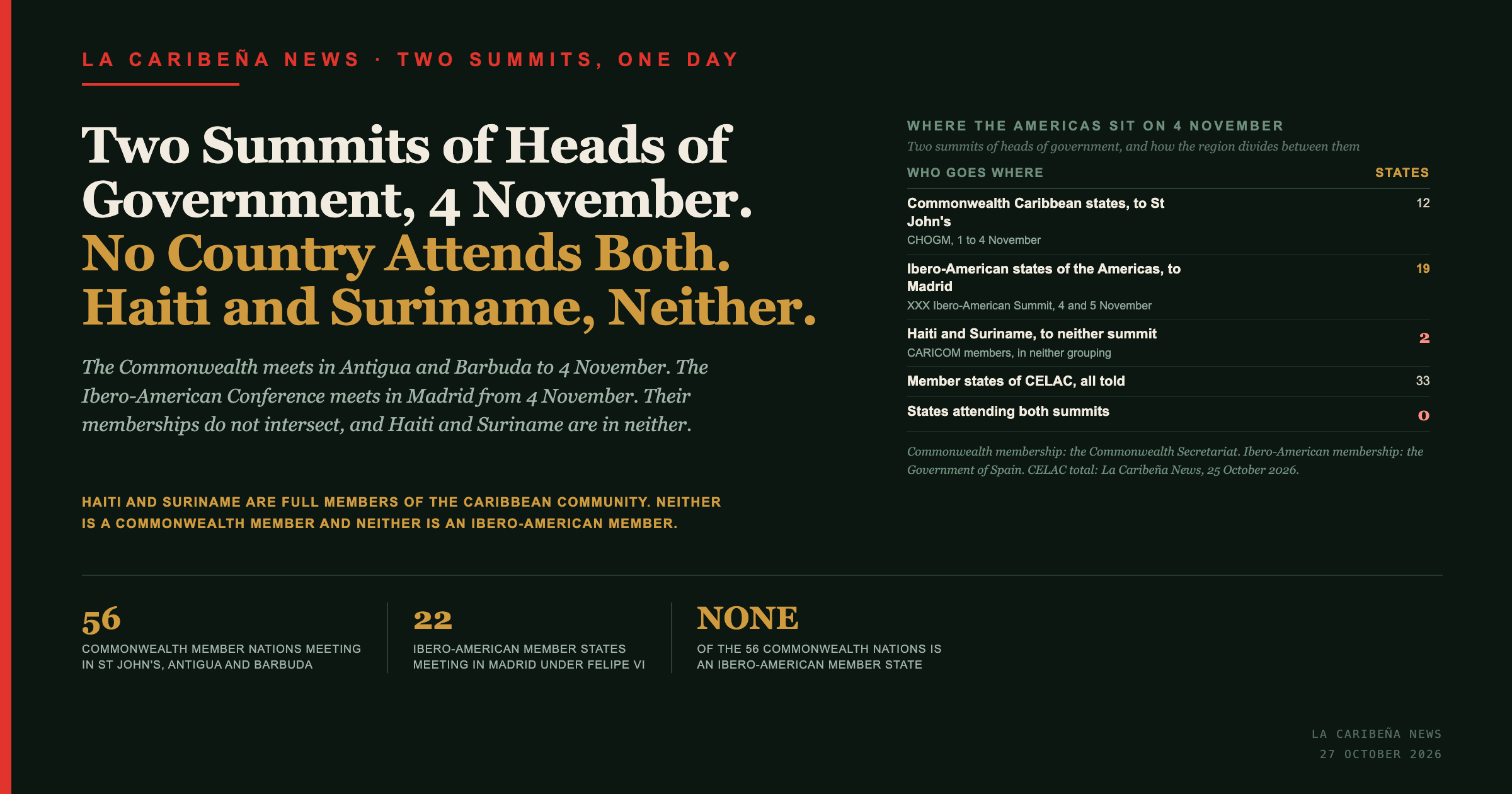
What the title card shows
Every data point on the article's title card, in text.
- 4 November 2026. The day both summits sit. Source: the Commonwealth Secretariat and the Spanish government.
- 0. States attending both. Source: the two bodies' own membership lists.
- 2. CARICOM members attending neither, Haiti and Suriname. Source: as above.
- 56. Commonwealth member nations. Source: the Commonwealth Secretariat.
- 22. Ibero-American Conference member states. Source: the Spanish government's summit page.
- 33. CELAC member states. Source: La Caribeña News, 25 October 2026.
Frequently Asked Questions
When and where are the two summits?
CHOGM 2026 runs 1 to 4 November 2026 in St John's, Antigua and Barbuda, with 56 Commonwealth nations, per the Commonwealth Secretariat. The XXX Ibero-American Summit of Heads of State and Government runs 4 and 5 November 2026 in Madrid, presided over by King Felipe VI, with the 22 member states of the Ibero-American Conference. Both sit on 4 November.
Does any country attend both summits?
No. The Commonwealth's 13 member countries in the Americas are Antigua and Barbuda, The Bahamas, Barbados, Belize, Canada, Dominica, Grenada, Guyana, Jamaica, Saint Lucia, St Kitts and Nevis, St Vincent and the Grenadines and Trinidad and Tobago. The Ibero-American Conference's 22 members are Andorra, Argentina, Bolivia, Brazil, Colombia, Costa Rica, Cuba, Chile, the Dominican Republic, Ecuador, El Salvador, Spain, Guatemala, Honduras, Mexico, Nicaragua, Panama, Paraguay, Peru, Portugal, Uruguay and Venezuela. No state appears on both lists.
Which Caribbean countries have no seat at either summit?
Haiti and Suriname. Both are full CARICOM members, neither is a Commonwealth member and neither is an Ibero-American member. Montserrat, a fifteenth full CARICOM member, is a British Overseas Territory rather than a sovereign state and sits outside both memberships for that reason.
What is on the Madrid summit's agenda?
Five priorities set by the Spanish Secretaría Pro Tempore: an Alianza Digital Iberoamericana, with a Foro Digital Iberoamericano on 3 November; cooperation on natural disasters, including the constitutive meeting of a Red Iberoamericana de Reducción de Riesgo de Desastres; a Carta Iberoamericana de Cuidados y Apoyos; mutual recognition of studies and qualifications; and the planning of Ibero-American cooperation from 2027. The Agenda Medioambiental Iberoamericana and a common road-safety space also go to the summit.
Why does the split matter to a Caribbean business?
Two mutual-recognition projects for qualifications are being advanced in the same fortnight by bodies with no common member, so a credential built to travel under one has no stated standing under the other. Two disaster-risk networks will cover one hurricane basin. An employer or a worker moving between a Commonwealth Caribbean state and a Spanish-speaking one is working across both systems with nothing joining them on the day.