By LCN Wire
Argentina moved against the Malvinas oil industry three times in four days in the week of 4 September. On the Friday President Javier Milei vowed to sanction oil companies drilling in the British overseas territory. On the Saturday the world's three largest oil-services companies said they would not take part. On the Monday the presidency announced a criminal complaint against the company that actually operates the field.
In the same week, a Chilean city agreed to open a commercial sea route to the islands.
What did Argentina announce?
The Buenos Aires Herald reported that Argentina is suing oil companies over the Sea Lion drilling project in the Malvinas, and the BBC reported that Buenos Aires will file a criminal case against an oil company operating in the Falklands. The Guardian reported that foreign minister Pablo Quirno will file the criminal complaint against several Navitas subsidiaries and partners operating in the territory, along with their corporate directors, according to a statement from the presidency. Reuters and The Telegraph carried the same development.
The Guardian reported that Milei's government alleges Navitas Petroleum violated Argentine law by holding hydrocarbon exploration and exploitation licences issued by the United Kingdom in the North Falkland Basin. Navitas did not immediately reply to a request for comment, The Guardian reported.
What did the oil-services companies say?
Página/12 reported that SLB announced it would not provide services in the Malvinas, and La Nación reported that SLB confirmed it would not take part in any activity in the islands. Clarín reported that the three largest oil-services companies in the world announced they would not do business there.
Noticias Mundo reported that Schlumberger, Halliburton and Baker Hughes issued statements on the Saturday afternoon saying they do not take part and do not foresee taking part in hydrocarbon projects near the islands. That outlet reported Milei later shared the news on X with the acronym "TMAP", todo marcha de acuerdo al plan.
What is Argentina doing to enforce the exclusion?
Noticias Mundo reported that Argentina will investigate possible links between 45 entities and projects to exploit hydrocarbons around the islands, citing a Presidency communiqué that did not name them. The Argentine Foreign Ministry stated on its own site that "none of the global oil companies based in our country will participate in activities in disputed areas."
A second instrument reaches the shipping lane rather than the oilfield. El Mostrador reported a decree requiring authorisation for ships travelling to or from the islands.
How does the Punta Arenas route cut across that?
La Nación reported that the route would connect Punta Arenas with Puerto Argentino/Stanley, with the shipping firm Easter Island handling the stretch and the first trip expected in November. The islands' only maritime connection to South America until now has been Montevideo, a voyage of nearly 2,000 kilometres, the outlet noted, while Punta Arenas cuts that distance roughly in half.
Los Andes reported, citing Chile's El Mercurio, that the Falkland Islands Development Corporation closed a contract with the Chilean carrier Easter Island, which currently covers the subsidised Valparaíso-Easter Island route. Los Andes named Punta Arenas mayor Claudio Radonich (RN) as one of the main drivers and reported that a Malvinas trade delegation would visit Punta Arenas on 28 and 29 September. Emol and Página|12 also carried the story.
Emol reported the agreement came amid weeks of strain between Chile and Argentina, including remarks by the head of Argentina's Air Force claiming sovereignty over part of the Strait of Magellan. El Mostrador reported the initiative could again strain relations with Buenos Aires because of the authorisation decree, and quoted former Navy chief Julio Leiva, who warned, "Obviously, there is going to be a problem."
Why does this matter to CELAC?
The Community of Latin American and Caribbean States (CELAC) has taken a standing position on the islands, and its Caribbean members are signatories to it. At the VIII CELAC Summit in Kingstown, Saint Vincent and the Grenadines, on 1 March 2024, heads of state and government reiterated their "firmest support for the legitimate rights of the Argentine Republic" in the sovereignty dispute over the Malvinas, South Georgia and the South Sandwich Islands, called for negotiations to resume, and described the situation as an anachronistic colonial situation on American soil.
That position is not new to the Caribbean. At the CELAC summit in Costa Rica in January 2015, thirteen Caribbean Commonwealth states signed the same language: Antigua and Barbuda, The Bahamas, Barbados, Belize, Dominica, Grenada, Guyana, Jamaica, Saint Kitts and Nevis, Saint Lucia, Saint Vincent and the Grenadines, Suriname, and Trinidad and Tobago. The declaration reiterated "their strongest support to the legitimate rights of Argentina in the sovereignty dispute" and expressed the region's permanent interest in Argentina and the United Kingdom resuming negotiations.
Chile is a CELAC member and signed those declarations. A Chilean municipality has now contracted a Chilean carrier to sail a commercial route to the islands, with the Falkland Islands Development Corporation as its counterparty, and a delegation from the islands arrives in Punta Arenas on 28 September. Argentina is prosecuting a company in Buenos Aires for holding licences the United Kingdom issued over the same waters.
Who is actually developing Sea Lion?
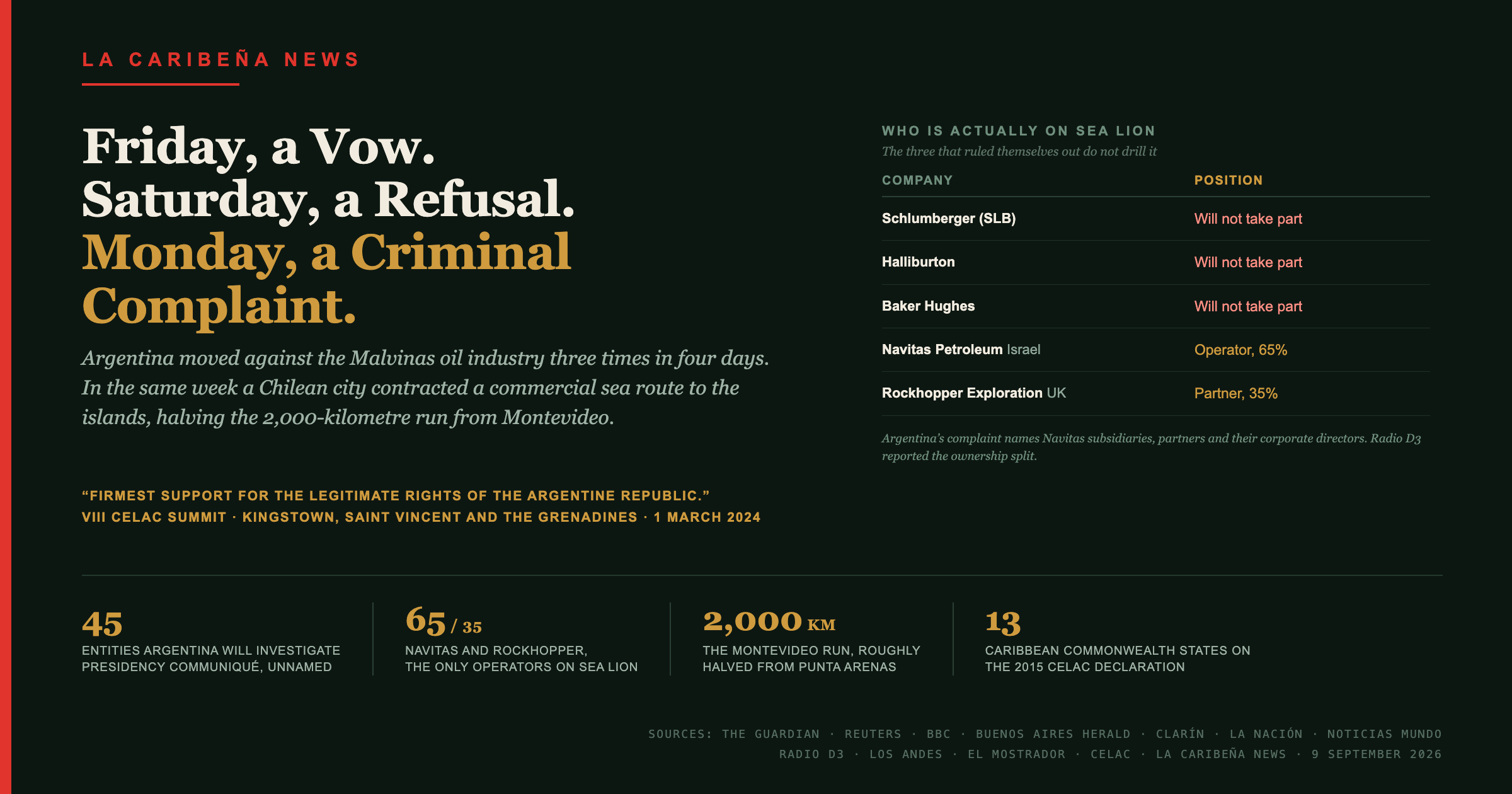
Radio D3 reported that the Sea Lion project is driven not by the international majors but by Navitas Petroleum of Israel and Rockhopper Exploration of the United Kingdom, with Navitas controlling 65 percent and operating the project and Rockhopper holding the remaining 35 percent. Neither is among the three companies that ruled themselves out, and neither is based in Argentina, where the Foreign Ministry drew its line.
What does the title card show?
The title card carries the four-day sequence as its headline, a table headed "Who is actually on Sea Lion", and the CELAC declaration wording.
- Schlumberger (SLB), Halliburton and Baker Hughes: will not take part. Source: Noticias Mundo, La Nación, Clarín, Página/12.
- Navitas Petroleum, Israel: operator, 65 percent. Rockhopper Exploration, United Kingdom: partner, 35 percent. Source: Radio D3.
- 45, the number of entities Argentina will investigate over hydrocarbon projects around the islands, unnamed in the Presidency communiqué. Source: Noticias Mundo.
- Roughly 2,000 kilometres, the Montevideo run, roughly halved from Punta Arenas. Source: El Mostrador and Emol.
- 13, the Caribbean Commonwealth states that signed the 2015 CELAC declaration. Source: MercoPress.
- Quoted on the card: "firmest support for the legitimate rights of the Argentine Republic", VIII CELAC Summit, Kingstown, Saint Vincent and the Grenadines, 1 March 2024.
Frequently Asked Questions
What has Argentina charged, and against whom?
The Guardian reported that foreign minister Pablo Quirno will file a criminal complaint against several Navitas Petroleum subsidiaries and partners operating in the territory, along with their corporate directors, according to a statement from the presidency. It reported the government alleges they violated Argentine law by holding United Kingdom-issued hydrocarbon licences in the North Falkland Basin.
Which companies said they will not work in the Malvinas?
Noticias Mundo reported that Schlumberger, Halliburton and Baker Hughes issued statements saying they do not take part and do not foresee taking part in hydrocarbon projects near the islands. La Nación, Clarín and Página/12 carried the same development.
What is CELAC's position on the islands?
At the VIII CELAC Summit in Kingstown on 1 March 2024, heads of state and government reiterated their firmest support for Argentina's legitimate rights in the sovereignty dispute and called for negotiations to resume. Thirteen Caribbean Commonwealth states signed the same language at the 2015 summit in Costa Rica.
When is the first Punta Arenas sailing planned?
La Nación, Emol and El Mostrador all reported the first trip is expected in November. Los Andes reported that a Malvinas trade delegation would visit Punta Arenas on 28 and 29 September.
Who operates Sea Lion?
Radio D3 reported that Navitas Petroleum of Israel operates the project with 65 percent, and Rockhopper Exploration of the United Kingdom holds 35 percent.
The three companies that ruled themselves out do not drill Sea Lion. The two that do are an Israeli operator and a British partner, and the complaint names their subsidiaries, their partners and their directors. The delegation lands at Punta Arenas on 28 September and the first sailing is set for November, against a decree that requires authorisation for the voyage.