By LCN Business Desk
The Falkland Islands Government announced on Monday that it is extending all existing offshore hydrocarbons production licences for an initial five years, with a further two years at its discretion, and said the decision has "the full support of the UK Government", MercoPress reported. The licences are all in their exploration term, and the extension is conditional on satisfactory progress by the licence holders against their work programmes.
The islands' Department of Mineral Resources is working with holders on enhanced work programmes for the extension period, including commitments to drill additional appraisal wells, MercoPress reported. The statement did not say how many licences are covered or who holds them. Registered holders include Rockhopper Exploration, through its subsidiaries Falkland Oil & Gas and Desire Petroleum, and Navitas Petroleum Development and Production.
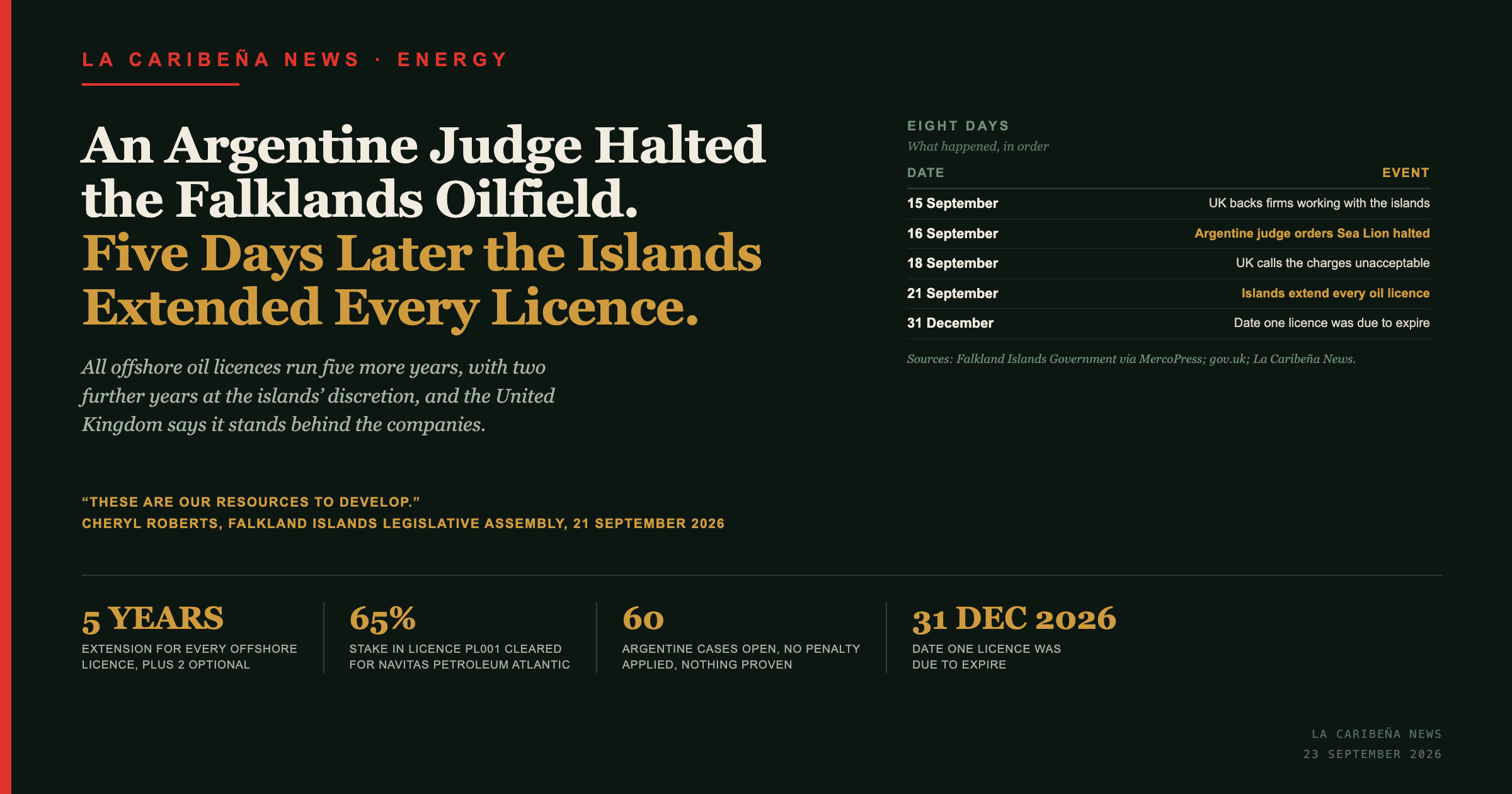
"These are our resources to develop, and we will ensure they are developed responsibly, in line with best global practice with regards to environmental and safety standards, in order to deliver long-term benefits to current, and future generations of Falkland Islanders," said Cheryl Roberts, the member of the Legislative Assembly who holds the trade, industry and mineral resources portfolio. She said the extensions "provide security to operators, enabling them to continue to invest and develop their acreage".
What else did the government approve?
The transfer of a majority stake in one licence area. Navitas Petroleum Atlantic Limited has been cleared to acquire 65 per cent of licence area PL001, in a deal announced on 2 March that had been waiting for that authorisation, MercoPress reported. JHI Associates keeps the remaining 35 per cent through its subsidiary JHI Falkland. The block covers about 1,126 square kilometres in roughly 500 metres of water, and borders PL032 to the west, where the Sea Lion project is being developed. JHI puts its combined prospects at 3.1 billion barrels, with the Tyche and Dinlas prospects at about 400 million recoverable barrels each; those are company estimates and are not independently verified.
The timing was set by a deadline. The PL001 licence was due to expire on 31 December this year, and its partners had been negotiating an extension since early 2026. Under the islands' rules, a production licence permits the search for and extraction of petroleum, but a development plan must still be approved before commercial production starts, and the holders must appoint an operator acceptable to the Governor, according to the Falkland Islands Government.
What happened in the eight days before the announcement?
| Date | Event |
|---|---|
| 15 September | The United Kingdom published guidance for companies and individuals doing business in or with the islands, including those developing its natural resources, offering help to any that receive legal threats from Argentine authorities |
| 16 September | An Argentine federal judge in Río Grande ordered Rockhopper and Navitas to halt drilling, subsea installation and first production at Sea Lion until an Argentine environmental assessment is carried out |
| 18 September | Britain's Minister for the Overseas Territories called the proceedings against those companies unacceptable |
| 21 September | The Falkland Islands Government extended all offshore production licences by five years, with UK support |
Sources: MercoPress for the guidance and the extension; the ministerial statement on gov.uk; and La Caribeña News's report of the court order.
"In recent weeks, Argentina has continued to threaten businesses and individuals supplying goods and services, directly and indirectly, to the Falkland Islands, including in the hydrocarbons sector," the Minister for the Overseas Territories, Uma Kumaran, said on 18 September. "These charges against companies and individuals are unacceptable, with no legal justification... The UK Government and our diplomatic network stands fully behind those businesses and individuals."
What did the Argentine court order say?
Judge Mariel Borruto ordered the two companies, "in so far as it depends on them", to stop drilling, subsea installation, the start-up of a floating production unit and the start of commercial extraction, until an environmental impact assessment is carried out before Argentina's national environmental authority. The same ruling said enforcement "depends on international cooperation and the conduct" of the companies. La Caribeña News reported the order in full in An Argentine Judge Has Ordered Sea Lion Halted.
Argentina claims sovereignty over the islands and holds that licences granted by the Falkland Islands Government are invalid. It has 60 administrative proceedings open with no penalty applied, three criminal complaints covering ten companies and their directors, and last Thursday sent Congress a bill extending prohibitions to all natural resources on the continental shelf, MercoPress reported. None of the allegations has been proven. Three oil-services companies have said they will not take Sea Lion work, as La Caribeña News reported in Argentina Charges the Sea Lion Operator.
Why does this matter in Guyana?
Because the shape is familiar. Guyana licenses and produces oil in a country whose neighbour claims two thirds of its territory, and it has taken that claim to the International Court of Justice. The support Georgetown receives on Essequibo, and what it does not settle, was set out in Support on Essequibo Is the Floor. Caracas has taken its energy talks to three CARICOM capitals since April, reported in Venezuela Has Taken Its Energy Talks to Three CARICOM Capitals.
What the islands' government did on Monday is what a licensing authority does when a claim is pressed against its licensees: it extended the terms, named the work it wants in return, and published the backing of the state that administers it. Guyana's own licensing questions run the other way, towards what its agreements promise companies if the law changes, reported in Guyana Has Promised Five Mining Companies That If the Law Changes, the State Pays.
The extension does not put a rig on location. The licences remain in their exploration term, the enhanced work programmes are still being negotiated, and the companies still need an approved development plan before commercial production can begin.
What the title card shows
- Five years: the extension granted to every offshore production licence, with two further years at the government's discretion. Source: MercoPress.
- 5 days: between the Argentine court order halting Sea Lion and the extension. Source: La Caribeña News, MercoPress.
- 65 per cent: the stake in licence area PL001 that Navitas Petroleum Atlantic has been cleared to acquire, with JHI Associates keeping 35 per cent. Source: MercoPress.
- 60 administrative proceedings: open in Argentina against companies linked to the islands' economy, with no penalty applied, alongside three criminal complaints covering ten companies. None of the allegations has been proven. Source: MercoPress.
- 31 December 2026: the date the PL001 licence was due to expire. Source: MercoPress.
Frequently Asked Questions
What did the Falkland Islands Government announce?
It extended all existing offshore hydrocarbons production licences for five years, with two further years at its discretion, subject to satisfactory progress against work programmes. It also approved Navitas Petroleum Atlantic's acquisition of 65 per cent of licence area PL001.
Does the extension override the Argentine court order on Sea Lion?
They are separate. The order was issued by an Argentine federal judge and its own text says enforcement depends on international cooperation and the conduct of the companies. The licences are granted by the Falkland Islands Government, whose authority Argentina does not recognise.
Who holds the Falklands offshore licences?
The government did not name them in its statement. Registered holders include Rockhopper Exploration, through Falkland Oil & Gas and Desire Petroleum, and Navitas Petroleum Development and Production.
Does the extension mean production is about to start?
No. The licences are in their exploration term, work programmes for the extension period are still being agreed, and a development plan must be approved before commercial production begins.