By LCN Opinion
Twice this year, the Heads of Government of the Caribbean Community (CARICOM) have restated their "unequivocal and unwavering support" for Guyana's sovereignty and territorial integrity. That support is real, it is unanimous, and it matters in a case now before the International Court of Justice.
It is also not the whole of what the region has said.
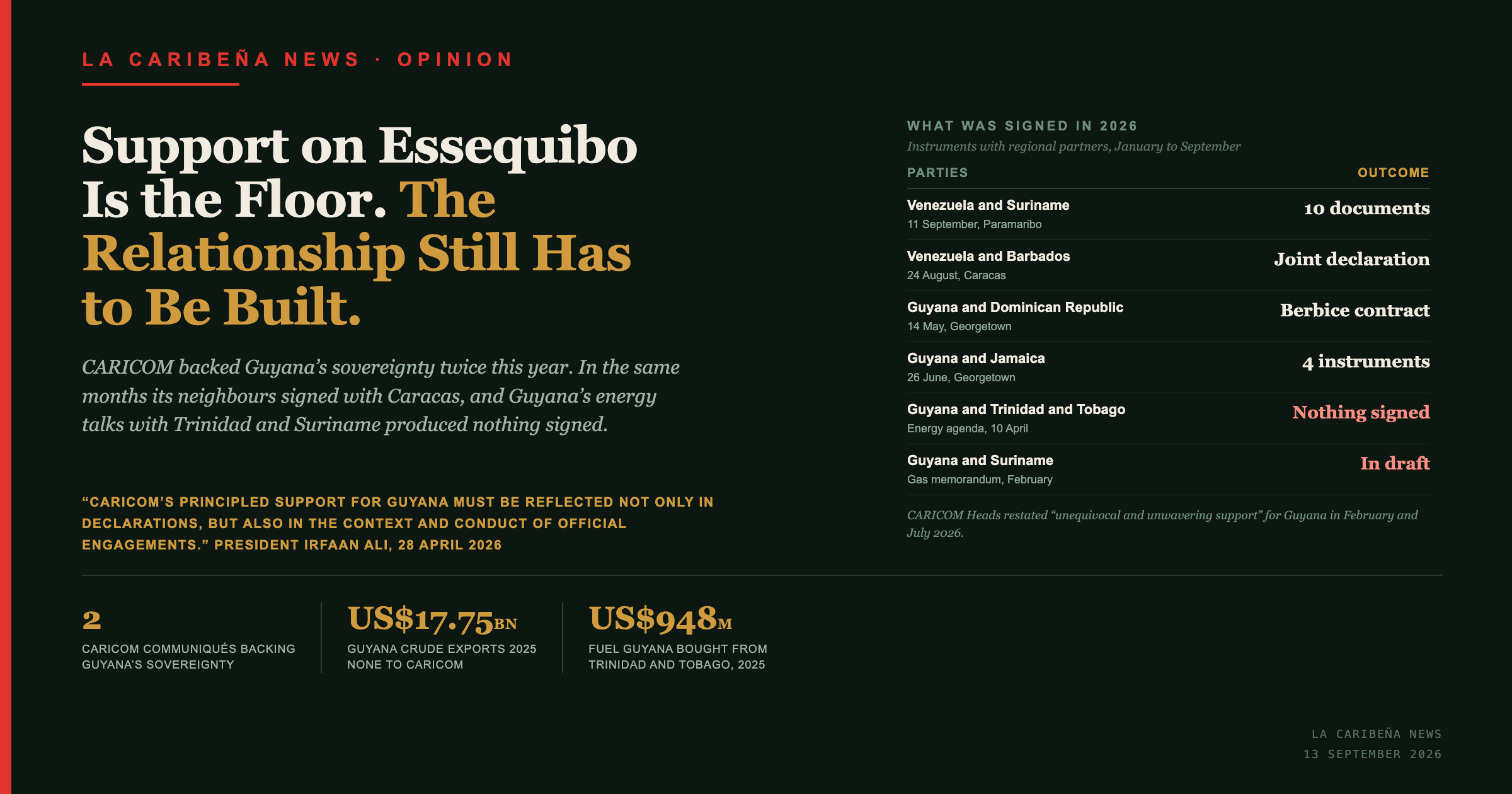
In the same months, Venezuela's Interim President, Delcy Rodríguez, made her first foreign visit as leader to Grenada. She went to Barbados, where Prime Minister Mia Mottley later travelled to Caracas to sign a joint declaration on energy and hydrocarbons. On Friday she signed ten documents in Paramaribo with Suriname. Trinidad and Tobago's Prime Minister says she hopes to meet her in New York this month. The record of those visits, and of Guyana's own, is set out in this newspaper's report.
None of those leaders has endorsed Venezuela's claim, and no CARICOM government has declined to meet her. Each is doing what small states do, which is to keep every door open.
What are the region's leaders saying by what they do?
That solidarity on the border and partnership on everything else are two separate things, and they intend to keep them separate.
CARICOM said so in writing. Its statement of 28 April, issued after Rodríguez wore a brooch mapping Essequibo into Venezuela at official engagements in St George's and Bridgetown, drew a line against Community platforms being used to advance the claim. The same statement affirmed each member state's sovereign right to conduct its own bilateral relations.
President Irfaan Ali named the gap between those two sentences the same day. "CARICOM's principled support for Guyana must be reflected not only in declarations," he wrote to the CARICOM Chairman that day, "but also in the context and conduct of official engagements."
He was right about the brooch. The larger point applies beyond it. Declarations cost a Head of Government nothing. What a government chooses to sign, and with whom, is where interest shows.
Why is Guyana not the region's energy partner?
Because, on the record, it has not yet become one.
Guyana exported US$17.75 billion of crude oil in 2025. None of it was declared to a CARICOM member state. Trinidad and Tobago has asked for Guyanese hydrocarbons since 2024 and has no agreement. A gas memorandum with Suriname, announced in February, was still being drafted in May. Guyana's neighbours sell it fuel: US$948 million worth from Trinidad and Tobago last year, and US$149 million from Suriname.
There are good reasons for some of this. Most of Guyana's crude is lifted and sold by the oil companies that produce it, not allocated by ministers. Guyana wants its own refining and its own gas for its own grid, and a country whose capital lost power this month has reason to put its grid first. And Guyana cannot court Caracas the way its neighbours can. Venezuela is its adversary in a court case, and armed attacks on Guyanese soldiers have come from Venezuelan territory this year.
Guyana has also done real work. It signed a contract giving the Dominican Republic a stake in the Berbice Block. It signed four instruments with Jamaica. Barbadians and Guyanese can now travel between their countries on national identity cards.
But the neighbours with the most at stake in energy, Trinidad and Tobago and Suriname, have nothing signed with Guyana on energy. Venezuela, whose own oil operators now need licences issued in Washington, travelled to Paramaribo and signed ten documents in a day.
What does the region's support actually guarantee?
A floor, and nothing above it.
The floor is valuable. It has held in every communiqué this year. It does not buy gas pipelines, refinery feedstock, shared grids or the habit of turning first to Georgetown. Those are built the way Venezuela is building them this year: by turning up in other capitals, with something to sign.
Guyana has what its neighbours lack, which is oil, gas and the money that follows them. Oil wealth alone has not made it the region's partner. The Caribbean has been clear about that, in the most polite way it knows, by its conduct.
The support on Essequibo will stay. The relationship above it is still Guyana's to build.
Frequently Asked Questions
Does CARICOM support Guyana on Essequibo?
Yes. CARICOM Heads of Government restated their unequivocal support for Guyana's sovereignty and territorial integrity in February and July 2026, and a CARICOM statement on 28 April said Community platforms must not be used to legitimise Venezuela's claim.
Which CARICOM leaders have engaged with Venezuela's Interim President this year?
Grenada's Prime Minister Dickon Mitchell hosted her in April, Barbados' Prime Minister Mia Mottley met her in Bridgetown and Caracas and signed a joint declaration, and Suriname's President Jennifer Geerlings-Simons signed ten documents with her on 11 September 2026.
Does Guyana supply oil or gas to CARICOM countries?
Guyana's customs data show no crude exported to any CARICOM member in 2025. Trinidad and Tobago's request for Guyanese hydrocarbons and a proposed gas arrangement with Suriname have not produced signed agreements.