By LCN Compliance Desk
A federal judge in Río Grande, Tierra del Fuego, on Wednesday, 16 September, ordered the British company Rockhopper Exploration and the Israeli company Navitas Petroleum to halt work on the Sea Lion oilfield, 220 kilometres north of the Malvinas, until an environmental impact assessment is carried out before Argentina's national environmental authority, according to Infobae, La Nación and The Associated Press, each of which obtained a copy of the ruling. The order is a precautionary measure, not a final judgment.
The same 17-page resolution concedes a limit on its own reach. Enforcement "depends on international cooperation and the conduct" of the two companies, Judge Mariel Borruto wrote, as quoted by AP and El Cronista. The United Kingdom administers the islands and does not recognise the jurisdiction of Argentine courts over them, the Buenos Aires Times reported.
What does the order stop?
Judge Borruto ordered the two companies, "in so far as it depends on them", to refrain from "initiating, continuing, executing or having executed" material acts on the project, which the ruling calls León Marino, including any extension and any well or installation functionally integrated into it, according to Infobae. The prohibition covers:
- drilling of the seabed or marine subsoil to develop or produce hydrocarbons;
- permanent subsea infrastructure, pipelines, flowlines, control systems and mooring structures;
- installation or start-up of a floating production, storage and offloading unit;
- the start of commercial extraction;
- onshore and port works in support of the project, including port expansions, a logistics base, plants for drilling mud and cement, chemical stores, housing and aviation facilities (Infobae, La Nación).
The order runs until the assessment required by Argentina's General Environmental Law, Law 25.675, is completed and the competent authority rules, or until the court decides otherwise, La Nación reported. "The risk is neither hypothetical nor remote," the judge wrote, citing the project's final investment decision in December 2025 and contracts already signed for a floating production unit and a drilling rig, Infobae reported.
On what grounds did the judge rule?
The decisive evidence was a negative. A report from the environmental impact assessment directorate of Argentina's Under-Secretariat of Environment, dated 24 February 2026, stated that no project notice had been lodged and no assessment had been opened with either company, according to Infobae and El Cronista. The ruling treats Law 25.675 and Law 26.659, which governs hydrocarbon activity on the Argentine continental shelf, as mandatory and immediately applicable "regardless of the nationality of the companies" or of licences issued by other authorities, El Cronista reported.
The judge did not find that environmental damage will occur. "It is not asserted that the environmental damage alleged will occur, nor could that be asserted at this stage," she wrote, according to Infobae. Her reasoning rests on the precautionary principle: "Not because the harm has been shown, but because whoever had to assess it did not, and intends to carry out the work without doing so," El Cronista quoted. The claim, as summarised in the ruling, describes a development of 23 wells: 16 producers, six water injectors and one remote gas injector, Infobae reported.
The ruling states that it makes no pronouncement "on the validity of acts issued by third States", El Cronista reported, while describing the defence of national sovereignty as an indivisible collective good and a federal interest that underlies the case. The claimants are the La Plata Malvinas War Veterans Centre (CECIM) and the Association of Environmental Lawyers and Professionals (AAdeAA), whose filing is published on the association's site.
What must Rockhopper and Navitas disclose?
Within ten working judicial days of notification, the companies must file a sworn statement with supporting documents covering the construction, drilling and production schedule; the number, location and status of wells; the floating units and rigs contracted; the main contractors and subcontractors; the corporate structure; the banks and funds that financed Sea Lion, with disbursements made, committed and pending; the insurers and reinsurers; and the environmental studies, spill models and contingency plans, according to La Nación and Infobae. They must also preserve all related technical, corporate, contractual, financial and insurance records.
The judge held two requests back. She declined, for now, a general ban on new financing contracts, disbursements, transfers, capital contributions, intra-group loans and guarantees, on the ground that such a broad restriction could reach operations and third parties not yet identified, and she deferred notices to foreign stock exchanges and regulators, according to El Cronista and Infobae. "Effective protection of the environment does not require dispensing with proportionality or the right of defence," she wrote.
Enrique Viale, president of the environmental lawyers' association, told Infobae that the claimants will pursue the project's financial structure next. "Oil companies do not do it alone, they have banks, insurers," he said. "Without financing there is no project."
How have the companies responded?
Rockhopper declined to comment on the injunction and Navitas did not immediately respond, AP reported. Before the ruling, on 4 September, the partners said in a statement to the Tel Aviv Stock Exchange, republished by Rockhopper, that they operate under "valid petroleum licenses lawfully granted" by the Government of the Falkland Islands "with the full and ongoing support of the UK Government", and that recent developments were "not expected to have a material effect" on the project's development timetable.
Commercial production is expected to start in 2028, according to AP and Infobae. Navitas provides 65 per cent of the project's financing and Rockhopper the remainder, La Nación reported.
What other legal action is Argentina taking?
Separately, Federal Court No. 11 in Buenos Aires opened a criminal investigation, case CFP 4492/2026, into Desire Petroleum on the request of federal prosecutor Carlos Stornelli, following a complaint by the Foreign Ministry, and asked for the same corporate and banking information on the Rockhopper group, Infobae reported. The court ordered a letter rogatory to the United Kingdom for Desire's full corporate records since 2012.
The government has filed three criminal complaints against Navitas and nine other companies and their executives and is preparing legislation to broaden sanctions on companies in oil projects around the islands, AP reported. La Caribeña News reported on 9 September the complaint against the Sea Lion operator, and the statements by SLB, Halliburton and Baker Hughes that they would not take part in projects near the islands. At the VIII CELAC Summit in Kingstown on 1 March 2024, Latin American and Caribbean heads of state reiterated their "firmest support for the legitimate rights of the Argentine Republic" in the sovereignty dispute, as La Caribeña News also reported.
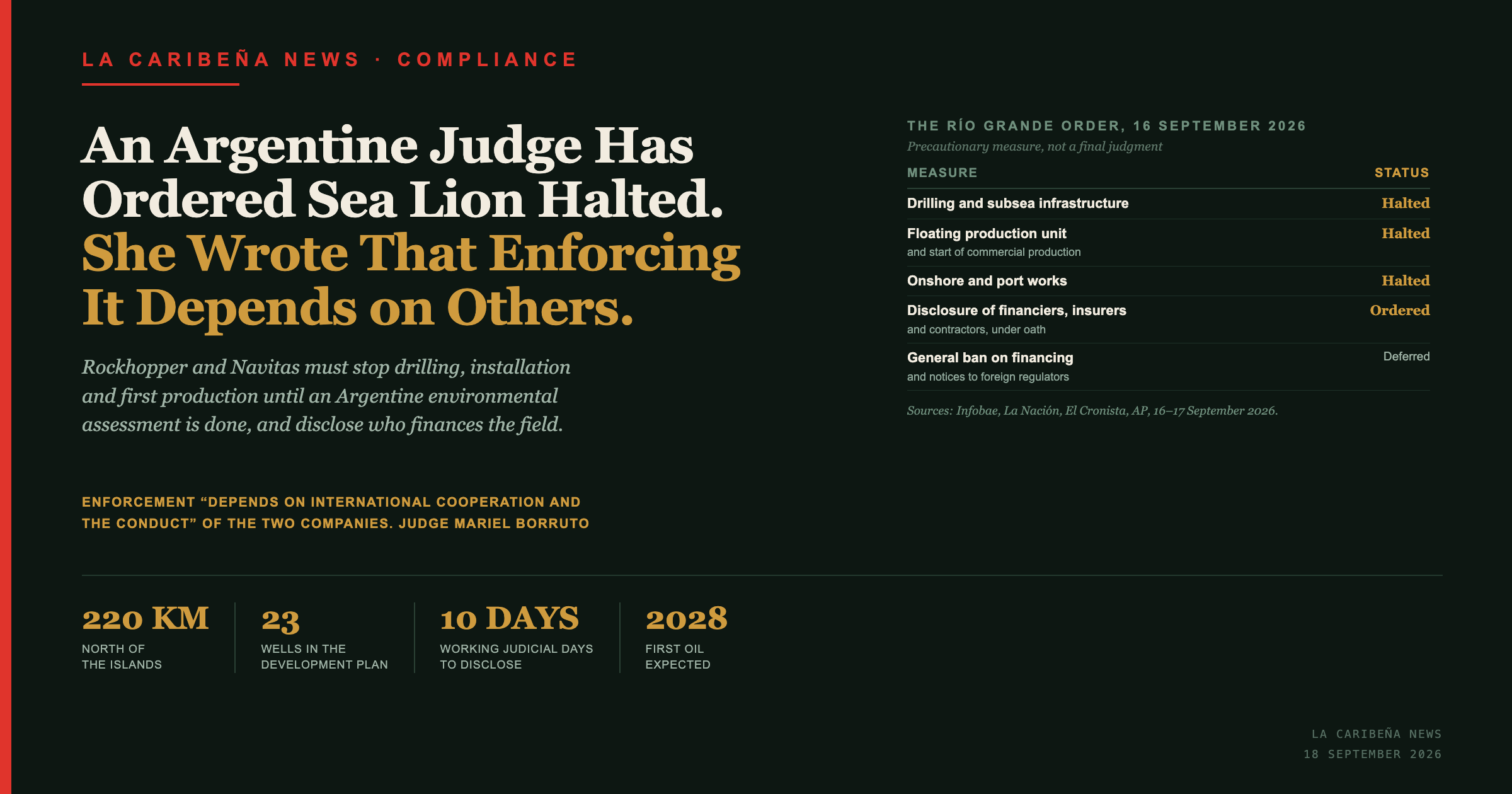
What the title card shows
- Ruling: Federal Judge Mariel Borruto, Río Grande, 16 September 2026, precautionary measure against Rockhopper Exploration and Navitas Petroleum. Sources: Infobae, La Nación, AP.
- Halted until an Argentine environmental assessment: drilling, subsea infrastructure, the floating production unit, commercial production, onshore and port works. Sources: Infobae, La Nación.
- Deferred: a general ban on financing, disbursements and guarantees; notices to foreign exchanges and regulators. Source: El Cronista.
- Figures: 220 km north of the islands; 23 wells planned; 10 working judicial days to disclose; first oil expected 2028. Sources: AP, Infobae.
- Quotation: enforcement "depends on international cooperation and the conduct" of the two companies, Judge Borruto, as quoted by AP.
Frequently Asked Questions
Did an Argentine court stop the Sea Lion oil project?
A federal court in Río Grande ordered Rockhopper Exploration and Navitas Petroleum on 16 September 2026 to halt drilling, installation and production at Sea Lion until an Argentine environmental impact assessment is completed. The judge wrote that enforcing the order depends on international cooperation and the companies' conduct, and the UK does not recognise Argentine jurisdiction over the islands.
Is the Sea Lion ruling final?
No. It is a precautionary measure. The court will decide whether to keep, change, widen or lift it once the companies and Argentine ministries have reported.
What information must the companies provide?
A sworn statement within ten working judicial days on the schedule, wells, floating units and rigs, contractors, corporate structure, financiers and disbursements, insurers and reinsurers, and environmental and spill studies.
Did the court block Sea Lion's financing?
Not yet. Judge Borruto deferred a general ban on financing, payments and guarantees, and deferred notices to foreign regulators, until the financiers are identified, El Cronista reported.
The court now waits on two sets of papers: the companies' sworn statements, and reports from Argentina's environment, energy and foreign ministries on whether any assessment was ever opened.