By LCN Business Desk
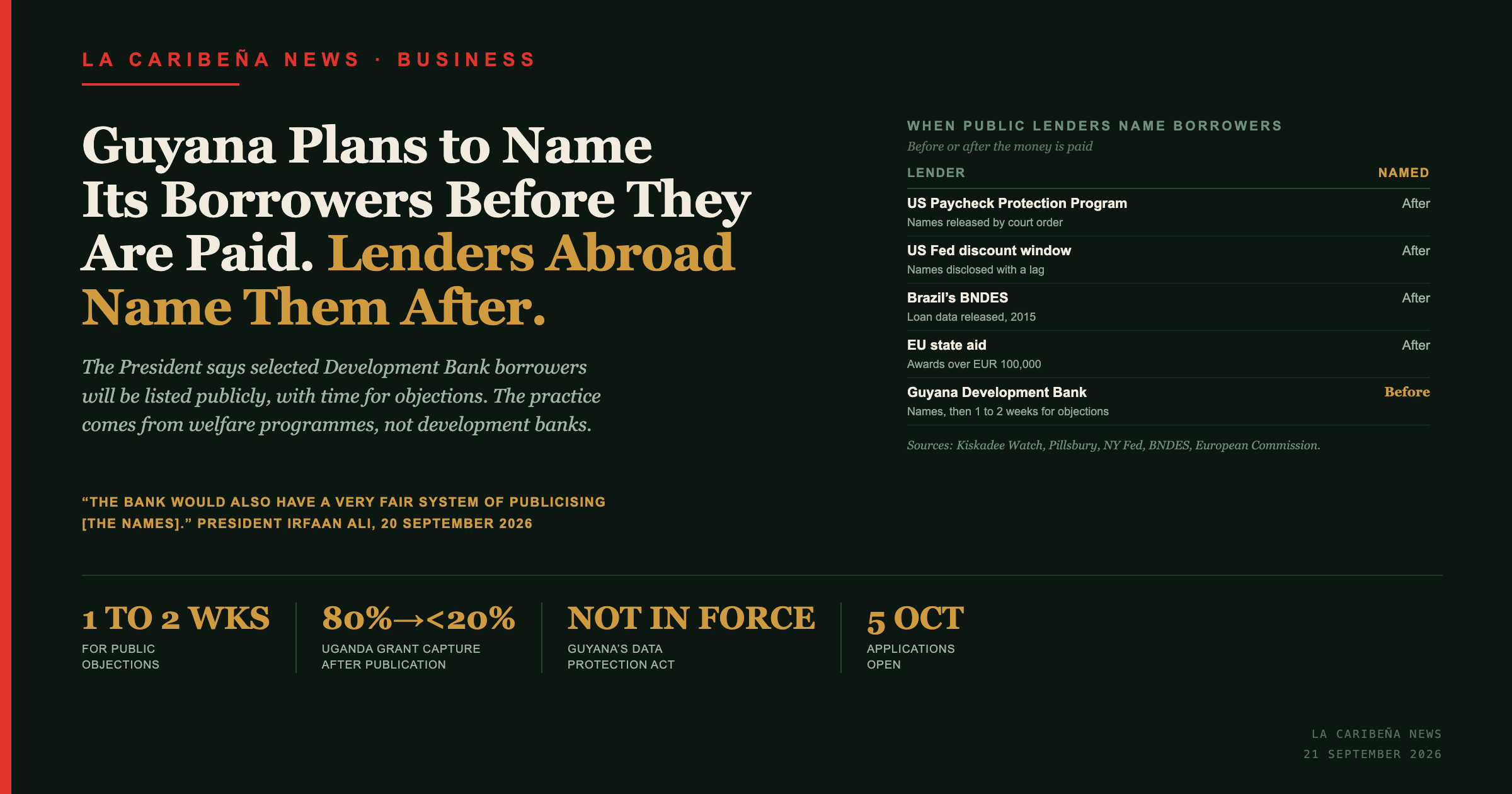
Persons selected for loans from the Guyana Development Bank will be publicly identified before receiving financing, and members of the public will be allowed to raise objections, President Irfaan Ali said during a live discussion on the bank on Sunday, 20 September, Kiskadee Watch reported. "The bank would also have a very fair system of publicising [the names] because that's what we want, the community to know," he said. The bank pairs its own lending with commercial money, reported in Guyana Development Bank Pairs G$3M Loans With G$10M Commercial Co-Financing.
A database of beneficiaries will be set up and the public could be given one or two weeks to raise concerns, the President said. Publishing the names would let communities spot attempts by related persons or established business owners to dominate the programme. He gave the example, from another programme, of residents recognising that four proposed beneficiaries were brothers. The bank begins processing applications on 5 October.
The announcement follows concerns from opposition figures and commentators that the state-owned bank could be politicised or used to favour supporters of the governing PPP/C, Kiskadee Watch reported. "This is not a grant," the President told the panel. "This is your opportunity to earn. This is your opportunity to pay back. This is an opportunity to build your credit."
Do other public lenders publish their borrowers?
Some do, but after the money has been paid, and usually after pressure. Publishing names before payment, with a window for objections, is a practice from social welfare, not lending.
| Institution | What is published | When |
|---|---|---|
| US Paycheck Protection Program | Names, addresses and exact amounts of every borrower, after a court ordered release in a suit by news organisations | After the loans, December 2020 |
| US Federal Reserve discount window | Borrower names and loan details, required by the Dodd-Frank Act | With a lag, after the loan |
| Brazil's BNDES | Loan data covering R$320 billion from 2012 to 2015, released through BNDES Transparente after criticism of lending to donors and contractors | After the loans, 2015 |
| European Union state aid | Beneficiary name, amount, sector and purpose for individual awards above EUR 100,000 | Within six months of the award |
| India's rural housing scheme (PMAY-G) | Draft beneficiary lists placed before village assemblies and published for claims and objections, heard by district appeal committees | Before approval |
Sources: Pillsbury Winthrop on the PPP release; Federal Reserve Bank of New York; Latin America Daily Briefing on BNDES; European Commission; Patna Press on PMAY-G.
What could naming borrowers achieve?
Less capture. When Uganda began publishing monthly transfers of school grants in national newspapers in 1997, the share of grants that never reached schools fell from about 80 per cent in 1995 to less than 20 per cent by 2001, economists Ritva Reinikka and Jakob Svensson found in research. The information let parents and head teachers see what should have arrived, and complain.
A named list does something similar for a lender whose loans carry no collateral and no interest. It lets neighbours see who was chosen, it gives a public check against the concern that the bank could favour supporters, and it answers the question the President raised: whether relatives or established owners are crowding out the vulnerable applicants the programme is meant for.
What went wrong where it was tried?
Stigma. The Dodd-Frank Act's requirement for delayed public disclosure of discount window borrowers, names included, is one of the factors that has kept banks reluctant to borrow from the Federal Reserve, according to the Yale Program on Financial Stability. Researchers at the Federal Reserve Bank of New York found "clear evidence of stigma between 2014 and 2024, especially among smaller banks". A facility that its intended users avoid does not reach them.
Unwanted attention. Before the PPP names were released, the National Federation of Independent Business warned that disclosure would bring unwanted attention and potential harassment to small businesses, WRAL reported. The US Small Business Administration had first proposed withholding the names of borrowers below US$150,000 on privacy grounds.
Community monitoring alone is weak. In a randomised experiment across more than 600 Indonesian village road projects, Benjamin Olken found that raising government audits from 4 per cent of projects to 100 per cent cut missing expenditure by eight percentage points, while increasing grassroots participation in monitoring had little average effect, reducing missing funds only where free-riding and elite capture were limited, according to his NBER study. Public objection works where people know what to look for and are free to speak.
What does Guyana's own law say?
The Guyana Development Bank Bill, as gazetted on 4 June 2026, provides that information obtained by the bank is to be treated as confidential and used solely for its functions "except where disclosure is required by law", and makes improper disclosure of confidential information an offence, according to the Bill text held by EICCIO Advisors. No provision of the Act as passed requires the bank to publish its lending criteria or its lending outcomes, as La Caribeña News reported in What the Guyana Development Bank Act Requires.
Guyana's Data Protection Act 2023 is not yet in force because no commencement order has been issued, Demerara Waves reported in April, and in May Data Protection Commissioner Aneal Giddings said work was under way to formally establish the Data Protection Office, Kaieteur News reported. A public list of named borrowers would therefore need its own legal basis in the bank's rules.
What has La Caribeña News reported on the bank?
The bank opens on 5 October with a first tranche of US$100 million and application desks inside commercial banks (The Guyana Development Bank Act Is in Force). Its headline loan is G$3 million at zero interest with no collateral, with up to G$7 million more from commercial banks that the Act permits but does not require (Seventy Per Cent of the Development Bank Package Sits at a Counter the Act Barely Reaches). Public servants may apply under conflict-of-interest rules (Public Servants to Access Development Bank Loans), and the President said on Sunday that salaried workers who are not low-income may have to wait for a later round. An importer financed by the bank still has to buy US dollars to pay a foreign supplier (The Development Bank Opens on 5 October).
On the President's point about building credit: Guyana's credit bureau, where lenders' reports on borrowers are held, was bought by Creditinfo Group in August (Guyana's Credit Bureau Opened as Creditinfo in 2013). In July, a La Caribeña News opinion argued that the bank should publish the lending criteria the Act already requires it to write, and give reasons for declines (Write the Rules Down Before the Doors Open).
A list of names tells the public who was chosen. The criteria tell them why, and the Act requires those to be written but not published.
What the title card shows
- Proposal: selected borrowers named before financing; one to two weeks for public objections. Source: Kiskadee Watch.
- Comparators: PPP names published after the loans (2020); Fed discount window disclosure with a lag; BNDES loan data released 2015; EU state aid above EUR 100,000 within six months; India PMAY-G lists open to objection before approval. Sources as in the table.
- 80 per cent to under 20 per cent: fall in capture of Uganda's school grants after transfers were published. Source: Reinikka and Svensson.
- Eight percentage points: reduction in missing funds from universal audits in Indonesia; community monitoring had little average effect. Source: Olken, NBER.
Frequently Asked Questions
Will Guyana Development Bank borrowers be publicly named?
President Irfaan Ali said on 20 September 2026 that people selected for loans will be publicly identified before receiving financing, and that the public could have one or two weeks to raise objections.
Do other development banks publish borrower names?
Some public lenders publish after loans are made: the US Paycheck Protection Program after a court order, the Federal Reserve's discount window with a lag, Brazil's BNDES since 2015, and EU state aid awards above EUR 100,000. Publishing before payment with an objection period is used in welfare schemes such as India's rural housing programme.
Is borrower information confidential under the Development Bank Act?
The Bill as gazetted treats information obtained by the bank as confidential, except where disclosure is required by law, and makes improper disclosure an offence. Guyana's Data Protection Act 2023 has not been brought into force.
What are the risks of naming borrowers?
Research on the US Federal Reserve's discount window found that disclosure deters eligible borrowers through stigma, and US small-business groups warned that PPP disclosure invited unwanted attention. Studies also find that community monitoring works best alongside formal audits.