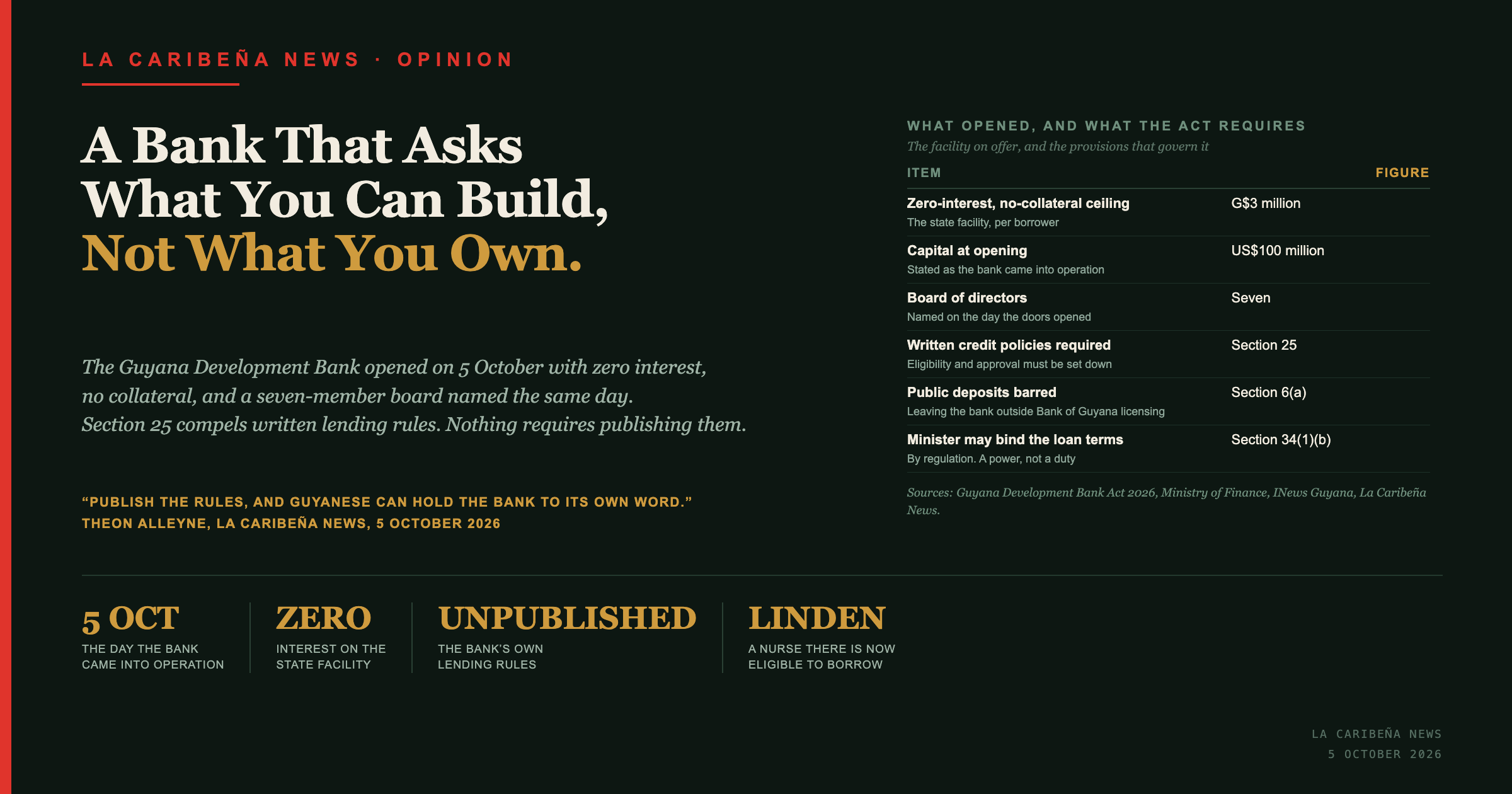
The Guyana Development Bank opened on 5 October 2026 offering loans of up to G$3 million with no interest and no collateral. It opens credit to Guyanese without assets, including public servants, but its lending rules remain unpublished.
By Theon Alleyne, CRCP, CCEP | Georgetown, Guyana | 5 October 2026
Credit where it is due. The Guyana Development Bank came into operation on Monday, 5 October, with a seven-member board, offering zero-interest, no-collateral loans to individuals and small businesses. It starts with US$100 million in capital and lends up to G$3 million across a wide range of sectors. The Government of Guyana promised this bank, legislated it, and opened it. That deserves to be said plainly before anything else is said at all.
Our banking system lends against what you already own. For most of our history that meant land and buildings. When Parliament passed the movable property law, it was rightly welcomed, because equipment, vehicles, inventory, livestock and even receivables could now count as collateral. I do not dismiss that reform. It widened the list of acceptable assets. It did not change the question the bank asks at the counter. Whether the security is a house lot or a minibus, the rule is the same. Only those who have assets can get loans.
A development bank is supposed to break that rule, and this one is designed to.
Consider the public servant. Thousands of teachers, nurses, technicians and clerks have ideas and products worth backing. The Small Business Bureau's grant excludes employees of government-affiliated organisations outright. On paper, they may still apply for a loan. In practice, public servants with good ideas have found that door shut too, and even where it opens, the loan runs through a guarantee that covers only part of the collateral. Either way, they were left facing the one question the Development Bank no longer asks: what do you own?
The Guyana Development Bank removes that wall. Public servants are eligible, and the Minister of Public Service, Government Efficiency and Implementation, Zulfikar Ally, confirmed in May that conflict-of-interest guardrails would apply. If the Government delivers on that promise, a nurse in Linden with a sound business plan stands where a shop owner with a transport fleet stands. That is a real change in who gets to take part in commerce.
There is more to commend. The bank is built to offer mentorship, technical support and capacity building, with the aim that borrowers eventually graduate into commercial banking. Regional credit officers are meant to work directly with applicants, shaping ideas and monitoring projects. A lender that helps you write the plan before judging it is rare anywhere in the region.
Now the harder part.
The public has not yet been told what safeguards govern the money. The Government says the Auditor General will examine the accounts each year and an annual report will go to the National Assembly. Good. An audit follows the money, though. It does not follow the decision at the desk. Section 25 of the Act requires the bank to keep written credit policies on eligibility and approval. No provision requires those policies to be published. Section 6(a) bars the bank from taking public deposits, which places it outside Bank of Guyana licensing. The conflict-of-interest rules for public servants have been announced but not released.
I am not alone in asking. Writing in Kaieteur News on the eve of the launch, Dr Karen Abrams, director of STEM Guyana, called for quarterly data on applications, approvals, rejections and processing times by region and sector. Others have warned that a launch date is no substitute for transparency, and the amendments pressed while the Bill was before the House went to the same gaps. One concern has already been answered: the board was named on opening day, chaired by Abu Zaman with Kathy Smith as deputy chairperson, INews Guyana reported. That shows the Government listens. It should keep listening.
In July, LCN argued that the rules should be written down before the doors opened. The doors are open. The rules can still be published this week, and section 34(1)(b) gives the Minister the power to make the key ones binding by regulation. Five steps would settle most doubts. Publish the credit policy. Publish the conflict rules for public servants. Give every declined applicant a written reason. Name a complaints route outside the branch. Report quarterly results by region and sector.
None of this slows the bank down. It protects the bank's best feature, which is the promise that what you can build will count for more than what you already own. A promise like that has to be checkable. Publish the rules, and Guyanese can hold the bank to its own word.
What the title card shows
- 5 October 2026: the Guyana Development Bank came into operation. Source: Ministry of Finance, as La Caribeña News reported.
- G$3 million at zero interest with no collateral, the ceiling on the state facility, and US$100 million in capital at opening. Source: Ministry of Finance.
- Seven directors, named on the day the doors opened, chaired by Abu Zaman with Kathy Smith as deputy chairperson. Source: INews Guyana.
- Section 25: written credit policies on eligibility and approval are required. Section 6(a): public deposits are barred, which leaves the bank outside Bank of Guyana licensing. Section 34(1)(b): the Minister may make loan terms binding by regulation. Source: Guyana Development Bank Act 2026.
- Unpublished: no provision requires the credit policies to be published. Source: Guyana Development Bank Act 2026.
- Linden: named in the piece as the place where a nurse with a sound business plan would now be eligible to borrow.
- Quotation: "Publish the rules, and Guyanese can hold the bank to its own word." Theon Alleyne, La Caribeña News, 5 October 2026.
Disclosure: Theon Alleyne is Vice President and Public Relations Officer of the Essequibo Islands–West Demerara Chamber of Commerce and Industry (R3CCI) and Director and Chair of the Services Sub-Sector at the Guyana Manufacturing and Services Association (GMSA), whose membership includes commercial banks. He chairs the Finance and Economics Working Group of the Private Sector Commission, whose Vice Chair, Kathy Smith, has been named Deputy Chairperson of the Guyana Development Bank. He is the founder and owner of La Caribeña News. The views expressed are his own and do not represent those of R3CCI, GMSA or the Private Sector Commission.