By LCN Business Desk
Caribbean exporters have spent four months absorbing a United States tariff imposed because their governments were judged not to enforce a ban on importing goods made with forced labour. On 20 August a United States senator put it to the agency that administers that ban at home that it had declined to enforce it.
The letter is from Ron Wyden of Oregon, the ranking Democrat on the Senate Finance Committee, to Rodney Scott, the Commissioner of US Customs and Border Protection. The committee announced it the same day and quoted from it at length.
What does the letter say?
That the agency went around its own process, and that the tariffs sit badly beside it.
Wyden wrote that "circumventing standard trade enforcement processes for politically connected, billionaire-owned corporations undermines the integrity of U.S. trade policy," and that doing so "places law-abiding American agricultural businesses and workers at a distinct competitive disadvantage while facilitating ongoing, egregious human rights abuses against stateless and vulnerable workers abroad."
He then joined the two instruments together:
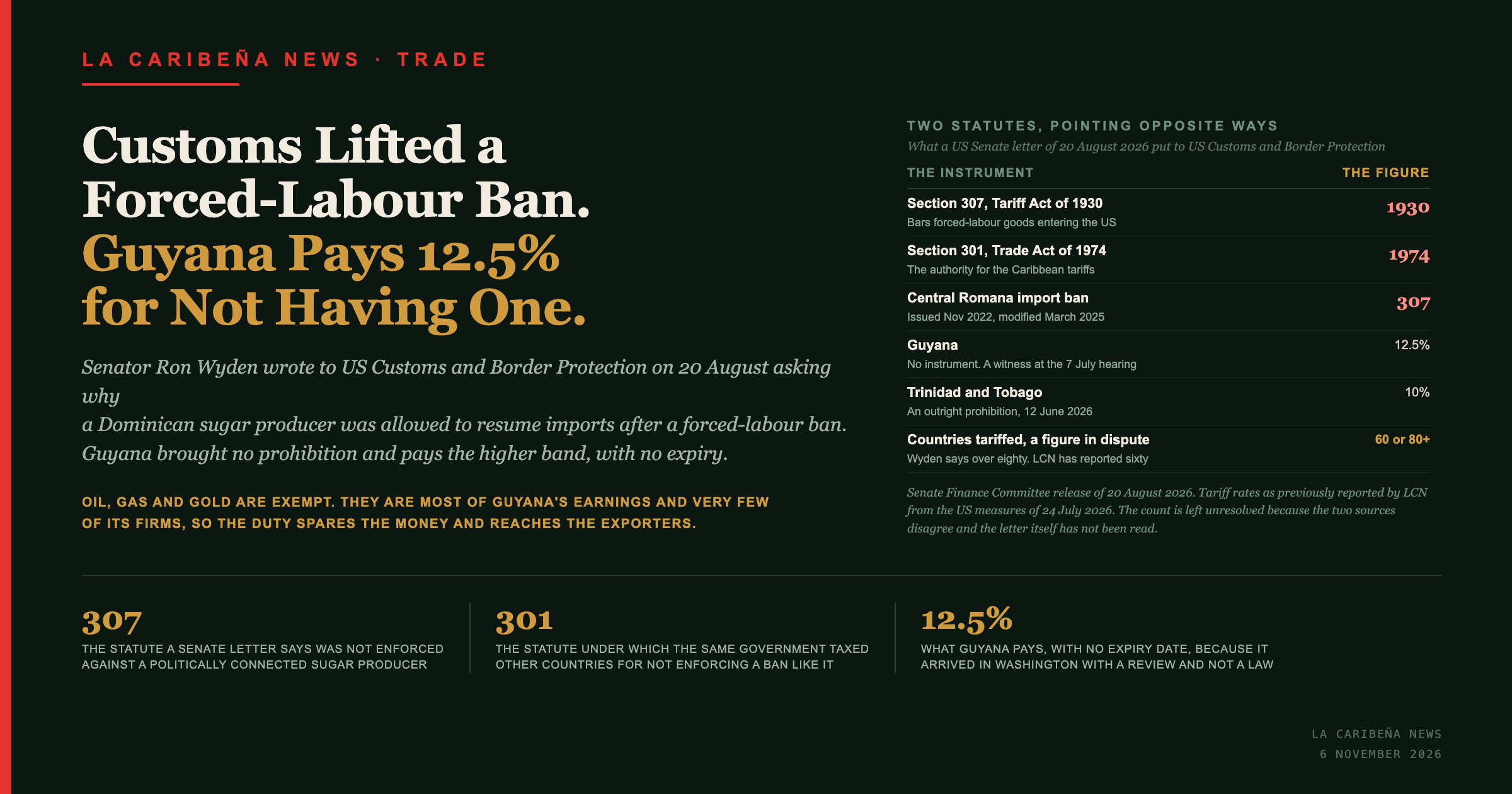
"And this failure to fully enforce Section 307 of the Tariff Act of 1930 (Section 307) only serves to highlight the hypocrisy in the Administration's recent imposition of tariffs on over eighty countries under Section 301 of the Trade Act of 1974, purportedly due to those countries' failure to enforce an equivalent import ban on forced labor goods."
Section 307 is the domestic instrument: it bars goods made with forced labour from entering the United States. Section 301 is the outward one, and it is the authority under which the Caribbean tariffs were set.
::: Section 301 is the authority for the Caribbean tariffs. Section 307 is the one the letter says was not enforced at home. :::
What is he asking for?
Nine specific things, and the deadline on them has passed.
La Caribeña News has now read the letter itself. It puts nine numbered requests to the Commissioner and sets a reply date of 20 September 2026, which passed forty-seven days ago. They ask for the complete administrative record CBP reviewed before the modification; every draft and final recommendation behind both the modification and the rescission; whether CBP evaluated remediation at all, and whether Central Romana filed a Corrective Action Plan; a formal explanation of the cancelled briefing described below; the certification of compliance the company supplied; the 2 June 2025 letter from CBP’s Trade Remedy Law Enforcement Executive Director to the company’s counsel; and all communications about Central Romana between CBP and the State Department, and between CBP and the White House, from 1 November 2024 to 30 June 2025.
Wyden is seeking complete CBP records relating to what the committee's release calls "the irregular modification" of the 2022 Withhold Release Order on Central Romana, and "all contemporaneous communications regarding Central Romana between CBP and the White House and the State Department, among other information."
A request for communications with the White House is a narrower thing than a request for a file. It asks whether the decision was discussed outside the agency that made it.
Which ban, and which company?
A Dominican sugar producer whose access to the United States market was withdrawn and then given back.
CBP barred Central Romana Corporation's raw sugar in November 2022 under Section 307, citing five of the International Labour Organization's eleven indicators of forced labour. It did not simply modify that order. On 11 March 2025 it notified the company of a “conditional” modification carrying a six-month grace period in which to supply a certification of compliance, rather than proof of remediation first; the modification was executed on 17 March, which the letter says bypassed standard public notification; and on 2 June 2025 the order was rescinded outright. The letter also records that CBP cancelled a briefing with civil society monitors on 28 February 2025, eleven days before the conditional modification, with monitors who held contemporary evidence of forced labour at the company.
The standard those steps were measured against is CBP’s own. Its Withhold Release Order and Finding Modifications Guide requires “clear evidence that demonstrates full remediation of forced labor conditions” before any order is modified. The committee's release states that "shortly after Trump took office in 2025, that decision was reversed."
The release records that the company's owner, José Francisco "Pepe" Fanjul, "has donated more than $1 million to Trump and the Republican party, and he hosted a fundraiser that raised more than $50 million for Trump."
Central Romana denies any impropriety. Its attorney wrote to Corporate Accountability Lab in March 2026 that "CBP's decision to rescind the WRO was based on the evidentiary record, not political considerations," and that the company "had not engaged in any violations of Dominican Republic law or international labor standards." The company holds the largest share of a Dominican sugar quota that is almost three times the size of every CARICOM allocation combined.
What is CARICOM paying?
Two rates, and what separated them was whether a country arrived with a law.
| Economy | What it brought to Washington | Rate from 24 July 2026 |
|---|---|---|
| Mexico | A prohibition covering any tariff heading, published 17 February 2023 | 10% |
| Trinidad and Tobago | An outright prohibition under Customs Act s.45, 12 June 2026 | 10% |
| The Bahamas | A power for a Minister to prohibit by Order | 12.5% |
| Dominican Republic | Decree 502-26, a case-by-case power for customs, 23 July 2026 | 12.5% |
| Guyana | No instrument. A witness at the 7 July hearing | 12.5% |
Instruments and rates as previously reported by La Caribeña News from the US measures of 24 July 2026. Twelve other CARICOM members were never investigated and reverted to ordinary duty.
A power to prohibit was not accepted as a prohibition, which is why The Bahamas sits above Trinidad and Tobago and why the Dominican decree arriving a day early did not help either. Mexico holds the lower band on a measure published three years before the investigation opened. Nothing in the table required size or wealth: it required a text.
Why does this reach Guyana hardest?
Because the exemptions cover the earnings and the duty covers the exporters.
Guyana arrived with nothing to show. Honduras drafted a decree in weeks; Guyana brought a review that had commenced, and Trinidad moved into the lower band while Guyana did not. The rate carries no expiry date.
Georgetown's position is that nothing changes. Foreign Secretary Robert Persaud has said the duty makes no difference because oil and gold are exempt and the rate is below last year's, and the government has said it will lobby for removal.
On the national accounts that holds. On the business register it does not, and La Caribeña News has reported the split before: the tariff spares Guyana's biggest export and taxes almost all its exporters. Oil, gas and gold are most of the money and very few of the firms. Every rice miller, timber shipper, seafood packer, rum producer and manufactured-goods exporter sits outside the exemptions and inside the duty, and each of them competes for United States shelf space against a Trinidadian rival paying less.
That is the position a Guyanese exporter is in while a Senate committee asks the same administration why it stopped applying the domestic version of the rule to a sugar producer with the largest Dominican quota share.
The grading itself was unforgiving. Against eight elements of effective enforcement applied on 2 June 2026, every economy examined failed, including the seventeen placed in the lower band. A region told it has not enforced a prohibition is therefore being measured against a standard that nobody met, by an authority a senior member of the Senate's tax-writing committee says did not apply the equivalent standard to a company at home.
The instrument says sixty. The letter says over eighty.
Wyden's letter says tariffs were imposed on "over eighty countries". La Caribeña News has reported 60, consistently, at each stage: 60 economies when investigations opened on 12 March 2026, 60 judged against the eight elements on 2 June, and 60 tariffed on 24 July.
USTR’s own notice of action settles the scope of the forced-labour tranche. It states that the Trade Representative determined “in each of 60 investigations” that the economy’s practices were actionable, and it repeats the figure three more times, once in a sentence tying the sixty expressly to “each investigated economy related to its failure to enact and effectively enforce a forced labor import prohibition.” That is the measure the Caribbean rates come from.
The senator may be counting Section 301 actions beyond that tranche. The United States has others running, including a separate 25 per cent duty on all Brazilian imports from 22 July 2026. What the letter does is attach the forced-labour rationale to the larger figure, and on the instrument that rationale covers sixty economies. A reader checking whether their own market is in scope should work from the notice.
What is not established
CBP has published no explanation of the modification. Corporate Accountability Lab states that CBP did not answer it, and no CBP statement setting out the evidentiary basis either way is on the public record. CBP has not published a response to this letter.
La Caribeña News has not read the letter itself. The Senate Finance Committee publishes it as a download, and the figures and quotations above are from the committee's own release of 20 August 2026. The full list of questions Wyden put to the Commissioner has therefore not been examined here.
Whether the donations recorded in the committee's release bore on the decision is not established by the sequence, and no document connecting them has been produced. The company says they did not.
Nor does the letter change any tariff. It is a request for records by a member of the minority on a Senate committee, which carries no power to compel production.
The entities in this report
Ron Wyden is the senator from Oregon and ranking Democrat on the Senate Finance Committee, which published the letter. Rodney Scott is Commissioner of US Customs and Border Protection, the agency that issues and modifies Withhold Release Orders under section 307 of the Tariff Act of 1930. Section 301 of the Trade Act of 1974 is the authority for the tariffs. The Office of the United States Trade Representative ran the eight-element assessment. Central Romana Corporation is the Dominican sugar producer; José Francisco "Pepe" Fanjul is its owner as named in the release. Corporate Accountability Lab published the report the letter follows.
Frequently asked questions
What is the difference between Section 307 and Section 301? Section 307 of the Tariff Act of 1930 bars goods made with forced labour from entering the United States. Section 301 of the Trade Act of 1974 is the authority under which the United States imposed additional tariffs on other countries, in this case for not enforcing a comparable ban of their own.
What forced-labour tariff does Trinidad and Tobago pay? 10 per cent additional duty from 24 July 2026, the lower of the two bands, because it imposed a prohibition rather than taking a power to impose one.
Has CBP responded to the letter? No response is on the public record. Nor has CBP published an explanation of why it modified the 2022 order.
Does a Senate letter change the tariffs? No. It requests records. The sender is a committee's ranking minority member and the request carries no power to compel production.
---
Sources: US Senate Committee on Finance, release of 20 August 2026, and the letter itself. Corporate Accountability Lab, Bitter Empire, 18 August 2026, updated 16 October 2026, with its Withhold Release Order factsheet. Central Romana Corporation, Ltd., letter of 10 March 2026 from Rasco Klock to Corporate Accountability Lab. Tariff rates as previously reported by La Caribeña News from the US measures of 24 July 2026. Documents held in the La Caribeña News source archive.