By LCN Business Desk
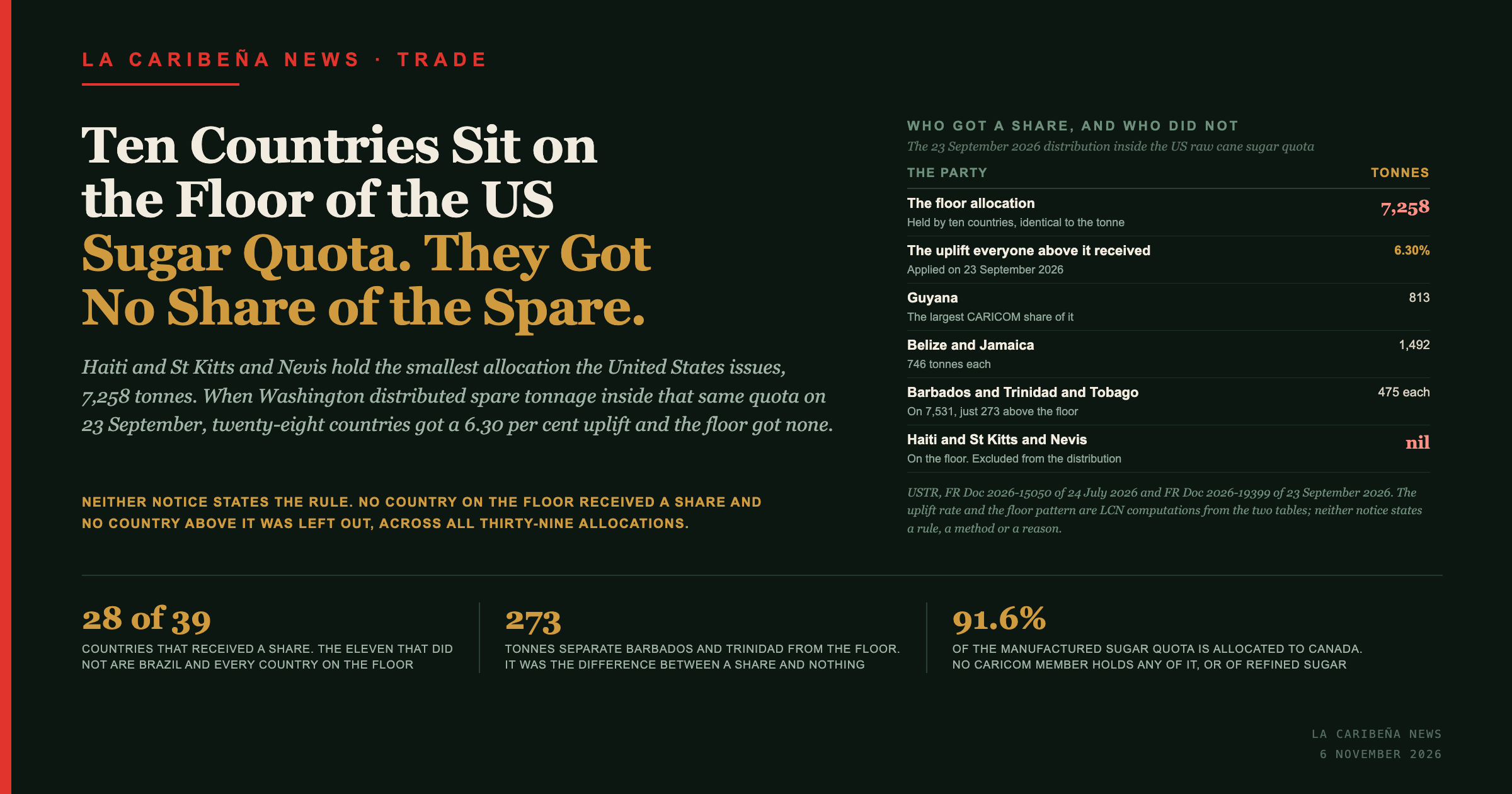
Two Caribbean countries hold the smallest raw cane sugar allocation the United States issues. In September the United States had spare tonnage to distribute inside that same quota, gave a share to twenty-eight countries, and gave those two nothing.
The rule that produced it is not written anywhere. It is visible only by setting two Federal Register notices against each other.
Who is on the floor?
Ten countries, and they hold the identical figure.
| FY2027 allocation of 7,258 tonnes | |
|---|---|
| Haiti | CARICOM member |
| St Kitts and Nevis | CARICOM member |
| Congo (Brazzaville) | |
| Côte d'Ivoire | |
| Gabon | |
| Madagascar | |
| Mexico | |
| Papua New Guinea | |
| Paraguay | |
| Uruguay |
USTR, FR Doc 2026-15050, published 24 July 2026. Ten of the thirty-nine allocations in that notice are the same number.
Ten countries holding an identical figure to the tonne is not a coincidence of trade history. It is the smallest allocation the schedule issues, and the countries on it are there because the quota has a bottom.
What happened on 23 September?
The United States distributed tonnage it had held back, and the floor was passed over.
USTR allocated 1,061,202 tonnes of a 1,117,195-tonne quota in July and said it would place the remaining 55,993 before the fiscal year began. It did so on 23 September. Twenty-eight of the thirty-nine countries received a share. Eleven did not.
| The 23 September distribution | |
|---|---|
| Countries that received a share | 28 |
| Uplift each one received | 6.30% of its July allocation |
| Countries that received nothing | 11 |
| Of those eleven | Brazil, and all ten floor countries |
USTR, FR Doc 2026-19399, published 23 September 2026, read against FR Doc 2026-15050. The uplift rate and the floor pattern are computed from the two notices; neither states either.
No country on the floor received a share, and no country above it was left out. The pattern holds without a single exception across thirty-nine allocations, which is what makes it a rule rather than an accident of rounding.
::: Every country above the floor received 6.30 per cent more. Every country on the floor received nothing. Neither notice states that rule. :::
Why would the floor be excluded?
Because a proportional uplift and a fixed minimum cannot both be honoured.
The most likely reading is arithmetic rather than adverse. Applying 6.30 per cent to 7,258 produces 457 tonnes, and a schedule that holds ten countries at an identical minimum is a schedule that treats that minimum as a floor rather than a share. Lifting the floor would have raised all ten together and changed what the minimum is.
So the exclusion is probably a consequence of how the minimum is maintained, not a judgement about the ten countries. The consequence for them is the same either way.
What does it cost Haiti and St Kitts and Nevis?
457 tonnes each, this once, and the position in every future distribution.
Neither country lost anything it held. What they did not receive is the uplift that twenty-eight other countries did, and the same arithmetic will apply the next time tonnage moves inside the quota.
Barbados and Trinidad and Tobago show how narrow the line is. Both hold 7,531 tonnes, 273 above the floor, and both received 475 tonnes in September. Being just above the minimum was worth the whole uplift; being on it was worth nothing.
| What each CARICOM member received on 23 September | Tonnes |
|---|---|
| Guyana | 813 |
| Belize | 746 |
| Jamaica | 746 |
| Barbados | 475 |
| Trinidad and Tobago | 475 |
| Haiti | nil |
| St Kitts and Nevis | nil |
USTR, FR Doc 2026-19399, 23 September 2026.
Is the floor the only place the Caribbean is structurally outside?
No. The region holds no country allocation at all in either of the two higher-value sugar quotas.
The United States runs three sugar tariff-rate quotas. CARICOM members appear in one.
| FY2027 sugar quota | Size | Country allocations go to |
|---|---|---|
| Raw cane sugar | 1,117,195 MTRV | 39 countries, 7 of them CARICOM |
| Refined sugar | 22,000 MTRV | Canada 10,300 and Mexico 2,954. The rest is first-come |
| Sugar-containing products | 64,709 MT | Canada 59,250. The rest is first-come |
USTR, FR Doc 2026-15050, 24 July 2026. Refined sugar requires a polarimeter reading of 99.5 degrees or more.
Canada holds 91.6 per cent of the manufactured-products quota by country allocation and, with Mexico, 60.2 per cent of refined. A CARICOM exporter may still ship into the first-come remainders, which is a different commercial proposition from holding a reserved tonnage: it requires being at the border early rather than being named in a notice.
The two findings point the same way. Where the region holds a reserved allocation, it is in the raw commodity, and seven members between them hold 5.92 per cent of that pool while one country holds 16.95. Where value is added, it holds none.
What is not established
Why the floor countries were excluded. Neither notice states a rule, a method of apportionment, or a reason. The 6.30 per cent uplift and the floor exclusion are both computed here from the two tables. USTR gives a contact for the allocations, Erin Nicholson of its Office of Agricultural Affairs, and has published no explanation.
Whether the floor is a published minimum. That ten allocations are identical is a fact in the notice. That 7,258 is a formal minimum rather than ten coincidentally equal historical shares is an inference from the notices, and no instrument consulted states it.
Whether the same treatment will recur. One distribution establishes what happened in September 2026, not a standing practice. The FY2027 quota is now fully allocated, so the next test is the FY2028 notice.
What the first-come remainders are actually worth to a Caribbean shipper. The refined and sugar-containing quotas leave 8,746 and 5,459 tonnes to be taken on arrival. Who has historically filled them, and how quickly, is not in the allocation notices.
The entities in this report
The Office of the United States Trade Representative allocates the quotas under section 404(d)(3) of the Uruguay Round Agreements Act, delegated by Presidential Proclamations 6763 and 7235; Jamieson Greer signed the July notice. The Administrator of the Foreign Agricultural Service of the US Department of Agriculture set the quantities on 14 July 2026. Haiti and St Kitts and Nevis are the two CARICOM members on the floor; Guyana, Belize, Jamaica, Barbados and Trinidad and Tobago are the five that received a September share. Canada and Mexico hold the value-added allocations. Brazil is the only country whose allocation changed between the two fiscal years. Erin Nicholson is named in the notice as USTR's contact for the allocations.
Frequently asked questions
What is the smallest US raw cane sugar quota allocation? 7,258 metric tons raw value. Ten countries hold exactly that figure for FY2027, including Haiti and St Kitts and Nevis.
How much did Haiti and St Kitts and Nevis get from the September distribution? Nothing. Every country holding 7,258 tonnes was excluded, while the twenty-eight above the floor received a 6.30 per cent uplift.
Which CARICOM members did receive a share? Guyana 813 tonnes, Belize 746, Jamaica 746, Barbados 475 and Trinidad and Tobago 475.
Does CARICOM hold refined sugar quota? No country-specific allocation. Canada and Mexico hold the allocated portion of the refined sugar quota, and Canada holds 59,250 of the 64,709-tonne sugar-containing products quota. The remainders are first-come, first-served.
Has USTR explained the floor exclusion? No. Neither allocation notice states a method of apportionment or a reason, and no explanation is on the public record.
---
Sources: Office of the United States Trade Representative, Fiscal Year 2027 Tariff-Rate Quota Allocations for Raw Cane Sugar, Refined Sugar, and Sugar-Containing Products, FR Doc 2026-15050, filed 23 July 2026 and published 24 July 2026; and the further allocation of 55,993 MTRV, FR Doc 2026-19399, published 23 September 2026. Both notices held in the La Caribeña News source archive. The uplift rate, the floor pattern and all percentages are LCN computations from the two published tables.