By LCN Business Desk
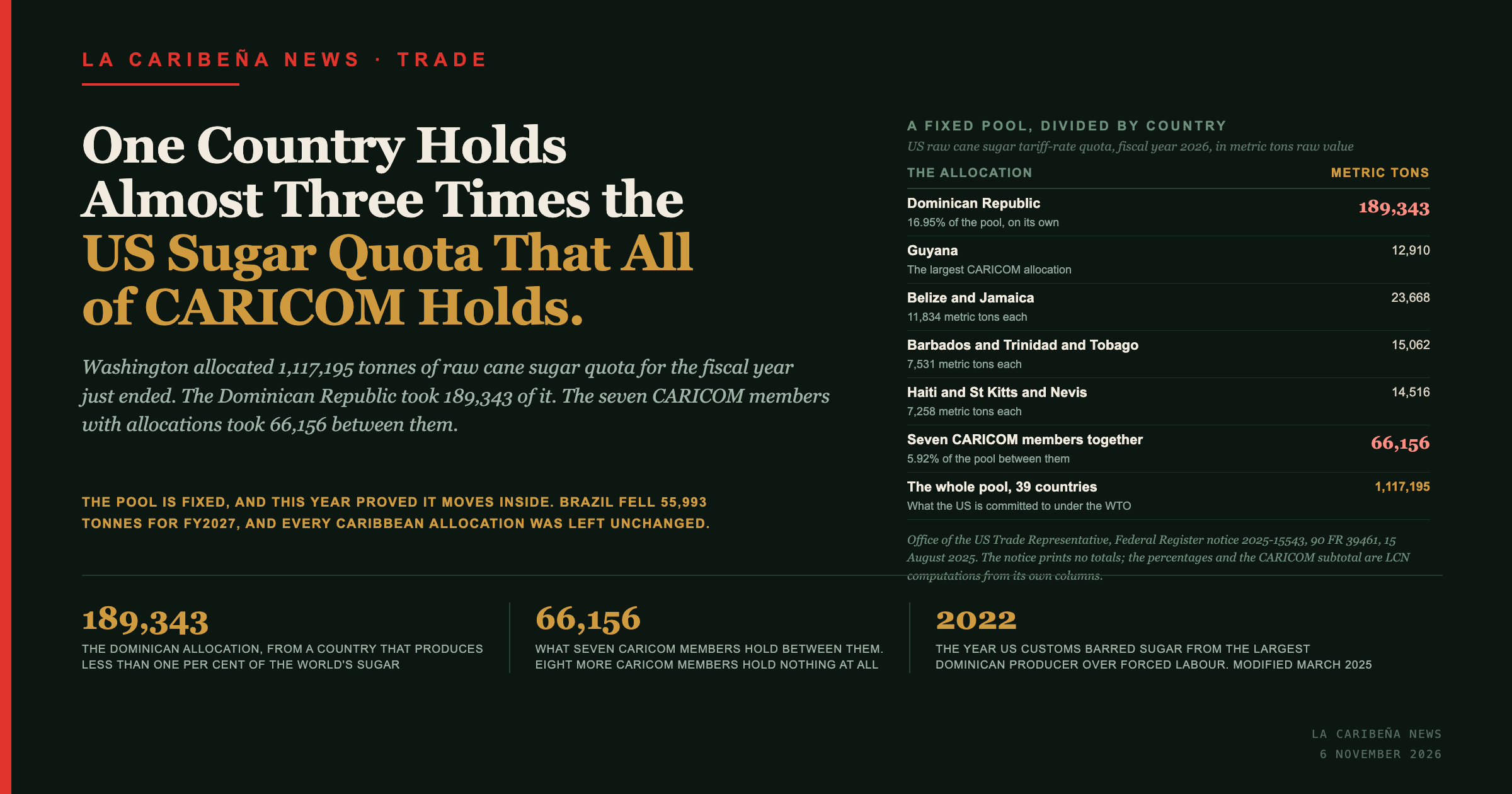
The United States buys sugar from thirty-nine countries at a preferential tariff and tells each one, a year at a time, exactly how much it may send. For the fiscal year that ended on 30 September, one Caribbean country was told it could send almost three times what the rest of the Caribbean was told it could send, combined.
The instrument is a Federal Register notice published on 15 August 2025. It is four pages of country names against tonnages, and it is the most consequential document in Caribbean sugar.
Who holds the quota?
| FY2026 raw cane sugar allocation | Metric tons raw value |
|---|---|
| Dominican Republic | 189,343 |
| Guyana | 12,910 |
| Belize | 11,834 |
| Jamaica | 11,834 |
| Barbados | 7,531 |
| Trinidad and Tobago | 7,531 |
| Haiti | 7,258 |
| St Kitts and Nevis | 7,258 |
| Total pool, all 39 countries | 1,117,195 |
Office of the United States Trade Representative, Federal Register notice 2025-15543, 90 FR 39461, 15 August 2025. The notice prints no totals; the pool figure is the in-quota quantity it states.
The seven CARICOM members in that table hold 5.92 per cent of the pool between them. The Dominican Republic holds 16.95 per cent on its own. Neither percentage is in the notice, and both follow from dividing its own columns.
Eight more CARICOM members hold nothing. Suriname, The Bahamas, Antigua and Barbuda, Dominica, Grenada, St Lucia, St Vincent and the Grenadines and Montserrat do not appear in the allocation at all. Two that do appear, Haiti and St Kitts and Nevis, sit at the schedule’s 7,258-tonne minimum, and every country on that floor was passed over when spare tonnage was handed out in September.
Why a share rather than a volume?
Because the pool does not grow when a country wants more of it.
The 1,117,195 tonnes is set by the Administrator of the Foreign Agricultural Service as what the notice calls "the minimum amount to which the United States is committed under the World Trade Organization (WTO) Agreement." The United States Trade Representative then divides that fixed figure among supplying countries under section 404(d)(3) of the Uruguay Round Agreements Act.
The quota exists to hold imports down. It was built into the Sugar Program established by the 1981 Farm Bill, alongside price support loans and supply restrictions, to protect the domestic sugar price. A quota designed as a ceiling is a different asset from a quota designed as an opening: every tonne inside it is a tonne somebody else is not sending.
A Guyanese or Belizean producer therefore competes for a share rather than for a volume. Washington took the opposite approach in beef, where it added 300,000 tonnes to a category Brazil already dominated and the new volume went almost entirely to the incumbent. The sugar pool gains no tonnes when demand for a place in it rises.
What is the Dominican share worth to the country that holds it?
More than the country's size in sugar would suggest.
The Dominican Republic produces less than one per cent of the world's sugar. More than 89 per cent of the Dominican sugar that leaves the country goes to the United States. The allocation is therefore not one market among several; for Dominican producers it is very close to the market entire, which is why the figure in that Federal Register table is watched in Santo Domingo more closely than the world price.
The Dominican Sugar Institute, INAZUCAR, then divides the national allocation among the three private producers. Four entities dominate the sector: Central Romana, Consorcio Azucarero Central, Consorcio Azucarero de Empresas Industriales and the state-owned Consejo Estatal de Azúcar.
Before November 2022, Central Romana received the largest of the three private allocations.
What happened in November 2022?
United States Customs and Border Protection stopped the company's sugar at the border.
CBP issued a Withhold Release Order against "imports of raw sugar and sugar-based products produced by Central Romana Corporation Limited," based on information that it said "reasonably indicates the use of forced labor in its operations." The authority is section 307 of the Tariff Act of 1930, which prohibits importing merchandise produced wholly or in part by forced labour.
CBP identified five of the International Labour Organization's eleven indicators of forced labour: abuse of vulnerability, isolation, withholding of wages, abusive working and living conditions, and excessive overtime.
A Withhold Release Order does not fine a company or prosecute anyone. It removes access to the quota. For a producer whose output goes almost entirely to one market under a preferential allocation, that is the entire commercial consequence, which is why the next two years were spent on it.
How was it restored?
CBP modified the order in March 2025 and rescinded it outright on 2 June 2025, so the order no longer exists. The published standard for taking either step is not the only thing on the record.
CBP's own guidance is more demanding than that. Its Withhold Release Order and Finding Modifications Guide requires “clear evidence that demonstrates full remediation of forced labor conditions” before any order is modified. What the record shows alongside that is a sequence of dates.
| November 2022 | Withhold Release Order issued |
| Eighteen months following | At least US$1.3 million spent lobbying the US government, per federal lobbying disclosures |
| March 2024 | José Francisco "Pepe" Fanjul donates US$413,000 to the Republican National Committee |
| May 2024 | Fanjul hosts a fundraiser reported by The New Yorker as grossing around US$50 million for the Trump campaign |
| July 2024, January 2025, February 2025 | Florida Crystals donates US$3 million in total to the Make America Great Again PAC, in three instalments |
| December 2024 | Fanjul donates US$443,000 to the Republican National Committee |
| March 2025 | CBP modifies the order. In the same month, President Trump publicly refers to Pepe Fanjul as "a great friend" |
| October 2025 | The New York Times reports Fanjul among donors to the White House ballroom project |
Compiled from Corporate Accountability Lab's Withhold Release Order factsheet and its report Bitter Empire, published 18 August 2026 and updated 16 October 2026, which cites federal lobbying disclosures and reporting by The New York Times and The New Yorker.
The eighteen months of lobbying did not move the previous administration. The order was modified seven weeks into the next one.
::: Eighteen months of lobbying failed under one administration. The order fell seven weeks into the next. :::
Reporting by The New York Times on 19 March 2025 quoted an unnamed United States official who said the reversal "had not followed established processes," cited the company's powerful ownership, and said the decision was most likely made at the top levels of CBP.
Central Romana is the largest private landowner and employer in the Dominican Republic, it operates the world's largest furfural plant, and it controls the Port of La Romana, where two cruise lines have just signed ten-year fly and cruise partnerships. Its own 2024 sustainability report puts its sugarcane fields at approximately 173,737 acres, and INAZUCAR's season report for 2024 to 2025 records it milling 2,935,531 metric tons of sugarcane, of which 819,718 tonnes, about 28 per cent, came from colonos, the smallholder farms that grow cane and sell it on. Both figures are taken from Corporate Accountability Lab's citations of those two documents rather than from the documents themselves. Its owners, the Fanjul family, are based in Florida and also own Florida Crystals, a beneficiary of the same Sugar Program that caps the quota its Dominican company competes for.
What does the company say?
That the order was imposed for political reasons and lifted on the evidence.
Central Romana denies that the modification was improper. Writing to Corporate Accountability Lab on 10 March 2026 in response to a draft summary, the company's attorney Joseph P. Klock, Jr. of Rasco Klock said the company "had not engaged in any violations of Dominican Republic law or international labor standards" and that "the reasons Central Romana was singled out have to do with U.S. politics rather than Dominican labor practices."
On the lifting of the order, the letter states: "CBP's decision to rescind the WRO was based on the evidentiary record, not political considerations, as opposed to the initial imposition, which was without question based on politics." It says the company retained outside experts who examined its operations and did not agree with the allegations, describes the characterisation of political influence as "false and defamatory," alleges that the organisation attempted "to extort US $2 million from the Company," and puts the company's losses at "well in excess of US$ 100 million."
Corporate Accountability Lab, which conducted field interviews with workers, reports that conditions had not meaningfully changed since 2022. Its executive director Charity Ryerson said the organisation "found striking continuity with the findings of forced labor and exploitative working conditions noted by the U.S. government and civil society for well over a decade."
What is being asked of Washington?
Four things, and one of them is the quota in the table above.
Corporate Accountability Lab's report closes with recommendations. Those directed at the United States government ask it to reinstate the Department of Labor's SWEET project in the Dominican sugar sector on terms that bind all major companies and exclude company-dominated unions; to investigate Dominican sugar producers under the Global Magnitsky Human Rights Accountability Act for possible sanctions; to continue Homeland Security Investigations enquiries into possible offences under the Trafficking Victims Protection Reauthorization Act; and, through USTR, to "reconsider the Tariff Rate Quota (TRQ) allocated to the Dominican Republic based on U.S. law and policy opposing forced labor in global supply chains."
The last of the four reaches the Caribbean directly. The pool does not shrink when a country's allocation does. If USTR ever reduced the Dominican share, the tonnage would not disappear; it would be available to redistribute among the other thirty-eight countries in the same notice, seven of which are CARICOM members.
Whether USTR has responded to that recommendation is not on the public record.
::: The pool does not shrink when one country's allocation does. Tonnage taken from one line of the notice has to go somewhere on the others. :::
What is not established
CBP's reasons. The agency has published no explanation of the modification. Corporate Accountability Lab states that CBP did not answer it, and no CBP statement setting out the evidentiary basis either way is on the public record. That silence is the subject of a Senate letter asking Customs why it lifted the ban and of a freedom of information suit by Public Citizen, neither of which has produced the file.
Whether the money bore on the decision. The dates above are each documented, several of them to federal lobbying disclosures, but a sequence is not a cause and no document connecting them has been produced. The company says there is none. The unnamed United States official quoted by The New York Times said established processes were not followed, which is an assertion about procedure and not about motive.
Central Romana's current share of the Dominican quota. INAZUCAR divides the national allocation among the three private producers, and the Federal Register notice allocates by country only, so the notice cannot show it. INAZUCAR publishes a season report carrying company production figures, and the 2025 to 2026 edition has not been consulted. Whether the company's share returned to its former level after March 2025 is therefore open, and it is answerable from a published Dominican document.
The company's allegation against its accuser. Central Romana's letter alleges an attempt "to extort US $2 million from the Company" and puts its losses at "well in excess of US$ 100 million". The company asserts both in its own correspondence, and La Caribeña News has seen no evidence for either and no answer to the first.
What the letter responded to. The Rasco Klock letter of 10 March 2026 answers a draft document titled "Company Summary Central Romana", not the report published in August. The report's footnotes separately cite a Central Romana response to the questions put to it. Whether the company's position changed between March and publication has not been established.
The conditions themselves. Corporate Accountability Lab's account of current conditions rests on its own field interviews with workers, which La Caribeña News has not independently repeated. The company rejects that account and says outside experts it retained examined its operations and did not agree with it. Those experts are not named in either document and their findings are not public.
What has already happened to next year's pool
The FY2027 allocation is made, the Caribbean numbers did not move, and one country's did.
| FY2027 raw cane sugar | Initial notice, 24 July 2026 | Change on FY2026 |
|---|---|---|
| Dominican Republic | 189,343 | none |
| Guyana | 12,910 | none |
| Belize and Jamaica | 11,834 each | none |
| Barbados and Trinidad and Tobago | 7,531 each | none |
| Haiti and St Kitts and Nevis | 7,258 each | none |
| Brazil | 100,000 | down 55,993 |
| Total in-quota quantity | 1,117,195 | none |
USTR, 91 FR 46822, 24 July 2026, read from the Federal Register public inspection copy. A second notice of 23 September 2026 allocated the remaining 55,993 tonnes, lifting each Caribbean allocation above by 6.3 per cent.
Brazil is the only one of the thirty-nine countries whose allocation changed at all. The other thirty-eight are identical to the tonne, the FY2026 table sums to the whole pool, and the FY2027 table sums to 1,061,202, which is the figure USTR states. The difference is 55,993, which is Brazil’s reduction exactly. Brazil is also the only round-thousand figure in the table; the other thirty-eight are irregular in the way a formula output is.
On 23 September 2026 USTR allocated that 55,993. Twenty-eight of the thirty-nine countries received a share, each at a uniform 6.30 per cent uplift on its initial allocation. Eleven received nothing: Brazil, and every country sitting at the 7,258-tonne floor, which no notice states as a rule but which holds without exception. Two of the eleven are CARICOM members, Haiti and St Kitts and Nevis.
The single largest recipient was the Dominican Republic, at 11,931 tonnes, ahead of the Philippines on 9,151. Because the floor countries were excluded, it took 21.3 per cent of the redistribution against a 17.8 per cent share of the initial allocation. The five CARICOM recipients took 3,255 tonnes between them, and the Dominican allocation took 3.67 times that.
Neither notice explains why Brazil was set at 100,000, and neither says the held-back quantity came from Brazil. The arithmetic leaves no other source, because one allocation moved and the hold-back equals it to the tonne. What the notices demonstrate rather than assert is the mechanism: in a pool of fixed size, a reconsidered allocation is tonnage that is handed to the other holders.
That is the request now sitting with USTR in respect of the Dominican Republic.
Raw cane sugar is also the only one of the three sugar quotas in which the Caribbean holds a place. The same office allocated 22,000 tonnes of refined sugar quota for FY2027, giving every country-specific share of it to Canada and Mexico, and 64,709 tonnes for sugar-containing products, of which Canada holds 59,250. No CARICOM member has a country allocation in either. The region may compete for what is left on a first-come basis, which is not the same thing as holding tonnage.
What it means for a Caribbean exporter
Two things follow, and they pull in opposite directions.
The first is arithmetic. Every CARICOM tonne in that table sits in the same fixed pool as the Dominican allocation, and the notice makes allocations on historical shipments. The basis for next year's allocation is what a country shipped against this one, so a share given up does not come back on request.
The second is the standard. On 24 July 2026 the United States imposed additional tariffs on 60 economies for failing to enforce a prohibition on importing goods made with forced labour. Trinidad and Tobago pays 10 per cent and The Bahamas 12.5, a difference that turned on whether a country had imposed a prohibition or merely taken the power to impose one. The Dominican Republic also pays 12.5 per cent, after signing Decree 502-26 one day before the duty took effect. Mexico pays the lower rate because of an administrative measure it published in 2023, three years before the investigation began.
Against the eight elements of effective enforcement USTR applied on 2 June 2026, every one of the sixty economies failed, including the seventeen placed in the lower band. Guyana, for its part, has said the tariff will not burden its exporters and that it will lobby for removal.
So the region is being graded on enforcement of a forced-labour import ban, and the sugar quota it competes inside contains a producer whose own forced-labour exclusion was lifted without a published finding that the labour conditions changed.
The dates a Caribbean sugar exporter plans against are these. The FY2027 allocation is already set and their tonnage is unchanged. The next allocation notice falls due in the northern summer of 2027, and it will be written against shipments made under the current one. A request to reconsider the largest allocation in the pool is with USTR and unanswered. And the tonnage that moved this year, 55,993, is more than four fifths of what the seven CARICOM members hold between them.
The entities in this report
Central Romana Corporation, Ltd. is the Dominican sugar producer, the country's largest private landowner and employer, owned by the Florida-based Fanjul family. INAZUCAR, the Dominican Sugar Institute, divides the national quota among the private producers. United States Customs and Border Protection issues and modifies Withhold Release Orders under section 307 of the Tariff Act of 1930. The Office of the United States Trade Representative allocates the quota by country. Corporate Accountability Lab is the Chicago non-profit that published Bitter Empire; Charity Ryerson is its executive director. Joseph P. Klock, Jr. of Rasco Klock wrote for the company. Florida Crystals is the Fanjul family's United States sugar business. José Francisco "Pepe" Fanjul is named in the donation record.
Frequently asked questions
How much US sugar quota does Guyana hold? Guyana was allocated 12,910 metric tons raw value of raw cane sugar for the 2026 fiscal year, the largest CARICOM allocation, out of a total pool of 1,117,195 tonnes.
Which CARICOM countries hold US raw sugar quota? Seven: Guyana, Belize, Jamaica, Barbados, Trinidad and Tobago, Haiti and St Kitts and Nevis. Together they hold 66,156 tonnes, 5.92 per cent of the pool.
What is a Withhold Release Order? An order by US Customs and Border Protection under section 307 of the Tariff Act of 1930 stopping imports of goods it has information reasonably indicating were made with forced labour. It bars entry rather than imposing a penalty.
Why was Central Romana's order lifted? CBP conditionally modified it on 11 March 2025, executed the modification on 17 March and rescinded it on 2 June 2025, publishing no explanation of any of the three steps. The company says the decision rested on the evidentiary record. Corporate Accountability Lab, which interviewed workers, says conditions had not meaningfully changed.
Does the Dominican Republic pay the forced-labour tariff? Yes, 12.5 per cent from 24 July 2026, the higher of the two bands.
---
Sources: Office of the United States Trade Representative, Federal Register notice 2025-15543, 90 FR 39461, 15 August 2025, retrieved via govinfo. Corporate Accountability Lab, Bitter Empire: Labor Exploitation in the Dominican Sugar Sector and the Trump-Billionaire Alliance Behind It, 18 August 2026, updated 16 October 2026, with its accompanying press release, Withhold Release Order factsheet and recommendations. Central Romana Corporation, Ltd., letter of 10 March 2026 from Rasco Klock to Corporate Accountability Lab. US Customs and Border Protection Withhold Release Order of 23 November 2022. All documents held in the La Caribeña News source archive.