By LCN Business Desk
AIDA Cruises signed a ten-year partnership with Central Romana Corporation for fly and cruise packages departing from and returning to La Romana, described in the announcement as a binding framework for cooperation over the next ten years. Costa Cruises signed its own ten-year agreement covering ship calls, flights, berths, and port and airport infrastructure. Both were announced on 5 November 2026 and both brands sit under Carnival.
Three AIDA ships call at La Romana regularly this winter, beginning with the arrival of AIDAdiva on 14 November. The AIDA agreement was signed at an industry event in London by Anika Birkholz, a member of the line's executive committee, and Luis Emilio Rodríguez, La Romana Airport and Port Director at Central Romana Corporation, with Dominican Tourism Minister David Collado present.
Why is this different from how the big lines are buying access?
Because the destination's operator is the counterparty rather than the asset.
This newspaper reported this week that Royal Caribbean's summer 2028 Caribbean season names Perfect Day CocoCay on three of the four ships listed and does not name Labadee at all, and that Carnival's own 2028 and 2029 Port Canaveral programme leads on Celebration Key. The lines own all three of those destinations.
| Who controls a Caribbean cruise destination | Example in our reporting |
|---|---|
| The line owns it | Perfect Day CocoCay, Royal Beach Club, Celebration Key |
| A terminal operator holds a concession | Global Ports Holding at Saint Vincent, 30 years |
| A local corporation contracts with the line | Central Romana at La Romana, 10 years |
Compiled from LCN reporting on each of the three.
Saint Vincent took the middle route and signed a 30-year concession with Global Ports Holding. La Romana is the third model, and it is the one a Caribbean port with its own infrastructure is most likely to be offered.
What does the local side actually hold?
The airport and the port sit under one director at one company.
The two sit differently. Central Romana's own corporate pages say the La Romana port "is directly operated by the Central Romana Corporation, Ltd.", the same legal name United States customs used. The airport it built from 1998 and inaugurated in December 2000, at a stated cost of over US$100 million, is run through its subsidiary, Airport Management Services, Ltd. Ownership of the airport is given differently across sources, some naming the City of La Romana as owner with Central Romana as operator.
A third account, the Corporate Accountability Lab's report of August 2026, uses neither word for ownership: it states that the company "also operates a private airport and controls the Port of La Romana". Operating an airport, controlling a port and owning either are three different legal positions, and the sources agree on the first two while disagreeing on the third. For a cruise line the operative question is who it signs with, and on all three accounts that is the same company.
A fly and cruise homeport needs both, and a line negotiating for both at one counter is dealing with a single commercial group rather than assembling a route from separate parties.
Nor are these the first cruise agreements at the port this year. In early 2026 MSC Cruises announced a partnership with the Port of La Romana for weekly departures, which the same report records as estimated to bring a further 120,000 visitors a year to La Romana province.
Who is the counterparty?
A Dominican sugar corporation that United States customs named in a forced-labour order four years ago.
Central Romana is the largest private landowner and employer in the Dominican Republic, and it operates the world's largest furfural plant, the only one in the country turning sugarcane bagasse into that industrial product. Its operations run past sugar into beef, iron manufacturing, real estate, a professional baseball team, the Casa de Campo resort, and the generation of water and electricity for the city of La Romana itself.
Its officers changed this year. Brothers Alfonso and José Francisco "Pepe" Fanjul were co-chairmen and co-chief executives until Alfonso's death in August 2026, and Pepe's son, José Francisco Fanjul Jr., is the company's president. The parent Fanjul Corporation, reported at around US$5 billion in annual revenue, owns Central Romana, Florida Crystals and ASR Group. It holds the largest of the three private shares of a Dominican raw sugar quota that is almost three times the size of every CARICOM allocation combined. Its owners, the Florida-based Fanjul family, also own Florida Crystals in the United States.
United States Customs and Border Protection issued a Withhold Release Order effective 23 November 2022 on "raw sugar and sugar-based products produced in the Dominican Republic by Central Romana Corporation Limited", issued, in its own words, "based on information that reasonably indicates the use of forced labor in its operations". CBP stated that it had identified five of the International Labour Organization's eleven indicators of forced labour: abuse of vulnerability, isolation, withholding of wages, abusive working and living conditions, and excessive overtime.
::: The order concerns sugar. The agreements signed this week concern ships, flights and berths. It is the same company. :::
Where does that order stand now?
Modified, contested, and under congressional question.
CBP's own listing of Withhold Release Orders showed the order as inactive after a modification effective 17 March 2025, and the order was rescinded outright on 2 June 2025, as reported by the trade law firm Sandler, Travis and Rosenberg on 24 March 2025. That report also states that "CBP has not issued a press release explaining the nature of the modification". The Dominican Ministry of Industry, Commerce and MSMEs said the change would allow "the normalization of Dominican sugar access to the U.S. market".
Central Romana denies that the modification of the ban was improper, and says so in its own words. Writing to the Corporate Accountability Lab on 10 March 2026 in response to a draft summary, the company's attorney Joseph P. Klock, Jr. of Rasco Klock said "CBP's decision to rescind the WRO was based on the evidentiary record, not political considerations, as opposed to the initial imposition, which was without question based on politics". The same letter states the company "had not engaged in any violations of Dominican Republic law or international labor standards", that "the reasons Central Romana was singled out have to do with U.S. politics rather than Dominican labor practices", and that the organisation's characterisation is "false and defamatory". It alleges an attempt "to extort US $2 million from the Company" and puts the company's losses at "well in excess of US$ 100 million".
The Corporate Accountability Lab, which published a report titled Bitter Empire based largely on field interviews by its own staff, says "workers interviewed by CAL reported that conditions at Central Romana's sugarcane fields had not meaningfully changed since CBP issued the WRO in 2022", and that the modification came shortly after the change of United States administration. Senator Ron Wyden, the ranking Democrat on the Senate Finance Committee, wrote to the CBP Commissioner on 20 August 2026 seeking the agency's records on what the committee calls "the irregular modification". Public Citizen has brought a freedom of information suit seeking the same records. Nothing found indicates the order has been reinstated.
Why does a sugar order bear on a cruise contract?
Because a ten-year framework is a counterparty decision, and counterparty history is a fact about the party.
The order covers a commodity and not a berth, so nothing in it restricts a ship from calling. What a ten-year commitment does is tie two European cruise brands, a Dominican ministry's tourism promotion and a German and Italian passenger base to the same corporate name for a decade. A port authority, a tour operator or a travel agent elsewhere in the region would price that exposure before signing an agreement of its own.
What is not established here?
Who owns La Romana airport, as distinct from who runs it. The company's own pages describe it building and inaugurating the airport and running it through a subsidiary; other sources name the City of La Romana as owner. On the operating position the sources agree: the company's pages say the port is directly operated by it, and the Corporate Accountability Lab says the company operates the airport and controls the port. No source consulted states that Central Romana owns either outright.
Which entity actually contracted. English and German trade reports name AIDA Cruises and Costa Cruises; one Spanish-language report frames the agreement as signed with Carnival Maritime, the parent of both brands.
CBP's own account of why it modified the order. The agency published no explanation, which is what the freedom of information suit and the Senate inquiry are directed at. LCN has read CBP's 2022 release, the Corporate Accountability Lab's own page and report, and Central Romana's letter of 10 March 2026 at source. The modification date is carried from a trade law firm's reading of CBP's listing. Senator Wyden's letter itself has not been read: the quotations from it are those his committee published on 20 August 2026.
The company's allegation that the Corporate Accountability Lab sought US$2 million from it. That is the company's assertion, made in its own letter, and LCN has seen neither evidence for it nor an answer to it.
Passenger numbers, call counts, flight capacities and any investment figure. The announcements name these as areas of coordination and give no figures.
The entities
- Central Romana Corporation is the Dominican company whose Airport and Port Director signed the ten-year agreements, and whose raw sugar is named in the 2022 United States Withhold Release Order. - AIDA Cruises is the German brand whose executive committee member Anika Birkholz signed in London. - Costa Cruises is the Italian brand whose ten-year agreement covers calls, flights, berths and port and airport infrastructure. - Luis Emilio Rodríguez is La Romana Airport and Port Director at Central Romana Corporation. - David Collado is the Dominican Tourism Minister, present at the signing. - United States Customs and Border Protection is the agency that issued the Withhold Release Order effective 23 November 2022 and modified it in March 2025. - Corporate Accountability Lab is the organisation that published findings in August 2026 calling for the order to be reinstated.
What the title card says
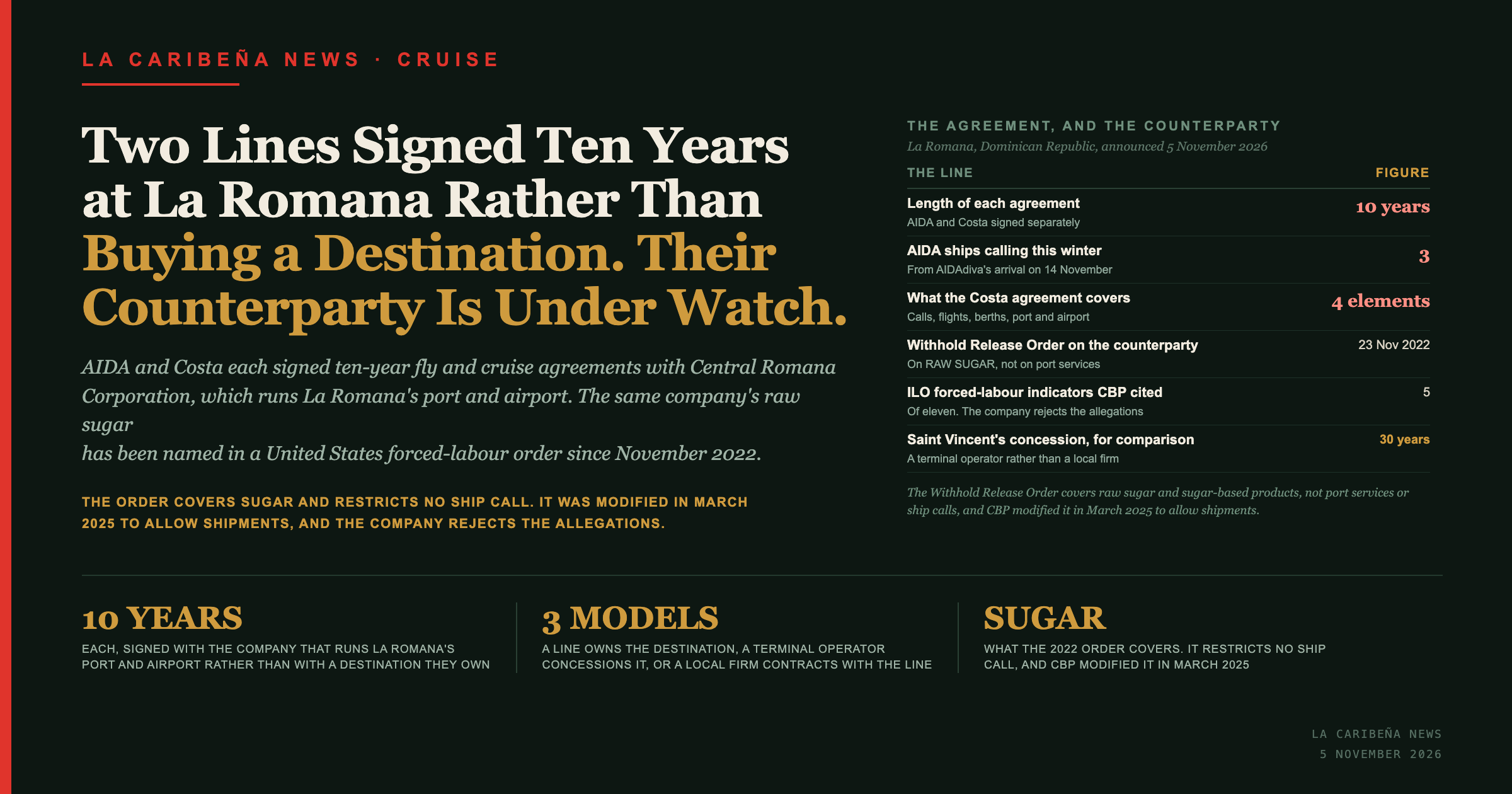
- Headline: two lines signed ten years at La Romana rather than buying a destination, and their counterparty has been under United States forced-labour scrutiny since 2022. - Length of each agreement: ten years. - Cruise brands signing: two, AIDA and Costa, both under Carnival. - AIDA ships calling at La Romana this winter: three. - Date AIDAdiva arrives: 14 November 2026. - Date the Withhold Release Order took effect: 23 November 2022. - ILO forced-labour indicators CBP said it identified: five of eleven. - Date the order was modified: March 2025. Date it was rescinded outright: 2 June 2025. - Years in Saint Vincent's concession with Global Ports Holding, for comparison: 30.
Frequently Asked Questions
What did AIDA and Costa sign?
Separate ten-year fly and cruise partnerships with Central Romana Corporation at La Romana in the Dominican Republic, announced on 5 November 2026. The Costa agreement covers ship calls, flights, berths, and port and airport infrastructure.
When do the ships arrive?
Three AIDA ships call at La Romana regularly this winter, beginning with AIDAdiva on 14 November 2026.
What is the Withhold Release Order?
A United States Customs and Border Protection order effective 23 November 2022 on raw sugar and sugar-based products produced in the Dominican Republic by Central Romana Corporation Limited, issued on information that reasonably indicated the use of forced labour in its operations. CBP said it identified five of the International Labour Organization's eleven indicators.
Is that order still in force?
CBP conditionally modified it on 11 March 2025, executed that on 17 March and rescinded it outright on 2 June 2025, allowing shipments to resume. The company rejects the allegations. In August 2026 the Corporate Accountability Lab called for reinstatement and Senator Ron Wyden questioned CBP over the modification. Nothing found indicates it has been reinstated.
Does the order affect cruise calls?
No. It covers raw sugar and sugar-based products, not port services or ship calls.
How does this compare with other Caribbean cruise ports?
Three models appear in this newspaper's reporting: the line owns the destination, as with Perfect Day CocoCay and Celebration Key; a terminal operator holds a concession, as Global Ports Holding does at Saint Vincent for 30 years; or a local corporation contracts with the line, as at La Romana.