By LCN Business Desk
Britain's export credit agency came to Georgetown on 9 September with an offer and a boundary. The offer was finance. The boundary was oil.
What made the session worth attending was where the boundary actually falls, because it is drawn around the barrel and not around the company.
What did UKEF tell Guyana's private sector?
That it can finance most things, and not the thing the economy is built on.
At a workshop at the World Trade Centre Georgetown aimed only at the Guyanese private sector, UK Export Finance Business Manager Rhania Mansour said that in keeping with the British government's fossil fuel policy, the agency cannot support contracts for the oil and gas sector.
UKEF is a UK government department, and that restriction follows a stated commitment to end support for the fossil fuel energy sector overseas. The agency says it has financed renewable energy projects to the value of £800 million since 2019, and runs a Transition Export Development Guarantee for organisations moving out of fossil fuels into clean energy.
Where does the oil and gas line actually fall?
Around the equipment, not around the company.
George Hames, UKEF's regional head of business origination for the Americas, drew the distinction himself.
Hames said companies working in the oil sector would not be subjected to a "purity test" because they are active in that supply chain.
For a country where the oil sector reaches into haulage, catering, fabrication, security, accommodation and logistics, that distinction decides who is inside the tent. A Guyanese firm that supplies the oil industry can still borrow against a UK contract for its trucks, its cold storage or its workshop. What it cannot do is use UKEF money to buy the specific equipment that goes offshore.
This newspaper has reported before on how local content in the oil boom is claimed and measured. The UKEF line cuts across that debate at an angle: it treats the supply chain as legitimate business while refusing the barrel itself.
How much is actually on the table?
A published band of £2 billion to £3 billion, described as risk appetite rather than a fund.
The workshop was reported as UKEF having upgraded its financial window to £3 billion for Guyana's public and private sectors. UKEF's own country cover publication is more precise, and the precision matters.
| Field | Guyana |
|---|---|
| Market risk appetite | £2 billion to £3 billion |
| Cash or short term cover | Yes |
| Medium or long term cover | Yes |
| Cover policy | Subject to sustainable lending criteria |
Two things follow. The £3 billion is the top of a band, not a figure on its own. And "market risk appetite" is a statement of how much exposure the agency is willing to consider, not money set aside, promised or drawn.
The regional table puts that in proportion.
| Economy | Published market risk appetite |
|---|---|
| Trinidad and Tobago | At least £5 billion |
| Dominican Republic | £4 billion to £5 billion |
| Jamaica | £4 billion to £5 billion |
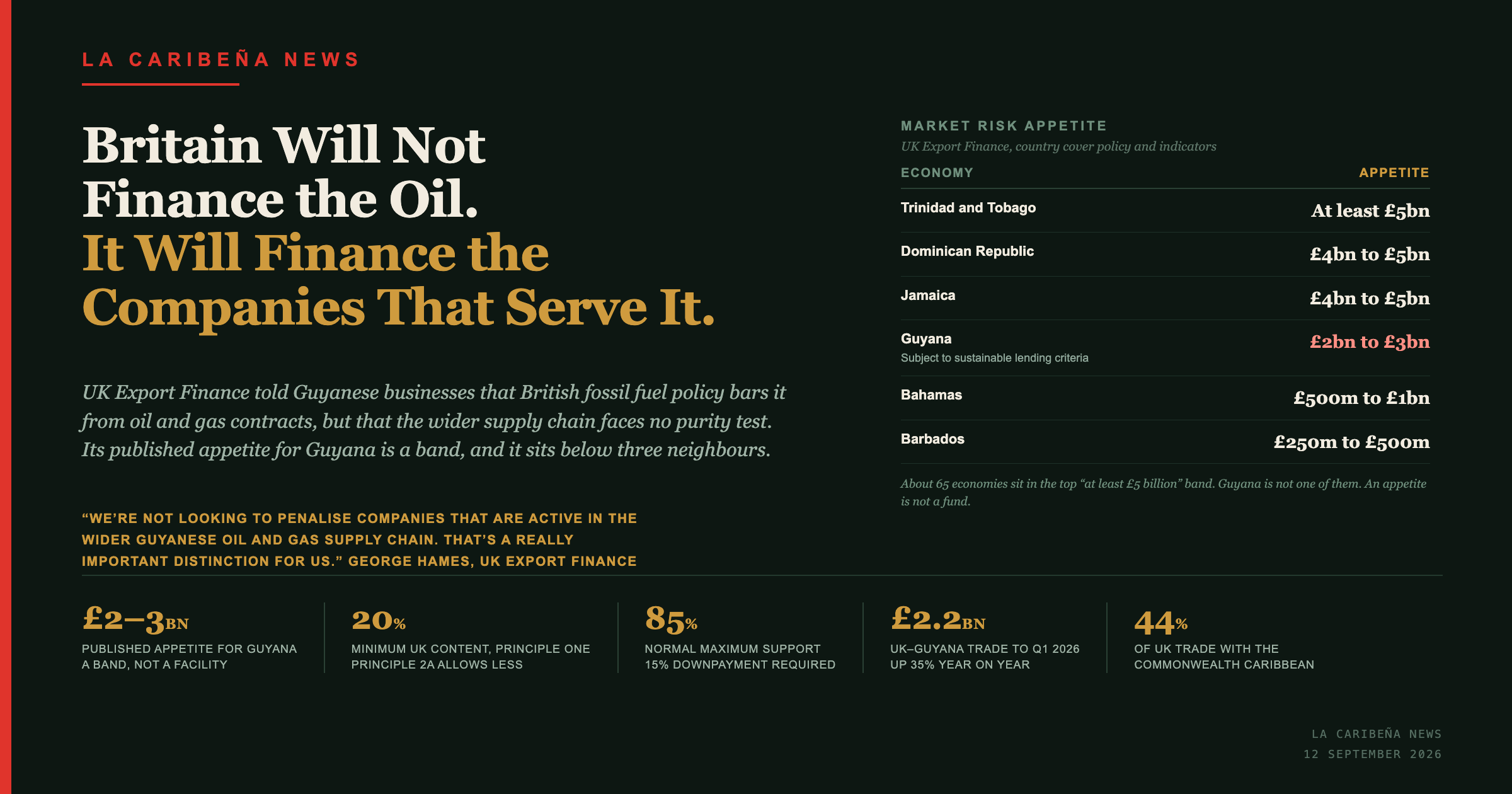
| Guyana | £2 billion to £3 billion |
| Bahamas | £500 million to £1 billion |
| Barbados | £250 million to £500 million |
| Grenada | £100 million to £250 million |
| Belize | Case by case |
| Suriname | Case by case |
| Haiti | Not able to offer any cover |
Across all the economies UKEF lists, the single most common band is "at least £5 billion", which applies to about 65 of them. Guyana is not in that tier, and sits below three of its own neighbours. That is worth stating plainly in a week when the country is routinely described as the fastest-growing economy in the hemisphere.
Is 20 per cent really the floor?
No. It is the first of three principles, and the policy expressly contemplates going below it.
Finance Minister Dr Ashni Singh told the workshop that UKEF supports projects with a minimum 20 per cent UK content, and called that formula the "most flexible export credit agency that I have encountered across the entire spectrum of export credit agencies", because most require a significantly larger home country share.
The figure checks out. UKEF's published approach to foreign content, last updated on 27 October 2025, sets it out at Principle One: "The maximum level of support for all foreign content is 80% of the contract value, requiring a minimum 20% UK content." The document calls this the 80:20 rule.
What the workshop reporting did not carry is that Principle One is not the end of it.
So the minister's characterisation is not only supportable, it is understated. The 85 per cent ceiling is UKEF's normal maximum, which the policy says is "aligned to international obligations requiring a 15% downpayment".
Hames framed the 20 per cent as "marrying" UK supply chain strengths with local goods, services and jobs. An official also said UKEF supports the importation of products from countries other than the UK.
How does the money actually move?
Through the buyer's bank, with UKEF standing behind the loan.
Judith Huijnen, who heads the Commonwealth Caribbean section at UKEF, described the mechanism. A UK exporter delivers a signed commercial contract with a buyer. The buyer's bank provides a loan to pay the exporter. UKEF provides an unconditional 100 per cent guarantee of repayment.
"The credit risk sits with UKEF," she said. "UKEF de-risks a transaction and unlocks financing. There's no longer a project risk. The risk sits with the government."
The report does not say which government that last sentence refers to, and the structure allows either reading. UKEF is itself a UK government department, and it has just been described as carrying the credit risk. In a buyer credit structure the repayment obligation sits with the borrower, which for a public project is the borrowing state. Both readings are available from the words as reported.
On products, Huijnen listed short-term working capital, bond support and export insurance, with a buyer credit facility for longer tenors, and said UKEF offers debt financing through commercial banks and insurers to fill gaps they cannot cover.
The agency also direct-lends at fixed rates in named priority areas: renewable energy, transport infrastructure, healthcare, agriculture and airports.
That list is the part a Guyanese reader should sit with. Guyana has run almost entirely on imported heavy fuel oil since January 2025. Two of those five are precisely where the country's constraints showed this month, in a grid running on a three per cent reserve and a regulator's scorecard of two and a half out of eight.
What does this mean for a Guyanese business?
That the binding constraint is a UK contract, not a UK bank account.
The structure rewards a specific shape of transaction: a Guyanese buyer with a signed contract from a UK supplier, where at least a fifth of the value is British, or less than a fifth if the deal fits Principle Two. Access runs through commercial banks, not through a UKEF counter, and the domestic side of that journey runs through Go-Invest.
For the smaller end of the market that is both the opportunity and the difficulty, because the gap it addresses is one this newspaper has examined across the region. A guarantee removes the lender's credit risk. It does not by itself produce the UK counterparty, the signed contract or the documentation that a first-time exporter has never had to assemble. That assembly is the whole job, as one Guyanese food producer's route into the United States market showed.
Britain is not the only European state putting money into Guyana on conditions. Germany committed €31 million to CARICOM climate and energy work including Guyana, and Guyana's tariff treatment has already spared oil taxes while exposing exporters elsewhere. CARICOM has separately negotiated industrial tariff terms with Colombia, and the Bahamas has built its own hub to connect exporters to global markets.
Why does this matter beyond Guyana?
Because an export credit agency is a foreign policy instrument that arrives looking like a bank.
UKEF's refusal to finance oil and gas is a British climate commitment applied to someone else's economy. Its willingness to finance the supply chain around that oil is a commercial judgement about where the line can hold. Both decisions are made in London and land in Georgetown.
UK High Commissioner Joseph Fisher told the workshop that Guyana is Britain's largest trading partner in the Commonwealth Caribbean, accounting for almost 44 per cent of the UK's total trade with the region, and that trade stood at more than £2.2 billion for the year to the end of the first quarter of 2026, a 35 per cent increase year on year.
A relationship growing at that rate, with a published risk appetite below three of its neighbours and an explicit carve-out around the country's largest industry, is not a simple offer. It is a set of terms. The terms are published, which is more than can be said for a good deal of what arrives in the region, and they repay reading before the first application rather than after it.
What the title card shows
- UKEF market risk appetite for Guyana: £2 billion to £3 billion. Short term and medium or long term cover both available, subject to sustainable lending criteria. Source: UK Export Finance, country cover policy and indicators.
- Regional comparison, same publication: Trinidad and Tobago at least £5 billion; Dominican Republic and Jamaica £4 billion to £5 billion; Bahamas £500 million to £1 billion; Barbados £250 million to £500 million; Grenada £100 million to £250 million; Belize and Suriname case by case; Haiti no cover. About 65 economies sit in the top "at least £5 billion" band.
- Minimum 20 per cent UK content under Principle One of UKEF's approach to foreign content, last updated 27 October 2025, described as the 80:20 rule. Principle 2A permits support below 20 per cent, sized at up to 85 per cent of five times the UK content.
- 85 per cent is UKEF's normal maximum support, aligned to international obligations requiring a 15 per cent downpayment.
- Oil and gas contracts cannot be supported under British fossil fuel policy; companies in the wider supply chain face no "purity test" (George Hames).
- Direct lending priority areas: renewable energy, transport infrastructure, healthcare, agriculture, airports.
- UK-Guyana trade: more than £2.2 billion for the year to end Q1 2026, up 35 per cent year on year, almost 44 per cent of UK trade with the Commonwealth Caribbean. Source: UK High Commissioner Joseph Fisher.
Frequently Asked Questions
Can a Guyanese oil services company use UKEF finance?
Yes, for contracts outside the specific oil and gas equipment that British policy excludes. George Hames said UKEF is not looking to penalise companies active in the wider Guyanese oil and gas supply chain, and that they would not face a "purity test".
Is £3 billion available to Guyana?
UKEF publishes a market risk appetite band of £2 billion to £3 billion for Guyana. That is a statement of how much exposure the agency is willing to consider, not a fund, a facility or money committed.
Does a project need 20 per cent UK content?
Twenty per cent is Principle One of UKEF's foreign content policy, the 80:20 rule. Principle 2A expressly allows support where UK content is under 20 per cent, sizing support on a multiple of the UK content instead.
Who carries the risk in a UKEF-backed deal?
UKEF provides an unconditional 100 per cent guarantee of repayment to the lender. Judith Huijnen said the credit risk sits with UKEF, and also that the risk sits with the government. The report does not say which government, and the structure allows either reading.
How does a business start?
Through a commercial bank, with a signed contract from a UK supplier. UKEF works through banks and insurers rather than lending to buyers directly in most cases, though it does direct-lend at fixed rates in renewable energy, transport infrastructure, healthcare, agriculture and airports.