By LCN Business Desk
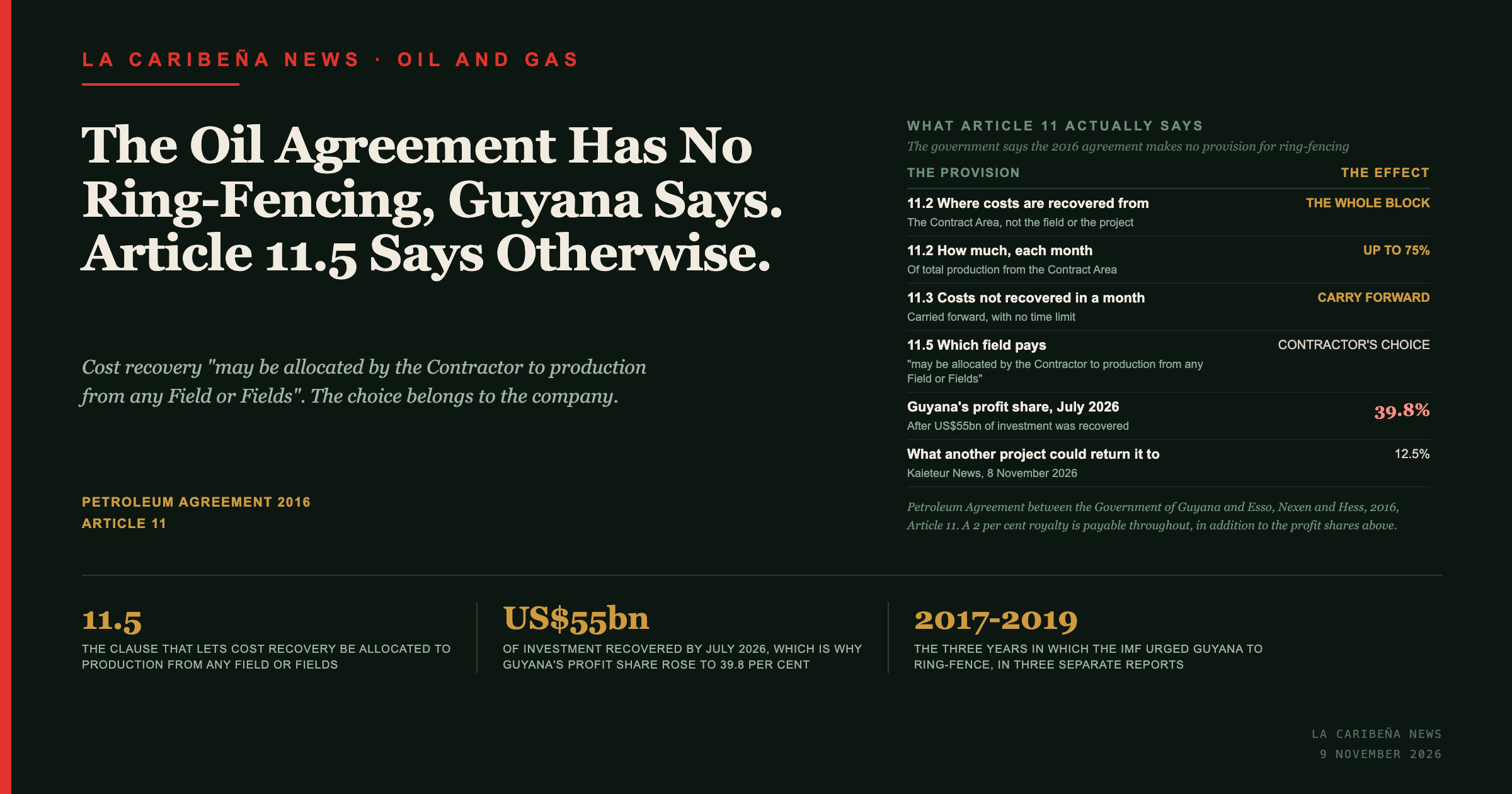
The government says the 2016 agreement makes no provision for ring-fencing. Article 11.5 of that agreement makes a provision, and it runs the other way.
Guyana's profit share tripled in July, when ExxonMobil finished recovering US$55 billion of investment and the cost pool emptied. A new project refills that pool. Whether it refills from its own production or from everything already flowing is the question a ring-fencing clause answers.
What did the government say?
That the agreement does not provide for it.
A government source told Kaieteur News on 8 November that the eighth project, Longtail, is still under review, and that if approved it "is not likely to feature a ring-fencing clause as the 2016 Production Sharing Agreement makes no provision."
The same source said ring-fencing cannot be included unless the contract is renegotiated, which the government has refused.
What does the agreement say?
Article 11.5 provides for it, in the opposite direction.
The text reads: "The quantity of Cost Oil and/or Cost Gas actually utilized in satisfying the Recoverable Contract Costs may be allocated by the Contractor to production from any Field or Fields."
The permission belongs to the contractor. The agreement does not omit the subject. It decides it.
Where is the fence drawn instead?
Around the whole block.
Article 11.2 recovers costs from oil and gas "produced and sold from the Contract Area," capped in any month at "seventy-five percent (75%) of the total production from the Contract Area." The Contract Area is the Stabroek Block, not a field and not a project.
Article 11.3 carries any shortfall forward into the following months, with no time limit. Article 11.4 then splits what is left, "for each Field," fifty-fifty.
| Article | What it does |
|---|---|
| 11.2 | Recovery from the Contract Area, capped at 75 per cent of monthly production |
| 11.3 | Unrecovered costs carry forward indefinitely |
| 11.4 | Profit oil split 50/50, for each field |
| 11.5 | ! Cost recovery may be allocated to any field or fields, at the contractor's choice |
Source: Petroleum Agreement between the Government of Guyana and Esso, Nexen and Hess, 2016.
What changed in July?
The pool emptied, and Guyana's share tripled.
ExxonMobil's Senior Vice President and Chief Financial Officer, Neil Hansen, told investors the company had "fully recovered the $55 billion of investment, along with all the operating costs." That investment dates from 2014, and recovery ran about two years ahead of schedule.
President Irfaan Ali confirmed the effect. Cost recovery fell from 75 per cent of monthly production to 20 per cent, and Guyana's profit share rose from 12.5 per cent to 39.8 per cent, on top of its 2 per cent royalty.
ExxonMobil recorded the same shift from the other side. Its third-quarter results, filed on 30 October, name an accelerated Guyana entitlement impact among the reasons upstream earnings fell.
This newspaper reported in August that while costs were being recovered, Guyana's total take ran at about 14.5 per cent of gross revenue, being the 2 per cent royalty and 12.5 per cent of profit oil. That royalty is a quarter of what a large gold mine pays above US$1,000 an ounce, and gold carries its own allocation rules in a separate agreement.
What would an eighth project do to that?
Kaieteur reports the share could fall back toward where it started.
Its 8 November piece opens on the point: approval of another project "could see Guyana's share of profits fall from the current 39.8% to just 12.5%."
What that share funds is the rest of the economy. Guyana's real GDP grew an estimated 33.3 per cent in the first half of 2026, while the full-year forecast for everything except oil was cut.
Longtail would be the first gas-focused development in the block. ExxonMobil requested approval in March 2026 and has filed environmental studies with the Environmental Protection Agency. Dates on this block have diverged before: for Uaru, the fifth phase, the Ministry expected September and CNOOC scheduled the fourth quarter. The plans describe 24 to 60 development wells, drilling from 2027 into 2031 and beyond, subsea installation from 2028, and the floating production vessel installed and started up between 2028 and 2031.
Who has asked Guyana to ring-fence?
Four institutions, across nine years.
The International Monetary Fund urged it in three separate reports dated 2017, 2018 and 2019. One of them put the mechanism plainly: "This asymmetrical treatment of profit and cost oil will benefit the contractor at the expense of delaying government revenue."
The United Nations Development Programme, Chatham House and the World Bank each called for a ring-fencing provision for every project. The Institute for Energy Economics and Financial Analysis went further through its Director of Financial Analysis, Tom Sanzillo: "The lack of contract protections means that every time Guyana announces it has received more revenue, it is actually being shortchanged."
Has Guyana added terms to this agreement before?
Yes, twice that are a matter of record.
Kaieteur notes that the government introduced a flaring fee and passed the Local Content Act in 2021, neither of which was in the 2016 agreement. That Act reserves 40 service areas for Guyanese companies and binds operators in the same block. It sets the Guyanese share in each, reaching 90 per cent on office space rental and 75 per cent on food supply. Those are obligations on the same contractor, imposed in 2021, that the 2016 agreement did not contain.
Where has this been tested?
Ghana, and the revenue authority lost time to it.
The Ghana Revenue Authority found that contractors had offset exploration and development costs for the TEN and MTA developments against profits generated by the Jubilee Field, a finding it repeated in 2014. The Jubilee Partners contested it, arguing that section 38(2) of the Petroleum Income Tax Act did not amount to a ring-fencing provision. The authority collected US$217 million in 2012 and about US$284 million in 2013, less than it had projected.
Ghana's Income Tax Act of 2015 now requires chargeable income to be calculated by production field. It does not apply retrospectively to agreements already stabilised.
The entities
- Stabroek Block is the contract area the 2016 agreement covers. - 2016 Production Sharing Agreement is the instrument whose Article 11 governs cost recovery. - ExxonMobil recovered US$55 billion of investment by July 2026. - Neil Hansen is its Senior Vice President and Chief Financial Officer. - Irfaan Ali is the President of Guyana, who confirmed the change in shares. - Longtail is the proposed eighth project, under review. - International Monetary Fund urged ring-fencing in 2017, 2018 and 2019. - Tom Sanzillo is Director of Financial Analysis at the Institute for Energy Economics and Financial Analysis. - Ghana Revenue Authority found costs from two developments offset against a third field.
What the title card says
- Headline: Guyana says the oil agreement makes no provision for ring-fencing, and Article 11.5 lets the contractor choose which field pays. - Article 11.5: cost recovery may be allocated by the contractor to production from any field or fields. - Article 11.2: recovery from the Contract Area, capped at 75 per cent of monthly production. - Investment recovered by July 2026: US$55 billion. - Cost recovery after the pool emptied: 20 per cent of production. - Guyana's profit share before and after: 12.5 per cent, then 39.8 per cent. - Royalty throughout: 2 per cent. - Institutions that asked for ring-fencing: the IMF, the World Bank, Chatham House and the UNDP.
Frequently Asked Questions
Does the 2016 agreement provide for ring-fencing?
It provides the opposite. Article 11.5 says cost recovery "may be allocated by the Contractor to production from any Field or Fields."
Where is the boundary for cost recovery drawn?
At the Contract Area, under Article 11.2, which is the whole Stabroek Block rather than a field or a project.
What is the cost recovery cap?
Seventy-five per cent of total monthly production from the Contract Area. After ExxonMobil finished recovering its investment in July 2026 the figure fell to 20 per cent.
What is Guyana's share now?
A 2 per cent royalty and 39.8 per cent of profit oil, up from 12.5 per cent of profit oil while costs were being recovered.
Which institutions have asked Guyana to ring-fence?
The International Monetary Fund in 2017, 2018 and 2019, and the United Nations Development Programme, Chatham House and the World Bank.