By LCN Business Desk
Zijin booked US$334 million from the Aurora Gold Mine in six months. Clause 9.8 of the Aurora Mineral Agreement lets the royalty be set against the company's tax, so the rate and the receipt are different numbers.
Zijin Gold International reported US$334 million of revenue from the Aurora Gold Mine for the six months to 30 June 2026, in half-year results dated 14 August. Kaieteur News first reported that revenue figure on 29 September. On 9 November it put Guyana's royalty on it at about US$26 million, applying an 8 per cent rate. Rio Times reported the same revenue and noted that neither the royalty paid nor the rate in the agreement appears in the documents it read.
The rate is right. The calculation is not what the agreement describes.
What rate does the agreement set?
Eight per cent, once gold sells above US$1,000.
Clause 9.3 of the Aurora Mineral Agreement, reviewed by La Caribeña News, sets the Applicable Gold Royalty on a two-band scale.
| Sales price of gold, or gold contained in a concentrate | Royalty |
|---|---|
| Up to US$1,000 | 5.0 per cent |
| From US$1,000.01 and up | ! 8.0 per cent |
Source: Aurora Mineral Agreement, clause 9.3.
Clause 9.4.2 describes the difference between the two bands as "the Additional Royalty (of 3%)". It also records that if an updated feasibility study for underground mining shows that the additional 3 per cent "will serve as a disincentive to production, the government may consider reducing" it.
That 8 per cent is the figure this newspaper set against the oil regime in August, when a proposed mine at Omai showed large-scale gold paying four times the royalty ExxonMobil pays on Stabroek oil. The oil side rests on a different mechanism again: cost recovery under the 2016 agreement may be allocated by the contractor to any field or fields.
Anything mined at Aurora that is not gold carries 1.5 per cent, under clause 9.3.1, the same rate Guyana charges on every grade of bauxite.
What is the royalty applied to?
Not the revenue line. The settlement.
Clause 9.4 says the percentage "shall be applied to the quantity of gold and other Valuable Minerals that the Company is actually paid for in settlement with the smelter, refinery or other arms-length third party purchaser."
The US$334 million is a revenue figure in a half-year report. The royalty base under the agreement is what the smelter settles. The two figures are different, and only one of them is published.
How is it paid?
In gold.
Clause 9.4 opens: "The Applicable Royalty shall be paid in kind by the Company to the GoG unless otherwise agreed." The company must keep enough metal uncommitted for future delivery to meet that obligation.
Payment can be switched to cash, but only "upon the mutual agreement of GoG and the Company" under clause 9.4.1. Whether that has happened is not on the public record.
So a figure stated in United States dollars describes metal delivered to the state, unless the method was changed.
What happens to it in the tax computation?
The company deducts it.
Where the royalty is paid in kind, clause 9.4 entitles the company and its affiliates "to deduct the value of all gold and other Valuable Minerals paid to the GoG in-kind as an expense," valued at the market price on the trading day of delivery. Where it is paid in cash, clause 9.4.1 gives the same deduction.
The royalty therefore reduces the profit on which corporation tax is charged. Clause 9.8 caps that tax at "the lesser of (i) 30% and (ii) the prevailing rate in Guyana from time to time."
What else does clause 9 do?
It moves in one direction.
Clause 9.5 provides that if the government enacts any law, signs any Mineral Agreement, or takes any action "prescribing a lower rate of fees or royalties than that set forth in this Agreement, the obligation to pay fees and royalties under this Agreement shall be reduced to such rate as is so prescribed." Clause 9.6 applies the same rule to rent, set at US$5.00 per acre a year.
Clause 9.9 does it for tax. Income tax is computed under the rules as they stood at the Effective Date, "to the exclusion of such rules less favourable to the taxpayer as may be enacted in the future." Where a later rule is more favourable, the company takes it.
Clause 9.1 exempts supplies imported for the project from duties and import fees. Clause 9.2 sets a partial excise tax of 10 per cent on fuel.
The same machinery runs through the sector. Five Guyanese mineral agreements reviewed by this newspaper carry a stability clause word for word: if a new law increases what a company must pay or do, the state restores it to the position it held.
What does the Mining Act say about any of this?
That the licence decides.
Section 68(3)(a) of the Mining Act makes royalty payable "at the rate fixed by, or computed in accordance with the provisions of, the mining licence concerned," and only where no rate is so fixed does the prescribed rate apply.
The Guyana Geology and Mines Commission describes the sector's standard gold royalty as 5 per cent, with agreements "commonly" applying 8 per cent above US$1,000 an ounce. The Commission reported in October that it found no material deviations in how mineral and petroleum licences were awarded in 2023 and 2024. For Aurora, clause 9.3 settles it.
So what is Guyana owed?
A quantity of gold, and it can be estimated two ways.
Because clause 9.4 pays the royalty in metal, the obligation is a weight, not a sum. Eight per cent of the 70,731 ounces Zijin reports is 5,658 ounces. Eight per cent of the 70,105 ounces the Ministry of Finance declared is 5,608 ounces. The two bases are 50 ounces apart.
In the units Zijin uses, eight per cent of 2.2 tonnes is 176 kilogrammes of gold for the half year.
| Base | Output | Royalty at 8 per cent |
|---|---|---|
| Zijin half-year results | 70,731 oz | ! 5,658 oz |
| Ministry of Finance declaration | 70,105 oz | 5,608 oz |
| Zijin, stated in metal | 2.2 tonnes | ! 176 kg |
Both calculations apply the clause 9.3 rate to reported output. Clause 9.4 applies it to the quantity settled with the smelter, which is not published, so these are estimates and the true figure will differ.
Dividing the revenue by the output implies a realised price of about US$4,722 an ounce, far above the US$1,000 threshold, which is why the higher band applies.
What is that worth in cash?
About US$23.4 million tonight, and the figure moves every day.
Gold stood at a bid of US$4,141.30 an ounce on Kitco at 18:29 New York time on 9 November 2026, which is 19:29 in Georgetown. At that price the 5,658 ounces are worth about US$23,433,000, and the 5,608 ounces on the Ministry's own declaration about US$23,226,000.
| Valued at US$4,141.30 an ounce | Cash equivalent |
|---|---|
| 5,658 oz, on Zijin's reported output | ! about US$23,433,000 |
| 5,608 oz, on the Ministry's declaration | about US$23,226,000 |
| Eight per cent of the US$334 million revenue line | ! US$26,720,000 |
Kitco bid, 9 November 2026, 18:29 New York. The revenue line implies a realised price of about US$4,722 an ounce for the half year.
The gap between the two is about US$3.3 million, and it exists because the royalty is a weight of metal rather than a sum of money. Gold closed tonight 25.9 per cent below the US$5,589.38 it reached on 28 January 2026. The ounces Guyana is owed have not changed. What they fetch has.
Which price decides, and on what day?
The London afternoon fix, on the day the gold is handed over.
The agreement defines "Market Price of Valuable Minerals" as, for gold, "the spot market price in U.S. Dollars for one fine troy ounce of gold as fixed on such day by the London Bullion Houses (second fixing)."
That definition does one job in clause 9.4. It values the deduction the company takes against its taxable income, measured on the trading day the metal is delivered.
So the price on the delivery day changes what the company can deduct. It does not change the number of ounces Guyana receives. And turning those ounces into money, with whatever refining, transport and timing that involves, falls outside the clause entirely.
What is still not published?
The royalty actually delivered.
Neither the government nor the company has published the gold or the cash handed over for the half year, or the settlement proceeds the percentage was applied to. On output the two sides are close: Zijin reported 2.2 tonnes, or 70,731 troy ounces, and the Ministry of Finance declared 70,105 ounces, a difference of 626 ounces, or 0.89 per cent.
They moved in opposite directions, though. Rio Times recorded that the company's reported tonnage rose about 10 per cent while the ounces declared to the state fell 1.7 per cent. It also put the world gold price over the period at about US$4,694 an ounce and the mine's all-in cost at about US$1,682.
Eight per cent of US$334 million is US$26.72 million, which is arithmetic on a revenue line rather than a payment anyone has reported. Rio Times made the same point about the absence of a disclosed figure.
The entities
- Aurora Gold Mine reported US$334 million of revenue in the first half of 2026. - Zijin Gold International published the half-year results dated 14 August 2026. - Mineral Agreement is the instrument whose clause 9 sets the royalty, the rent and the tax terms. - Mining Act is the statute whose section 68 defers the rate to the licence. - Guyana Geology and Mines Commission publishes the fiscal regime for the sector. - Ministry of Finance declared national gold output of 70,105 ounces for the half year. - Kaieteur News reported the revenue figure on 29 September and the royalty estimate on 9 November. - Rio Times reported the revenue and recorded that no royalty figure or rate appears in the documents it read.
What the title card says
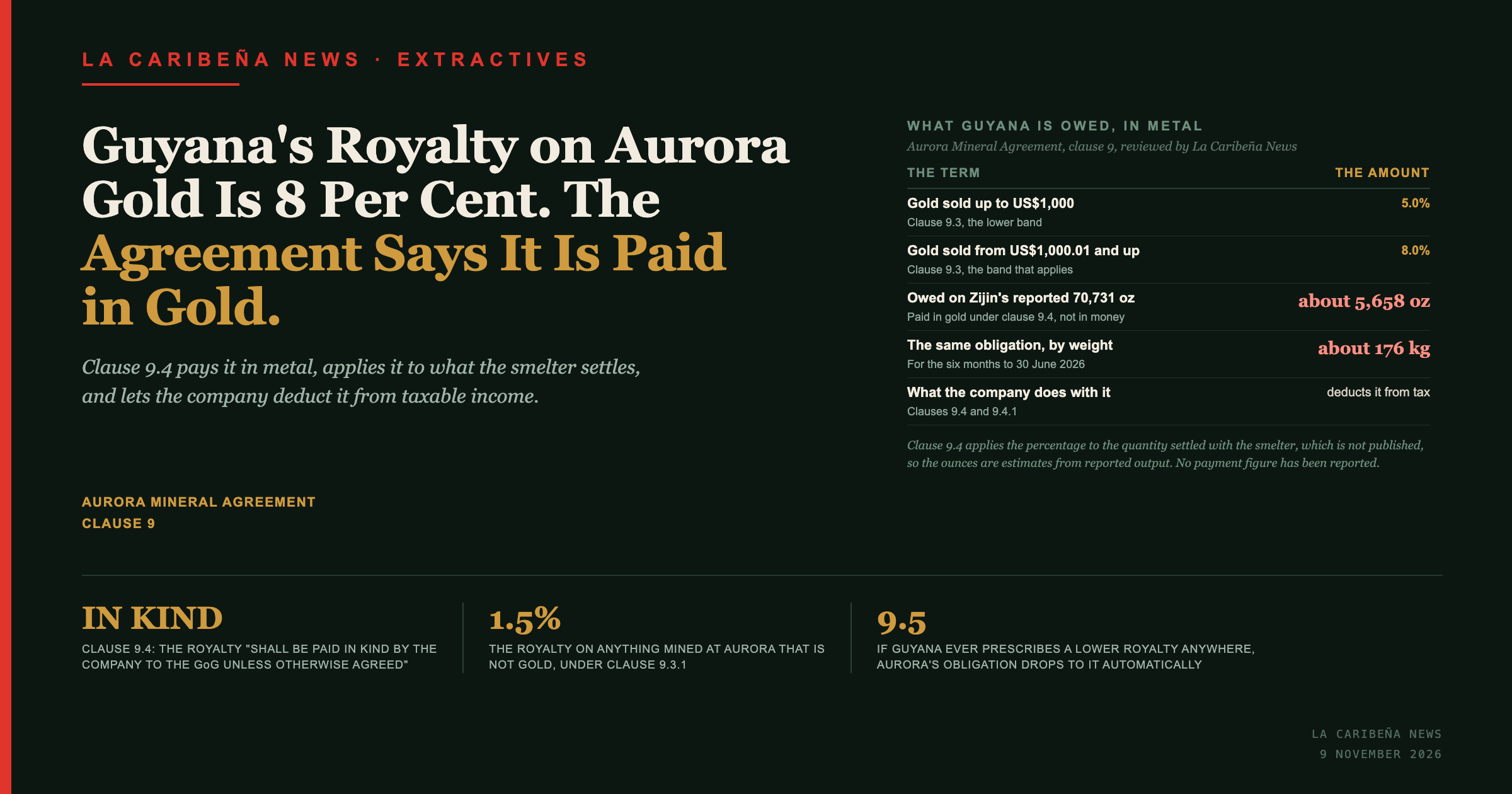
- Headline: Guyana's royalty on Aurora gold is 8 per cent, paid in gold and deducted from the company's tax. - Royalty above a sales price of US$1,000: 8.0 per cent. - Royalty at or below US$1,000: 5.0 per cent. - Royalty on minerals other than gold: 1.5 per cent. - Method of payment under clause 9.4: in kind, in gold, unless both sides agree otherwise. - Treatment in the tax computation: deducted as an expense. - Corporation tax under clause 9.8: the lesser of 30 per cent and the prevailing rate. - Rent under clause 9.6: US$5.00 per acre a year. - Aurora revenue, six months to 30 June 2026: US$334 million. - Royalty on Zijin's reported 70,731 ounces at 8 per cent: about 5,658 ounces of gold. - Royalty on the Ministry's declared 70,105 ounces at 8 per cent: about 5,608 ounces. - The same obligation in metal: about 176 kilogrammes for the half year.
Frequently Asked Questions
What royalty does Guyana charge on Aurora's gold?
Clause 9.3 of the Mineral Agreement sets 5.0 per cent where gold sells up to US$1,000 and 8.0 per cent from US$1,000.01 and up.
Is the royalty paid in money?
Not by default. Clause 9.4 says it "shall be paid in kind by the Company to the GoG unless otherwise agreed." Switching to cash requires the mutual agreement of both parties.
Is the royalty applied to the company's revenue?
No. Clause 9.4 applies the percentage to the quantity the company is actually paid for in settlement with the smelter, refinery or other purchaser.
Does the royalty affect the company's tax?
Yes. Clauses 9.4 and 9.4.1 let the company deduct it as an expense. Clause 9.8 caps corporation tax at the lesser of 30 per cent and the prevailing rate.
What happens if Guyana lowers royalties for someone else?
Clause 9.5 reduces Aurora's obligation to that lower rate automatically.
How much gold is Guyana owed for the half year?
Applying the clause 9.3 rate to reported output gives about 5,658 ounces on Zijin's 70,731 ounces, or about 5,608 ounces on the Ministry of Finance's declared 70,105 ounces. In metal that is roughly 176 kilogrammes. Clause 9.4 applies the percentage to the quantity settled with the smelter, which is not published, so these are estimates.