By LCN Business Desk
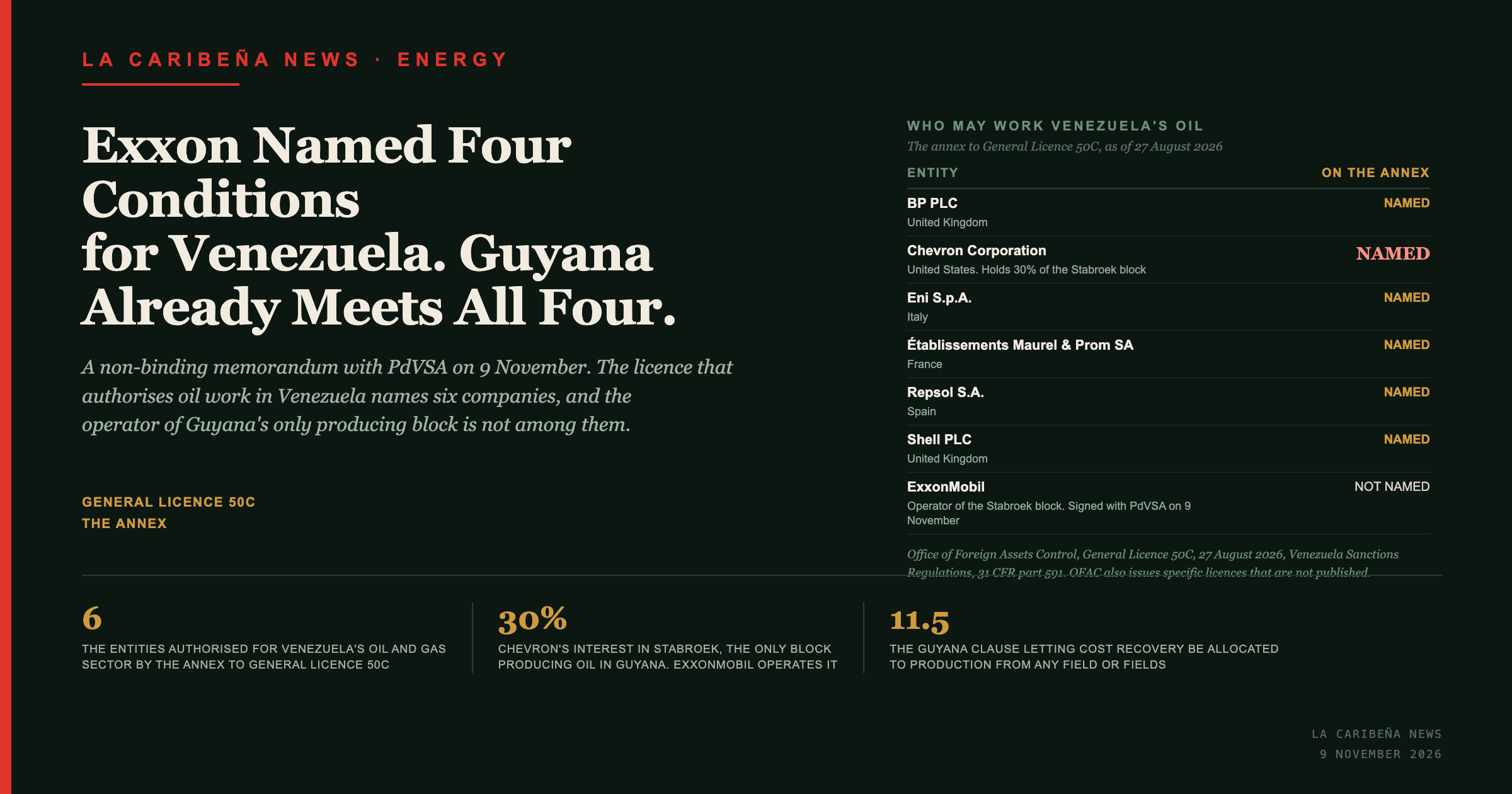
ExxonMobil set out four conditions for investing in Venezuela. Guyana's 2016 agreement, signed a decade earlier, already carries every one of them.
The New York Times reported on the evening of Monday 9 November that ExxonMobil had reached a preliminary agreement with Petróleos de Venezuela, S.A. The agreement binds the company to no project and gives it a period to evaluate production opportunities. A final joint venture or production sharing contract would be required before Exxon could explore or produce. Venezuela's Interim President, Delcy Rodríguez, welcomed it.
Exxon left Venezuela in 2007, after the government changed the terms under which foreign oil companies operated and the company declined to accept them. It has sought compensation for the assets it gave up ever since.
What did Exxon say it requires?
Four things, named in its own statement.
Exxon said any future investment "would require stable policies, clear regulations, strong investment protections and competitive returns." Those are the company's own words about what it needs from a host government before it will put capital into the ground.
The four conditions are worth holding onto, because Guyana is the jurisdiction where Exxon already has them.
Does Guyana's agreement already meet those conditions?
It meets each of them, and the terms are a matter of public record.
The 2016 production sharing agreement sets a royalty of 2 per cent and allows the contractor to recover costs from up to 75 per cent of total monthly production from the Contract Area, under Article 11.2. Profit oil is then divided. Article 11.5 of the same agreement provides that cost recovery "may be allocated by the Contractor to production from any Field or Fields," so Article 11.5 lets the contractor choose which field pays.
That clause is the fourth condition in its most concrete form. A contractor that may choose which producing field absorbs a new project's costs is a contractor whose returns are protected against the timing risk of that project.
What does the United States licence say?
It authorises six companies by name, and Exxon is not one of them.
General Licence 50C was issued by the Office of Foreign Assets Control on 27 August 2026 under the Venezuela Sanctions Regulations, 31 CFR part 591. It authorises transactions related to oil or gas sector operations in Venezuela of the entities listed in its annex. The annex is headed "List of Entities Described in Paragraph (a) of General License 50C as of August 27, 2026" and runs to six lines.
| Entity named in the annex to General Licence 50C | Home jurisdiction |
|---|---|
| BP PLC | United Kingdom |
| Chevron Corporation | United States |
| Eni S.p.A. | Italy |
| Établissements Maurel & Prom SA | France |
| Repsol S.A. | Spain |
| Shell PLC | United Kingdom |
Source: Annex to General Licence 50C, as of 27 August 2026.
The word Exxon does not appear anywhere in the licence. On the Treasury's own Venezuela sanctions page, General Licence 50C remains the operative oil sector authorisation; no 50D or later version of the 50 series is listed. The Office of Foreign Assets Control also issues specific licences that it does not publish, so the annex settles the company's position under this general licence and nothing beyond it. The licence also directs that any payment of oil or gas taxes or royalties to the Government of Venezuela or PdVSA be made into the Foreign Government Deposit Funds or another account as the Treasury instructs.
This newspaper reported the annex on 29 August, when the licence was two days old. Seventy-two days later the memorandum was signed and the list is unchanged.
Which company on Stabroek is licensed for Venezuela?
The partner, not the operator.
Chevron Corporation appears in the annex. Chevron also holds 30 per cent of the Stabroek block, the only block producing oil in Guyana. ExxonMobil operates that block and holds no authorisation under this licence.
Chevron also carries US$50,960 million of Guyana net properties on its books, and the Hess business it bought earned US$193 million in the 166 days after the acquisition closed.
The two American companies on the same Guyanese acreage therefore sit on opposite sides of the United States authorisation for Venezuela.
What changed in Exxon's position since January?
The price of oil, Venezuela's legislation, and the company's answer.
In January, at a televised White House meeting held days after United States forces captured Nicolás Maduro, chief executive Darren Woods called Venezuela uninvestable. He said the company's assets had been seized there twice and that returning a third time would require significant change. On the third quarter earnings call last month he put it differently, saying Exxon absolutely saw a need for the resource at some point and would ultimately have a role, while adding that there was a way to go.
Between those two statements, by the Times's account, oil prices rose by about 50 per cent, largely because of the war with Iran, and that conflict raised the value of barrels produced far from choke points such as the Strait of Hormuz. Venezuela overhauled its legislation after Maduro's seizure to attract foreign oil companies.
Reuters reported in September that Exxon had shown interest in the Petromonagas heavy oil project and nearby Carabobo acreage in the Orinoco Belt. Exxon has not said publicly which fields the memorandum covers.
A company that required significant change in January signed in November, in a market where the barrel was worth half as much again.
What does this mean for ring-fencing in Guyana?
It separates what the agreement forbids from what the government declines to do.
Cost recovery under the 2016 agreement is bounded by the Contract Area. Spending in Venezuela cannot enter Guyana's cost bank, and nothing in the memorandum changes that. The relevance runs the other way.
A government source told Kaieteur News on 8 November that a ring-fencing clause is unlikely on the eighth Stabroek project because the 2016 agreement makes no provision for one. Guyana has nonetheless imposed new obligations on the same contractor twice since that agreement was signed: a flaring fee, and the Local Content Act of 2021, which reserves forty categories of work for Guyanese companies and sets a Guyanese share in each. Neither was in the 2016 agreement.
The timing matters because the pool is empty. ExxonMobil finished recovering US$55 billion of investment in July 2026, cost recovery fell to 20 per cent of production, and Guyana's profit share rose from 12.5 per cent to 39.8 per cent. An eighth project refills that pool, and Article 11.5 leaves the choice of which field pays to the contractor.
The block is a single accounting unit, and the US$12.7 billion Errea Wittu development was recovering against other fields from 2023, before it had produced a barrel.
The International Monetary Fund set out the mechanism in one of three reports it published on the subject in 2017, 2018 and 2019: "This asymmetrical treatment of profit and cost oil will benefit the contractor at the expense of delaying government revenue." The United Nations Development Programme, Chatham House and the World Bank each asked for a ring-fencing provision for every project.
What happens to the border question?
It moves to a court first, and to a negotiating table afterwards.
Exxon produces in Guyana while Venezuela maintains a territorial claim. The Times reported that negotiations over the maritime boundary between the two countries are expected to begin after the United Nations' principal judicial organ rules on the land boundary, most likely by early next year. The Stabroek block lies offshore.
Exxon also has an unresolved claim of its own against Venezuela. An International Centre for Settlement of Investment Disputes tribunal awarded the company US$1.6 billion plus interest in 2014 over the 2007 nationalisation. Venezuela challenged the award and the matter is not settled.
The entities
- ExxonMobil operates the Stabroek block and signed the memorandum of 9 November 2026. - Darren Woods is its Chairman and Chief Executive Officer. - Petróleos de Venezuela, S.A. is the Venezuelan state oil company and the counterparty. - Delcy Rodríguez is Venezuela's Interim President. - Chevron Corporation holds 30 per cent of Stabroek and is named in the annex to General Licence 50C. - Office of Foreign Assets Control issued General Licence 50C on 27 August 2026. - General Licence 50C authorises oil and gas sector operations in Venezuela of six named entities. - 2016 Production Sharing Agreement is the instrument whose Article 11 governs cost recovery in Guyana. - International Monetary Fund urged ring-fencing in 2017, 2018 and 2019.
What the title card says
- Headline: Exxon named four conditions for investing in Venezuela, and Guyana's 2016 agreement already meets every one. - Memorandum signed: 9 November 2026, non-binding, with PdVSA. - Exxon's stated conditions: stable policies, clear regulations, strong investment protections, competitive returns. - Entities named in the annex to General Licence 50C: 6. - ExxonMobil among them: no. Chevron: yes. - Chevron's interest in the Stabroek block: 30 per cent. - Guyana's royalty under the 2016 agreement: 2 per cent. - Cost recovery ceiling: 75 per cent of monthly production from the Contract Area. - Investment recovered by July 2026: US$55 billion. - Guyana's profit share before and after: 12.5 per cent, then 39.8 per cent.
Frequently Asked Questions
Did Exxon commit to investing in Venezuela?
No. The memorandum of 9 November 2026 is non-binding and commits the company to no project. A final joint venture or production sharing contract would be required before it could explore or produce.
Is ExxonMobil authorised by the United States to operate in Venezuela?
It is not named in the annex to General Licence 50C, which lists six entities as of 27 August 2026 and remains the operative oil sector authorisation on the Treasury's Venezuela sanctions page. The word Exxon does not appear in that licence.
Can Exxon charge its Venezuelan spending against Guyana's oil revenue?
No. Cost recovery under the 2016 production sharing agreement is bounded by the Contract Area, which is the Stabroek block.
What are the four conditions Exxon named?
Stable policies, clear regulations, strong investment protections and competitive returns, in a statement about any future investment in Venezuela.
Has Guyana ever added terms to the 2016 agreement?
Twice on the record: a flaring fee, and the Local Content Act of 2021, which binds the same contractor and was not in the 2016 agreement.
What is Guyana's share now?
A 2 per cent royalty and 39.8 per cent of profit oil, up from 12.5 per cent while costs were being recovered.