By LCN Business Desk
The Errea Wittu reached Guyana at the end of August, the fifth and largest floating production vessel to work the Stabroek Block. MODEC built it for a development called Uaru.
In the same week two organisations with money in that vessel said when it would start producing, and they said different things. Guyana's Ministry of Natural Resources said September. CNOOC Limited, which owns a quarter of the block, said the fourth quarter.
September came and went. Nobody has since said the vessel is producing, and the operator's own quarterly results do not mention Uaru at all.
What did CNOOC report for the first three quarters?
Record production, slowing growth, and revenue running far ahead of both.
| First three quarters of 2026 | Figure | Change |
|---|---|---|
| Net oil and gas production | 593.7 million boe | +2.7% |
| China net production | 408.5 million boe | +1.9% |
| Overseas net production | 185.1 million boe | +4.3% |
| Oil and gas sales revenue | RMB 305.35 billion | +19.5% |
| Net profit attributable to shareholders | RMB 119.12 billion | +16.8% |
*CNOOC Limited, results announcement of 30 October 2026. The company calls the revenue figure unaudited. It is listed in Hong Kong as 00883 and 80883 and in Shanghai as 600938.*
Revenue grew at seven times the rate of the barrels behind it. That gap is price and mix: CNOOC sold dearer oil, not much more of it. Capital spending was about RMB 89.9 billion, which the company says is on plan.
The volume growth is also slowing. At the half year CNOOC was up 3.7 per cent. Across nine months it is up 2.7.
Where does Guyana appear in CNOOC's figures?
In the overseas line, named next to Brazil, as a reason it grew.
The company credits the rise in overseas production to projects in Guyana and Brazil, among others. It does not say how much came from which, and the sentence puts neither country ahead of the other.
What it does say is that a company owning a quarter of Guyana's oil treats the country as a reason its overseas output went up, and says so in the document it files for its shareholders.
It says it in Chinese. The English side of CNOOC's own website answers announcements of this kind with a one-kilobyte notice: a version may or may not appear here.
What did CNOOC publish about Uaru?
The project, the block and the quarter, on one line under a heading reading Guyana.
"Uaru Project, the fifth phase of the Stabroek Block, is scheduled to commence production in the fourth quarter" CNOOC LIMITED, 2026 MID-YEAR REVIEW, 27 AUGUST 2026
A line on the same page bounds it. The section holding that bullet is headed *Overseas Projects: Information disclosed by Operators*, so CNOOC is passing on what the operator told it.
What did Guyana's own ministry say?
September. Same week, same ship.
When Guyana's fifth FPSO Errea Wittu arrives was reported at the end of August, the Ministry of Natural Resources said MODEC had built the vessel for the Uaru development in the Stabroek Block, and that production was expected to begin in September.
CNOOC's review, published days earlier, put it a quarter later. Neither has been corrected since. CNOOC's third-quarter release covers the period to 30 September and does not report the project onstream.
How does that compare with the operator's own release?
ExxonMobil names Guyana three times and the project not once.
This newspaper reported on 1 November that ExxonMobil's third-quarter results name Guyana twice as a gain and once as a drag, and that the release never names the Stabroek Block, never names Uaru, and never uses the phrase cost recovery.
Two owners of the same field, reporting the same quarter. One tells you what Guyana did to the earnings. The other tells you which project starts and when.
None of that means anything was withheld. A results release and an operational review do different jobs. It is a question of which document to open, and that matters to a supplier quoting for work or a ministry forecasting revenue.
Chevron owns the rest, and Chevron holds 30 per cent of the block that produces all of Guyana's oil.
What does the loading schedule imply?
That the working date has slid towards the end of the quarter.
On Guyana's preliminary December programme, the first shipment of Uaru crude is scheduled for 11 and 12 December, with Uaru exports expected to reach four million barrels over the month. Oil has to be produced before it can be loaded, so a cargo booked for mid-December puts production ahead of it, and a long way after September.
Three dates, in the order they were published: September, the fourth quarter, then 11 December. The programme is preliminary, and loading dates move with weather, maintenance and whoever is buying. No one has said the vessel is producing.
Where is the project detail actually published?
In the minority owners' filings, not the operator's results.
Three companies own this block and all three publish, on different calendars, in different formats, for different readers. The project-level detail a supplier or a lender actually needs has been turning up in the partners' documents rather than in the operator's quarterly results.
It turns up in the language those documents are filed in, too. The line crediting Guyana for CNOOC's overseas growth exists in Chinese, and nowhere in English on the company's own site except as a notice saying it might not.
None of this has slowed the country down. Guyana's own accounts have its oil and gas industry expanding 41.3 per cent in the first half of 2026. That happened before the fifth vessel produced a barrel.
The entities
- CNOOC Limited is the Hong Kong and Shanghai listed oil company that holds a quarter of the Stabroek Block and publishes the results announcement and mid-year review used here.
- Stabroek Block is the offshore petroleum block that produces all of Guyana's crude.
- Uaru is the fifth phase of the Stabroek Block, which CNOOC scheduled for production in the fourth quarter of 2026.
- Errea Wittu is the floating production vessel for that phase, reported as having arrived at the end of August 2026.
- ExxonMobil is the operator of the Stabroek Block, whose third-quarter results release names Guyana without naming the project.
- Chevron is the third owner of the block, holding 30 per cent.
- Mid-year review is the operational and financial presentation CNOOC published on 27 August 2026, which carries the Guyana line quoted here.
- Net production is a company's share of production after deductions, the measure CNOOC reports in barrels of oil equivalent.
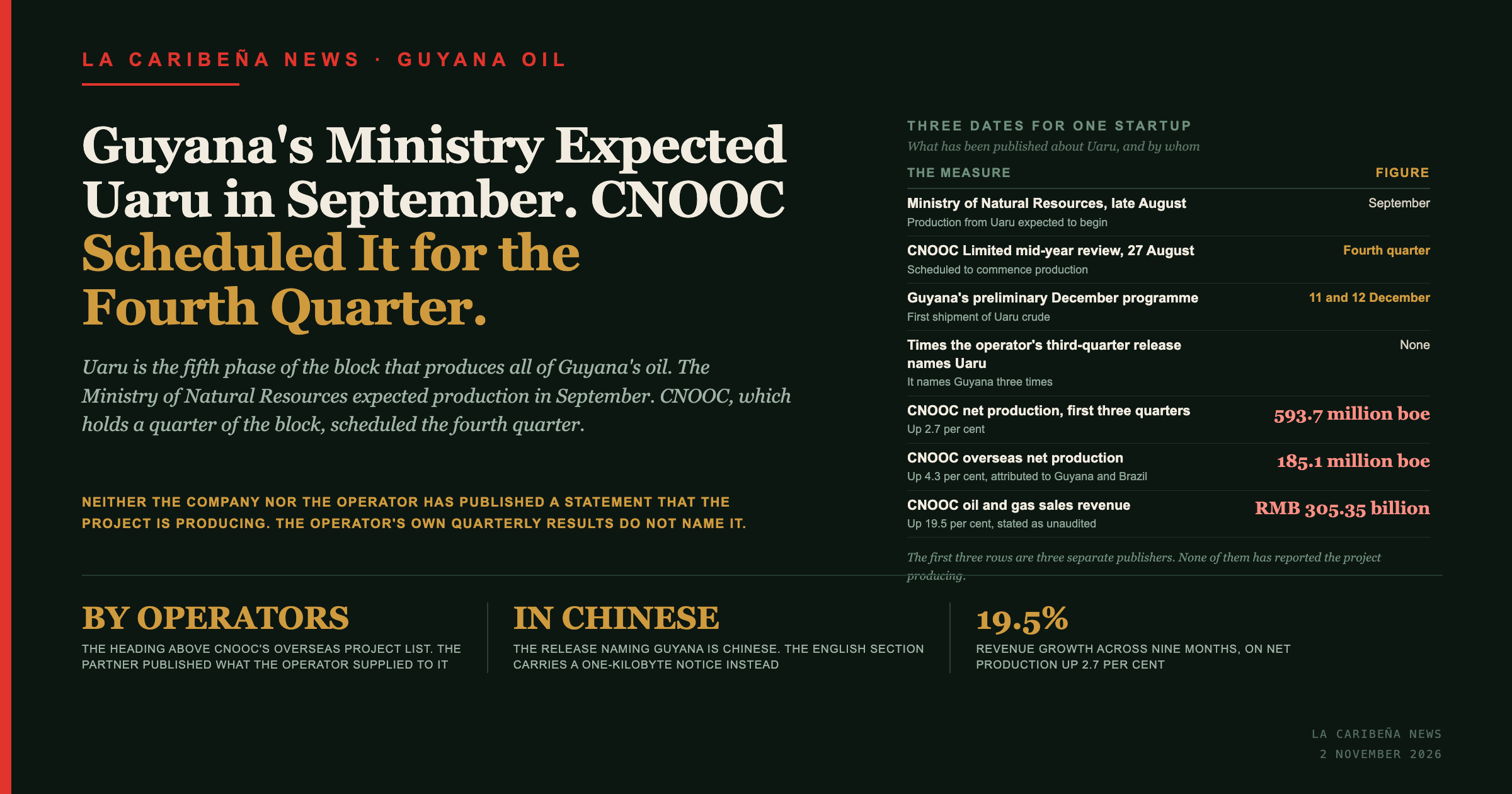
What the title card says
- Headline: Guyana's ministry expected Uaru in September, and CNOOC scheduled it for the fourth quarter.
- What the Ministry of Natural Resources said in late August: production from the Uaru development was expected to begin in September.
- What CNOOC Limited's mid-year review of 27 August scheduled: commencement of production in the fourth quarter.
- First shipment of Uaru crude on Guyana's preliminary December programme: 11 and 12 December.
- Times ExxonMobil's third-quarter results release names Uaru: none. It names Guyana three times.
- CNOOC net oil and gas production, first three quarters of 2026: 593.7 million boe, up 2.7 per cent.
- CNOOC overseas net production in the same period: 185.1 million boe, up 4.3 per cent, attributed to projects in Guyana and Brazil among others.
- CNOOC oil and gas sales revenue: RMB 305.35 billion, up 19.5 per cent, described by the company as unaudited.
- The heading above CNOOC's overseas project list: Overseas Projects, Information disclosed by Operators.
- The release naming Guyana is published in Chinese, with a one-kilobyte notice in the English section.
Frequently Asked Questions
Who owns the Stabroek Block?
ExxonMobil operates it, Chevron holds 30 per cent and CNOOC Limited holds a quarter. All three publish, on different calendars and in different formats, and the project-level detail on Guyana has been appearing in the partners' documents rather than in the operator's quarterly results release.
What did CNOOC report for the first three quarters of 2026?
Net oil and gas production of 593.7 million barrels of oil equivalent, up 2.7 per cent, with China at 408.5 million and overseas at 185.1 million. Oil and gas sales revenue was RMB 305.35 billion, up 19.5 per cent, which the company describes as unaudited, and net profit attributable to shareholders was RMB 119.12 billion, up 16.8 per cent.
How much of CNOOC's growth comes from Guyana?
The company does not say. It attributes its 4.3 per cent overseas production increase to the contribution of projects in Guyana and Brazil among others, without splitting the figure between them. The statement establishes that Guyana is one of the reasons overseas production rose, not that it is the larger one.
When does Uaru start producing?
Three dates have been published and none has been confirmed as met. Guyana's Ministry of Natural Resources said in late August that production was expected to begin in September. CNOOC Limited's mid-year review of 27 August scheduled it for the fourth quarter. Guyana's preliminary December loading programme sets the first shipment of Uaru crude for 11 and 12 December. Neither CNOOC nor ExxonMobil has published a statement that the project is producing.
Why does the language of the filing matter?
CNOOC's results announcement is published in Chinese, and the English section of its own site carries, for announcements of this class, a one-kilobyte notice saying a corresponding version may or may not be published there. The figure attributing overseas production growth to Guyana appears in the Chinese text.