By LCN Business Desk
A loading schedule is a plan, and this one has not shipped. Guyana's preliminary programme for December lists 33 million barrels of crude for export, which across a 31-day month is about 1.06 million barrels a day.
That would be the first month in which the country's crude exports pass a million barrels a day. Commercial production began in December 2019.
What does the December schedule actually say?
Thirty-three million barrels, and a date for a crude grade that has never been sold.
The schedule was reported by Bloomberg on 13 October and set out by OilPrice the same day. The first shipment of Uaru crude is scheduled for 11 and 12 December, with Uaru exports expected to reach four million barrels over the month, about an eighth of the total.
The word doing the work is preliminary. Loading programmes move with weather, maintenance and buyer scheduling, and a December figure published in October is a plan for a month that has not begun.
Has Guyana crossed a million barrels a day?
Not on the production figures, and exports and production are not the same measure.
ExxonMobil confirmed Stabroek Block production had reached 900,000 barrels a day in November 2025. Government data reviewed by OilNOW put output at 903,000 a day in April 2026, after a record 918,000 in February. Those are production numbers from the field.
Exports are what leaves on a tanker in a given month, and they move with the loading calendar rather than with the daily rate. A month with an extra cargo reads higher than the field was running.
A loading schedule published in October describes a December that has not happened.
What is Uaru crude?
A new grade, from Guyana's fifth producing development.
The Uaru project was approved in April 2023 at US$12.7 billion and targets more than 800 million barrels of recoverable oil from the Uaru, Mako and Snoek fields. It runs through the Errea Wittu floating production, storage and offloading vessel, built by Japan's MODEC, which arrived offshore in August 2026 with a design capacity of 250,000 barrels a day and storage for about two million barrels. The vessel can also process 540 million cubic feet of gas a day and inject 350,000 barrels of water.
S&P Global Commodity Insights data reported by OilNOW projected Uaru producing about 136,000 barrels a day initially, rising to about 215,000 in 2027. Even the lower figure would carry national output past a million if the four existing developments hold near current rates.
The arrival of that vessel was covered in Guyana's Fifth FPSO Errea Wittu Arrives, Eyes 1M Barrels Daily. What Guyana pays for it before it takes a profit share is examined in Guyana's Share of Its Own Oil Hit a Record.
How did Guyana get from nothing to this in seven years?
Five vessels in seven years.
| Development | Vessel | First oil | Capacity, barrels a day |
|---|---|---|---|
| Liza Phase 1 | Liza Destiny | 20 December 2019 | 120,000 as designed |
| Liza Phase 2 | Liza Unity | February 2022 | 220,000, since optimised to about 270,000 |
| Payara | Prosperity | November 2023 | 220,000, target reached January 2024 |
| Yellowtail | ONE GUYANA | 8 August 2025 | 250,000 |
| Uaru | Errea Wittu | due December 2026 | 250,000 |
Source: ExxonMobil, MODEC and government data reported by OilNOW and OilPrice. Liza Destiny has since operated above its original nameplate capacity.
Two of the five arrived ahead of schedule. Payara hit its initial target three months early, and Yellowtail achieved first oil four months early.
In September 2026 ExxonMobil announced that cumulative production from the Stabroek Block had passed one billion barrels, reported in Guyana's Oil Fund Has Taken In US$10.5 Billion Since 2020.
What comes after Uaru?
Three more developments, and a gas project that is not yet licensed.
Whiptail is the sixth, scheduled for late 2027 through the Jaguar vessel being built by SBM Offshore, adding 250,000 barrels a day. Hammerhead, the seventh, took final investment approval in September 2025 at US$6.8 billion and is slated for 2029, adding 150,000. Longtail, the eighth, targets 2030 and is weighted to natural gas and condensate rather than crude; Guyana's government is still reviewing its development plan and production licence application.
Together the eight developments would lift installed capacity to roughly 1.7 million barrels a day by 2030. How much of the oil Guyana keeps as those projects stack up is the subject of Guyana Waited Six Years for 39.8 Per Cent, and how much is in the ground at all is disputed in Guyana Says 11.6 Billion Barrels. The Operator Says Just Under 11 Billion..
What does the export figure not tell you?
What the country earns from it.
A barrel loaded is not a barrel Guyana is paid for. Production is split between cost oil, which repays the operator's spending, and profit oil, which is shared. The export total counts every barrel on the tanker whoever ends up with the proceeds.
The International Monetary Fund, in its October 2026 assessment, reported Guyana's economy growing more than 19 per cent in 2025 and the Natural Resource Fund holding about US$3.3 billion at year-end. That is a fund balance, not a measure of what the oil sold for.
What the title card shows
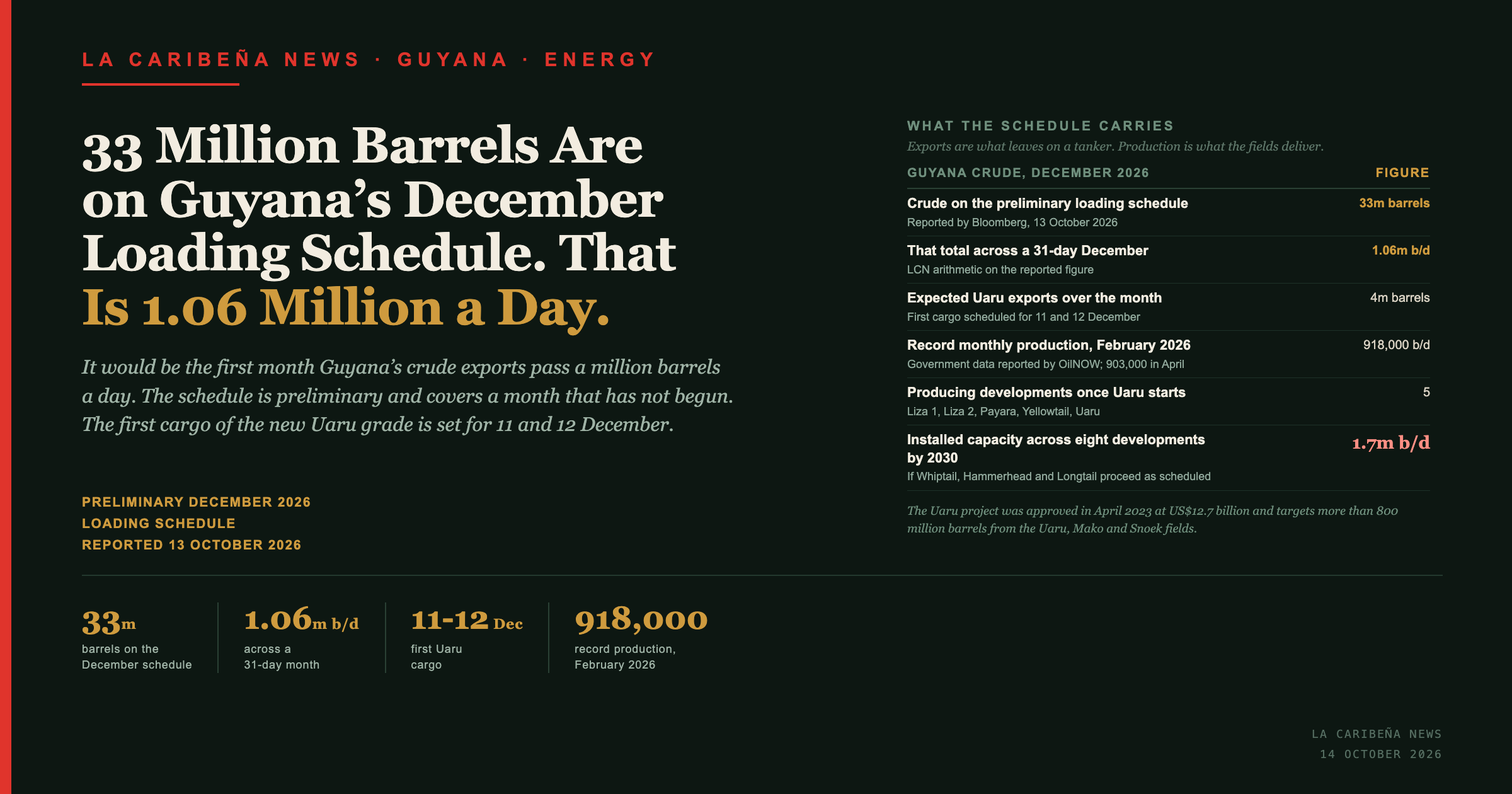
Every data point on the article's title card, in text.
- 33 million barrels. Guyana's preliminary December 2026 loading schedule for crude exports, as reported by Bloomberg on 13 October 2026.
- 1.06 million barrels a day. That total across a 31-day December. LCN's arithmetic on the reported figure.
- 11 and 12 December. The scheduled first shipment of the new Uaru crude grade.
- 4 million barrels. Expected Uaru exports over the month, about an eighth of the total.
- 5 developments. Producing fields once Uaru starts: Liza 1, Liza 2, Payara, Yellowtail and Uaru.
- 918,000 barrels a day. The record monthly production rate, in February 2026, per government data reported by OilNOW. Output was 903,000 in April 2026.
- 1.7 million barrels a day. Installed capacity across eight developments by 2030, if Whiptail, Hammerhead and Longtail proceed as scheduled.
- US$12.7 billion. The approved cost of the Uaru project, which targets more than 800 million barrels from the Uaru, Mako and Snoek fields.
Frequently Asked Questions
Has Guyana exported a million barrels of oil a day?
Not yet. The preliminary loading schedule for December 2026 carries 33 million barrels, about 1.06 million a day across the month, which would be the first time exports passed that level. The schedule was reported on 13 October and covers a month that has not begun.
What is the difference between Guyana's production and its exports?
Production is what the fields deliver daily. Exports are what leaves on tankers in a given month, which moves with the loading calendar. ExxonMobil reported production at 900,000 barrels a day in November 2025, and government data showed 903,000 in April 2026 after a record 918,000 in February.
What is Uaru crude?
A new grade from Guyana's fifth producing development, running through the Errea Wittu vessel built by MODEC. The US$12.7 billion project was approved in April 2023 and targets more than 800 million barrels from the Uaru, Mako and Snoek fields.
How many oil projects does Guyana have?
Five producing once Uaru starts, with three more planned: Whiptail in late 2027, Hammerhead in 2029 and Longtail targeting 2030. Longtail is weighted to gas and condensate, and its development plan and production licence are still under government review.
What would Guyana's capacity be by 2030?
About 1.7 million barrels a day across all eight developments, if each proceeds as scheduled.