By LCN Business Desk
ExxonMobil Guyana president Alistair Routledge argued against ring-fencing new Stabroek developments at the Georgetown Chamber of Commerce and Industry's 2026 Energy Luncheon on Thursday, Kaieteur News reported. The event ran under the theme "Beyond the Barrel: Oil, Gas, Growth, and the Guyanese Contractor", INews Guyana reported separately. Ring-fencing would stop costs from a new project being recovered against revenue from producing ones, which is the mechanism that decides when Guyana's share rises and when it falls back.
What is actually at stake in the percentage?
The difference between 39.8 per cent and 12.5 per cent of profit oil. Guyana reached the higher figure only after nearly six years of production, once the investment made in the earlier developments had been recovered. Two further projects are awaiting approval, and without ring-fencing their costs are recoverable against the revenue the producing fields now generate.
| Position | Guyana's share of profit oil |
|---|---|
| After cost recovery on the producing developments | 39.8 per cent |
| If new projects are not ring-fenced | 12.5 per cent |
How the share got to its record is itself on this record. It rose because Guyana finished paying for assets, including two vessels, set out in Guyana's Share of Its Own Oil Hit a Record. A share that arrives by finishing payment is a share that can be reset by starting a new one.
What did the company say?
That deepwater is different. "Some have raised questions about ring-fencing. Should every project be ring-fenced? In some places that happens. I would say in deep water, which is what we are talking about here, that is something we should be cautious about," Routledge said.
He argued the provision changes sequence rather than size. "Ultimately, ring-fencing does not change, if you do exactly the same number of projects you would have done with or without ring-fencing, it doesn't change the gross revenue that the government sees, that the country sees. What it does is just change the timing." He also said ring-fencing each project would have "seriously undermined" the company's ability to make investments such as the Vreed-en-Hoop shorebase and the Guyana Technical Training Centre at Port Mourant.
Does the timing argument hold?
It holds on the arithmetic and it is silent on the cost of waiting. Gross revenue over the life of a block can be unchanged while the state receives it years later, and money received later is worth less, has to be borrowed against in the meantime, and arrives after the budgets it was meant to fund have already been set.
Timing is also what the state is currently planning around. Real output grew 33.3 per cent in the first half while the forecast for everything except oil was cut, reported in Guyana's Economy Grew 33.3 Per Cent. A budget leaning on petroleum receipts is a budget exposed to when those receipts land, not only to whether they do.
The electricity side is already waiting on the same timetable. The Prime Minister has said bills will not halve until the plant runs at full capacity, examined in The Prime Minister Says Bills Will Not Halve Until the Plant Runs at Full Capacity, and in the meantime the country is paying 9.5 US cents for rented power, in Guyana Pays 9.5 Cents for Rented Power.
What do the terms look like beside a neighbour?
Thinner on both counts. Guyana's royalty on the 2016 Stabroek agreement is 2 per cent; Suriname signed 6.25 per cent next door, set out in Guyana's Oil Royalty Is 2%. Suriname Next Door Signed 6.25%. Royalty is the part that pays whatever the cost position is, which is exactly why it matters most in the years when cost recovery is taking the profit share down. A 2 per cent royalty is what Guyana keeps receiving when profit oil falls to 12.5 per cent.
Suriname is the sharpest comparison available because the geology is shared and the timing is close. The same deepwater argument that is offered here as a reason for caution applies to a basin that continues across the maritime boundary.
| Measure | Guyana | Suriname | Trinidad and Tobago |
|---|---|---|---|
| Royalty | 2 per cent | 6.25 per cent | Not compared here |
| EITI validation status | Fairly low | Fairly low | High |
| Year EITI joined | 2017 | 2017 | 2011 |
| Latest EITI data published | 2022 | 2024 | 2022 |
The lower half of that table is the transparency record rather than the fiscal one, taken from the Extractive Industries Transparency Initiative's country pages for Guyana, Suriname and Trinidad and Tobago. Guyana and Suriname joined within five months of each other and hold the same status, but Suriname has been validated on 2024 data while Guyana's most recent published picture of the sector is from 2022. A question about how profit oil is calculated is harder to settle from the outside when the published record stops four years back.
What else is the company asking for?
A second pipeline, at roughly twice the price of the first. ExxonMobil has laid a US$1 billion pipeline bringing gas from Liza to the Gas-to-Energy site at Wales, and INews Guyana reported that Routledge told the same luncheon the foundation must be laid before a further development in Region Six, a second pipeline he has previously put at approximately US$2 billion.
"We need some significant gas demand in order to make the foundational investments in the pipeline to bring the gas onshore and all the associated infrastructure that goes with it," he said, naming data centres, aluminium melting and power generation as the anchor purchases being sought.
Each of those three has a record here already. Trinidad has signed up 800 megawatts of data centres while its own gas utilisation fell, set out in Trinidad Has Signed Up 800 Megawatts of Data Centres. On power generation, the plant at Wales is being built at 300 megawatts while the resource ministry has described 600, in The Resource Ministry Says Wales Will Carry 600 MW. And the natural gas liquids facility that sits beside that plant went to tender this month, with two bidders and a US$465 million gap between them, in Two Firms Bid to Build Guyana's Gas Liquids Plant.
That sits directly beside the ring-fencing argument. The case against ring-fencing was that it would have undermined strategic investments such as a shorebase and a training centre. The investment now being described is a US$2 billion pipeline, and whether its cost is recoverable against producing fields is precisely what ring-fencing decides.
Where does the decision sit?
With the government, and it has not been made. President Irfaan Ali has committed to seeking expert advice on whether the financing arrangement that allows costs from new developments to be recovered against current production should change. The two projects are awaiting approval, so the question is live rather than retrospective.
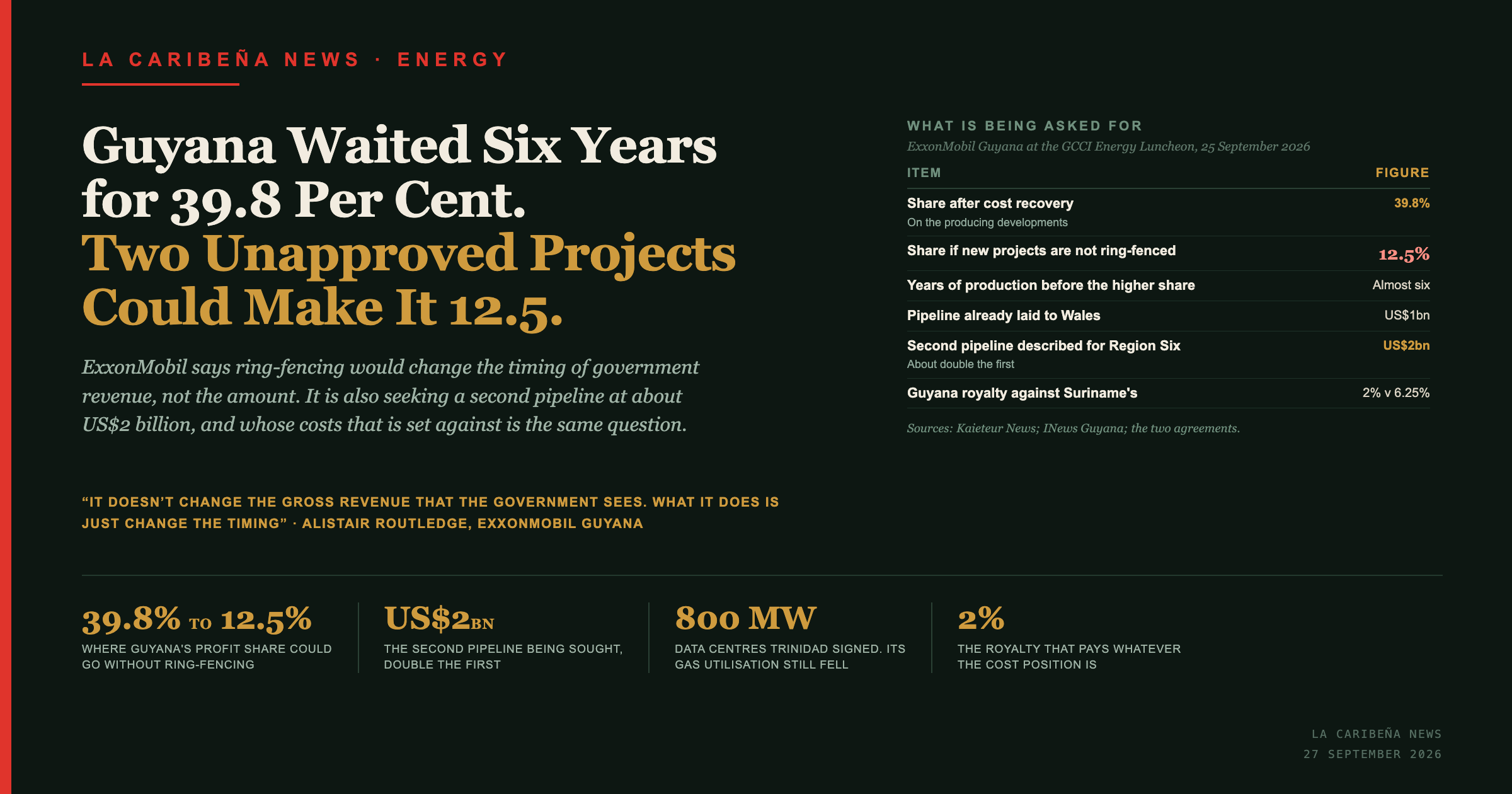
What the title card shows
- 39.8 per cent: Guyana's share of Stabroek profit oil after ExxonMobil recovered its investment in the producing developments. Source: Kaieteur News.
- 12.5 per cent: the share it could return to if two further projects are approved without ring-fencing. Source: Kaieteur News.
- Almost six years: how long production ran before the higher share was reached at all. Source: Kaieteur News.
- US$1 billion: the pipeline already laid from Liza to the Gas-to-Energy site at Wales. Source: INews Guyana.
- About US$2 billion: the second pipeline described for Region Six, roughly double the first. Source: INews Guyana.
- 2 per cent against 6.25 per cent: Guyana's royalty on the 2016 Stabroek agreement beside Suriname's. Source: the two agreements, as reported by La Caribena News.
- 800 megawatts: the data centres Trinidad and Tobago signed up, after which its gas utilisation fell. Source: La Caribena News, 30 August 2026.
- “It doesn't change the gross revenue that the government sees. What it does is just change the timing”: Alistair Routledge, ExxonMobil Guyana. Source: Kaieteur News.
Frequently Asked Questions
What is ring-fencing?
Treating each project as its own accounting unit, so the costs of a new development cannot be recovered against the revenue of a producing one. Without it, spending on a new project reduces the profit oil available to be shared while that spending is being recovered.
What would it change for Guyana?
The share of profit oil the state receives while new developments are being built. Guyana's share reached 39.8 per cent once earlier investment was recovered, and could fall to 12.5 per cent if two projects awaiting approval are financed against current production.
What is ExxonMobil's argument?
That deepwater warrants caution, that ring-fencing would have undermined investments such as the Vreed-en-Hoop shorebase and the Guyana Technical Training Centre, and that for the same number of projects it changes the timing of government revenue rather than the gross amount.
Has the government decided?
No. President Irfaan Ali has committed to seeking expert advice on whether the current financing arrangement should change. The two developments are awaiting approval.