By LCN Business Desk
Alistair Routledge told a Georgetown chamber luncheon this week that ring-fencing new Stabroek projects would change when Guyana is paid rather than how much, reported in Guyana Waited Six Years for 39.8 Per Cent. The argument is a real one and it is made by serious people. It is also testable, because other countries have run this experiment and written down what happened.
What is being argued about?
Whether a company may set the costs of a new project against the profits of one already producing. The Intergovernmental Forum on Mining defines ring-fencing as a limitation on consolidating income and deductions across different activities or projects undertaken by the same taxpayer, and it can be drawn at sector, contract-area, licence or project level.
For production sharing agreements the IGF toolkit records what is normal: cost recovery "is often ring-fenced around the exploration and/or development licence within a contract area, which means that exploration and/or development costs associated with a particular licence must be recovered from revenues generated within that block or licence". Guyana's fence is drawn around the whole Stabroek Block. The question is whether it should also be drawn around each project inside it.
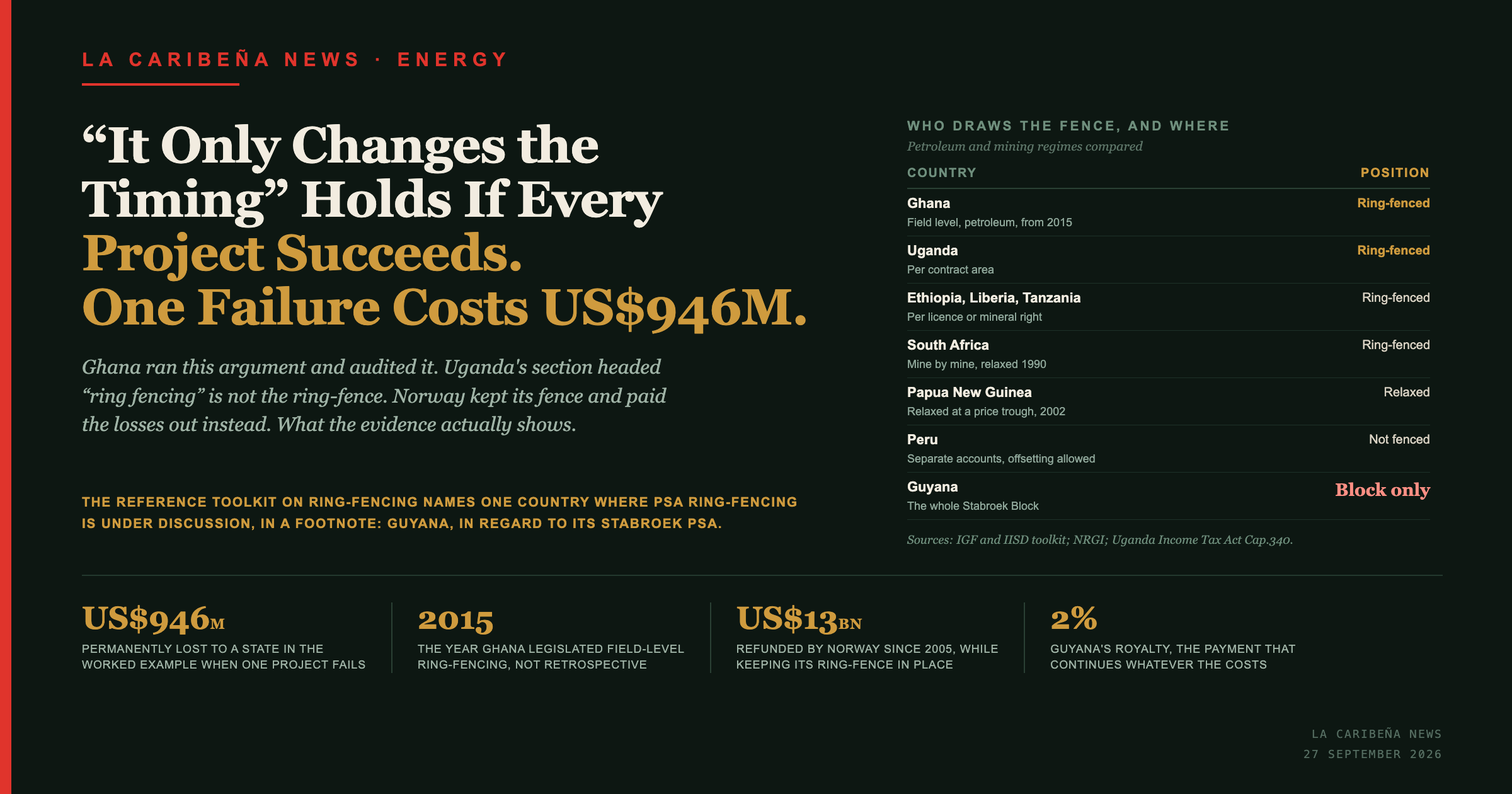
The same toolkit carries a footnote that is worth reading twice. Discussing where PSA ring-fencing has been debated, it names one country: Guyana, in regard to its Stabroek PSA.
Is it really only about timing?
No, and the arithmetic that shows why is in the toolkit itself. It runs two worked examples.
| Scenario | Government revenue, ring-fenced | Government revenue, consolidated |
|---|---|---|
| Two successful mines | First tax in year 8 | First tax in year 11 |
| One producing mine, one abandoned project | US$3.664 billion | US$2.718 billion |
The first row is the timing effect, and it is three years. The second row is the part the timing argument leaves out. Where one project fails and its costs are carried against a producing one, the toolkit records that US$946 million in possible government revenue is permanently lost. Not deferred. Lost, because a loss set against someone else's profit is never recovered from a field that never produced.
So the claim that gross revenue is unchanged holds on one condition: that every project the company builds succeeds. In exploration and development, that is the condition that cannot be assumed, which is precisely why the provision exists.
Which countries ring-fenced, and which did not?
Enough of both to compare. The practice is common and the level at which the fence is drawn varies more than whether it exists at all.
| Country | Position | Where the fence is drawn |
|---|---|---|
| Ethiopia | Ring-fenced | Per mining licence area, Federal Income Tax Proclamation 979/2016, Article 38(1) |
| Liberia | Ring-fenced | Per mining licence area, Revenue Code s.705 as amended 2011 |
| Tanzania | Ring-fenced | Per mineral right, Income Tax Act Cap.332 s.65F |
| Ghana | Ring-fenced in 2015, not retrospective | Per production field, petroleum |
| Uganda | Ring-fenced | Per contract area, Income Tax Act Cap.340 s.89M |
| South Africa | Ring-fenced 1980s, partially relaxed 1990 | Mine by mine, relaxed for new mines |
| Papua New Guinea | Relaxed in 2002 | At a price trough |
| Peru | Not ring-fenced | Separate accounts required, losses may be offset |
| Guyana | Block level only | The whole Stabroek Block |
Two of those rows carry a warning about reading labels. Uganda's Income Tax Act has a section actually headed "The Principle of Ring Fencing", section 89K, and it is not the ring-fencing provision: it governs how expenditure is split when a field crosses into a neighbouring country. The fence sits in section 89M, titled "Consolidation Principle", which assesses income tax on revenues and expenditures "carried out in a contract area", with section 89N keeping carried-forward losses inside the same fence. The Act is published here.
In the consolidated text those sections carry a margin note recording repeal by the Income Tax (Amendment) Act 2010, with replacement sections inserted. They are set out here as the structure of the regime rather than as the wording in force today.
What happened in Ghana, which ran this exact argument?
It ran it with the same facts and it ended in an audit. Ghana's Jubilee field straddles two concessions, developed by Tullow, Kosmos, Anadarko, PetroSA and the national company, with first oil in 2010. The Natural Resource Governance Institute case study records what followed.
In 2012, the first year income tax was paid on Jubilee, the Ghana Revenue Authority collected US$217 million, rising to about US$284 million in 2013. It had projected more. In the same period the Authority found that the contractors had offset exploration and development costs for the TEN and MTA developments against profits generated by the Jubilee field, and that the deductions were made again in 2014.
The companies contested it on a point of construction: that section 38(2) of the Petroleum Income Tax Act does not amount to a ring-fencing provision at all. The case study's own conclusion is that it "underscores the importance of having unambiguous legislation".
Ghana then legislated. Its 2015 Income Tax Act requires chargeable income to be calculated by production field for petroleum, and it does not apply retrospectively to agreements already stabilised. New investors comply; existing ones do not. That is the shape of the decision now in front of Guyana, taken by a country one oil cycle ahead.
Does ring-fencing actually deter investment?
On the evidence available, no. Not one country has produced a case where ring-fencing can be shown to have driven investment away. The claim is made by the companies that would benefit from its absence, it rests on a mechanism that is real in theory, and after four decades of the provision being in use nobody has demonstrated the effect.
That is a strong statement, so here is what it is based on and what would overturn it.
The claim is an interest, not a finding. The Ghana study records the International Monetary Fund's observation that oil and gas companies see ring-fencing as a major disincentive, and that Indonesia's companies have repeatedly asked for relaxation. That is a report of what companies say. It is evidence of their preference, which nobody disputes, and it is not evidence of an outcome.
The two cases cited as proof both collapse on inspection. South Africa relaxed in 1990 after a decline, and the toolkit that reports it names three other causes in the same paragraph: no major new discoveries, the decline of the global gold industry, and the political instability before independence. Papua New Guinea relaxed in 2002 when mineral prices were near record lows. In both, the fiscal change followed a slump that had already happened for reasons of geology and price. A country that loosens its terms during a downturn has not demonstrated that its terms caused the downturn.
The body that recommends the provision undercuts its own harm case three times. The disadvantage, it says, "is valid only in cases of investors who can actually benefit from the consolidation effect", which excludes any company holding a single project. Any impact "is likely to be limited by the location-specific nature of mineral resources, which makes investors less mobile than in other sectors": oil is where it is, and a company that will not develop Guyana's barrels cannot take them elsewhere. And it asks "whether these new investments would have taken place anyway due to their commercial attractiveness", which is the question the harm claim never answers.
Where ring-fencing exists, investment has continued. Ghana is the clearest case because it tightened. Tullow, Kosmos and ENI put billions into Jubilee, TEN and Sankofa Gye Nyame; in 2023 the three fields produced 48.2 million barrels, and Ghana's government take runs above 50 per cent. Ethiopia, Liberia, Tanzania and Uganda all ring-fence and all still hold producing operations. If the provision were the deterrent it is described as, that record would look different.
What would change this answer. A country that ring-fenced at a stable point in the price cycle, with no other fiscal change, and then saw exploration or development fall against a comparable basin that had not. That case does not appear in the literature, in the toolkits, or in the country studies read for this article. Until it does, the burden sits with the party asserting the harm, and it has not been discharged.
The honest residue. Ring-fencing does raise the effective cost of a genuinely marginal project, because a company that cannot use a loss carries it. That is arithmetic and it is not in dispute. What is in dispute is whether it has ever been large enough to stop a project that would otherwise have gone ahead, and on that there is no case on the record. It is also the part with a known remedy, which is the next section.
Is there a country that solved it?
Norway, and it did not solve it by removing the fence. Norway ring-fences offshore petroleum income. In 2005 it introduced a refund of the tax value of exploration costs for companies in a loss position, who may take the cash immediately instead of carrying the loss forward, stated policy being to reduce entry barriers for new actors and encourage economically viable exploration.
About US$13 billion has been refunded since. A shelf that had low activity and few players in the early 2000s saw a boom in mid-sized entrants, significant discoveries and greater competition through 2002 to 2013, and the European Free Trade Association Surveillance Authority ruled the refund is not state aid. Norway's own sources attribute the effect to the scheme combined with rising oil prices, so it is not a clean experiment either.
The design point survives the caveat. The harm ring-fencing causes is that a company cannot use a loss. Norway addressed that by paying the loss out while keeping the fence. Kenya, Papua New Guinea and the Cook Islands do a narrower version, exempting unsuccessful exploration costs. The choice is not between a fence and no fence.
What is Tanzania evidence of?
Not this. Tanzania is the case most often reached for and it does not belong in this argument. In 2017 it passed laws allowing renegotiation of extractive contracts, restricting international arbitration and banning concentrate exports, and required a 16 per cent state stake in large mines. The export ban cut Acacia Mining's output by a third and the government issued a US$190 billion assessment covering two decades, settled for a US$300 million payment and a half share of economic benefits.
Every one of those measures is an export ban, a retroactive assessment or a unilateral reopening of a contract. None of them is ring-fencing. What Tanzania demonstrates is what abrupt unilateral action costs, and a country can ring-fence prospectively without doing any of it. Ghana did.
What does this leave in front of Guyana?
A narrower question than the debate suggests. Guyana already ring-fences at block level. Nobody is proposing to abolish that, and the decision is whether the fence is also drawn around each development inside the block, and whether it applies to projects not yet approved. Ghana's answer was yes and prospectively only. Guyana's share of profit oil reached 39.8 per cent only after the costs of the producing developments were recovered, set out in Guyana's Share of Its Own Oil Hit a Record.
Three features of Guyana's position sharpen it. The royalty is 2 per cent, against 6.25 per cent next door, in Guyana's Oil Royalty Is 2%, so the payment that continues regardless of cost position is thin. A gold mine at Omai would pay four times that royalty, in A Gold Mine at Omai Would Pay Four Times the Royalty. And five mining companies already hold promises that if the law changes the state pays, in Guyana Has Promised Five Mining Companies That If the Law Changes, the State Pays.
The last of those is why the Ghanaian sequence matters more than the Ghanaian outcome. Ghana did not reopen what it had signed. It wrote the rule clearly, applied it to what came next, and left the stabilised agreements alone.
What the title card shows
- US$946 million: the government revenue permanently lost in the toolkit's worked example when one project fails and its costs are carried against a producing one. Source: IGF and IISD, Ring-Fencing Mining Income.
- Year 8 against year 11: when a government receives its first corporate income tax from two successful mines, ring-fenced and consolidated. Source: the same toolkit.
- US$217 million and US$284 million: what Ghana collected on Jubilee in 2012 and 2013, below projection, while costs for two other developments were offset against it. Source: Natural Resource Governance Institute.
- 2015: the year Ghana legislated field-level ring-fencing for petroleum, without retrospective effect. Source: Natural Resource Governance Institute.
- About US$13 billion: refunded by Norway since 2005 for exploration costs, while keeping its ring-fence. Source: Norwegian Petroleum.
- 2 per cent: Guyana's royalty, the payment that continues whatever the cost position. Source: the 2016 Stabroek agreement, as reported by La Caribena News.
Frequently Asked Questions
What is ring-fencing?
A limit on consolidating income and deductions across different projects or activities of the same taxpayer. It can be drawn at sector, contract-area, licence or project level. Where it applies, the costs of one project cannot be set against the profits of another.
Does ring-fencing only change the timing of government revenue?
Only where every project succeeds. The IGF toolkit's worked example shows that where one project is abandoned and its costs are consolidated against a producing one, government revenue falls from US$3.664 billion to US$2.718 billion, a permanent loss of US$946 million.
Which countries ring-fence petroleum or mining income?
Ethiopia, Liberia and Tanzania ring-fence per licence or mineral right. Ghana legislated field-level ring-fencing for petroleum in 2015. Uganda assesses petroleum income tax per contract area. South Africa ring-fenced in the 1980s and partially relaxed in 1990; Papua New Guinea relaxed in 2002. Peru requires separate accounts but permits offsetting.
Is there evidence that ring-fencing reduces investment?
The mechanism is accepted and the causal evidence is weak. The toolkit that recommends ring-fencing notes that the disadvantage applies only to investors who can use consolidation, that mineral resources are location-specific so investors are less mobile, and that the investment might have happened anyway. The two relaxations usually cited, South Africa and Papua New Guinea, both followed slumps with other causes.
How did Norway handle it?
It kept the ring-fence and removed the harm separately, refunding the tax value of exploration costs to companies in a loss position from 2005. About US$13 billion has been refunded. Kenya, Papua New Guinea and the Cook Islands use a narrower exemption for unsuccessful exploration costs.
What is the decision in front of Guyana?
Not whether to have a ring-fence, since the Stabroek PSA already draws one around the block, but whether to draw it around each development inside the block, and whether it applies to the projects awaiting approval. Ghana faced the same question and answered it prospectively in 2015.
Editorial note
This article rests on the IGF and IISD ring-fencing toolkit, the Natural Resource Governance Institute's Ghana case study, Uganda's Income Tax Act Cap.340 as published by the Natural Resource Governance Institute, and Norwegian Petroleum's statement of exploration policy. Uganda's model production sharing agreement, cited in the toolkit at Article 11.2, could not be retrieved and has not been read. The Uganda sections quoted carry a repeal note in the consolidated text and are given as the structure of that regime rather than as the law in force today.