By LCN Business Desk
Puerto Rico is arguing about what kind of electricity system it should have. Its grid is "suspended between two realities", building the future system while depending on infrastructure that is vulnerable, outdated and operationally strained, the chairman of the Puerto Rico Energy Bureau, Edison Avilés, told Utility Dive. Outages persist, reserve margins are narrow and ageing thermal units struggle in heat.
The island's assets are split three ways. PREPA still owns them and is still in bankruptcy. LUMA Energy runs transmission and distribution on a 15-year contract. Genera PR runs most thermal generation on a 10-year contract. Meanwhile rooftop solar with batteries has accelerated, driven by high costs, outages, federal incentives and what the regulator calls a craving for energy independence.
What are Puerto Rico's two visions?
Centralised generation against distributed generation. The utility's preferred path adds gas: new liquefied natural gas import terminals and new plants. The counter-case is that the island should put its money into rooftops, community microgrids and storage, which cost more per unit but come back faster after a hurricane. The regulator describes where it is landing as a hybrid: a centralised transmission backbone supported by distributed solar, microgrids and utility-scale storage.
The targets have already moved. Act 17-2019 set 40 per cent renewable generation by 2025, 60 per cent by 2040 and 100 per cent by 2050. Act 1-2025 relaxed the interim benchmarks, on the argument that a reliability crisis cannot be fixed by deployment alone.
The money is contested too. The regulator approved budgets well below what the operators asked: roughly US$1.78 billion against about US$3.14 billion sought in base-rate revenue for the 2026 financial year, a cut of about 43 per cent, and the operators are weighing reconsideration or appeal, El Nuevo Día reported.
What is Guyana renting, and at what price?
Two floating power plants, at a published tariff. Guyana and Karpowership agreed a two-year contract in July for the vessel at Everton on the Berbice River to supply 36 megawatts at 9.5 US cents per kilowatt hour, up from 7.2 US cents when it was signed in 2024, the Minister of Public Utilities, Deodat Indar, said, as Demerara Waves reported. The second vessel, at Meadow Bank on the Demerara, has been on 9.5 US cents since it arrived.
The tariff excludes fuel. The government buys the fuel itself at zero tax, Indar said, and the 36 megawatts is needed to cover transmission line loss. President Irfaan Ali said the renewal was "completed at the same rate. The rate of the second ship that is being used, nothing above that rate."
The grid is being rebuilt around the ships while it waits for the gas plant. GPL is taking an extra 15 megawatts from the powership through the new Georgetown substation, its head of executive management, Kesh Nandlall, said in August, citing a record peak demand of 244 megawatts, Kaieteur News reported. The 300-megawatt gas plant at Wales is expected to start feeding the grid by the end of this year with 228 megawatts from four turbines, and the rest in early 2027.
Is there a third power ship?
Two accounts are circulating, and they describe different things. The minister says the state is 99 per cent of the way to finalising an agreement for a smaller third plant to give voltage support and extra generation for the Berbice corridor, HGPTV reported.
Kaieteur News reported on 20 September, citing multiple sources, that the government has begun talks with a Turkish power company for a large vessel, likely 300 megawatts running on heavy fuel oil, likely stationed at Wales, and likely to replace the two vessels now in service. The same report said the administration was preparing to bypass national procurement law to secure it, and that fuel for a 300-megawatt vessel could run into tens of millions of US dollars a month with heavy fuel oil above US$500 a tonne on Platts spot indexes. Those are sourced claims, not confirmed terms, and Kaieteur said the minister did not respond to its request for comment.
What both accounts share is the reason. President Ali said there is no spinning reserve left on the grid and that a number of generators have exceeded or are approaching their maintenance schedules. Asked directly about a third power ship, he did not rule it out: "Whatever the situation demands now we have to have a holistic approach to this."
What do other countries pay for floating power?
| Where | Price, US cents per kWh | Fuel | Term |
|---|---|---|---|
| Guyana, now | 9.5 | Fuel NOT included. The state buys it separately | Two years, renewed July 2026 |
| Guyana, 2024 contract | 7.2 | Fuel not included | Two years, signed 2024 |
| Sierra Leone | 16.4 (previous supplier 19.6) | Not stated | Not stated |
| South Africa, bid price April 2020 | About 8.3 (R1.50) | Fuel included, and the price moves with the international gas price | 20 years, proposed |
| South Africa, regulator's figure from April 2022 | About 19.1 (R2.80) | Fuel included | 20 years, proposed |
| South Africa, independent estimate April 2022 | About 34.2 (R5) | Fuel included | 20 years, proposed |
| South Africa, national grid average for comparison | About 10.0 (R1.4648), rising to about 9.7 (R1.7380) from April 2023 | Grid tariff | Regulated |
| Ghana | No price published; the company says it cut costs by nearly half | Not stated | From 2014 |
Rand figures converted at European Central Bank reference rates on the date each applied: 17.9791 rand to the dollar on 1 April 2020, 14.6295 on 1 April 2022 and 17.8664 on 3 April 2023. The rand weakened between those dates, which is why a higher rand figure in 2023 converts to fewer cents than a lower one in 2022.
Sources: Demerara Waves for Guyana; the Organisation Undoing Tax Abuse (OUTA) for the South African figures, which it cites from the regulator and from its own court filing; The Africa Report for Sierra Leone and Ghana. The comparison has limits even normalised: Guyana pays for 36 and 60 megawatts on two-year terms with fuel bought separately, while South Africa was quoted for twenty years with fuel included in the price.
The company itself lists 19 countries, including Guyana, Brazil, the Dominican Republic, Ecuador, Lebanon, Iraq and nine in Africa, and describes 45 powerships as the largest such fleet in the world, on its own site.
What does 9.5 cents actually cover?
Rented power is priced in one of two ways. Either the supplier sells electricity at an all-in price and buys the fuel itself, so the price rises and falls with fuel markets, which is how South Africa's proposed deal was structured. Or the supplier charges for the machine, its crew and its availability, and the buyer supplies the fuel, which is how Guyana's contract works.
So Guyana's 9.5 US cents is the rental. The fuel that turns into electricity is bought separately by the state, at zero tax, and never appears in that number.
What is the true cost of a rented kilowatt hour?
Add the fuel back. Medium-speed engines of this type burn between 175 and 210 grams of fuel for every kilowatt hour they produce, on the industry range compiled by Sustainable Ships; the manufacturer of these vessels says its dual-fuel engines reach efficiencies of up to 51 per cent in combined cycle, which sits at the efficient end of that band, POWER magazine reported. Heavy fuel oil was above US$500 a tonne on Platts spot indexes this month, as Kaieteur News reported.
| Fuel burn per kWh | Fuel cost at US$500 a tonne | Rental | All-in cost |
|---|---|---|---|
| 175 grams, the efficient end | 8.8 US cents | 9.5 US cents | 18.3 US cents |
| 190 grams, mid-range | 9.5 US cents | 9.5 US cents | 19.0 US cents |
| 210 grams, the thirsty end | 10.5 US cents | 9.5 US cents | 20.0 US cents |
Calculated by La Caribeña News from the contracted tariff, the published fuel-burn range and the reported fuel price. The real figure moves with the fuel price and with how hard the engines are run, and it excludes the taxes a private buyer would pay on the same fuel, because the state buys it tax-free.
At that rate, every 100 million kilowatt hours taken from the ships costs about US$9.5 million in rental and a further US$8.8 million to US$10.5 million in fuel. The rental is paid to the operator. The fuel is bought on the international market, in United States dollars.
In Guyana dollars, at the G$216.50 businesses pay to wire United States dollars out, the rental is about G$20.57 a kilowatt hour and the fuel a further G$19.05 to G$22.73, giving about G$39.62 to G$43.30 for each unit generated on a rented ship.
How does that compare with what a household pays?
It is close to it. The Guyana Energy Agency, launching a grid-connected household solar scheme in March, said a 5 kilowatt-peak rooftop system generating about 7,884 kilowatt hours a year would cut a bill by about G$342,402 a year, based on the current GPL residential tariff. That works out at about G$43.43 for each kilowatt hour, or about 20.1 US cents at the G$216.50 rate businesses pay to wire United States dollars.
Set the two together in the same money. A household pays about G$43.43 for a kilowatt hour. The same kilowatt hour, generated on a rented ship, costs the state about G$39.62 to G$43.30 before a single wire, pole, transformer, meter, salary or loss is counted. That is the arithmetic behind every promise that bills will fall when the gas plant runs.
How have powership prices become public elsewhere?
Through an auction, a procurement round or a parliamentary process. In each of the three cases below the price entered the public record as a by-product of how the power was bought.
| Country | How the price became public | What is known |
|---|---|---|
| Brazil | A competitive reserve-energy auction run by the national regulator in October 2021 | Four 140 MW ships at the Port of Itaguai, gas supplied through a floating regasification unit, for a fixed 44 months |
| South Africa | A public procurement round, then a regulator's decision and a court challenge | Bid price about R1.50 per kWh in 2020; the regulator later put it at up to R2.80; a 20-year term |
| Ghana | Parliamentary scrutiny and public policy analysis of the power purchase agreement | A take-or-pay clause; the tariff fell when the ship moved to Sekondi and switched from heavy fuel oil to domestic gas |
| Guyana | No auction, no published agreement | A tariff stated by the minister: 9.5 US cents, fuel excluded, two-year term |
Sources: Enerdata on the Brazilian auction and the vessels; OUTA on the South African figures; POWER magazine on Ghana. The Guyanese figures in this article are the ones the minister has stated publicly.
What should a reader watch?
Three things, all of them checkable. First, the tariff and the term, because 9.5 US cents before fuel is the number to hold any new contract against. Second, the procurement route, because a contract signed outside the tender board is a contract nobody competed for. Third, the fuel bill, which is the part that does not appear in the tariff at all and which is paid in United States dollars, in a market where businesses already queue for currency, as La Caribeña News reported in Banks Told the President US$200 Million Is Unfilled.
The gas plant that is supposed to end the renting has already slipped. La Caribeña News reported the ministry's own account of Wales in The Resource Ministry Says Wales Will Carry 600 MW, and what the delay is costing consumers in The Prime Minister Says Bills Will Not Halve Until the Plant Runs at Full Capacity. Georgetown has gone dark repeatedly in the meantime, reported in Georgetown Went Dark Again.
Puerto Rico's answer to the same question, after two decades of it, is that neither side wins outright: a central backbone plus distributed solar. Guyanese households have been arriving at that privately, as reported in Before Gas-to-Energy Arrives, a Guyanese Family Is Already Helping Homes and MSMEs Beat the Blackouts.
Puerto Rico is deciding what to build. Guyana is deciding what to rent while it builds.
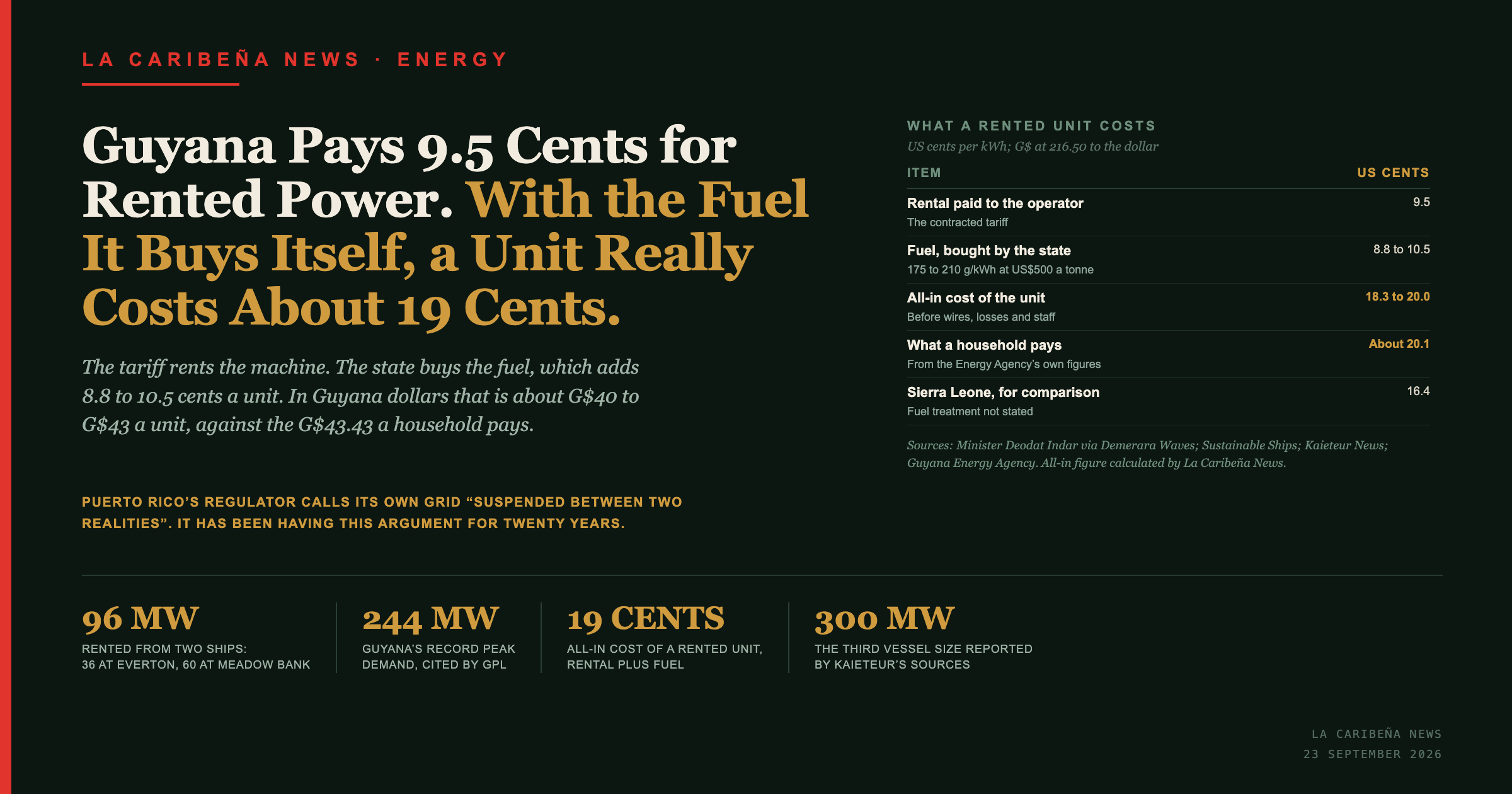
What the title card shows
- 9.5 US cents per kilowatt hour: the rental Guyana pays for power from each floating plant, before fuel, up from 7.2 cents in 2024. Source: Minister Deodat Indar, via Demerara Waves.
- 18.3 to 20.0 US cents: the all-in cost once fuel is added, at US$500 a tonne and a fuel burn of 175 to 210 grams per kilowatt hour. Calculated by La Caribeña News from the contracted tariff, the published fuel-burn range and the reported fuel price.
- About G$43.43 a kilowatt hour, or 20.1 US cents: what a household pays, derived from the Guyana Energy Agency's own figures for a 5 kilowatt-peak rooftop system, converted at G$216.50. Source: Guyana Energy Agency.
- 96 megawatts: the combined capacity of the two vessels, 36 at Everton and 60 at Meadow Bank. Source: Demerara Waves; Kaieteur News.
- 244 megawatts: Guyana's record peak demand, cited by GPL in August. Source: Kaieteur News.
- 8.3 to 34.2 US cents: the range of prices reported for South Africa's proposed 20-year powership deal, converted at the exchange rate on each date, against a national grid average near 10 cents. Sources: OUTA; European Central Bank reference rates.
- Two accounts of a third ship: the minister describes a smaller plant for Berbice at 99 per cent agreed; Kaieteur News reports sources describing a 300-megawatt heavy-fuel vessel at Wales. Sources: HGPTV; Kaieteur News.
- 43 per cent: the cut Puerto Rico's regulator made to the budgets its power operators requested. Source: El Nuevo Día.
Frequently Asked Questions
How much does Guyana pay for power ship electricity?
9.5 US cents per kilowatt hour for each of the two vessels, excluding fuel, which the government buys separately at zero tax. The Berbice vessel's rate rose from 7.2 US cents when the contract was renewed for two years in July 2026.
Is Guyana getting a third power ship?
The Minister of Public Utilities says the state is 99 per cent of the way to an agreement for a smaller third plant for the Berbice corridor. Kaieteur News, citing sources, reported talks for a 300-megawatt heavy fuel oil vessel that could be stationed at Wales and replace the two current vessels. The two accounts have not been reconciled publicly.
What does power ship electricity really cost Guyana?
The contracted rental is 9.5 US cents a kilowatt hour and the state buys the fuel separately. At heavy fuel oil above US$500 a tonne, and an engine burning 175 to 210 grams a kilowatt hour, the fuel adds 8.8 to 10.5 cents, giving an all-in cost of about 18.3 to 20.0 US cents, or about G$39.62 to G$43.30, before any wires, transformers or losses. A household pays about G$43.43.
What do other countries pay for powership electricity?
Sierra Leone was reported at 16.4 US cents per kilowatt hour, against 19.6 cents from its previous supplier, with the fuel treatment not stated. South Africa's proposed 20-year deal was bid at about R1.50 in 2020, roughly 8.3 US cents at the exchange rate then, and the regulator later put it at up to R2.80, roughly 19.1 US cents in April 2022, with fuel inside the price. Guyana pays 9.5 US cents with fuel excluded.
What is Puerto Rico's energy plan?
Contested. The utility's preferred path adds liquefied natural gas capacity, while distributed rooftop solar and storage expand quickly. The regulator describes the outcome as a hybrid of a central transmission backbone with distributed generation, and the 2019 renewable targets have already been relaxed by Act 1-2025.