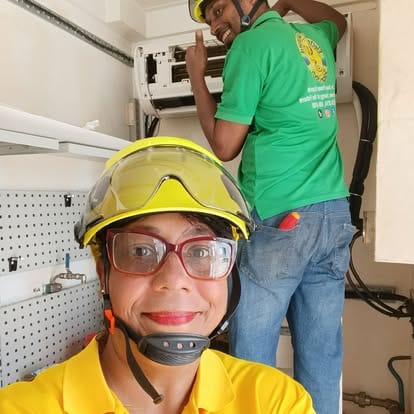
Omesh and Ambika Singh run Electronic Wizard & Solar Tech out of Eccles, EBD. Their mission is plain. Start building your own energy independence. Put the power back in your own hands.
By La Caribeña News • May 2026
It was a Sunday afternoon in late April when Guyana went dark.
On April 26, 2026, heavy-duty machinery struck a 69-kilovolt transmission line during road works at Dennis Street, Sophia, Georgetown. Within minutes, most of the country lost power. The outage lasted more than four hours. Cascading damage to switchgear at the Garden of Eden facility kept parts of the East Bank corridor in the dark even longer. Stoves cooled. Routers blinked off. Cold-chain inventory at corner shops started its slow countdown. Guyana Power and Light is now seeking US$30.6 million from the Chinese contractor, but for the homes and businesses that sat through the heat that afternoon, no lawsuit will unspoil the meat in the freezer.
A few hours into the blackout, Ambika Singh's phone started ringing.
She was not surprised. Her customers know the drill. The solar arrays she and her husband Omesh have installed across Region 4 and beyond do not care who hit what cable. The lights stay on. The inverter keeps running. The security cameras keep watching.
“You don’t realise what you have until the country goes black at the same time,” one customer told her later. “We just kept living.”
That is the promise Electronic Wizard & Solar Tech sells. Not equipment. Living through the blackout.
A family business that grew up with the country
Electronic Wizard started more than a decade ago as a quiet little repair business. Omesh Singh, an ACCA-qualified accountant with an unusual love of soldering irons and oscilloscopes, was the kind of person who fixed his neighbours’ computers on weekends because nobody else nearby would. The weekends got busier than the accounting practice. He stopped pretending it was a hobby.
Ambika joined as co-owner and the marketing voice of the business. She handles the customer relationships, the field visits, the after-installation check-ins. Anyone who has bought solar from them tells the same story. You speak to the family. You do not get passed to a call centre. There is no call centre.
The business is now organised in two pieces. Electronic Wizard covers consumer electronics, air conditioning installation and maintenance, and CCTV surveillance systems. Solar Tech is the side that has grown the fastest. It designs and installs solar photovoltaic systems, battery banks, and hybrid inverters for homes, farms, shops, and small offices across Guyana.
They are members of the Georgetown Chamber of Commerce and Industry. That detail matters when a Guyanese homeowner is parting with several hundred thousand dollars for a system and wants to know the business will still be there in five years to honour the warranty.
Slaying blackouts before Gas-to-Energy arrives
Government has promised relief. The Gas-to-Energy Project at Wales, West Bank Demerara, is the headline piece. First power of about 228 megawatts is targeted for end of 2026, with the full combined-cycle plant expected by mid-2027. Officials have said electricity bills could fall by as much as half once gas is flowing.
But the bigger Wales question is governance, not megawatts. La Caribeña News has examined the transparency gaps around the project, and the answer to whether ordinary Guyanese will participate in this buildout is still in flux.
Twenty-eight months is a long time to sit in the dark.
That is the gap Electronic Wizard & Solar Tech has decided to fill. Not by replacing the grid. By making sure that when the grid trips, your house does not.
For the Singhs, the proposition is bigger than backup. “Owning your own sustainable power is more than backup electricity, it’s independence, stability and control over your energy consumption,” Ambika has put it.
The frustration with the grid is on the public record. Stabroek News documented another nationwide GPL outage in January 2026, and the April 26 cascade was only the latest.
Here is the part that matters for Guyanese homeowners doing the math at the kitchen table. A solar PV system with battery backup pays you back in two ways at once. First, you stop paying GPL for some or most of your monthly consumption. Second, when the grid fails, your fridge, your router, your lights, and your security cameras do not. The second benefit never shows up on the invoice. Ask any salon owner who has had a perm half-applied when the power cut whether she would pay for it.
For the homeowner thinking “I should just wait for Gas-to-Energy,” the question is gentler than you might expect. How many more blackouts between now and 2027? How many spoiled freezers, how many missed Zoom calls, how many security cameras off the air, how many nights with the children studying under a phone torch? Even after Gas-to-Energy arrives, solar still lowers your monthly bill. You do not lose the investment when the grid improves. You just stop subsidising it.
Why this matters for Guyanese MSMEs
Most of Guyana’s economy is small business. Salons, mini-marts, family bakeries, panel-beating shops, internet cafés, tourism guides, rice farmers running rice mills. These are the people who feel blackouts hardest because they cannot pass the cost along. When a flour mill stops mid-batch, the dough is gone. When a hairdresser’s lights cut, the appointment is gone. When a guesthouse loses its security feed at night, the booking is gone.
This is precisely the audience La Caribeña News exists to amplify. The MSME sector keeps Guyana running between the headline-making oil revenues and the headline-making blackouts. Businesses like Electronic Wizard & Solar Tech are not just suppliers. They are the small-business answer to a small-business problem.
A 5kW hybrid system with batteries can keep a corner shop trading through a four-hour outage. A 3kW system can keep a home office productive, the deep freezer cold, and the security cameras running until the grid sorts itself out. Larger commercial systems can carry a guesthouse or a small factory.
The Singhs are deliberate about who they install for. They have done utility-scale work. They have also done two-panel rooftop kits for hinterland families. They do not push you toward the most expensive option. They start by asking what you actually need to keep running when the lights go out, and they build from there.
Strong local chambers are part of what makes this model work. Region Three’s chamber under Bhabita Albert is the visible template for what organised private-sector advocacy can look like as Guyana’s industrial buildout accelerates.
These systems are modular and scalable. You can start with the load you can afford today, then expand the array, the batteries, or both as your home grows or your business takes on more equipment. The investment compounds with the business.
What’s actually in the box
For the technically curious, Electronic Wizard & Solar Tech installs equipment from international brands they have been trained on. EG4 inverters and RUIXU lithium iron phosphate batteries are common in their builds. Both are widely used in North American residential and small-commercial solar installations.
A typical Guyanese home system from them includes:
- Roof-mounted PV panels sized to the household’s daily consumption
- A hybrid inverter that talks to both the panels and the grid
- A lithium battery bank sized for the hours of backup you actually need
- A full complement of safety devices on every system to protect your investment
- Every installation built to National Electrical Code standards
- A monitoring app so you can see, from your phone, how much power your roof made today
They handle everything from start to finish. Load assessment. System sizing. Equipment supply. Installation. Commissioning. After-sales service. One number to call.
Guyana is already going solar
The national context strengthens the case. The Government of Guyana approved GYD $885 million (about US$4.2 million) in May 2025 to upgrade solar systems across 21 Amerindian villages. The Solar Home Energy programme has already distributed more than 37,000 solar home kits nationwide, with another 7,230 systems ordered for 2025. A new National Grid-Connected Solar Programme is targeting 5,000 homes in its first phase. Region 10 is getting three utility-scale solar parks totalling 15 megawatts.
Local skills development is keeping pace. La Caribeña News reported on the latest cohort of qualified electricians graduating into the workforce, which is precisely the talent pool that gets a hybrid solar system installed safely on a Guyanese roof.
This is not a question of whether Guyana goes solar. The country is already going solar. The question for a homeowner or small-business owner is who installs your system, whether they will pick up the phone when something needs adjusting, and whether they will still be in business in 2031 when the battery warranty starts to matter.
A family business that has been steadily installing in Regions 3 and 4, and delivering solar energy systems to homes and businesses across every other region of Guyana for more than a decade, is a different proposition than a popup importer.
How to start
Picking up the phone is the only step that matters. Electronic Wizard & Solar Tech offers free initial consultations and load assessments. A short conversation with Ambika or Omesh will tell you whether your roof, your loads, and your budget make sense for solar today.
WhatsApp messages tend to get the fastest reply. A short note saying “I’d like a quote for a home solar system” is enough to start. If you run a small business, mention your average monthly GPL bill and whether you have had outage-related losses in the last six months. That gets you a tailored proposal faster.
Frequently asked questions
Should I just wait for Gas-to-Energy before going solar?
First power from Gas-to-Energy is targeted for end of 2026, with the full combined-cycle plant by mid-2027. Even after it arrives, solar continues to reduce your monthly bill and keeps your home or business running through grid outages. The two are complementary, not competing. Solar pays you back whether or not the grid improves.
How long does a typical home installation take?
Most residential systems are designed, installed, and commissioned within one to two weeks of the contract being signed, depending on system size and equipment availability.
What happens during a blackout if I have solar with batteries?
A properly designed hybrid system automatically switches to battery power within milliseconds. You will likely not notice the grid is down unless you check your phone.
Are the systems expandable later?
Yes. Every system is modular and scalable. You can start with the load you can afford today and add more panels, more battery capacity, or both as your needs grow.
What is the typical payback period for a residential solar system in Guyana?
It depends on your electricity consumption and the size of the system, but most residential customers see payback within five to seven years on systems sized to cover most of their monthly consumption. Commercial systems with high daytime loads can pay back faster.
Does Electronic Wizard & Solar Tech service systems after installation?
Yes. After-sales service and warranty support are part of every installation. Because the business is run by the owners, the person who quoted your system is likely the same person who picks up when you call about it.
What areas does Electronic Wizard & Solar Tech serve?
Installations are concentrated in Regions 3 and 4, and solar energy systems are delivered to homes and businesses across every region of Guyana. Call or WhatsApp +592 621-3214 to schedule a free load assessment.