By LCN Business Desk
The contract behind Guyana's eighth offshore development now has a name on it. SBM Offshore said on Tuesday that ExxonMobil Guyana Limited has awarded it the Longtail floating production vessel, to build, to install and then to run.
This newspaper reported on 13 November that the Local Content Act reserves no Guyanese share in either of the two things the US$12.5 billion is being spent on, the vessel and about 45 subsea wells. That still holds for the build. It does not hold for the ten years that follow it.
What exactly was awarded?
Three pieces of work, and only one carries a published term: ten years of operations.
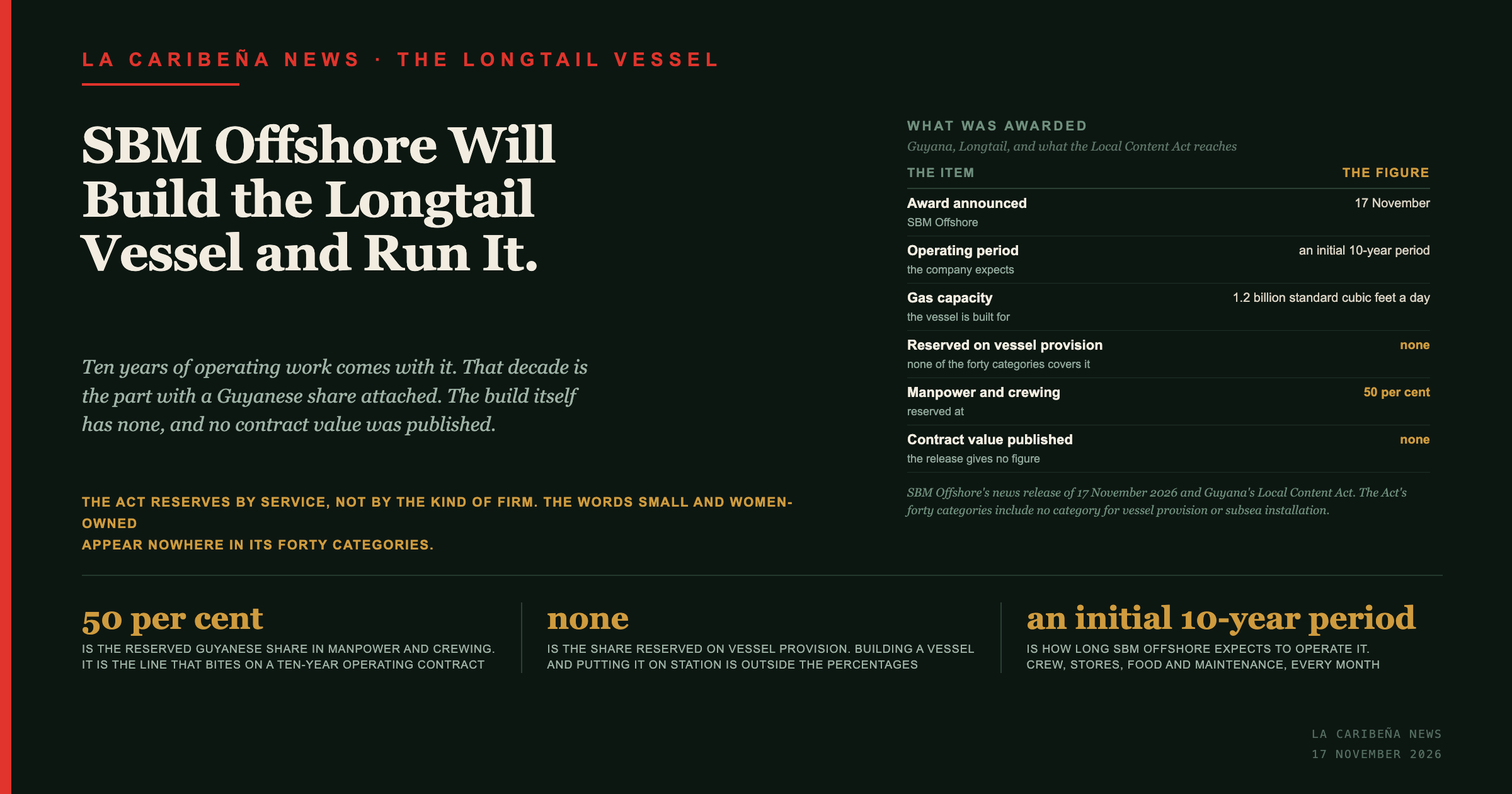
SBM Offshore will build the vessel and install it. It then "expects to operate the FPSO for an initial 10-year period", in the words of its own release. The client is ExxonMobil Guyana Limited.
The award follows two things that had to happen first. SBM won the front end engineering and design work on 24 March, and that award was conditional on the Government approving the development plan and on the partners taking a final investment decision. Both have now happened. ExxonMobil sanctioned Longtail on 12 November at US$12.5 billion.
Why does the operating period matter more than the build?
Because the law reaches operations and does not reach hulls. Crewing is reserved at 50 per cent; vessel provision at nothing.
Guyana's Local Content Act sets a minimum Guyanese share in forty named categories of work. None of the forty covers vessel provision, vessel charter, marine transport, anchor handling or subsea installation. Building a vessel and putting it on station is outside the percentages.
Running it is not. Manpower and crewing is reserved at 50 per cent. Ship and rig chandlery, which is the business of supplying a vessel rather than providing one, is reserved at 25 per cent. Catering sits at 90 per cent and engineering at 5.
The Act reserves by service and not by the kind of firm doing it. The words small and women-owned appear nowhere in its forty categories, so a reserved percentage says what work is Guyanese and nothing about who in Guyana gets it.
So the ten years is where the instrument bites. A vessel on station needs crew, stores, food and maintenance, every month, for a decade. Those are the lines in the Schedule.
What does the vessel do?
It is built for gas: 1.2 billion standard cubic feet a day, against 250,000 barrels of condensate. Guyana licensed its first non-associated gas project without putting its fiscal terms on the public record, so what the state earns from those cubic feet is not a matter a reader can check.
SBM Offshore puts the design at 1.2 billion standard cubic feet of gas a day and 250,000 barrels of condensate a day, with storage for about two million barrels. It will sit in about 1,750 metres of water, spread moored. The hull is the company's tenth new build multi purpose floater, on its Fast4Ward design.
How many of Guyana's vessels does one contractor hold?
Six of them, on the contractor's own count, out of eight developments planned by 2030.
Øivind Tangen, chief executive of SBM Offshore, said the company was "proud to receive this sixth FPSO award from ExxonMobil Guyana". Not every vessel in the block is theirs. The Errea Wittu, which started producing on 16 November, was built by Japan's MODEC.
For a Guyanese firm that means the counterparty for vessel scope is a Dutch company, not ExxonMobil, and it is the same Dutch company most of the time.
What was not published?
The value of the contract, and the startup year.
SBM Offshore's release gives no figure for what it has been awarded and does not name a year for first gas. ExxonMobil's US$12.5 billion is the sanctioned cost of the whole development, not the vessel contract. Earlier reporting put a Longtail startup at 2030.
The absent figure has a yardstick. ExxonMobil and its contractors spent US$3.9 billion with Guyanese suppliers across eleven years and seven developments. One vessel contract, with ten years of operations behind it, is not published at all. SBM Offshore's own third quarter trading update, issued five days before the award, carried no mention of it either.
What should a Guyanese supplier do now?
Register and get a plan approved before the tendering, which starts now that the 17 November award is in.
A supplier in the reserved categories is dealing with SBM Offshore for the operating scope, not with ExxonMobil. SBM must register, file a local content plan and report what it procures. Getting the work and getting paid for it are separate problems: eleven oil companies agreed to pay Guyanese suppliers within 30 to 45 days, and four years on the Secretariat is still asking them to pay sooner. Which firms already hold approved plans cannot be checked: the Government approved plans for more than forty companies and publishes neither the list nor the count.
The dated events to work to are the vessel build, which starts now, and the ten years of operations behind it. Crewing, chandlery and catering are the lines with a percentage attached. Vessel provision has none.
The entities
- SBM Offshore: the Dutch contractor awarded the Longtail floating production, storage and offloading vessel on 17 November 2026. - ExxonMobil Guyana Limited: the operator of the Stabroek Block and the client on the award. - Longtail: the eighth development on the Stabroek Block, sanctioned on 12 November 2026 at US$12.5 billion. - Øivind Tangen: chief executive of SBM Offshore. - Local Content Act: the Guyanese statute reserving a minimum Guyanese share in forty named categories of work. - Fast4Ward: SBM Offshore's standard multi purpose floater hull design, of which Longtail's is the tenth new build. - MODEC: the Japanese builder of the Errea Wittu, the vessel for the Uaru development.
What the title card says
- Award announced: 17 November 2026. - Scope: build, install, and an initial ten year operating period. - SBM Offshore's own count of ExxonMobil Guyana awards: sixth. - Vessel design: 1.2 billion cubic feet of gas a day, 250,000 barrels of condensate, two million barrels of storage, 1,750 metres of water. - Reserved Guyanese share on vessel provision: none. - Reserved on manpower and crewing: 50 per cent. Chandlery: 25 per cent. - Contract value published: none.
Frequently asked questions
Who will build Guyana's Longtail vessel?
SBM Offshore. It said on 17 November 2026 that ExxonMobil Guyana Limited had awarded it the work to build and install the vessel.
Will SBM Offshore also run it?
It expects to, for an initial ten year period, on its own statement.
Does Guyanese local content law apply to this contract?
Partly. The Local Content Act's forty categories include no category for vessel provision or subsea installation, so no minimum share attaches to the build. Manpower and crewing is reserved at 50 per cent and ship and rig chandlery at 25 per cent, and both of those arise in operations.
How much is the contract worth?
SBM Offshore did not publish a figure. The US$12.5 billion is ExxonMobil's sanctioned cost for the whole Longtail development.
What is the vessel built for?
Gas. The design handles 1.2 billion standard cubic feet a day and 250,000 barrels of condensate a day, with about two million barrels of storage.
What is not established?
The value of the SBM Offshore contract. The year first gas is expected, which the release does not give. And whether the operating contract has been signed or is still expected, since the company says it expects to operate the vessel rather than that it has been engaged to.