By LCN Business Desk
The Errea Wittu is pumping oil. ExxonMobil said so on Monday from Spring, Texas, and Guyana's Natural Resources Ministry said so the same day. It is the fifth floating production vessel to work the Stabroek Block, which produces all of Guyana's oil. Dan Ammann, who runs ExxonMobil's upstream company, said "the startup of Errea Wittu is another major milestone for Guyana and ExxonMobil".
Guyana's output has been running at just over 900,000 barrels a day. The new vessel is built for 250,000 and does not reach that until the first quarter of 2027, so the increase arrives across months rather than on Monday.
Two weeks ago none of this was settled. This newspaper reported on 2 November that Guyana's Ministry expected Uaru in September while CNOOC scheduled it for the fourth quarter, and no party had said the vessel was running.
When does the vessel reach its full rate?
The first quarter of 2027, on ExxonMobil's own guidance.
The Errea Wittu holds two million barrels of crude, can treat 540 million cubic feet of gas a day and can inject 350,000 barrels of water. It draws on 44 production and injection wells across up to 10 drill centres, about 200 kilometres offshore. MODEC built it in Japan.
How much is left to produce is itself disputed. The Government and the companies publish different estimates of what the Stabroek Block holds, and the gap runs to hundreds of millions of barrels.
One outside estimate was lower. S&P Global Commodity Insights data reported by OilNOW put Uaru at about 136,000 barrels a day at the start, rising to about 215,000 during 2027. This newspaper set that against the 33 million barrels on Guyana's December loading schedule, which works out at 1.06 million a day.
What does this mean for the December cargo?
There is now production behind a cargo already booked for 11 and 12 December.
Guyana's preliminary December loading programme carries 33 million barrels for export, about 1.06 million a day. Bloomberg reported that programme on 13 October. It would be the first month in which Guyana's crude exports pass a million barrels a day, seven years after commercial production began in December 2019.
The first cargo of Uaru crude is set for 11 and 12 December, and Uaru was expected to supply about four million barrels across the month.
Oil has to be produced before it can be loaded. A startup on 16 November leaves a little over three weeks before that cargo sails. For a buyer, a shipping agent or a trader, that is the date to work to.
Which of the published start dates was met?
CNOOC's fourth quarter, with six weeks of it still to run. The Ministry's September was not.
CNOOC Limited owns a quarter of the Stabroek Block. Its mid-year review of 27 August said the "Uaru Project, the fifth phase of the Stabroek Block, is scheduled to commence production in the fourth quarter". First oil on 16 November falls inside that quarter with six weeks of it left to run.
Guyana's Ministry of Natural Resources said in late August that production was expected to start in September. September passed and no party said the vessel was running.
What can Guyana pump now?
About 1.15 million barrels a day on the Ministry's account, and 1.1 million on the company's.
ExxonMobil's release says the startup raises "Guyana's installed production capacity to 1.1 million barrels per day". The Ministry's account, carried by Guyana Times, is that output rises from just over 900,000 barrels to about 1.15 million.
The two are not counting the same thing. Installed capacity is what the vessels are built to pump; output is what they are pumping. On 28 September the company said its four running developments carried installed capacity of "more than 900,000 barrels per day", and the new vessel adds 250,000, which is the Ministry's figure. Either way the country is now in a band it has not been in before.
Who owns the oil?
Three companies, at 45, 30 and 25 per cent, and the state is paid separately.
The operator's results do not always read as a gain. Its third-quarter release marked a billion barrels in Guyana and named the country as a reason upstream earnings fell.
ExxonMobil's release gives ExxonMobil Guyana Limited 45 per cent, Hess Guyana Exploration Limited 30 per cent and CNOOC Petroleum Guyana Limited 25 per cent. The release names Hess. Chevron holds that same 30 per cent, and its latest quarterly report names Guyana twice and Stabroek not once.
Two more vessels are coming. ExxonMobil took a US$12.5 billion final investment decision on Longtail, the eighth development on the block, on 12 November. SBM Offshore said on 17 November that it had won the work to build, install and operate that vessel.
The vessel was recovering its cost long before it produced anything. In August this newspaper reported that Guyana's share of Stabroek production reached 39.8 per cent once the cost bank was cleared, while the US$12.7 billion Errea Wittu had still not produced a barrel. The block is a single accounting unit, so that cost had been recovering against other fields since 2023. It now has production of its own to recover against.
Guyana is paid through lifts of profit oil and through royalty, both of which go to the Natural Resource Fund. The Fund had taken in US$10.5 billion by 30 June. More production means more lifts. A receipt reaches the Fund when a cargo is lifted, so the first Uaru money turns on the December loading, not on Monday's announcement.
What should a board plan against?
The cargo on 11 and 12 December, and full rate in the first quarter of 2027.
Uaru's first cargo is booked for 11 and 12 December. Full rate comes in the first quarter of 2027. Both can be checked against a loading programme and against the operator's next set of results.
For anyone selling into the sector, moving cargo out of it or budgeting against its receipts, the lifting schedule carries the dates. Guyana's own receipts follow it, not the announcement.
The entities
- Uaru: the fifth development on the Stabroek Block, approved in April 2023 at US$12.7 billion, targeting more than 800 million barrels from the Uaru, Mako and Snoek fields. - Errea Wittu: the floating production, storage and offloading vessel for Uaru, built by Japan's MODEC, with an initial capacity of 250,000 barrels a day. - Stabroek Block: the offshore block that produces all of Guyana's oil, held by ExxonMobil Guyana Limited, Hess Guyana Exploration Limited and CNOOC Petroleum Guyana Limited. - Ministry of Natural Resources: the Guyanese ministry that announced the startup alongside ExxonMobil. - Dan Ammann: president of ExxonMobil Upstream Company. - CNOOC Limited: the partner holding 25 per cent, whose 27 August review scheduled Uaru for the fourth quarter. - Natural Resource Fund: the Guyanese fund that receives profit oil lifts and royalty. - Longtail: the eighth development on the block, for which ExxonMobil announced a US$12.5 billion final investment decision on 12 November 2026.
What the title card says
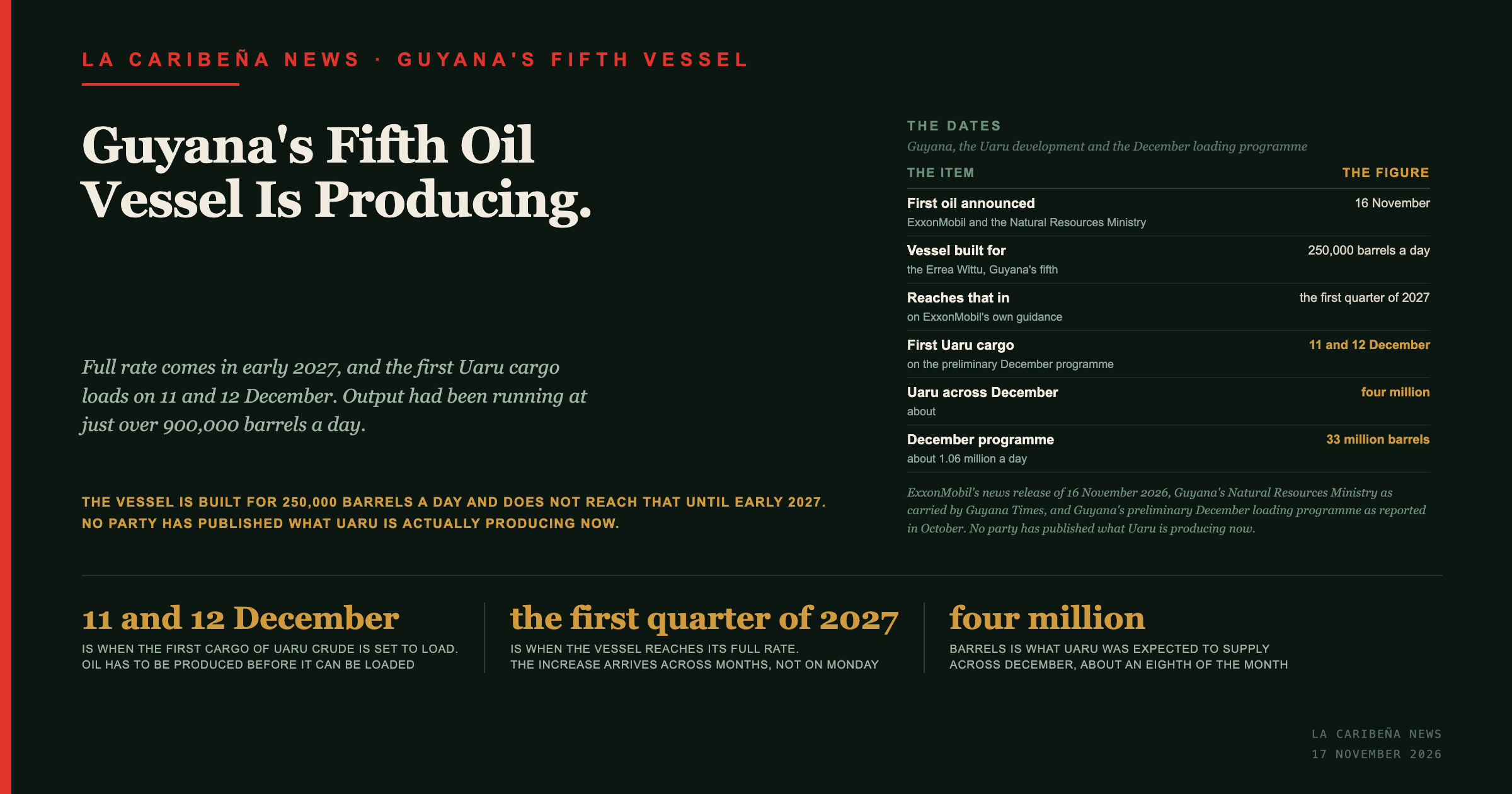
- Uaru first oil: announced 16 November 2026. - Errea Wittu initial capacity: 250,000 barrels a day, reached in the first quarter of 2027. - First Uaru cargo on the December programme: 11 and 12 December. - Uaru barrels expected across December: about four million. - December loading programme: 33 million barrels, about 1.06 million a day. - Output before Uaru: just over 900,000 barrels a day.
Frequently asked questions
Is Uaru producing oil?
Yes. ExxonMobil and Guyana's Ministry of Natural Resources both said on 16 November 2026 that the Errea Wittu had achieved first oil.
When does the new vessel hit full production?
ExxonMobil expects the Errea Wittu to reach 250,000 barrels a day in the first quarter of 2027.
When does the first Uaru cargo load?
Guyana's preliminary December programme sets it for 11 and 12 December, with Uaru expected to supply about four million barrels over the month.
How much can Guyana pump now?
The Ministry puts output at about 1.15 million barrels a day, up from just over 900,000. ExxonMobil puts installed capacity at 1.1 million. Installed capacity and output are different measures.
Which published start date was met?
CNOOC's. Its mid-year review of 27 August scheduled Uaru for the fourth quarter. The Ministry had said September.
What is not established?
The exact day in November that production began, as against the day it was announced. Whether the December loading programme has changed since it was published in October. And what Uaru is actually producing now, which no party has given.