By LCN Business Desk
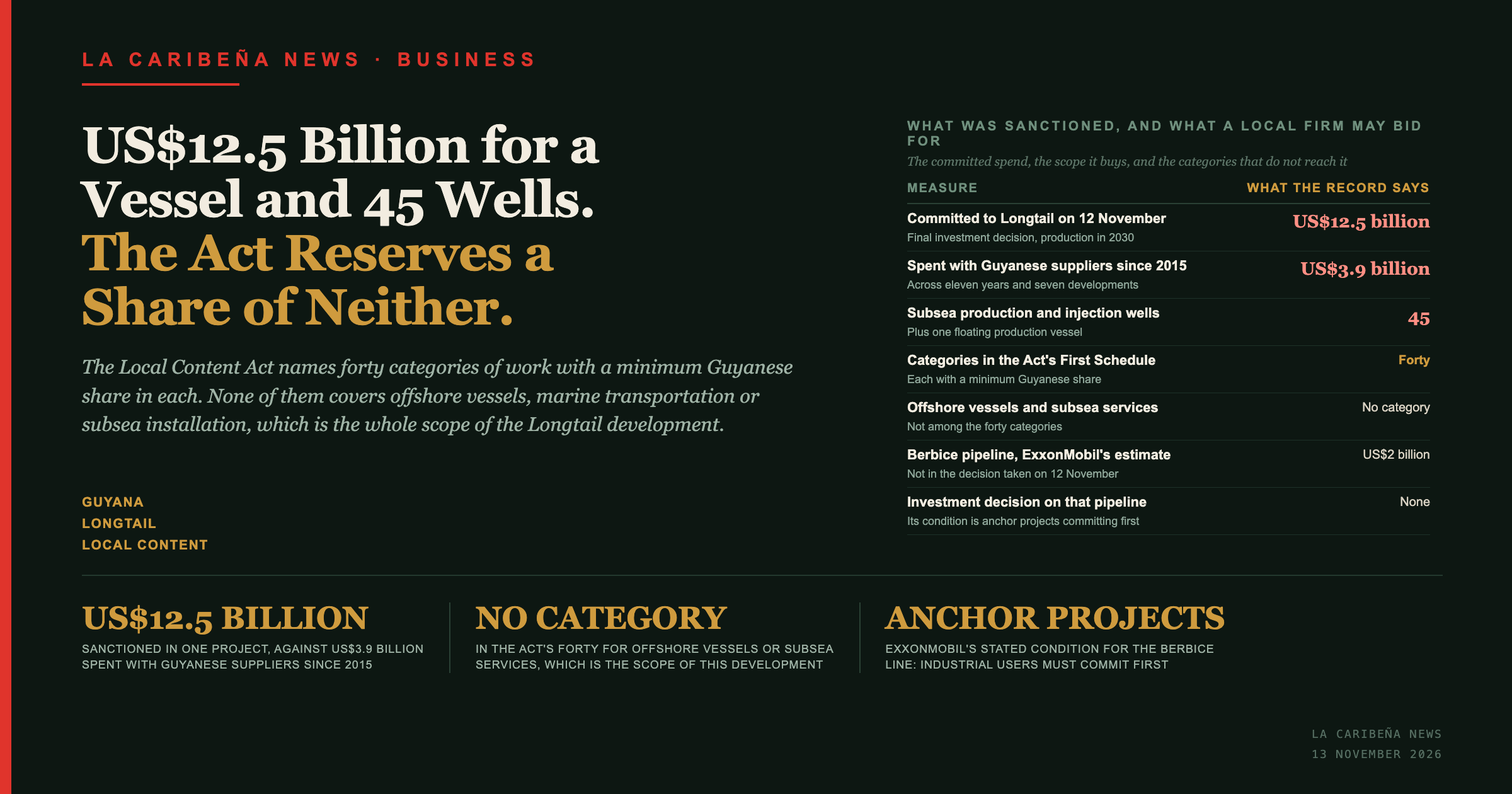
ExxonMobil committed US$12.5 billion to Guyana's eighth offshore development on 12 November. Almost all of it will be spent on one floating production vessel and about 45 subsea wells.
Guyana's Local Content Act sets a minimum Guyanese share in forty named categories of work. Offshore vessels and subsea services are not among the forty. The law that governs how much of this money reaches Guyanese companies does not reach the two things the money is being spent on.
What has actually been funded?
Nine reservoirs, for a 2030 start.
ExxonMobil "has made a final investment decision for the Longtail development offshore Guyana following required government and regulatory approvals", with "additional US$12.5 billion investment planned". The operator is ExxonMobil Guyana Limited, holding 45 per cent of the Stabroek block, with Hess Guyana Exploration Ltd. on 30 per cent and CNOOC Petroleum Guyana Limited on 25.
The Ministry of Natural Resources gives the same project nine reservoirs, 27 production wells and 18 gas injection wells, and a vessel handling 1.2 billion cubic feet of gas a day with up to 250,000 barrels of condensate.
How much of that can a Guyanese company bid for?
The services around the project are reserved. The project itself is not.
The Act's First Schedule sets a minimum Guyanese share in forty named categories, running from customs brokerage and insurance at 100 per cent down to engineering and machining at 5. Set against an offshore gas development, what the forty cover is the shore side of it, and five are written "onshore" in terms.
None of the forty covers vessel provision, vessel charter, marine transportation, anchor handling, towing, offshore supply vessels, remotely operated vehicles or subsea installation. That list is the Longtail development. The nearest the Schedule reaches is crewing, which is the people on a vessel rather than the vessel, and engineering and machining, which carries the lowest minimum in the instrument.
A vessel or subsea supplier on Longtail is therefore inside the Act and outside the percentages. It must register, file a local content plan and report what it procures, and no instrument sets a share of its work that has to go to a Guyanese firm. This newspaper reported the gap in August. US$12.5 billion in one sanctioned project is the first time it has had a price, against the US$3.9 billion ExxonMobil and its contractors spent with Guyanese suppliers across eleven years and seven developments.
Which companies hold approved local content plans is also not a matter a bidder can check: the government approved plans for more than forty companies and publishes neither the list nor the count. A firm deciding whether to pursue Longtail work cannot see who it is bidding against, or who has already qualified.
What is not in the decision?
The US$2 billion line to Berbice, and the company says so in the same release.
"Subject to future investment decisions, market demand and the development of necessary infrastructure, gas from Longtail could be transported to shore by pipeline."
Three conditions, none of them met and none of them dated. Guyana already has one gas-to-shore line, completed in December 2024 and running from the Liza fields to Wales on the West Bank Demerara. The Berbice programme needs a second, larger one, and that is what the decision leaves out.
What has to happen before Berbice gets gas?
Industrial users have to commit first. ExxonMobil set that condition in March.
Alistair Routledge, President of ExxonMobil Guyana Limited, told a media conference in March 2026 that the Berbice line could cost over US$2 billion, more than twice the first, and named what has to come before it.
"In the early stages it will require us to have some large anchor projects, and when I say that, an anchor project, these are projects that are large enough to give us the demand needed from an offshore gas supply point of view to make it worthwhile investing in significant infrastructure."
The order of events is therefore fixed and it runs against the investor. The plant commits, then the pipeline is justified, then the gas arrives. A company weighing a fertiliser, alumina or data centre project in Berbice is being asked to underwrite the infrastructure it depends on, by signing up to demand before the line that would serve it has been funded.
Routledge gave a timeline at a Houston reception in May, saying the challenge set by the President was that "by the end of his presidency, we will have also the Berbice Region supported gas flow and a whole new set of industries". His second term ends in 2030, the same year Longtail is due to produce, and no investment decision stands behind the line.
The first line is the precedent for what the second costs Guyana. Exxon built it and Guyana repays it, at a figure the head of the gas-to-energy task force put at US$55 million a year for twenty years, the amortised cost of US$1 billion. That principal has never been finally confirmed, the near-shore repair that ran from 14 October to about 1 December carries no stated cost, and the line moves 120 million cubic feet a day against a Longtail vessel designed for ten times that.
What does this do to the share that funds the budget?
Neither the direction nor the size can be read from what has been published.
Guyana receives 12.5 per cent of production while the contractor is recovering its costs, and 39.8 per cent when it is not, with a 2 per cent royalty throughout. The share has stood at 39.8 since July, when ExxonMobil finished recovering US$55 billion of earlier spending and the cost pool emptied.
What US$12.5 billion does to that depends on two things, and neither is public. The first is the schedule on which the sum is recovered, and the terms governing recovery on a gas project are not on the public record: they are subject to a Gas Annex the 2016 agreement requires, and no annex has been published. The second is the production it is recovered against, which is rising. ExxonMobil puts Stabroek output at approximately 900,000 barrels a day, passing a million with Uaru in the fourth quarter, with Whiptail in 2027 and Hammerhead in 2029.
A share is a ratio. Both of its terms are moving and only one of them has been published. Anyone stating what Longtail does to Guyana's take is working from numbers that are not on the record, and there is no filed detail behind the commitment either: ExxonMobil's last Form 8-K was filed on 30 October and its most recent quarterly report on 2 November, both before the decision, and a project decision of this kind carries no filing obligation. The next disclosure point is the full-year results.
When does the work start?
Before 2030, and into a queue.
Longtail is eighth and last of the sanctioned developments, which places its heaviest buying in the same years as Uaru, Whiptail and Hammerhead. Four projects will draw on one Guyanese supply base at once, in the categories where a minimum share applies and on the vessel and subsea scope where none does.
For a supplier that is the planning horizon: registration, an approved local content plan and capacity have to exist before the tendering, not after it. For the Treasury, the next dated event is the full-year results, which is where a figure behind the US$12.5 billion would first appear.
The entities
- Longtail is Guyana's eighth Stabroek development and its first targeting non-associated gas. - ExxonMobil took the final investment decision on 12 November 2026 and put US$12.5 billion behind it. - ExxonMobil Guyana Limited is the operator and holds 45 per cent of the Stabroek block. - Hess Guyana Exploration Ltd. holds 30 per cent. - CNOOC Petroleum Guyana Limited holds 25 per cent. - Local Content Act names forty categories of work with a minimum Guyanese share in each, and includes no category for offshore vessels or subsea services. - Ministry of Natural Resources approved the development plan and issued the production licence on 12 November 2026. - Berbice is where the government plans a natural gas industrial site served by a second Gas-to-Energy pipeline, which ExxonMobil has put at over US$2 billion. - Alistair Routledge is President of ExxonMobil Guyana Limited and set the anchor-project condition in March 2026. - Uaru starts in the fourth quarter, Whiptail is expected in 2027 and Hammerhead in 2029.
What the title card says
- Headline: ExxonMobil sanctioned US$12.5 billion for a vessel and 45 subsea wells, and the Local Content Act reserves a share of neither. - Committed on 12 November 2026: US$12.5 billion. - Spent with Guyanese suppliers since 2015: US$3.9 billion. - ExxonMobil's estimate for the Berbice pipeline: over US$2 billion. - Categories in the Act's First Schedule: forty, with a minimum Guyanese share in each. - Offshore vessels, marine transportation and subsea services: no category, so no minimum. - Approved local content plans published: none. - Berbice pipeline, ExxonMobil's estimate: over US$2 billion, and not in the decision. - ExxonMobil's stated condition for building it: large anchor projects committing demand first. - First production: 2030.
Frequently Asked Questions
How much has ExxonMobil committed to Longtail?
US$12.5 billion, described in its release of 12 November 2026 as additional investment planned, alongside a final investment decision taken after the government's approvals. Across 2015 to 2026 the company and its contractors spent US$3.9 billion with Guyanese suppliers in total.
What share of the work is reserved for Guyanese companies?
It varies by service. The Act's First Schedule sets a minimum in forty named categories, from customs brokerage and insurance at 100 per cent down to engineering and machining at 5. None of the forty covers vessel provision, vessel charter, marine transportation, anchor handling, towing, offshore supply vessels, remotely operated vehicles or subsea installation, which is the scope of the Longtail development.
Can a bidder see who holds an approved local content plan?
No. The government has approved plans for more than forty companies and publishes neither the list nor the count.
Does the decision include a pipeline bringing the gas ashore?
No. The release states that gas from Longtail could be transported to shore by pipeline subject to future investment decisions, market demand and the development of necessary infrastructure. The existing Gas-to-Energy line, completed in December 2024, runs from the Liza fields to Wales. The Berbice programme needs a second, which ExxonMobil has put at over US$2 billion.
What is Guyana's share of production?
12.5 per cent while the contractor is recovering its costs and 39.8 per cent when it is not, with a 2 per cent royalty throughout, and 39.8 since July 2026. What the US$12.5 billion does to it cannot be read: the recovery schedule has not been published, and the production it would be recovered against is rising.
When is Longtail expected to produce?
2030, behind Uaru in the fourth quarter of 2026, Whiptail in 2027 and Hammerhead in 2029.