By LCN Business Desk
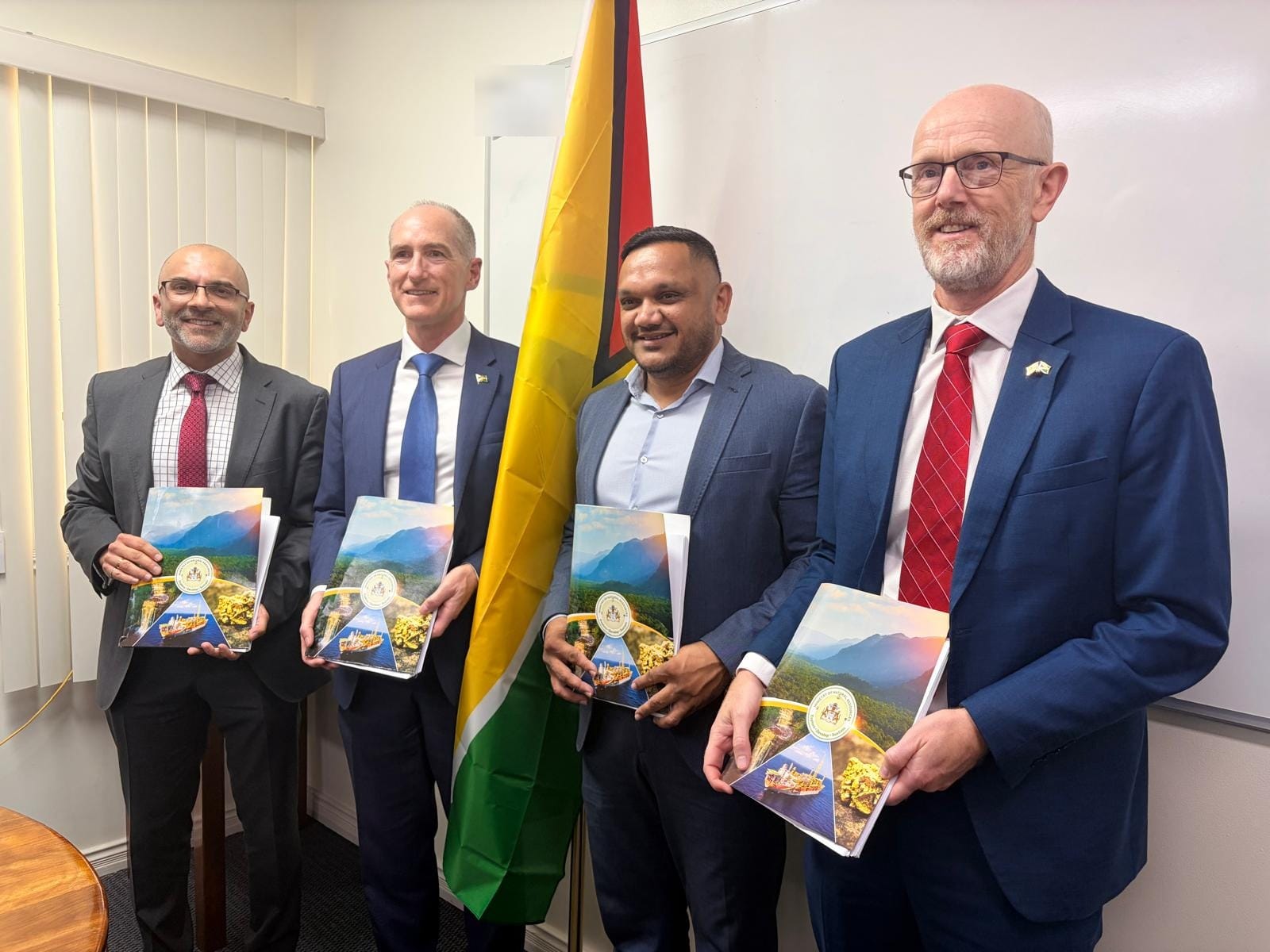
Guyana approved its eighth offshore development on 12 November and issued the production licence the same day. The Ministry of Natural Resources named what the licence requires: a study of gas export timelines and gas marketing opportunities, safety systems for gas export, and export facilities built into the vessel's base design.
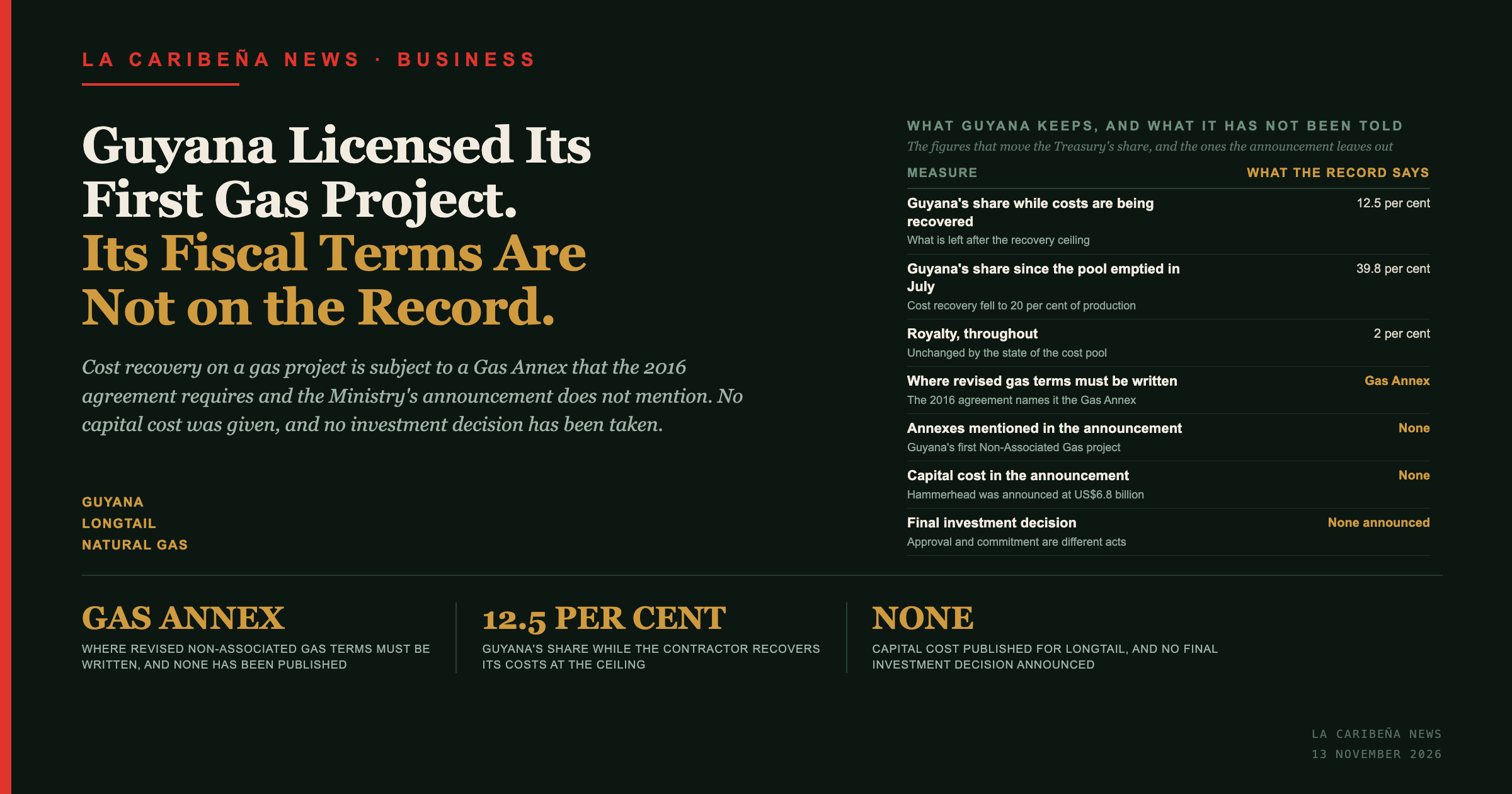
It did not publish what the project costs. That figure sets how much of the next decade's production Guyana keeps.
Does the approval send Guyana's share back to 12.5 per cent?
Not on the terms anyone can read.
Guyana receives 12.5 per cent of production while the contractor is recovering its costs at the ceiling, and 39.8 per cent when it is not. Its royalty is 2 per cent throughout. The share has been at 39.8 since July, when ExxonMobil finished recovering what Neil Hansen, its Senior Vice President and Chief Financial Officer, called "the $55 billion of investment, along with all the operating costs". Monthly cost recovery fell from 75 per cent of production to 20.
A new development refills that pool. On the ordinary terms of the 2016 agreement, the contractor may charge those costs to production from any field or fields, and the boundary is the whole Stabroek Block rather than the new project. Longtail is not on ordinary terms, because it is gas.
Which terms govern Longtail?
Not stated, and the agreement says where they belong.
Cost recovery under the 2016 agreement is expressly "subject to the terms and conditions of any agreement relating to Non-Associated Gas made pursuant to Article 12". Longtail is the first Non-Associated Gas project Guyana has licensed, so that condition is reaching for something for the first time.
What it reaches for is a document the agreement calls the Gas Annex. Revised terms for a gas development "shall be included as an annex to this Agreement", negotiated within twenty-four months of the contractor giving notice of the discovery. Guyana's first gas project has been licensed on fiscal terms that are not on the public record. The Ministry's announcement names no annex, and no annex has been published.
That leaves a counterparty pricing work, debt or supply against Longtail doing it against an instrument it cannot read. It leaves the Treasury's share of the project resting on a document nobody outside the negotiation has seen.
The same article disposes of the gas itself. Within the development plan the contractor, "in its sole discretion", recommends the market outlet for the gas. The export study the Ministry announced this week is that recommendation, and the agreement leaves it to ExxonMobil.
What did the Ministry say is new in this licence?
Three requirements, all of them about gas export.
Alongside measures carried over from earlier licences on reservoir management, production monitoring and operational efficiency, the release names what is tailored to Longtail: a gas utilisation and export study assessing "reservoir performance, production forecasting, gas export timelines and gas marketing opportunities"; risk and safety management systems for gas export; and a requirement that the vessel carry "the required gas export facilities included in the facility's base design".
Ring-fencing does not appear. The Ministry has not published the licence itself, so this is an absence from its announcement rather than a demonstrated absence from the instrument. A government source told Kaieteur News on 8 November that the eighth project was not likely to carry such a clause.
What was Exxon doing three days earlier?
Signing in Caracas.
On 9 November ExxonMobil's country director signed a memorandum with the president of PDVSA, with Venezuela's acting president presiding. Neither party has published the document, ExxonMobil has filed no Form 8-K and issued no release, and both sides call it preliminary to definitive operating agreements. The reported terms, seven areas and a year of exclusive rights, rest on unnamed sources.
The commercial point does not depend on any of them being confirmed. Until this month Guyana was the only place in the region where ExxonMobil could deploy capital at this scale. Guyana licensed its eighth project three days after that stopped being true, without announcing the term that would have bounded its cost.
What was actually approved?
A gas project sized for an export market it has not sold into.
| Longtail, as announced | |
|---|---|
| Reservoirs | Nine, multi-field gas and condensate |
| Gas handling capacity | Approximately 1.2 billion cubic feet a day |
| Condensate capacity | Up to 250,000 barrels a day |
| Condensate over the licence | Approximately 776 million barrels over 30 years |
| Wells | 27 production, 18 gas injection |
| First production | Before the end of 2030 |
| Capital cost | ! Not stated |
Source: Ministry of Natural Resources, 12 November 2026.
Longtail averages about 71,000 barrels of condensate a day across the licence, so anyone pricing Guyana's condensate revenue off the vessel's capacity is out by a factor of three and a half. The gas side carries no such discount: one vessel will handle ten times what the Wales pipeline moves at 120 million cubic feet a day, the only gas pipeline Guyana has built.
SBM Offshore holds the engineering and design contract, awarded in March. Its Chief Executive Officer, Øivind Tangen, called Longtail "a major gas play demanding the highest gas handling capacity ever deployed on an FPSO". The vessel will be spread-moored in about 1,750 metres of water and hold around two million barrels of condensate.
Who would buy the gas?
Nobody has been named, and eighteen months ago the government said there was none to sell.
No gas sales agreement, buyer or price appears in the announcement. In May 2025 Vice President Bharrat Jagdeo told Trinidad and Tobago Newsday, in a single line, "As of today, there is no gas to supply to anyone," and gave the reason: the gas was committed to electricity generation and a fertiliser plant.
The Ministry's framing keeps it committed. It places Longtail inside President Ali's plan for a natural gas industrial site in Berbice, served by a second offshore gas-to-energy pipeline, supplying fertiliser production, alumina and mineral processing and data centres. Berbice is domestic industrialisation, not export. The licence requires the vessel to be built for both.
Is this a final investment decision?
No, and the distinction is the money.
Approving a development plan and issuing a licence are acts of government. The investment decision is the operator committing the capital, and the release attributes none to ExxonMobil Guyana Limited, Hess Guyana Exploration Limited or CNOOC Petroleum Guyana Limited. Before 12 November, Longtail awaited both. One of the two has now happened, and the company's disclosure of what it holds offshore has its own gaps: ExxonMobil's exploration chief described a new Stabroek discovery that its own published list does not carry.
Hammerhead, approved as the seventh development in September 2025, was announced with its decision taken and its cost stated at US$6.8 billion. Longtail has been announced with neither. The investment decision is the next dated event on this project, and until it is taken the cost that sets Guyana's share stays unfixed.
The entities
- Longtail is Guyana's eighth approved offshore development and its first Non-Associated Gas project. - Ministry of Natural Resources approved the development plan and issued the production licence on 12 November 2026. - ExxonMobil Guyana Limited operates the project and holds 45 per cent of the Stabroek Block. - Hess Guyana Exploration Limited holds 30 per cent. - CNOOC Petroleum Guyana Limited holds 25 per cent. - Gas Annex is the 2016 agreement's name for the document carrying revised Non-Associated Gas terms. The Ministry's announcement does not mention one. - Neil Hansen is ExxonMobil's Senior Vice President and Chief Financial Officer, who confirmed the US$55 billion was recovered. - SBM Offshore holds the engineering and design contract for the vessel, awarded March 2026. - Øivind Tangen is its Chief Executive Officer. - Bharrat Jagdeo is Guyana's Vice President, who said in May 2025 there was no gas to supply to anyone. - PDVSA signed a memorandum with ExxonMobil in Caracas on 9 November 2026.
What the title card says
- Headline: Guyana licensed its first Non-Associated Gas project, and its fiscal terms are not on the public record. - Approved 12 November 2026: the Longtail development plan and its production licence. - New licence terms named by the Ministry: three, all on gas export. - Ring-fencing: not among them. - Where revised gas terms belong: a Gas Annex to the 2016 agreement. - Annexes mentioned in the announcement: none. - Guyana's share before and after the cost pool emptied in July: 12.5 per cent, then 39.8 per cent. - Gas handling capacity: approximately 1.2 billion cubic feet a day. - Capital cost published: none. - Final investment decision announced: none.
Frequently Asked Questions
Does the Longtail approval reduce Guyana's profit share?
Guyana receives 12.5 per cent of production while the contractor recovers its costs at the ceiling, and 39.8 per cent when it is not, with a 2 per cent royalty throughout. Which of those applies to Longtail depends on fiscal terms the Ministry has not published.
What is the Gas Annex?
The 2016 agreement's name for the document carrying revised terms for a Non-Associated Gas development, to be agreed within twenty-four months of the contractor's notice of discovery. Longtail is Guyana's first such project. The Ministry's 12 November announcement does not mention an annex.
Does the Longtail licence contain a ring-fencing clause?
The licence has not been published. The Ministry's announcement names three provisions it says are new, all concerning gas export, and ring-fencing is not among them.
Has ExxonMobil taken a final investment decision on Longtail?
No decision has been announced. The 12 November release records the government's approval and the issuing of the licence, and attributes no investment decision to the operator or its co-venturers.
What is Longtail expected to produce?
Approximately 1.2 billion cubic feet of gas a day and up to 250,000 barrels of condensate a day, from nine reservoirs through 27 production wells and 18 gas injection wells, with approximately 776 million barrels of condensate over 30 years and first production before the end of 2030.
Has Guyana agreed to sell the gas to anyone?
No buyer, price or gas sales agreement appears in the announcement. The Ministry places the gas within a domestic industrial plan for Berbice.