By LCN Business Desk
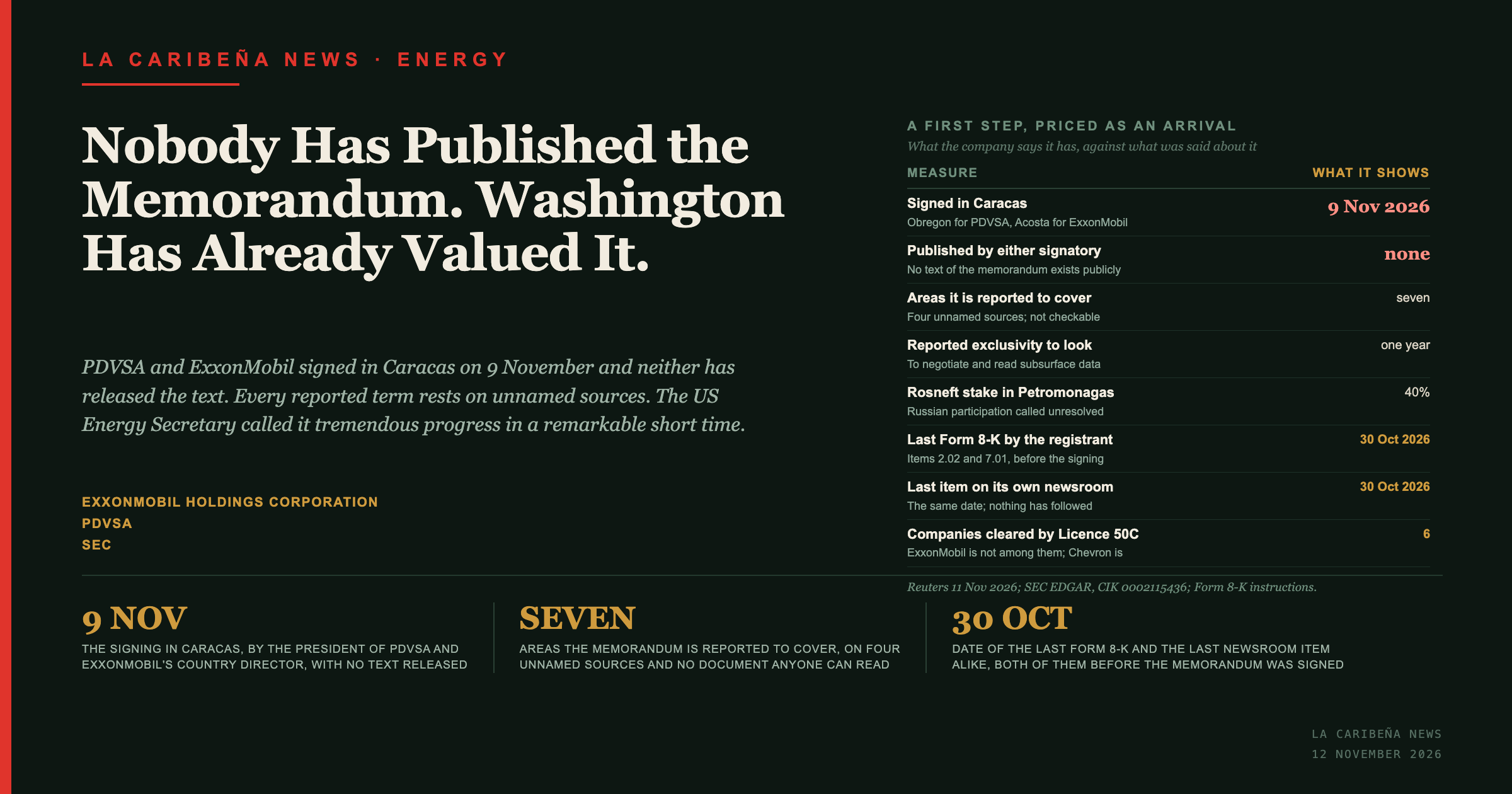
A memorandum was signed in Caracas on 9 November by the president of PDVSA and ExxonMobil's country director, with Venezuela's acting president presiding. That much is on the record from the Venezuelan state broadcaster. What the document says is not: no party to it has published it, and every reported term rests on people who are not named.
What is actually on the record?
A ceremony, its participants, and two characterisations.
Radio Nacional de Venezuela, the state broadcaster, reported the signing on 9 November crediting the state news agency. Héctor Obregón, president of PDVSA, and Andrés Acosta, ExxonMobil's country director, signed. Delcy Rodríguez, the acting president, presided. Dan Ammann, president of ExxonMobil Upstream Company, and David Juárez-Navarro, vice president of planning, attended.
On scope that account goes only this far: the memorandum "contempla la reactivación de yacimientos existentes, así como la exploración de nuevos campos de hidrocarburos", contemplating the reactivation of existing fields and the exploration of new ones. It names no field, no area count and no term. It describes the document as a "paso previo a la formalización de los convenios operativos definitivos", a step prior to formalising the definitive operating agreements.
What is not on the record?
Every figure in circulation.
Six specifics have travelled with the story.
- Seven areas, spanning undeveloped fields, mature areas and an exploration block - One year of exclusive rights to negotiate terms and to view subsurface data - Petromonagas, formerly Cerro Negro, which Exxon operated until the 2007 expropriation - Three further Orinoco areas under assessment - A separate exploration block, with rights under negotiation - Rosneft's 40 per cent of Petromonagas, and an unresolved Russian participation there and at Petrovictoria
Every one rests on the same foundation: four people familiar with the matter, in reporting carried on 11 November. Not one appears in a document either signatory has released, so none can be checked against the instrument.
What has Exxon told the SEC?
Nothing.
ExxonMobil Holdings Corporation, the group's registrant since a reorganisation in July moved it from New Jersey to Texas, last filed a Form 8-K on 30 October 2026, under Items 2.02 and 7.01, the results-of-operations and regulation disclosure items. Its quarterly report followed on 2 November 2026, covering the period to 30 September. Both close before the memorandum was signed, and no Form 8-K has come since.
It has gone on filing through November. None of what it has filed mentions Venezuela.
What does the rule say triggers a filing?
Enforceable obligations, or enforceable rights, whether or not conditional.
Item 1.01 of Form 8-K requires disclosure where a registrant enters a material definitive agreement not made in the ordinary course of business. The Securities and Exchange Commission's own instructions to the form define the term at Item 1.01(b):
"a material definitive agreement means an agreement that provides for obligations that are material to and enforceable against the registrant, or rights that are material to the registrant and enforceable by the registrant against one or more other parties to the agreement, in each case whether or not subject to conditions."
The definition has two limbs and the second is about rights rather than duties. A one-year exclusivity over negotiation and data access is a right, held by the company, against the other parties.
A non-binding heading does not by itself settle the question either. Registrants file letters of intent under this item while stating in terms that the document is not a binding commitment, carving out the provisions on exclusivity, confidentiality and due diligence as the parts that do bind. What Exxon's memorandum provides, and whether any part of it is enforceable, is not on the public record.
What has the company actually said?
One phrase, to reporters, and nothing in its own name.
Exxon declined to comment beyond a statement calling the memorandum a "meaningful first step", given to reporters. It issued no release of its own: its newsroom has published nothing since the third-quarter results of 30 October.
Neither Venezuela's oil ministry nor PDVSA answered the questions Reuters put to them. In January the chief executive, Darren Woods, had called Venezuela uninvestable and said much more work was needed to protect long-term investment and prevent future expropriations. Chris Wright, the United States Energy Secretary, wrote this week that the preliminary agreement was "tremendous progress in a remarkable short time".
The attributable record from the parties runs to one phrase given to a wire service, a line from a cabinet secretary of a third country, and silence from Caracas.
Is there an agreement?
Not on anything either party has published.
Three descriptions of the document exist and none is of a concluded deal. Non-binding is how every account of it reads. "A meaningful first step" is the company's own phrase. "Paso previo a la formalización de los convenios operativos definitivos", a step prior to formalising the definitive operating agreements, is the Venezuelan state broadcaster's. Two of those come from the signatories themselves.
What Exxon does not hold, on anything published, is a licence to operate in Venezuela or a contract on any acreage there.
What does this mean for Guyana?
The operator of Guyana's Stabroek block cannot act on this in Venezuela. Its 30 per cent partner on that block already holds a licence that would let it.
Washington replaced General Licence 50B with 50C on 27 August 2026, and the licence names six companies cleared to operate in Venezuela. ExxonMobil is not among them. Chevron is, and Chevron holds 30 per cent of the Stabroek block, while its Form 10-Q for the quarter ended 30 June named Guyana twice in 171,000 characters and never named Stabroek at all.
This newspaper set out on 9 November what Exxon said it requires before investing in Venezuela, and that Guyana's 2016 agreement already supplies all four conditions. The memorandum is the step after those conditions were stated, and it has arrived without the licence that would let the company act on it.
On Guyana the company does file numbers when a rule calls for them. Its Form SD for 2024 records US$2,581,822 thousand paid to six Guyanese government bodies, while Chevron's Form SD for the following year, furnished under the same rule, lists twenty countries and Guyana is not one of them.
The entities
- ExxonMobil Holdings Corporation is the group's SEC registrant, a Texas corporation since the July reorganisation.
- Darren Woods is its chief executive.
- PDVSA is Venezuela's state oil company and a party to the memorandum.
- Petromonagas, formerly Cerro Negro, is the Orinoco heavy-oil project Exxon operated until the 2007 expropriation, with one of the few working upgraders.
- Petrovictoria is a second Orinoco project named in the reporting as carrying an unresolved Russian participation.
- Rosneft holds 40 per cent of Petromonagas.
- Chris Wright is the United States Secretary of Energy.
- General Licence 50C is the Office of Foreign Assets Control authorisation naming six companies cleared for Venezuela; ExxonMobil is not among them and Chevron is.
- Form 8-K is the Commission's current-report form; its Item 1.01 covers entry into a material definitive agreement.
- Securities and Exchange Commission is the United States securities regulator with which listed companies file.
Figures
- 9 November 2026: the signing in Caracas, by PDVSA president Héctor Obregón and ExxonMobil country director Andrés Acosta, with acting president Delcy Rodríguez presiding. Source: Radio Nacional de Venezuela, 9 November 2026. - Seven: areas the memorandum is reported to cover. Not verifiable against the document, which no party has published. Source: Reuters, 11 November 2026, on four people familiar with the matter. - One year: the reported exclusivity to negotiate terms and view subsurface data. Reported on the same unnamed sources, and equally unverifiable. - 40 per cent: Rosneft's reported stake in Petromonagas, on the same basis. - 2007: the expropriation that removed Exxon from Cerro Negro, now Petromonagas. - 30 October 2026: the date of the registrant's most recent Form 8-K, filed under Items 2.02 and 7.01, and also the most recent item on the company's own news releases page. Nothing has followed in either place. - 2 November 2026: the date of its Form 10-Q for the period ended 30 September 2026. - Six: companies named on General Licence 50C. ExxonMobil is not one.
Frequently Asked Questions
What did ExxonMobil agree with Venezuela? A memorandum signed in Caracas on 9 November 2026. No party has published it. It is reported to be non-binding and to let the company evaluate seven areas with a year of exclusivity, but that account comes from four unnamed people and cannot be checked against the document.
Has ExxonMobil filed an 8-K about it? No. The group's registrant, ExxonMobil Holdings Corporation of Texas, last filed a Form 8-K on 30 October 2026 under the earnings and disclosure items, and filed its 10-Q for the quarter ended 30 September on 2 November. Both predate the memorandum, and the word Venezuela appears in none of that registrant's filings.
Did ExxonMobil issue a press release about the memorandum? No. The most recent item on its news releases page is the third-quarter results of 30 October 2026. The statement went to reporters.
When does an 8-K have to be filed? Item 1.01 covers entry into a material definitive agreement not made in the ordinary course of business. The form defines that as an agreement providing for obligations enforceable against the registrant, or rights enforceable by it against other parties, in each case whether or not subject to conditions.
Can ExxonMobil operate in Venezuela now? General Licence 50C names six companies cleared to operate there and ExxonMobil is not among them. Chevron, which holds 30 per cent of Guyana's Stabroek block, is.
Which Venezuelan fields are involved? Petromonagas, formerly Cerro Negro, which Exxon operated until 2007, plus three further Orinoco areas and a separate exploration block under negotiation. Petrovictoria is also named in the reporting.