By LCN Wire
The gas-to-shore pipeline is Exxon-built and Guyana repays it. What Guyana repays has never been finally stated, and the repair now under way has no figure at all.
What is being repaired, and when?
A near-shore section off Crane, West Coast Demerara, on a schedule running from 14 October to about 1 December.
Kaieteur News reported on 24 October 2026 that ExxonMobil announced the work in a media statement on 7 October, to address "a finding" on a near-shore section of the 220-kilometre Gas-to-Energy (GTE) project pipeline, identified through inspection activities earlier this year. The work was scheduled to commence on 14 October and to continue until around 1 December. EMGL's media advisor Kwesi Isles said further testing and evaluation would confirm the "exact nature of the issue".
Exxon timed it ahead of start-up, "to minimise potential for maintenance interruptions in the future", and said the line "is currently pressurised with inert gas (nitrogen) and is not yet in operation. As a result, it does not pose a risk to the public or the environment."
What has Exxon said the pipeline cost?
An estimate, once, and nothing since it was finished.
Kaieteur reported that it has asked for the final cost on numerous occasions and has been given only an "estimated US$1B" figure. Construction finished in December 2024. Twenty-two months later the company has not stated the sum Guyana must repay, and Kaieteur describes the financing arrangements as remaining sketchy. The Minister of Natural Resources, Vickram Bharrat, did not respond to questions on the repair cost either.
An estimate given before construction and never replaced is not a price. It is the number everything downstream has been calculated against, including every assessment of what gas will do to Guyanese electricity bills.
Who pays, and has that changed?
Guyana repays it, and the man who ran the task force put a number on how.
Winston Brassington, who headed the gas-to-energy task force, told the International Energy Conference in February 2023 that "US$55 million is the amortized cost of US$1 billion for 20 years at a discount rate." La Caribeña News reported that in August alongside the rest of the project's cost structure: the pipeline is Exxon-built and Guyana repays, and it sits outside the Wales onshore programme, which the Office of the Prime Minister budgets separately.
An amortisation is a calculation, and it takes a principal. The task force head's US$55 million is the amortised annual figure for a US$1 billion principal over twenty years. The principal has never been confirmed, so the annual figure has never been confirmed either, and a pipeline finished in December 2024 is still being repaid against an estimate made before it was built.
Kaieteur now reports something that would unsettle even that. It says recent public documents "seem to indicate" the structure was added to the cost bank and financed using oil revenue, which is a different arrangement from the one Guyanese were told about: recovery from production before profit is shared, rather than a scheduled payment beginning when gas flows. Kaieteur's wording is that the documents seem to indicate it, and no announcement of any change has been published.
Why does an unpriced repair matter to a Guyanese business?
Because the repair sits immediately in front of a start-up date that has already moved.
A firm in Georgetown has no contract with ExxonMobil and will never see a line item for this repair. What it has is the date, and the date is what the project sells.
The work is scheduled to finish around 1 December, which Exxon placed deliberately ahead of start-up. The project was expected online by the end of 2025. Exxon has described the defect only as "a finding" and says further testing will confirm the exact nature of the issue, so its scope is not established either.
The cost side cannot be sized at all. A figure nobody has given cannot be added to a cost bank balance, set against the US$759 million the government is spending on its own half of the project, or used by anyone pricing the gas.
| The component | Who builds it | Stated cost |
|---|---|---|
| Offshore and onshore pipeline, 12-inch | ExxonMobil, Hess, CNOOC | ~US$1 billion, estimated |
| 300 MW power plant and NGL plant | Government of Guyana | ~US$759 million, CH4/Lindsayca |
| The project as a whole | Both | US$1.7 billion |
| Central government spend to 2024 | Government of Guyana | GY$113 billion, about US$542 million |
| Loan application to the US Exim Bank | Government of Guyana | US$660 million |
The figures come from the Caribbean Investigative Journalism Network's 2024 investigation by Kiana Wilburg. Only one line in that table is an estimate, and it is the largest of the two construction components. The government's own half has a contractor, a contract and a number; the private half has a round figure and a word.
What does the project's own paperwork say about the near-shore?
That near-shore sections were to be buried, specifically to reduce the risk of an external impact.
CIJN's reading of the environmental impact assessment records that offshore pipeline design and installation vary with depth, and that "at a minimum, the pipeline will be laid in a trench, with sections closer to the nearshore area buried, which will reduce the likelihood of an external impact causing a release". The same document considers unplanned events, including a gas plume rising from the seafloor to the surface from a damaged subsea pipeline.
The assessment named the near-shore as the stretch requiring burial. The finding announced this month is on a near-shore stretch. Nothing on the public record connects the two, and no connection is asserted here. La Caribeña News has not read the assessment itself and relies on CIJN's quotation of it.
What is on the record is contested. In July the Opposition Leader, Azruddin Mohamed, posted video and photographs showing water bubbling above the pipeline's path and alleged the line sits less than ten feet deep at low tide inside a shipping channel. The Environmental Protection Agency and MARAD issued a joint statement rejecting claims of a rupture, on the ground that nothing is flowing: "As there is no gas passing through the line, there can be no leak or damage of the nature suggested in these reports."
What else is unsettled on the same project?
Two things on the project itself, each with a published trail, and a pattern across the sector.
The power plant's capacity is stated differently by different arms of the state: the resource ministry has put Wales at 600 MW while the project under construction is 300. And the saving the project is sold on is conditional: the Prime Minister has said bills will not halve until the plant runs at full capacity.
Disclosure is uneven across the same sector. Guyana publishes what each solar farm costs and has not published what the power plant costs, a pattern the pipeline now extends: a 41.5 kW village system in Region Nine has a stated price to the dollar, and a billion-dollar pipeline does not.
What would settle it?
A figure in a document, of which three kinds exist.
The cost recovery statement for the Stabroek Block would show whether the pipeline sits in the cost bank and at what value. The Ministry of Natural Resources holds the audited cost submissions that answer the same question. And a repair of this scale generates a contract, which has a price.
Until one of those is published, the pipeline's cost is an estimate from before it was built, and the repair's cost is nothing at all.
The entities
- ExxonMobil Guyana Limited (EMGL) is the operator that built the pipeline and announced the repair.
- Kwesi Isles is EMGL's media advisor, who said further testing would confirm the nature of the issue.
- Vickram Bharrat is Guyana's Minister of Natural Resources, who did not respond to questions on the repair cost.
- Gas-to-Energy (GTE) project is the US$1.7 billion scheme carrying Stabroek Block gas to Wales, West Bank Demerara.
- The cost bank is the Stabroek Block mechanism by which a recoverable cost is taken out of production before profit is shared. It applies to the oil developments; the pipeline's stated arrangement is repayment by Guyana.
- Winston Brassington headed Guyana's gas-to-energy task force and gave the US$55 million annual amortisation figure in February 2023.
- CH4/Lindsayca is the United States partnership building the 300 MW power plant and the NGL plant for the Government of Guyana.
- Azruddin Mohamed is the Opposition Leader, who published images of water bubbling above the pipeline's path in July and made allegations about its depth.
- Environmental Protection Agency (EPA) and the Maritime Administration Department (MARAD) are the agencies that jointly rejected claims the pipeline had ruptured.
- Caribbean Investigative Journalism Network (CIJN) published the 2024 investigation that sets out the project's cost architecture.
What the title card shows
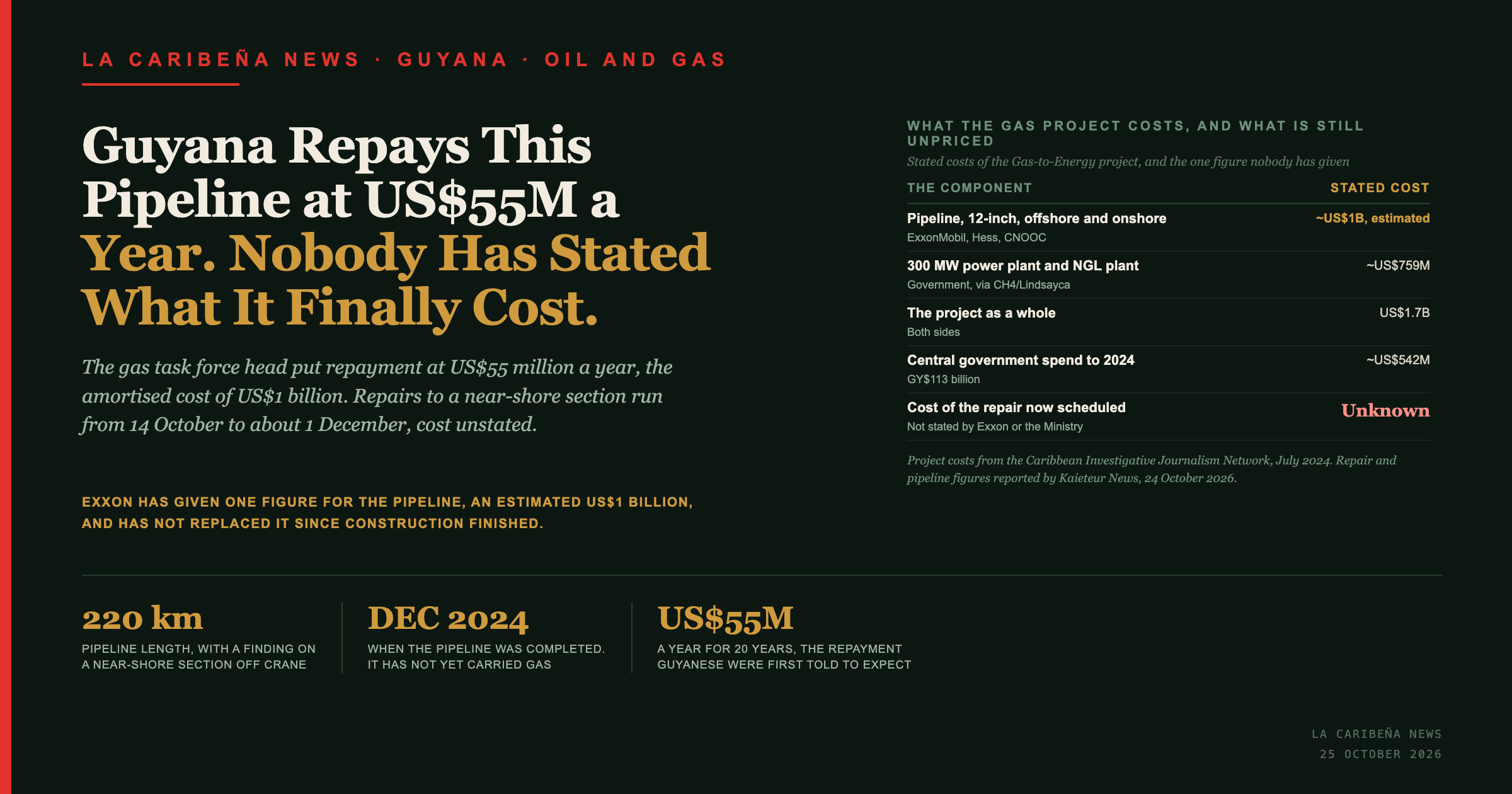
Every data point on the article's title card, in text.
- US$1 billion. The estimated cost of the pipeline, the only figure Exxon has given. Source: ExxonMobil, as reported by Kaieteur News and CIJN.
- 220 kilometres. The length of the pipeline. Source: ExxonMobil's 7 October statement, reported by Kaieteur News.
- 14 October to 1 December 2026. The repair window. Source: as above.
- December 2024. When the pipeline was completed. Source: Kaieteur News.
- US$1.7 billion. The cost of the Gas-to-Energy project as a whole. Source: CIJN.
- US$759 million. The cost of the government's power plant and NGL plant, built by CH4/Lindsayca. Source: CIJN.
- US$55 million a year for 20 years. The repayment Guyanese were originally told to expect. Source: Kaieteur News.
Frequently Asked Questions
What is wrong with Guyana's gas pipeline?
ExxonMobil announced on 7 October 2026 that it would address "a finding" on a near-shore section of the 220-kilometre Gas-to-Energy pipeline off Crane, West Coast Demerara, identified through inspection earlier in the year. The company said further testing would confirm the exact nature of the issue. The line is pressurised with nitrogen and is not in operation.
How much will the repair cost?
Not stated. ExxonMobil Guyana did not respond to questions on the cost, and the Minister of Natural Resources did not respond either, according to Kaieteur News.
How much did the Gas-to-Energy pipeline cost?
No final figure has been published. ExxonMobil has given an estimate of US$1 billion, and the pipeline was completed in December 2024. The project as a whole is costed at US$1.7 billion, of which the government's 300 MW power plant and NGL plant account for about US$759 million.
Who pays for the pipeline?
Guyanese were originally told it would be repaid at US$55 million a year over twenty years once the facility was operational. Kaieteur News reports that recent public documents appear to show it was instead added to the cost bank and financed from oil revenue, which means recovery from production before profit is shared.
Did the pipeline rupture?
The Environmental Protection Agency and MARAD issued a joint statement rejecting that claim, saying that because no gas is passing through the line there can be no leak or damage of the nature suggested. The Opposition Leader had posted images of water bubbling above the pipeline's path in July and made allegations about the line's depth.