By LCN Business Desk
Every commitment Chevron is still honouring in Guyana was made by the company it bought. The one it declined was the one that would have required a decision of its own.
What did Chevron decline to continue?
The engineering and design work on the Berbice deepwater port, and an understanding that came with Hess.
Harry Pastuszek, Bechtel's Guyana manager, told a panel at the World Trade Centre Guyana that Hess had funded the pre-front-end engineering and design his firm completed, on the basis that it would keep funding as the project advanced. Demerara Waves reported his account on 23 October, and Bloomberg, Baird Maritime and Maritime Executive carried the decision the same week.
"Then they (Hess) funded the pre-front-end engineering and design we did on the port with a notional agreement that they would continue to fund in partnership with the government as we pushed forward," Pastuszek said. "Chevron acquired HESS and Chevron sort of sat down and said, 'you're doing what? Why would we? No, not going to do (it). So, no shade thrown at Chevron'."
Two things in that account matter for what follows. The arrangement was notional rather than contractual, so nothing obliged Chevron to continue. And Hess had already spent US$4 million on the studies, which is the sum the decision was taken against.
What were those sums against Chevron's year?
Four hundredths of one per cent, and four tenths of one per cent.
| Measure | US$ million | Share of Chevron's 2025 net income |
|---|---|---|
| Chevron net income, 2025 | 12,299 | |
| The next stage of the study | about 50 | 0.4% |
| What Hess had already spent | 4 | 0.03% |
Sources: Chevron Corporation's Form 10-K for 2025, filed with the Securities and Exchange Commission; study costs from named speakers reported by Demerara Waves. The two percentages are this newspaper's arithmetic from those figures.
A study costing four tenths of one per cent of a year's earnings is not a capital allocation problem. It is a decision about whether a port in Berbice is Chevron's business, and the company answered that it is not.
What has Chevron kept?
Two are on the record, and Hess signed both of them.
The first is the Greater Guyana Initiative, which the Stabroek co-venturers announced on 9 February 2021 and their own release describes as "more than GY$20 billion (US$100 million)" over ten years. It funds capacity building with Guyana's technical and vocational institutions, the University of Guyana and the Centre for Local Business Development, which the same three companies established in Georgetown in 2017. The release lists the partners as ExxonMobil Guyana Limited on 45 per cent, Hess Guyana Exploration Limited on 30 and CNOOC Petroleum Guyana Limited on 25, which are interests in the block rather than stated shares of the fund. No annual figure is published, and no split between the three.
The second is the forest carbon purchase signed on 2 December 2022, which the Government of Guyana calls "the world's first sale of jurisdiction-scale carbon credits". Hess Corporation committed to buy 37.5 million ART-TREES credits, 12.5 million of the 33.47 million issued for 2016 to 2020 and 2.5 million a year from each year's issuance to 2030, for a minimum of US$750 million over the decade.
| Minimum price Hess agreed to pay | Per credit |
|---|---|
| 2016-2020 vintages | US$15 |
| 2021-2025 vintages | US$20 |
| 2026-2030 vintages | US$25 |
Source: Government of Guyana, Department of Environment and Climate Change, fact sheet on Guyana's engagement in ART TREES.
At 2.5 million credits against the US$25 minimum, the vintages now running are US$62.5 million a year, and the 15 per cent dedicated to village-led plans is US$9.375 million of that, both on this newspaper's arithmetic from the published terms. Against that, the Natural Resource Fund recorded US$3,883,350,120 of petroleum receipts in the nine months to 30 September. The remaining 85 per cent goes to multi-community and national programmes under the Low Carbon Development Strategy (LCDS) 2030, which the National Assembly passed in August 2022.
This one is a purchase rather than a gift. Guyana sells a product and the buyer pays for it, and reported as philanthropy it would be mis-stated. Those prices are also minimums rather than settled prices, and what Guyana actually receives has never been published.
Is Chevron adding anything of its own?
Nothing that appears on the record.
Both commitments predate the acquisition and both run to schedules set before it, so what Chevron took on was an instalment plan rather than a decision. Chief executive Mike Wirth reaffirmed the company's commitment to Guyana in February 2026 without attaching a figure to it. The US$7 billion of offshore capital spending set out for 2026, covering Guyana, the Eastern Mediterranean and the United States Gulf, is investment in its own asset.
As they stood on 28 October 2026, fifteen months after the acquisition completed, the Greater Guyana Initiative still named its partners as "ExxonMobil Guyana, Hess Guyana Exploration, and CNOOC Petroleum Guyana", and the Centre for Local Business Development still listed HESS among its clients. Chevron appears on neither. The likeliest explanation is the dull one, that Hess Guyana Exploration Limited is a legal entity which can hold licences and commitments under new ownership, and Vice President Bharrat Jagdeo said at the time that the acquisition would not affect the carbon agreement.
No new contribution from Chevron is recorded on the initiative's own pages, on the company's community pages, or in the reporting available on it. That bounds what the record carries rather than stating that none exists.
How large is the capacity fund beside what the partners earn?
Smaller than one tenth of one per cent.
| Net income, 2025 | US$ million |
|---|---|
| ExxonMobil | 28,844 |
| Chevron | 12,299 |
| The two combined | 41,143 |
Source: each company's Form 10-K for 2025, taken from its own data filed with the Securities and Exchange Commission. CNOOC Limited is not an SEC registrant and is absent from the table, which makes every comparison below smaller than a full three-partner picture would give.
Spread evenly, US$100 million over ten years is about US$10 million a year from all three companies together. One tenth of one per cent of Chevron's 2025 earnings on its own is US$12.3 million. The same fraction of the two companies above, taken together for that one year, is US$41.1 million, and held for the initiative's full term it would come to about US$411 million. Each of those is this newspaper's arithmetic from the figures in the table and the published commitment.
So the whole of the Greater Guyana Initiative, from three companies across a decade, is about a quarter of what a tenth of one per cent a year from two of them would produce over the same period. Its annual figure is smaller than a tenth of one per cent of what Chevron alone earned last year.
Where does Chevron say it invests in communities?
Eleven places, four of them in the United States, and Guyana is not among them.
Chevron Corporation's sustainability page carries a section headed "Around the world", introduced as a guide to "our sustainability efforts in the regions where we operate". As it stood on 28 October 2026 it names eleven locations.
| The eleven, in the page's own order | What is described |
|---|---|
| Argentina | A plant guide at El Trapial, about 230 species identified |
| Australia | A 29-storey Perth headquarters and Whadjuk artwork |
| Belgium | A Ghent lubricants plant changing its plastic wrap, 7 per cent less film |
| Colombia | The Energy Reefs coral project with Corales de Paz |
| Cyprus | A mobile science caravan turning used cooking oil into biodiesel |
| India | The Miller Center for Social Entrepreneurship, a US$1 million three-year gift |
| South Africa | The Chevron Engineering Leadership Program |
| California | Guadalupe Restoration, almost 24 acres of thistle habitat |
| El Segundo, California | Fenceline air monitoring since 2020 |
| Richmond, California | Over 7 million gallons a day of recycled water |
| New Mexico | The Pecos Watershed Conservation Initiative |
Source: chevron.com/sustainability, read 28 October 2026.
The only block of figures on the company's social investment page is headed "2023 volunteer highlights" and belongs to Chevron Humankind, which the page describes as "a program in the United States": US$33.5 million contributed to US non-profits, 1,432 charitable organisations, 95,829 volunteer hours. Its 2023 Corporate Sustainability Report supplies the worldwide figure the live pages omit, "USD 1.2 billion+ social investment in communities where we operate since 2016".
Chevron's country index, which promises "detailed information for the countries where Chevron's work is most extensive", lists 28 countries. Guyana is not on it, and the address where a Guyana page would sit returns a not-found error. Malaysia is on it, and Malaysia arrived in the same acquisition.
Is that absence explained by the date?
Partly, and only for the reports.
Across the 2024 Corporate Sustainability Highlights and the 62-page 2023 Corporate Sustainability Report, Guyana appears no times. Hess and Stabroek appear five times and once in each, every one of them inside the forward-looking-statements boilerplate. Both of those close before the acquisition completed on 18 July 2025, so neither had a Guyana to describe, and no Chevron sustainability report has yet covered a year in which the company owned its Guyanese interest. The live pages are the only published account that postdates the purchase, and they were read this week.
There is also an obvious defence of the absence, and it is a real one. Chevron does not operate in Guyana. ExxonMobil does, and a 30 per cent non-operating partner has no establishment of its own to run programmes from. The company's own report answers it in part: the Kazakhstan entry under social investment concerns Tengizchevroil, which the report describes as "a nonoperated joint venture".
What is Guyana worth to Chevron?
More than anywhere except the United States.
Its 2025 annual report puts Guyana net properties at US$50,960 million, records US$406 million of Guyanese income taxes paid, and contains no mention of social investment, no mention of community investment and no mention of local content. That Guyana figure is 23 per cent of the company's net properties worldwide, on this newspaper's arithmetic from the filing's own totals. A financial filing is not where social spending is required to appear.
The country sitting second on that balance sheet has no page on the company's own website, and its last Form 10-Q names Guyana twice in 171,000 characters and never names the Stabroek block. Its Form SD for 2025, furnished under the rule that discloses payments to governments, carries twenty countries and Guyana is not one of them.
Has this argument been had before?
In 2019, about Hess, in almost the same shape.
The Guyana Standard published a piece on 9 May 2019 headed "Hess prioritizes investment in education elsewhere but not in Guyana". It set out what Hess told shareholders and the Securities and Exchange Commission it was funding: the LEAP programme for at-risk students in Houston's Greater East End, then in the fifth year of a six-year US$6.4 million commitment and reaching more than 4,700 students; Hess toy trucks and a Baylor College of Medicine STEM curriculum for every public elementary school in North Dakota; and the Fulbright English Teaching Assistant programme in Malaysia, which Hess said benefited approximately 6,000 Malaysian students in 2018.
Its Guyana answer was a defence of someone else's numbers: that Guyanese nationals supporting project activities had doubled to more than 1,000, that the co-venturers had spent nearly US$60 million with more than 500 Guyanese vendors in 2018, and that more than 1,500 Guyanese companies had registered with the Centre.
Seven years and one acquisition later the structure is unchanged. Named programmes with named sums sit in Houston, North Dakota, Ghent and Perth. The Guyana answer is the operator's local content figures and a jointly funded centre.
Where does a Guyanese business actually knock?
The Centre for Local Business Development, and its door still says Hess.
The registration portal, the business courses, the mentoring and the supplier database are run from Georgetown by DAI, funded by three companies of which one no longer exists under that name. The Greater Guyana Initiative release puts registrations there at more than 7,000 companies.
The statutory route is less legible. Guyana's Local Content Secretariat signed 2026 plans with more than forty operators and contractors in June, published no list of them, and its local content register is a login portal rather than a public record. ExxonMobil Guyana, CNOOC Petroleum Guyana, MODEC and SLB are among the confirmed signatories. Because the register is closed, nobody outside it can say who else is on it.
For the carbon money the route is a different one again, through Village Sustainability Plans and the national budget, and Guyana budgeted G$49.7 billion of carbon credit inflows for 2026 and had recorded G$657.5 million by 30 June, 1.3 per cent of the estimate, which the Mid-Year Report then repeated unrevised.
What is settled, and what is not?
The withdrawal, the commitments and the earnings are settled. Chevron's reasoning is not.
Pastuszek's account is on the record from a named executive in public, and three outlets carried the decision the same week. The Greater Guyana Initiative terms and the carbon terms are each published by the parties themselves. The earnings are the companies' own filings. The community pages were read this week.
Not established: why Chevron declined, which no Chevron statement on the record explains; whether it funds anything in Guyana that none of these documents records; how the Greater Guyana Initiative divides between its three backers, and therefore what any one of them puts in; and whether the Hess naming on both Guyana vehicles reflects anything beyond a legal entity that has kept its name. On the public record there is no response from Chevron to Bechtel's account.
Chevron carries more of Guyana on its books than of any country but the United States. The money moving the other way was committed by somebody else, and the one commitment that would have needed a new signature did not get one.
The entities
- Chevron Corporation acquired Hess Corporation on 18 July 2025 and holds a 30 per cent non-operated interest in the Stabroek block. Its chief executive is Mike Wirth.
- Harry Pastuszek is Bechtel's Guyana manager, who gave the account of the funding decision.
- Bechtel is the United States engineering company that completed the pre-front-end engineering and design on the Berbice deepwater port.
- Greater Guyana Initiative is the ten-year commitment of more than US$100 million announced by the Stabroek co-venturers on 9 February 2021.
- Centre for Local Business Development is the Georgetown body the co-venturers established in 2017 and which DAI manages.
- ART-TREES is the jurisdictional forest carbon standard under which Guyana's credits are issued.
- Low Carbon Development Strategy (LCDS) 2030 is the national strategy under which the carbon revenue is allocated.
- Bharrat Jagdeo is the Vice President of Guyana.
- Chevron Humankind is the company's United States employee volunteering and giving programme.
- Guyana Standard is the Guyanese outlet that published the 2019 comparison of Hess's education spending.
What the title card shows
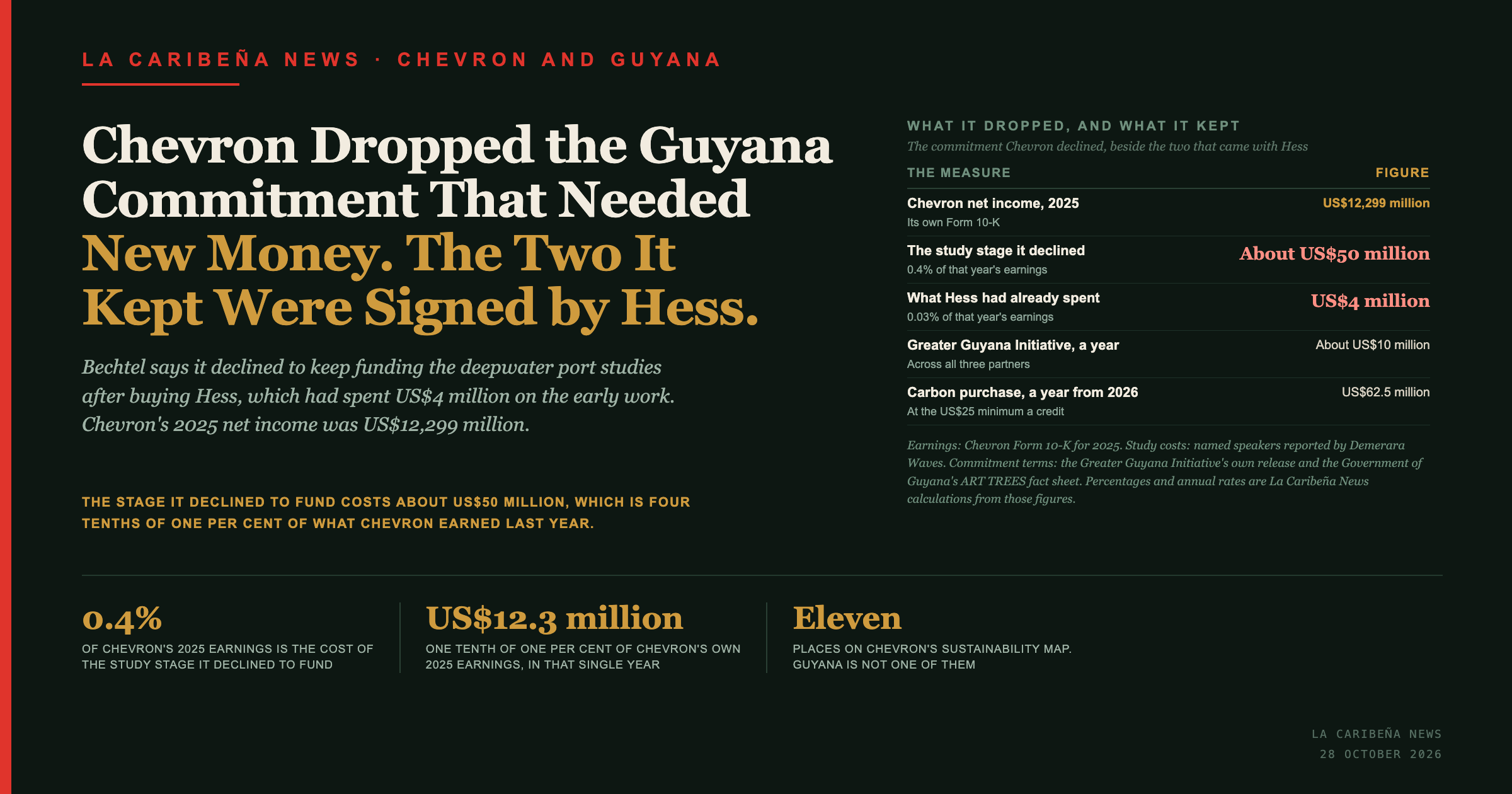
Every data point on the article's title card, in text.
- US$12,299 million. Chevron's net income for 2025. Source: Chevron Form 10-K for 2025.
- About US$50 million. The cost of the next stage of the port study, which Chevron declined to continue funding. Source: named speakers reported by Demerara Waves.
- 0.4 per cent. That stage as a share of Chevron's 2025 earnings, on this newspaper's arithmetic.
- US$4 million. What Hess had already spent on the initial studies. Source: Demerara Waves.
- About US$10 million. The Greater Guyana Initiative's implied annual rate across all three partners, on this newspaper's arithmetic from the published commitment.
- US$12.3 million. One tenth of one per cent of Chevron's 2025 earnings, in that single year, on the same basis.
- Eleven. Locations named on Chevron's sustainability map, none of them Guyana. Source: chevron.com/sustainability, 28 October 2026.
Frequently Asked Questions
What did Chevron stop funding in Guyana?
Bechtel's Guyana manager Harry Pastuszek said Hess had funded the pre-front-end engineering and design for the Berbice deepwater port under a notional agreement to keep funding, and that Chevron declined to continue after acquiring Hess. Hess had spent US$4 million on the initial studies. Demerara Waves reported his account on 23 October 2026.
How large was that against Chevron's earnings?
Chevron's net income for 2025 was US$12,299 million. The next stage of the study costs about US$50 million, which is 0.4 per cent of that year's earnings, and the US$4 million Hess had already spent is 0.03 per cent, both on this newspaper's arithmetic.
What Guyana commitments is Chevron still honouring?
Two, and Hess signed both before the sale. The Greater Guyana Initiative, announced on 9 February 2021 as more than US$100 million over ten years from the three Stabroek co-venturers, funds the Centre for Local Business Development. The forest carbon purchase agreement signed on 2 December 2022 commits a minimum of US$750 million over a decade and is a purchase of a product rather than a donation.
How big is the Greater Guyana Initiative compared with the partners' earnings?
Spread evenly, US$100 million over ten years is about US$10 million a year from all three companies together. One tenth of one per cent of Chevron's 2025 net income alone was US$12.3 million, and of Chevron and ExxonMobil combined for that year it was US$41.1 million. CNOOC Limited is not an SEC registrant and is not in that comparison.
Does Chevron have a social investment programme in Guyana?
Chevron's sustainability pages, read on 28 October 2026, name community and environmental work in eleven locations and Guyana is not among them. Its worldwide country index lists 28 countries and does not include Guyana. Guyana appears no times in either its 2023 Corporate Sustainability Report or its 2024 Corporate Sustainability Highlights, and both of those close before the acquisition completed on 18 July 2025.
Has Chevron announced any new money for Guyana?
Nothing appears on the record. Both continuing commitments predate the acquisition. Chief executive Mike Wirth reaffirmed the company's commitment to Guyana in February 2026 without a figure, and the US$7 billion of 2026 offshore capital spending covering Guyana, the Eastern Mediterranean and the United States Gulf is investment in its own asset.